AI Regulation in 2026: What Your Company Must Do Now

TL;DR
Global AI regulation has crossed the threshold from policy discussion into enforceable law. The EU AI Act 2024 is now binding on any organization deploying AI systems that affect EU residents, China AI Regulations 2023 impose mandatory security assessments on generative AI services offered within Chinese borders, and US Executive Order 14110 has restructured federal procurement and safety evaluation requirements for frontier models. Brazil AI Bill 2024 is tracking toward enactment. Five additional jurisdictions , the UK, India, Singapore, Canada, and Australia , have draft or incoming frameworks that are past the consultation stage and approaching enforcement reality. Organizations that wait for full implementation across all jurisdictions before acting will face compounded remediation costs and potential enforcement exposure in the jurisdictions where binding law already applies. The compliance decision is not whether to act but how to sequence action across frameworks with different timelines, jurisdictional triggers, and technical requirements.
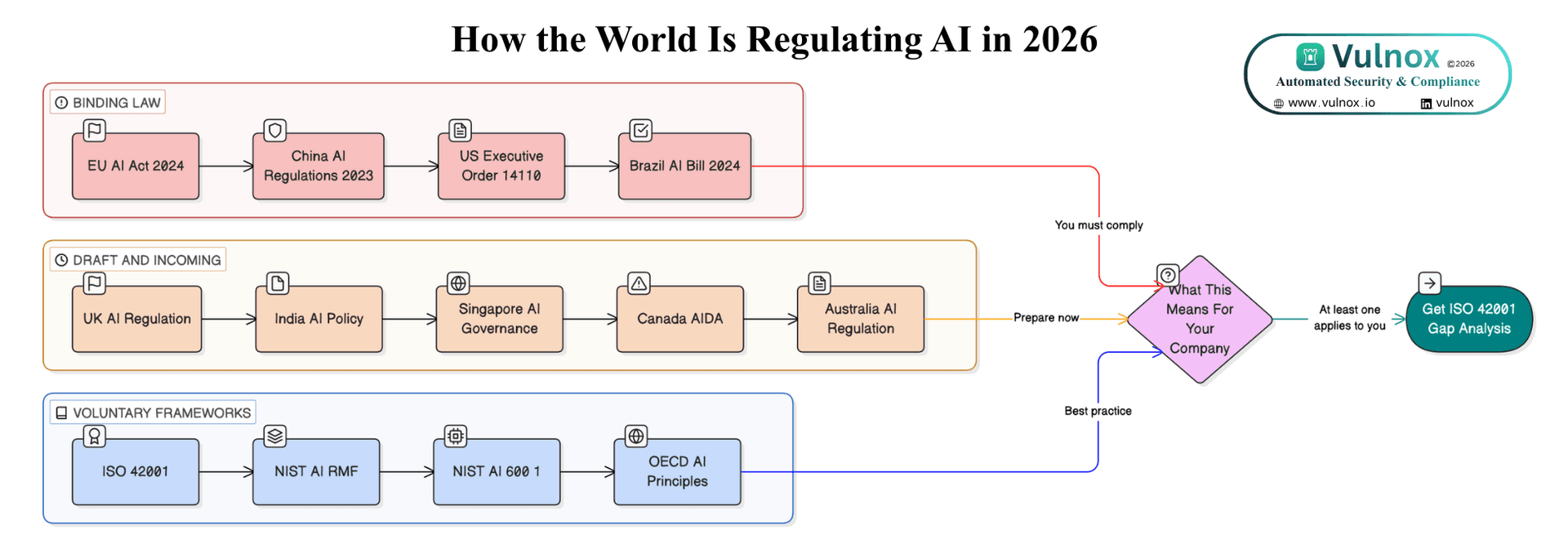
The world has not converged on a single approach to AI governance, and the regulatory map that compliance teams must navigate in 2026 reflects that fragmentation in every dimension that matters , legal basis, risk classification methodology, technical documentation requirements, enforcement mechanism, and jurisdictional trigger. What the major AI regulatory frameworks do share is a structural architecture that distinguishes between three tiers of obligation: binding law that carries penalty exposure today, draft and incoming frameworks that will become enforceable within a planning horizon that most organizations should already be designing for, and voluntary frameworks that function as both best practice guidance and pre-compliance infrastructure for the binding regimes that will follow them. Understanding which tier a given framework occupies, and which tier applies to a given organization, is the foundational compliance question , and answering it incorrectly in either direction carries real cost.
The most practically significant insight in the current AI regulatory landscape is that the voluntary frameworks , ISO 42001, NIST AI Risk Management Framework, NIST AI 600-1, and OECD AI Principles , are not separable from the binding and incoming regulatory obligations. ISO 42001, the AI management system standard published in December 2023, is already being referenced by the EU AI Act compliance guidance as an implementation pathway for high-risk AI system obligations under Articles 9 through 15. Organizations that implement ISO 42001 as a best practice measure before binding local AI regulation arrives are simultaneously building the documented management system, risk assessment methodology, and governance structure that EU AI Act compliance, Canada AIDA compliance, and Australia AI Regulation compliance will require when those frameworks reach enforceability. The voluntary tier is the infrastructure layer for the binding tier , treating it as optional is a strategic error.
Key takeaway
ISO 42001 gap analysis is the highest-leverage single action available to organizations in either the prepare now or best practice position. The standard provides the documented management system, risk assessment methodology, AI impact assessment process, and control framework that the EU AI Act, Canada AIDA, and Australia mandatory guardrails all require in their binding forms , implementing ISO 42001 before these frameworks reach enforceability means the compliance work is done once rather than repeated under deadline pressure for each jurisdiction as it activates. The ISO 42001 gap analysis also produces the artifact set , AI system registry, risk assessment documentation, governance policy framework, and control evidence , that a subsequent conformity assessment or regulatory inspection will require.
Binding AI Law: EU AI Act, China Regulations, US Executive Order, and Brazil
The EU AI Act 2024 is the most structurally comprehensive binding AI law currently in force, and its extraterritorial reach makes it the most consequential for multinational organizations regardless of where they are headquartered. The Act applies to any provider placing an AI system on the EU market or putting it into service in the EU, any deployer of an AI system located in the EU, and any provider or deployer whose AI system output is used in the EU , a jurisdictional trigger broad enough to capture US, UK, and Asian technology companies with EU customers. The risk-based classification framework divides AI systems into unacceptable risk systems that are prohibited outright, high-risk systems subject to mandatory conformity assessment under Annex III, limited risk systems subject to transparency obligations, and minimal risk systems with no mandatory requirements. High-risk AI systems , which include AI used in employment decisions, credit scoring, biometric identification, critical infrastructure management, law enforcement, and essential public services , must satisfy requirements across nine categories including data governance under Article 10, technical documentation under Article 11, human oversight under Article 14, and accuracy, robustness and cybersecurity under Article 15.
China AI Regulations 2023 apply a different risk classification logic than the EU AI Act, focusing specifically on generative AI services offered to the public within China rather than the broader risk-based scope of the EU framework. The Interim Measures for the Management of Generative Artificial Intelligence Services, effective August 2023, require providers of generative AI services to conduct security assessments before public deployment, implement content filtering mechanisms aligned with Chinese cybersecurity law, maintain user registration systems with real-name verification, and preserve generated content logs for a minimum of six months. The Cyberspace Administration of China is the primary enforcement authority, and the security assessment process , which must be completed before service launch , requires documentation of model training data sources, content safety measures, and system architecture that has more operational similarity to a technical audit than a policy review. For multinational companies offering AI services that include Chinese users, this represents an independent compliance track from EU AI Act obligations with different documentation requirements, different enforcement authorities, and different content standards.
US Executive Order 14110, signed in October 2023, operates through a different legal mechanism than the EU AI Act or China regulations , it is an executive directive to federal agencies rather than a statute with direct private sector obligations, but its practical effect on the private sector is significant through procurement requirements, National Institute of Standards and Technology guidance mandates, and the safety reporting requirements it imposes on developers of the most capable frontier models. The dual-use foundation model provisions require developers of models trained on computing clusters above a defined threshold to report safety test results to the federal government before public deployment. Federal procurement requirements flowing from EO 14110 effectively make compliance with NIST AI RMF a de facto requirement for AI vendors selling to the US government, operating on the same procurement-pressure mechanism that made NIST 800-171 and CMMC compliance economically necessary for defense contractors.
Draft and Incoming Frameworks: Five Jurisdictions That Are Past the Point of Watching
The draft and incoming AI frameworks from the UK, India, Singapore, Canada, and Australia share a characteristic that distinguishes them from the binding tier: they have passed the stage where organizations should monitor rather than act. Canada Artificial Intelligence and Data Act , AIDA , is the most advanced in its legislative pathway among the incoming frameworks, having been introduced as part of Bill C-27 in June 2022 and undergoing committee review. AIDA proposes a high-impact AI system designation framework that would impose obligations on developers and deployers of AI systems that meet impact thresholds including mandatory risk assessment documentation, bias mitigation measures, and plain-language impact assessment publication. Organizations with Canadian operations that are implementing ISO 42001 today are building precisely the documented risk management and governance infrastructure that AIDA will require at enactment, which is the correct sequencing strategy for an incoming framework in advanced legislative stage.
Australia AI Regulation is taking shape through a process that has involved voluntary AI ethics principles, a mandatory guardrails consultation process, and targeted high-risk domain regulation rather than a single omnibus AI Act. The Australian government published its mandatory guardrails proposal in September 2024 for AI in high-risk settings, covering ten guardrails including accountability, transparency, human oversight, and testing requirements that map closely to the ISO 42001 control categories and NIST AI RMF subcategories. Singapore AI Governance Framework , now in its second edition , is notable because it is the most technically detailed of the voluntary-to-mandatory transitioning Asian frameworks, with implementation guides that specify technical measures including model documentation practices, explainability approaches, and data pipeline governance procedures. India AI Policy is still in earlier development stages than the Singapore or Australian frameworks, but the Indian government has signaled regulatory intent through its Digital India Act consultation process, and organizations with Indian AI deployments should be monitoring the progression of MEITY guidance actively.
The UK AI Regulation approach is deliberately different from the EU AI Act , the UK government has chosen a pro-innovation, sector-led approach administered through existing regulatory bodies rather than a centralized AI Act. The AI and Intellectual Property guidance, the ICO AI auditing framework, the FCA AI guidance for financial services, and the CQC AI guidance for health and social care represent domain-specific AI governance obligations that UK-regulated organizations must navigate without the single-framework clarity that the EU AI Act provides. This sector-led model creates a compliance mapping challenge: UK companies must assess their AI systems against the AI governance expectations of every sector regulator with jurisdiction over their activities, rather than a single cross-sector standard. ISO 42001 performs better as a compliance preparation investment in the UK regulatory context than in the EU context precisely because the UK approach requires a documented management system that can be adapted to multiple sector-specific requirements rather than a single conformity assessment.
Voluntary Frameworks as Compliance Infrastructure: ISO 42001, NIST AI RMF, and OECD Principles
ISO 42001:2023 , the Artificial Intelligence Management System standard , is structured as a management system standard in the same architectural tradition as ISO 27001 for information security and ISO 9001 for quality management. It specifies requirements for establishing, implementing, maintaining, and continually improving an AI management system within the context of the organization, and its Annex A provides a set of AI-specific controls covering AI system impact assessment, AI risk management, data governance for AI, and AI system lifecycle management. The management system architecture , built on the Plan-Do-Check-Act cycle with leadership commitment, policy documentation, risk assessment, objective setting, and internal audit requirements , creates the documented governance structure that binding AI regulations consistently require but rarely specify in procedural detail. Organizations that implement ISO 42001 before their jurisdictional binding AI law reaches enforceability arrive at the compliance obligation with the governance infrastructure already in place rather than building it under enforcement pressure.
NIST Artificial Intelligence Risk Management Framework, published in January 2023, organizes AI risk management into four core functions , Map, Measure, Manage, and Govern , that provide a structured methodology for identifying AI risks, assessing their likelihood and impact, implementing controls, and establishing organizational governance for AI decisions. NIST AI 600-1, the companion publication addressing generative AI risks, extends the AI RMF framework to the specific risk categories that large language models and generative AI systems introduce, including confabulation, data privacy violations, harmful content generation, data provenance issues, and human-AI configuration risks. For organizations subject to US Executive Order 14110 requirements or selling AI capabilities to federal agencies, NIST AI RMF and AI 600-1 implementation represents the practical compliance pathway , NIST frameworks are the reference architecture that federal agencies and their contractors use for AI governance, in the same way that NIST 800-53 is the reference architecture for information security control requirements.
What This Means For Your Company: The Three-Path Decision
Every organization deploying AI systems in 2026 sits in one of three compliance positions, and identifying the correct position is the precondition for designing an appropriate response. The first position is mandatory immediate compliance , the organization is subject to binding AI law today because it deploys high-risk AI systems under EU AI Act Annex III scope, operates generative AI services with Chinese users, develops frontier AI models subject to EO 14110 reporting requirements, or deploys AI in a regulated sector where domain-specific AI obligations already apply. Organizations in this position need a gap analysis against the applicable binding framework requirements conducted urgently , the EU AI Act conformity assessment obligations for high-risk systems, for example, include technical documentation that must be completed before the system is placed on the market, which means the gap analysis identifies whether existing AI deployments are already out of compliance rather than whether future deployments will require new processes.
The second position is prepare now , the organization is subject to incoming AI frameworks that have passed the draft stage or is subject to binding law but deploys only minimal or limited risk AI systems that carry transparency rather than conformity assessment obligations. Preparation for this position means implementing ISO 42001 as the foundational AI management system, conducting an AI system inventory that classifies all current AI deployments against the risk taxonomies of the binding and incoming frameworks applicable to the organization jurisdiction, and establishing the data governance and human oversight procedures that all major AI frameworks require before enforcement deadlines arrive. The third position , best practice adoption without binding obligation , applies primarily to organizations with no EU AI Act exposure, no Chinese AI service deployments, no federal AI procurement relationships, and no operations in the incoming framework jurisdictions. Even in this position, ISO 42001 implementation and NIST AI RMF adoption are defensible risk management investments rather than compliance costs, because the voluntary frameworks are becoming the reference standard against which AI incident liability is assessed in litigation contexts.
Pro tip
When conducting an AI system inventory as preparation for EU AI Act compliance, do not organize the inventory by AI vendor or AI tool , organize it by use case and the decision or output the AI system produces. The EU AI Act Annex III high-risk classification is determined by what the AI system does and who is affected by its output, not by the technology architecture or vendor identity. An AI system used to screen employment applications is high-risk regardless of whether it is built on a hyperscaler API, an open-source model, or a proprietary vendor solution. Organizing the inventory by use case immediately surfaces the systems that require conformity assessment and those that carry only transparency obligations, which is the classification decision the EU AI Act compliance process requires.
Pro tip
For organizations subject to both EU AI Act obligations and US federal procurement AI requirements, build your AI governance documentation against NIST AI RMF first, then map to EU AI Act requirements. NIST has published an AI RMF to EU AI Act crosswalk that identifies the correspondence between NIST AI RMF subcategories and EU AI Act articles , using NIST AI RMF as the primary documentation framework means the technical documentation, risk assessment, and testing records you produce for EU AI Act conformity assessment are also the records that satisfy NIST AI RMF implementation evidence requirements for federal procurement purposes. This dual-jurisdiction documentation approach reduces the total documentation burden significantly compared to building independent documentation sets for each framework.
The global AI regulatory map in 2026 is not a set of independent national experiments , it is a structured system with binding obligations that apply now, incoming obligations that will apply within most organizations planning horizons, and voluntary frameworks that are the technical and procedural foundation for both. The compliance decision tree resolves to a single path for most organizations: assess which binding obligations apply immediately, implement ISO 42001 as the foundational AI management system to build preparation infrastructure for incoming frameworks, and use NIST AI RMF as the documentation architecture for organizations with US federal AI exposure. Vulnox conducts ISO 42001 gap analyses that assess the current state of an organizations AI governance against the full ISO 42001 control framework, identify the gaps between current practices and the management system requirements that binding AI regulations will impose, and produce a remediation roadmap sequenced to address mandatory compliance obligations before incoming framework deadlines arrive.
Further Reading
Gap Analysis
ISO 42001 gap analysisVulnerability Assessment
vulnerability assessmentEU AI Act Official European Commission Page
EU AI Act regulatory frameworkNIST Artificial Intelligence Risk Management Framework
NIST AI Risk Management FrameworkISO 42001 Artificial Intelligence Management System Standard
ISO 42001 artificial intelligence management system
Frequently Asked Questions
What does the EU AI Act require from companies deploying high-risk AI systems?
The EU AI Act 2024 requires organizations deploying high-risk AI systems — as classified under Annex III, which covers AI used in employment decisions, credit scoring, biometric identification, critical infrastructure management, law enforcement, and essential public services — to satisfy mandatory conformity assessment requirements across nine categories before placing the system on the EU market. These requirements include data governance procedures under Article 10 covering training, validation, and testing data quality; technical documentation under Article 11 that must be maintained throughout the system lifecycle; a logging system under Article 12 for automatic event recording; transparency obligations under Article 13; human oversight measures under Article 14; and accuracy, robustness and cybersecurity requirements under Article 15. The technical documentation must be completed before market placement, which means organizations with existing AI deployments that fall within Annex III scope need to conduct a gap analysis against current documentation practices urgently rather than treating these as forward-looking requirements.
How does ISO 42001 relate to EU AI Act compliance and why should organizations implement it now?
ISO 42001:2023 is the Artificial Intelligence Management System standard structured on the same Plan-Do-Check-Act management system architecture as ISO 27001 and ISO 9001. Its Annex A controls cover AI system impact assessment, AI risk management, data governance for AI, and AI system lifecycle management — requirements that correspond directly to the technical documentation, risk management, and governance obligations that EU AI Act Articles 9 through 15 impose on high-risk AI system providers. European Commission AI Act implementation guidance references ISO 42001 as an implementation pathway for demonstrating conformity with high-risk AI system obligations. Organizations implementing ISO 42001 before their binding AI regulation deadlines arrive build the documented management system, AI system registry, risk assessment documentation, and governance policy framework that conformity assessment and regulatory inspection will require, rather than constructing that infrastructure under enforcement pressure. The typical ISO 42001 implementation timeline of six to twelve months for organizations without a prior management system foundation means that organizations starting at the point of binding obligation have already lost the preparation window.
What is the difference between binding AI law and voluntary AI frameworks, and does the distinction matter for compliance planning?
Binding AI law — the EU AI Act 2024, China AI Regulations 2023, US Executive Order 14110, and Brazil AI Bill 2024 — carries direct penalty exposure and mandatory technical compliance obligations enforceable by designated authorities. Voluntary frameworks — ISO 42001, NIST AI RMF, NIST AI 600-1, and OECD AI Principles — carry no direct enforcement mechanism but are not separable from the binding tier in practice. The OECD AI Principles have been formally adopted by 46 countries as the reference principles underpinning national AI governance approaches, and every incoming AI framework in the draft tier — Canada AIDA, Australia mandatory guardrails, UK sector AI frameworks, and India AI Policy — is grounded in OECD AI Principles on transparency, accountability, robustness, and human oversight. ISO 42001 is referenced in EU AI Act implementation guidance and provides the management system infrastructure that multiple binding frameworks require. For compliance planning purposes, voluntary frameworks function as pre-compliance infrastructure for the binding tier — organizations that implement them before binding local AI regulation reaches enforceability arrive at the compliance obligation with governance systems already in place.
Related Articles

GovRAMP Moderate authorization: why the Significant Change Request process catches providers off guard
GovRAMP Moderate is the first tier where you need a government sponsor, annual 3PAO reassessment, and a Significant Change Request process that can pause normal product releases for months. Most providers who stall post-authorization were not prepared for what maintaining Moderate status actually costs operationally.

GovRAMP Low+ authorization: the impact level that punishes providers who get the CUI boundary wrong
GovRAMP Low+ is where providers handling limited Controlled Unclassified Information land — or discover they should not be there. The defining failure is not a missing control. It is a CUI boundary that was drawn before anyone asked what data the government actually sends through the system.

GovRAMP High authorization: why FIPS-validated crypto and personnel security controls catch providers off guard
GovRAMP High is where cloud providers discover that having strong encryption is not the same as having FIPS 140-2 validated encryption — and that distinction alone has derailed authorizations from vendors who passed every other control family. The architectural constraints at High are qualitatively different from every lower tier.
Ready to Secure Your Digital Assets?
Get a comprehensive vulnerability assessment for your website today.