CIS CSC v8.1 IG3 requirements: the external attack surface your program still ignores
 Julian ThorneMay 5, 2026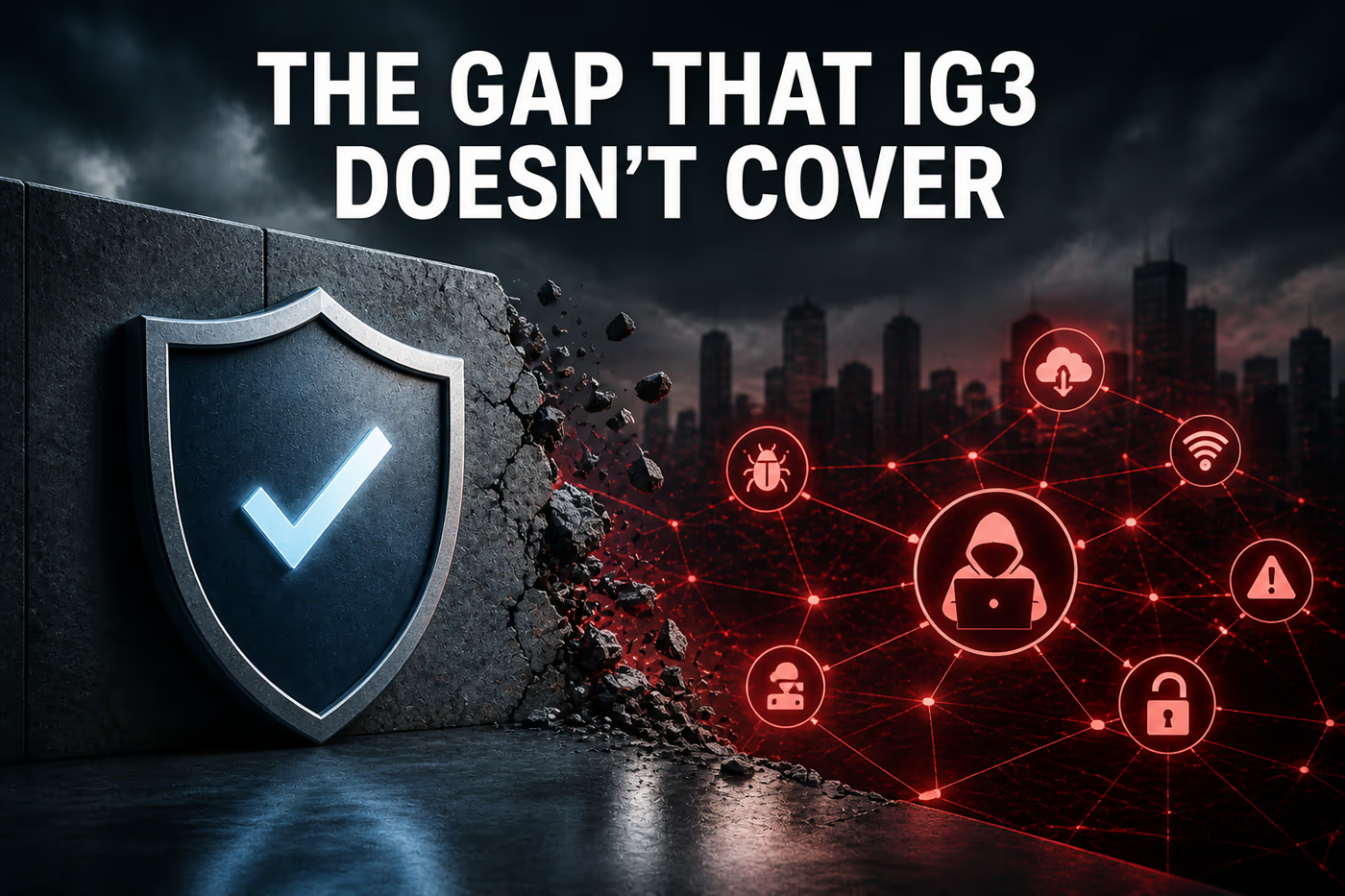
Key takeaways
CIS CSC v8.1 IG3 applies all 130 IG2 Safeguards plus 23 additional ones, targeting organizations with significant regulatory exposure, dedicated security functions, and data that would cause material harm if breached.
IG3 requires penetration testing under Control 18 (Safeguards 18.3 and 18.5) — the one structural requirement that separates it from IG2 — but scoping decisions for those tests routinely exclude the external attack surface attackers actually enumerate first.
In Vulnox external assessments of IG3-aligned organizations, an average of 40% of internet-facing subdomains are unknown to the internal security team at the time of assessment (Vulnox assessment data, 2024).
CIS Control 16 (Application Software Security) is the most resource-intensive IG3 control but produces the weakest risk reduction per dollar in environments where the external perimeter is uncharted — because it secures applications the organization knows about.
Shadow SaaS and OAuth-connected third-party applications represent the fastest-growing external exposure class in IG3 environments. CIS Control 15 addresses service provider management but does not reach applications authorized by individual employees outside IT procurement.
IG3 organizations that pass compliance assessments but have never mapped their full external footprint are structurally vulnerable to reconnaissance-driven attacks. The framework tests whether controls work. It does not test whether the attacker''s entry point is inside the scope of those controls.
TL;DR
CIS CSC v8.1 IG3 is built for organizations that face serious threat actors and have the internal capability to run a real security program. The 23 Safeguards it adds beyond IG2 are substantive — penetration testing, advanced audit log analysis, security awareness for specific roles, deeper application security requirements. The blind spot is not in the controls themselves. It is in the scoping assumption underneath them: that the organization knows what it is defending. In most IG3 environments, the external attack surface is larger than the security team believes, and the controls are scoped to the known perimeter, not the actual one.
The reconnaissance gap inside a compliant IG3 program
A 600-person financial services firm is three months out from a successful IG3 assessment. Clean penetration test report. Eighteen controls covered. Dedicated SOC, SIEM with 94% log coverage across known assets, a formal vulnerability management program running authenticated scans on a two-week cycle. The security team is experienced. The program is real.
A Vulnox external assessment starts the way an attacker would: passive reconnaissance against the organization''s registered domains, certificate transparency logs, DNS records, and job postings. Not a single packet sent to the client network for the first four hours.
By the end of passive recon, the external footprint includes 23 subdomains the security team has no record of. Seven of those resolve to live services. Three are running software versions that the internal vulnerability management program has patched on known assets — but these assets were never in scope because nobody knew they existed. One subdomain is serving a legacy customer portal that the organization believed was decommissioned 14 months ago. It is still processing session tokens.
The penetration test that satisfied IG3 Safeguard 18.3 was scoped against the assets the organization provided. Scoped tests find vulnerabilities in known systems. They do not find systems the organization forgot to include in scope. The attacker does not work from the organization''s asset list.
What IG3 actually adds and where the scoping assumption breaks it
CIS CSC v8.1 IG3 is the top tier of the framework. It inherits all 56 IG1 Safeguards and all 74 IG2 Safeguards, then adds 23 more. The organizational profile it targets is specific: entities with significant regulatory exposure, dedicated security personnel, and data whose loss would cause material harm to third parties or critical infrastructure. Defense contractors, large financial institutions, healthcare systems, critical infrastructure operators. Organizations where a breach is not a reputational problem — it is a national security or public safety event.
The 23 additional Safeguards concentrate in four areas. Control 18 (Penetration Testing) is the most structurally significant addition — it is the only control in the entire CIS framework that requires an adversarial simulation rather than a control implementation or scan. Control 13 (Network Monitoring and Defense) picks up Safeguards in IG3 that require traffic analysis and intrusion detection capabilities beyond what IG2 mandates. Control 6 (Access Control Management) adds Safeguards around privileged access workstations and centralized access control. Control 16 (Application Software Security) adds threat modeling requirements for internally developed and acquired applications.
None of these Safeguards address the external attack surface as a discovery problem. They address it as a testing problem — given a set of systems, validate that those systems are secure. The assumption embedded in that framing is that the organization has already solved the discovery problem. In practice, it has not.
External attack surface management is not a CIS Control. It is not a Safeguard. It appears in the framework only implicitly, through the asset inventory requirements of Control 1 — which most organizations interpret as an internal asset inventory problem, not an external footprint mapping problem. The distinction between ''what is on our network'' and ''what is on the internet attributed to our organization'' is where IG3 compliance diverges from IG3 security.
Example
Safeguard 18.3 requires external penetration testing by a qualified party. The Safeguard specifies annual testing and remediation of findings. It does not specify how scope is determined. In practice, scope is determined by the organization: they provide the IP ranges, domains, and application URLs to be tested. A tester working within that scope will find vulnerabilities in the systems provided. They will not find the legacy subdomain running on an IP range the organization forgot, the staging environment with a direct database connection, or the OAuth application that has read access to employee calendar data and is hosted by a vendor the security team has never evaluated.
Certificate transparency logs are public. Every TLS certificate issued for a subdomain of your organization''s domains is logged and searchable. Passive enumeration of an organization''s certificate history takes minutes and produces a complete list of subdomains that have ever had a valid certificate — including ones that were decommissioned but whose DNS records were never cleaned up. This is the first thing a competent attacker does. It is not part of the standard IG3 scoping conversation.
What external reconnaissance finds in IG3-aligned environments
Assessment base: Findings from Vulnox external attack surface assessments of organizations with formal security programs, 100 to 2,000 employees, across financial services, healthcare, technology, and critical infrastructure verticals, 2023 to 2024.
40% of internet-facing subdomains unknown to security teams at assessment time
Vulnox external assessments of organizations operating IG3-aligned security programs find that an average of 40% of discovered internet-facing subdomains are not present in the organization''s internal asset inventory (Vulnox assessment data, 2024). The sources follow a consistent pattern: historical subdomains from past product lines or acquired entities, development and staging environments provisioned outside the formal change process, partner and vendor integration endpoints hosted on the organization''s domains, and legacy systems retained for compliance or contractual reasons without active maintenance. The security team typically knows about none of these until they appear in the external assessment report.
The client assumption going in is that internal asset inventory covers the external perimeter because the internal inventory includes internet-facing systems. The actual gap is that internal inventory is populated through internal discovery processes — scanning internal networks, querying internal CMDBs, reviewing provisioning records. None of these processes capture subdomains that were created outside the formal provisioning workflow, acquired through M&A without full integration, or provisioned by third parties operating under the organization''s domains.
Penetration test scope covers an average of 61% of the actual external attack surface
When Vulnox maps the full external footprint of an organization before reviewing their most recent penetration test report, the systems included in the penetration test scope represent an average of 61% of the live external services discovered through passive and active reconnaissance (Vulnox assessment data, 2024). The remaining 39% was not tested because it was not included in the scope the organization provided to the tester. Critically, the excluded systems are not low-value: staging and development environments with database connections, legacy portals with active session handling, and management interfaces exposed to the public internet appear consistently in the untested portion.
A penetration test that satisfies IG3 Safeguard 18.3 is not the same as a penetration test that covers the external attack surface. The Safeguard requires testing. It does not require the organization to first enumerate everything that needs to be tested. Organizations that interpret compliance with 18.3 as ''we ran a penetration test'' are correct. Organizations that interpret it as ''our external perimeter has been tested'' are frequently wrong by a meaningful margin.
OAuth-connected third-party applications average 3.4x the number tracked by IT procurement
In assessments where Vulnox reviews OAuth application grants against an organization''s approved vendor list, the number of active OAuth-connected applications with access to corporate data averages 3.4 times the number on the formally approved list (Vulnox assessment data, 2024). The gap is driven by employee-authorized applications: productivity tools, AI writing assistants, calendar integrators, project management connectors, and development tools that individuals authorize using their corporate credentials without going through procurement or security review. Each of these applications has a grant scope that includes some level of access to corporate data — in many cases, read access to email, calendar, or cloud storage.
CIS Control 15 (Service Provider Management) requires classifying service providers and establishing contracts with security requirements. It does not reach applications that were never reviewed by the security team because individual employees authorized them. The IG3 Safeguards under Control 15 require managing known third parties. The unapproved OAuth application that a developer authorized to access their Google Drive three months ago does not appear in any vendor register. Its data access scope is invisible to the security program.
Exposed management interfaces on non-standard ports survive IG3 vulnerability scans
Standard vulnerability scanning — even authenticated scanning as required under IG2 and IG3 — is typically configured against common port ranges and known service fingerprints. In external assessments, Vulnox finds management interfaces — SSH, RDP, administrative web UIs, database management ports — exposed on non-standard ports in a consistent minority of IG3-aligned environments. These services are running, accepting connections from the public internet, and absent from vulnerability scan results because the scan configuration did not include their ports. They are also absent from the penetration test scope because the organization''s scoping document listed the application URLs and IP ranges it knew about, not the ones it had forgotten.
Non-standard port exposure is not a sophisticated evasion technique. It is usually an accident of configuration — a developer changed the default port to avoid a conflict, a legacy system was configured this way a decade ago, a vendor deployed a management interface on a non-standard port as a default. The result is a service that is invisible to the organization''s own scanning program while remaining fully visible to an attacker running a full port scan. Full port scanning is a standard step in external reconnaissance. It is not a standard step in most IG3 vulnerability management programs.
More security investment does not reduce the external footprint problem — it often expands it
Common belief
The assumption in most IG3 programs is that organizational maturity correlates with external footprint control. Larger security teams, more tooling, formal change management, and documented processes should mean fewer forgotten subdomains, fewer unauthorized integrations, fewer legacy systems sitting exposed. Mature organizations know what they are running.
What we found
In Vulnox external assessments, organizations that had undergone at least one acquisition in the preceding 36 months had external footprints averaging 2.1 times larger than organizations of equivalent size with no acquisition history. The acquired entity''s legacy subdomains and integration endpoints accounted for the majority of previously unknown external assets.
The data does not support this. The organizations with the largest undiscovered external footprints in Vulnox assessments are not the least mature. They are frequently the most complex: organizations that have grown through acquisition, that run parallel development environments across multiple cloud providers, that have long-tenured developer teams with broad infrastructure access, and that have accumulated years of integration partnerships. Organizational complexity is a stronger predictor of external footprint sprawl than organizational maturity.
Acquisitions are the clearest driver. A company that acquires three smaller firms over five years inherits three external footprints, three sets of DNS records, three histories of provisioned subdomains and integration endpoints. The integration process typically focuses on identity systems, financial consolidation, and core product migration. The subdomain cleanup, DNS audit, and legacy service decommissioning are deprioritized because they are unglamorous and non-urgent. They stay deprioritized until an external assessment makes the accumulated debt visible.
The paradox is that the investment that creates this problem is often the investment in product and engineering velocity — the same investment that IG3 organizations make to remain competitive. More developers with more cloud access provisioning more environments create more footprint. The security program matures in response to known risk. The footprint grows in response to business activity. The gap between them widens over time, not because the security program is failing but because the surface it is trying to cover is expanding faster than the program can track.
What IG3 leaves unaddressed at the perimeter
External footprint scoping is not a Control 1 requirement in practice
Control 1 requires active discovery of enterprise assets. The implementation guidance covers internal network discovery tools — DHCP logs, active scanning of internal subnets, MDM integration. It does not specify external reconnaissance as a discovery method. Organizations interpret Control 1 compliance as an internal inventory problem. The external attack surface — everything the internet can reach that is attributed to the organization — is treated as a subset of the internal inventory rather than as a separate discovery problem requiring different tools and methods. Certificate transparency enumeration, DNS walking, autonomous system mapping, and passive reconnaissance against the organization''s registered domains are not part of any CIS Control 1 implementation guidance.
IG3 Control 18 scoping is self-determined
Safeguard 18.3 requires external penetration testing. Safeguard 18.5 requires internal penetration testing. Neither Safeguard specifies how scope is determined or who validates that the scope covers the actual attack surface. The tester works within the scope the organization provides. The organization determines scope based on what it knows. The systems it does not know about are not in scope. A competent attacker starts from outside that scope, not inside it. The framework''s penetration testing requirement is satisfied by a test that may be systematically incomplete.
Shadow SaaS sits outside every IG3 control''s reach
Employee-authorized OAuth applications, browser extensions with corporate credential access, AI tools connected to corporate email or calendar, and freemium SaaS tools used for work purposes without IT authorization all exist outside the formal service provider management process. Control 15 addresses approved service providers. Control 2 (Inventory and Control of Software Assets) addresses software installed on managed devices. Neither control covers a web application that an employee authorized using corporate credentials from a personal device. The data access granted to these applications is often significant — read access to email and calendar is a common OAuth scope. The security program has no visibility into it.
The threat model in IG3 runs from inside the perimeter outward
Most IG3 security programs model threats from the perspective of a defended perimeter: attackers attempt to breach the perimeter, controls detect and prevent the breach, incident response activates if a breach occurs. The threat model does not start where the attacker starts — with passive reconnaissance against the public internet, identifying assets the organization does not know it is exposing, and selecting an entry point that is outside the control scope entirely. IG3 is excellent at hardening known systems. It does not prescribe a methodology for finding what the attacker finds before the attack begins.
Where IG3 and external attack surface management converge
CIS Controls v9 will introduce an explicit external attack surface management Safeguard, likely under Control 1 or as a new control, in direct response to the reconnaissance gap that IG3 penetration test scoping failures are making visible.
The gap between internal asset discovery and external footprint mapping has been a consistent finding across the security community for three years. CISA''s Known Exploited Vulnerabilities catalog includes a disproportionate number of vulnerabilities on internet-facing systems that organizations did not know they were running. The pressure to address this gap at the framework level is building from regulators, insurers, and the breach forensic record. CIS has updated the framework in response to practitioner feedback before. The external footprint gap is now well-documented enough to drive a Safeguard addition.
Confidence: mediumReview the CIS Controls v9 release when published. If no Safeguard addresses external asset enumeration, passive reconnaissance methodology, or external attack surface discovery as a distinct activity from internal asset inventory, the prediction is wrong.Within two years, a publicly disclosed breach at a formally IG3-compliant organization will be traced to an asset outside the scope of their most recent penetration test — and the post-breach disclosure will name the scoping gap explicitly.
The structural conditions for this breach already exist across multiple IG3-aligned organizations. The only question is timing and disclosure. Organizations that experience breaches through external footprint gaps today tend to describe the failure as a ''vulnerability in a legacy system'' without specifying that the legacy system was unknown to the security program and untested. As breach disclosure requirements tighten under SEC rules and international equivalents, the specificity of post-breach reporting is increasing. A detailed post-incident report from a regulated entity will eventually name the penetration test scoping gap explicitly.
Confidence: highMonitor SEC 8-K breach disclosures and equivalent international disclosures for IG3-compliant organizations through 2027. If no disclosure explicitly references a breach originating from an asset outside the scope of the most recent penetration test, the prediction is wrong.
IG3 is the right framework for the wrong perimeter model
My position is that IG3 is a genuinely strong framework that is being applied to a perimeter model that no longer matches how organizations are structured or how attackers approach them. The 153 Safeguards across 18 Controls describe a comprehensive internal security program. The penetration testing requirement under Control 18 is the right instinct — adversarial simulation should be mandatory at this risk level. The application security requirements under Control 16 are substantive in ways that most frameworks are not.
The problem is that all of it runs inside a boundary that the organization drew. The organization drew the boundary based on what it knows. What it does not know is systematically excluded. An attacker doing passive reconnaissance does not work from the organization''s asset list. They work from DNS records, certificate transparency logs, WHOIS data, job postings that reveal technology stack details, and any data source that reflects the organization''s internet presence without requiring the organization''s cooperation. The entry points they find are frequently the ones the security program has not considered because the security program starts from the known perimeter and works inward.
I am not arguing that IG3 should be replaced or that the controls are wrong. I am arguing that a full IG3 program requires external footprint mapping as a prerequisite to scoping any of the controls that face the perimeter. That mapping should happen before the penetration test scope is determined, not after. It should use the same methods an attacker uses. And the results should feed directly into Control 1 inventory, Control 18 test scope, and Control 7 vulnerability management scope. Without it, the framework is being applied to an incomplete picture of what needs to be defended.
Counterargument
The reasonable objection is that external attack surface management requires specialized tooling and expertise that even IG3 organizations may not have, and adding it as a prerequisite to IG3 compliance raises the bar in ways that could make the framework inaccessible. That concern is legitimate. The response is that passive external reconnaissance does not require specialized tooling — certificate transparency logs are public, DNS enumeration tools are freely available, and the methodology is well-documented. What it requires is a deliberate decision to start the scoping conversation from the attacker''s perspective rather than the organization''s asset register.
One action before the next assessment cycle
Before the next penetration test scope conversation, run a passive external reconnaissance pass against your organization''s registered domains. Use certificate transparency logs — crt.sh is public and free — to enumerate every subdomain that has ever had a valid TLS certificate under your domains. Compare that list against your current asset inventory. Every subdomain on the certificate log that is not in your inventory is a candidate for being a live service outside your current control scope and outside your penetration test scope. It takes two hours. The list it produces should be the starting point for your next test scope conversation, not the asset register your team compiled from internal sources.
Further Reading
Qatar Personal Data Privacy Law compliance
Qatar Personal Data Privacy Law: Complete PDPPL Compliance GuideSB1386 compliance assessment
CA SB1386 Breach Notification Compliance GuideTX-RAMP Level 1 self-attestation requirements
TX-RAMP Level 1 self-attestation requirements: what DIR reviews after an incidentCIS critical security controls v8.1: IG1, IG2, and IG3 explained
CIS CSC v8.1 IG3 requirements and what they leave unaddressed on your external attack surface
Frequently Asked Questions
What does CIS CSC v8.1 IG3 require that IG2 does not?
CIS CSC v8.1 IG3 adds 23 Safeguards to the 130 in IG2, for a total of 153 Safeguards. The most significant additions are penetration testing under Control 18 (Safeguards 18.3 for external and 18.5 for internal testing), advanced network monitoring and intrusion detection under Control 13, privileged access workstation requirements under Control 6, and application threat modeling under Control 16. IG3 is the only CIS tier that requires adversarial simulation rather than purely control implementation.
What organizations should implement CIS CSC v8.1 IG3?
CIS CSC v8.1 IG3 targets organizations with the highest risk exposure: those subject to significant regulatory requirements, with dedicated security personnel, and whose data loss would cause material harm to third parties. This includes defense contractors, large financial institutions, healthcare systems, and critical infrastructure operators. The framework assumes the organization has the internal capability to run a full security program, including incident response, continuous monitoring, and adversarial simulation.
Why do IG3 penetration tests miss parts of the external attack surface?
IG3 Safeguard 18.3 requires external penetration testing but does not specify how scope is determined. Organizations provide the scope — typically their known IP ranges, domains, and application URLs. Systems the organization does not know about are not included. Vulnox external assessments find that penetration test scope covers an average of 61% of the live external services discovered through full reconnaissance, with the remaining 39% untested because it was not in the scope the organization provided.
How does CIS CSC v8.1 IG3 address third-party and SaaS risk?
CIS Control 15 (Service Provider Management) requires classifying service providers, establishing security policies for them, and including security requirements in contracts. Under IG3, this covers formally approved and procured service providers. It does not reach employee-authorized OAuth applications, browser extensions with corporate credential access, or AI and productivity tools individuals connect to corporate accounts without IT review. Vulnox assessments find that active OAuth-connected applications average 3.4 times the number on approved vendor lists.
What is the external attack surface gap in CIS IG3 compliance?
CIS Control 1 requires active asset discovery but its implementation guidance focuses on internal network discovery. External footprint mapping — enumerating subdomains via certificate transparency logs, DNS reconnaissance, and passive recon — is not specified as a required discovery method. In Vulnox external assessments of IG3-aligned organizations, 40% of internet-facing subdomains on average are unknown to the internal security team, including legacy portals, staging environments, and acquired-entity infrastructure that is live but unmonitored.
Does CIS CSC v8.1 IG3 compliance mean an organization is secure against external attacks?
No. IG3 compliance means an organization has implemented 153 Safeguards across 18 Controls, including penetration testing. It does not mean the organization has mapped its full external footprint before scoping those controls and tests. Organizations with clean IG3 assessments consistently have unknown internet-facing assets that were outside the scope of their penetration tests and vulnerability scans. Compliance confirms that known systems are being managed. It does not confirm that the organization knows about every system an attacker can reach.
How should an IG3 organization scope its penetration test to avoid the external footprint gap?
Start scope determination from the attacker''s perspective, not the internal asset register. Use certificate transparency logs (crt.sh is public) to enumerate all subdomains that have ever had a valid TLS certificate under the organization''s domains. Cross-reference against internal inventory. Run full port scans against discovered external IP ranges to surface services on non-standard ports. The systems discovered through this process that are not already in scope should be the first addition to the penetration test scope — they are the systems most likely to be unpatched, unmonitored, and exposed.
Related Articles

GovRAMP Moderate authorization: why the Significant Change Request process catches providers off guard
GovRAMP Moderate is the first tier where you need a government sponsor, annual 3PAO reassessment, and a Significant Change Request process that can pause normal product releases for months. Most providers who stall post-authorization were not prepared for what maintaining Moderate status actually costs operationally.

GovRAMP Low+ authorization: the impact level that punishes providers who get the CUI boundary wrong
GovRAMP Low+ is where providers handling limited Controlled Unclassified Information land — or discover they should not be there. The defining failure is not a missing control. It is a CUI boundary that was drawn before anyone asked what data the government actually sends through the system.

GovRAMP High authorization: why FIPS-validated crypto and personnel security controls catch providers off guard
GovRAMP High is where cloud providers discover that having strong encryption is not the same as having FIPS 140-2 validated encryption — and that distinction alone has derailed authorizations from vendors who passed every other control family. The architectural constraints at High are qualitatively different from every lower tier.
Ready to Secure Your Digital Assets?
Get a comprehensive vulnerability assessment for your website today.