Does Your Company Need a CISO? The Complete Decision Guide
 Amara OkaforFebruary 20, 2026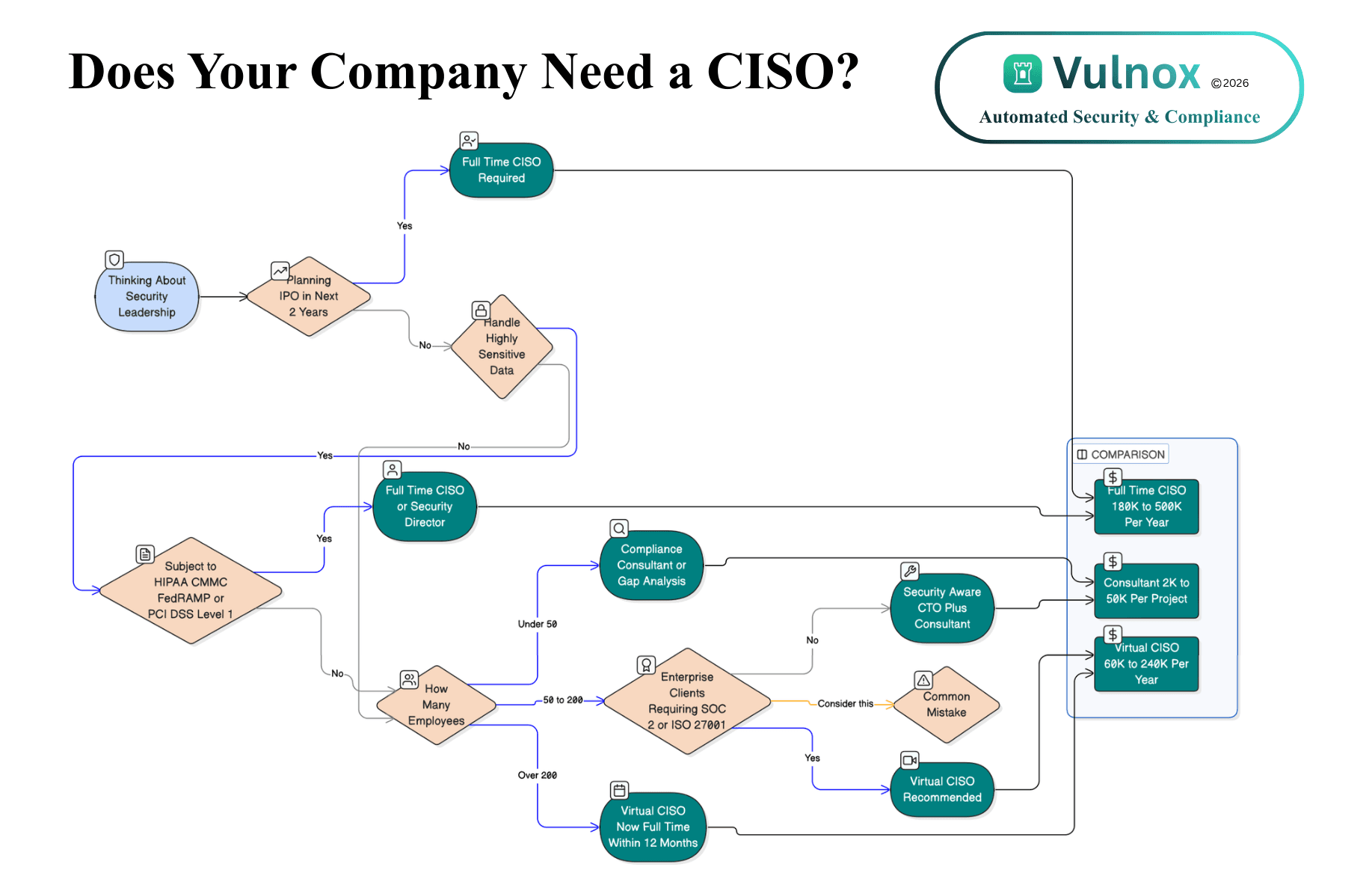
TL;DR
The CISO decision is one of the most consequential and most frequently mishandled security leadership choices a growing company makes. Hire a full-time CISO too early and you are paying $180,000 to $500,000 per year for a strategic function that your organization is not yet structured to absorb. Delay too long and you enter a SOC 2 audit, a HIPAA enforcement inquiry, or a Series B due diligence process without the security leadership infrastructure those situations demand. The decision maps cleanly across five variables: IPO timeline, data sensitivity, regulatory exposure, company size, and enterprise client requirements. Understanding which combination of those variables applies to your company determines whether you need a full-time CISO, a virtual CISO, a compliance consultant, or a security-aware CTO supported by specialist expertise.
Most companies arrive at the CISO question the wrong way. A board member raises it after a security incident. A prospective enterprise client puts it in their vendor questionnaire. A Series B investor asks who owns security accountability. These are legitimate triggers, but they are reactive ones , and reactive security leadership hiring almost always produces a mismatch between the role that gets created and the actual security and compliance challenges the company faces. The CISO question deserves to be asked proactively, with a clear methodology for evaluating which security leadership model fits the company current risk profile, regulatory exposure, and operational stage. The cost differential between the available options is substantial , full-time CISOs command $180,000 to $500,000 per year in total compensation, virtual CISOs typically cost $60,000 to $240,000 per year, and compliance consultants or gap analysis engagements run $2,000 to $50,000 per project. Choosing the right model is not just a hiring decision. It is a resource allocation decision with multi-year financial implications.
The most common and most expensive CISO hiring mistake is conflating security leadership with compliance program execution. A full-time CISO is a strategic organizational role , it owns security culture, board-level risk communication, security architecture decisions, and long-term program direction. Compliance program execution , gap analysis, framework implementation, audit preparation, evidence collection , is a specialist execution function that a virtual CISO or compliance consultant delivers more efficiently for most companies under 200 employees. Hiring a full-time CISO to run your SOC 2 program is like hiring a CFO to do your bookkeeping.
The IPO Branch: When Full-Time Security Leadership Becomes Non-Negotiable
The decision tree begins with the highest-stakes trigger in the security leadership landscape: is the company planning an IPO within the next two years? This question sits at the root because an IPO timeline changes the calculus on every other variable. The SEC cybersecurity disclosure rules, which became effective for large accelerated filers in December 2023 and for smaller reporting companies in June 2024, require public companies to disclose material cybersecurity incidents within four business days of determining materiality and to provide annual disclosures of cybersecurity risk management processes, governance structures, and board oversight of cybersecurity risk. These disclosure obligations require a CISO or equivalent executive who can assess materiality determinations, support legal counsel in drafting technically accurate disclosures, and testify credibly about the company security program to investors, auditors, and regulators.
The IPO branch produces a full-time CISO required outcome regardless of any other variable in the decision tree, and this is one of the few security leadership decisions where the answer is genuinely binary. Investment bankers, underwriters, and institutional investors conducting pre-IPO due diligence will ask who owns cybersecurity accountability at the executive level, what security incidents have occurred in the past three years, and how security risk is reported to the board. A company that cannot produce a named executive with CISO-level credentials and a documented security program history will face valuation discounts, delayed timelines, and underwriter concerns that create friction throughout the IPO process. The full-time CISO in an IPO context is not primarily a security practitioner , they are a risk governance executive whose organizational function is to ensure that the company security posture is defensible to public market scrutiny.
Highly Sensitive Data and Regulated Industries: The Second Mandatory Trigger
For companies not planning an IPO, the second branch evaluates whether the company handles highly sensitive data. In practical terms, this question is asking whether the company is subject to HIPAA, CMMC, FedRAMP, or PCI DSS Level 1 , the four regulatory frameworks that impose the most demanding security program requirements and carry the most consequential enforcement risk. HIPAA covered entities and business associates that experience a breach affecting 500 or more individuals are subject to mandatory public notification through the HHS Breach Portal, regulatory investigation, and potential civil monetary penalties that reached $1.19 million per violation category per year as of the most recent HHS civil money penalty adjustments. CMMC Level 2 and FedRAMP Moderate impose third-party assessment requirements that demand documented security programs with identified accountable owners.
The yes path on the sensitive data branch produces a full-time CISO or Security Director outcome , a deliberate distinction from the pure CISO recommendation. Security Director is a title that carries equivalent functional responsibility to a CISO in smaller organizations and commands compensation typically in the $140,000 to $280,000 range, below the upper end of CISO compensation but with equivalent security program ownership. For companies subject to HIPAA, CMMC, or FedRAMP that are not yet at the organizational scale where a C-suite CISO appointment is appropriate, a Security Director with program ownership authority and direct board or executive team access provides the accountability structure that regulators require without the full C-suite compensation expectation. The critical requirement in either case is that the role carries genuine decision-making authority , a security leader who can identify risks but cannot mandate controls or allocate budget to address them provides organizational chart compliance without operational effectiveness.
The no path on the sensitive data branch , companies that are not planning an IPO and do not handle highly sensitive data subject to HIPAA, CMMC, FedRAMP, or PCI DSS Level 1 , routes to the employee count question, which is where the practical reality of most growth-stage companies lives. The majority of B2B SaaS companies, professional services firms, and technology companies without specific healthcare, defense, or payment processing exposure fall into this category, and it is where the virtual CISO and compliance consultant models deliver the most value relative to full-time CISO investment.
Company Size and the Employee Count Thresholds That Actually Matter
The employee count thresholds in the decision tree , under 50, 50 to 200, over 200 , are not arbitrary size categories. They reflect genuine inflection points in organizational security complexity. Companies under 50 employees typically have a flat organizational structure, limited IT infrastructure complexity, a small number of third-party vendors, and security requirements that center on a relatively narrow set of controls around access management, endpoint protection, and data handling policies. At this stage, a compliance consultant or gap analysis engagement provides the highest return on security investment. A structured gap analysis identifies the specific control gaps against the applicable compliance framework , whether that is SOC 2, ISO 27001, or a sector-specific standard , and produces a remediation roadmap that the company can execute with internal resources or targeted specialist support.
The 50 to 200 employee range is where the enterprise client question becomes the critical branching variable. Companies in this size range with enterprise clients requiring SOC 2 Type II or ISO 27001 certification face a compliance program execution challenge that typically exceeds what a part-time engagement can effectively manage. SOC 2 Type II audit preparation requires sustained operational attention over a six-month minimum observation period , evidence collection, control monitoring, exception management, and auditor communication all require someone who is accountable for the program on an ongoing basis rather than episodically. The virtual CISO model serves this need effectively: a virtual CISO provides the strategic security leadership and compliance program oversight that the organization needs, at a cost of $60,000 to $240,000 per year, without the full-time executive compensation and organizational restructuring that a permanent CISO appointment requires.
The over 200 employee threshold produces a specific and time-bounded recommendation in the decision tree: virtual CISO now, full-time CISO within 12 months. This phased recommendation reflects the organizational reality that companies above 200 employees typically have sufficient security complexity , multiple product lines, significant third-party vendor relationships, distributed teams, and growing enterprise client portfolios , to justify full-time CISO investment, but often lack the internal security talent acquisition capability and executive team bandwidth to conduct a CISO search while simultaneously managing active compliance programs. The virtual CISO fills the leadership gap during the transition period, maintains compliance program continuity, and in many cases provides a more qualified evaluation of full-time CISO candidates than a CEO or CTO who has not previously hired at this level.
The Common Mistake: Hiring a Security-Aware CTO Instead of Appropriate Security Leadership
The decision tree flags a specific anti-pattern as a common mistake: the 50 to 200 employee company with enterprise clients requiring SOC 2 or ISO 27001 that responds by assigning security responsibility to the CTO rather than engaging a virtual CISO or compliance specialist. This pattern is understandable , the CTO already owns technology architecture, already has credibility with the engineering team, and security feels like a natural extension of the technology function. The problem is that SOC 2 Type II and ISO 27001 compliance require sustained, detailed attention to controls documentation, evidence collection, policy management, vendor assessment, and audit coordination that is incompatible with the CTO role at a growth-stage company. CTOs at companies in the 50 to 200 employee range are managing product architecture decisions, engineering team scaling, technical debt, and increasingly complex infrastructure , asking them to also own a compliance program that requires 10 to 20 hours per week of dedicated attention during audit preparation periods is a reliable path to both a failed compliance program and a frustrated CTO.
The security-aware CTO plus consultant model that the decision tree recommends as an alternative to the common mistake is a specific configuration worth understanding precisely. The CTO provides strategic security direction, makes architectural decisions that incorporate security requirements, and serves as the internal executive sponsor for the compliance program. The compliance consultant or virtual CISO provides the program execution , gap analysis, control documentation, evidence management, vendor questionnaire responses, and audit coordination. This division of responsibility keeps the CTO focused on the architectural and strategic security decisions where their expertise is genuinely differentiated while ensuring the compliance program has a dedicated owner who treats it as a primary responsibility rather than a secondary obligation. The cost of this model , consultant engagements ranging from $2,000 to $50,000 per project or virtual CISO retainers in the $60,000 to $240,000 range , is substantially below the full-time CISO cost and appropriate for the actual security leadership need.
Virtual CISO Economics: What the $60K to $240K Range Actually Buys
The virtual CISO market has matured significantly over the past five years, and the $60,000 to $240,000 annual cost range reflects genuine variation in what different virtual CISO engagements provide rather than arbitrary pricing. At the lower end of the range, virtual CISO services typically provide monthly or quarterly strategic advisory sessions, compliance program oversight, policy review and update services, and on-call support for security incidents or regulatory inquiries. This model works well for companies under 50 employees with a single compliance framework requirement and a stable security environment. At the upper end of the range, virtual CISO engagements provide dedicated weekly hours, active compliance program management, board-level security reporting, active participation in vendor due diligence, security awareness program management, and hands-on audit preparation support.
The economic case for a virtual CISO versus a full-time CISO rests on a straightforward utilization analysis. A full-time CISO at $300,000 total compensation , approximately the midpoint of the $180,000 to $500,000 range , represents 2,000 hours of dedicated security leadership per year. For a company under 150 employees with a single primary compliance framework and no active regulatory investigations, the actual demand for dedicated CISO-level attention is typically 400 to 600 hours per year , 20 to 30 percent utilization of a full-time hire. A virtual CISO engagement sized to deliver 400 to 600 hours per year costs $60,000 to $120,000, providing equivalent functional coverage at 20 to 40 percent of the full-time cost. The utilization math changes materially when a company is in active IPO preparation, responding to a regulatory investigation, or managing a significant security incident , circumstances where full-time CISO availability becomes genuinely necessary rather than theoretically optimal.
One dimension of virtual CISO value that the cost comparison understates is expertise breadth. A full-time CISO hired at any given compensation level brings deep expertise in a specific set of frameworks, industries, and technical domains shaped by their career history. A virtual CISO engagement from a firm that conducts gap analysis across 250 or more security frameworks brings multi-framework expertise that a single-hire CISO rarely matches , the virtual CISO has current, hands-on experience with SOC 2, ISO 27001, HIPAA, PCI DSS, CMMC, FedRAMP, GDPR, and emerging frameworks like EU AI Act and India DPDPA simultaneously, because those are the active compliance programs they are managing across their client portfolio. For companies facing multi-framework compliance requirements, this expertise breadth is often the decisive argument for the virtual model.
Building the Business Case: What Security Leadership Actually Costs When You Get It Wrong
The decision tree cost comparison presents the three security leadership models in terms of their direct costs. The indirect costs of getting the decision wrong are substantially larger and less frequently discussed. A company that delays security leadership until enterprise clients begin withdrawing or deferring contracts loses revenue that dwarfs the cost of any of the three models. The average enterprise SaaS contract that is lost or delayed because a vendor cannot produce a SOC 2 Type II report or demonstrate ISO 27001 certification ranges from $50,000 to $500,000 in annual contract value , a single lost enterprise deal at the lower end of that range exceeds the annual cost of a compliance consultant engagement.
The regulatory cost of delayed security leadership in highly sensitive data environments is more severe. HHS Office for Civil Rights has imposed HIPAA civil monetary penalties exceeding $1 million in multiple enforcement actions where the underlying failure was not a sophisticated attack but inadequate security program governance , missing risk analyses, absent access controls, unencrypted devices, and no documented security policies. These are not failures of technical sophistication. They are failures of security program ownership , the absence of an accountable person whose job was to ensure that HIPAA Security Rule requirements were understood, documented, and implemented. A Security Director hired at $200,000 per year who prevents a single $1 million HIPAA penalty delivers a five-year return on investment before accounting for any of the other value the role provides.
The reputational cost of a security incident that occurs in the absence of adequate security leadership is the most difficult to quantify and the most long-lasting in its effects. The IBM Cost of a Data Breach Report consistently finds that the average cost of a data breach for companies under 1,000 employees exceeds $3 million when direct costs, regulatory penalties, legal fees, and customer notification expenses are included. More consequential for growth-stage companies is the effect on enterprise sales cycles , a publicly disclosed breach creates a procurement friction that persists for 18 to 36 months in enterprise sales environments where vendor security review processes are thorough and security incident history is a standard questionnaire item. The security leadership decision is ultimately a risk management decision, and the relevant comparison is not CISO cost versus no CISO cost , it is security program cost versus security incident cost.
Pro tip
Before committing to a full-time CISO hire, run a three-month virtual CISO engagement first. The virtual CISO will conduct a gap analysis of your current security program, identify the scope of work required to meet your compliance objectives, and give you a grounded assessment of whether the ongoing security leadership demand justifies a full-time hire. Companies that skip this step frequently discover six months into a CISO search that they were hiring for a role that does not yet have enough defined scope to attract or retain a strong candidate.
Pro tip
When evaluating virtual CISO providers, ask specifically how many active compliance frameworks their practitioners are currently managing across their client portfolio. A virtual CISO who has run five SOC 2 programs in the past 12 months will have current, practical knowledge of what auditors are actually testing, what evidence artifacts are creating friction in current assessments, and what control implementations are being challenged. That current operational knowledge is worth more than credentials from framework training completed several years ago.
The CISO decision is not primarily a hiring decision , it is a security program governance decision that determines whether your organization has the leadership infrastructure to meet its compliance obligations, manage its security risk, and respond credibly when regulators, investors, or enterprise clients ask who is accountable for security. The right model depends on where you sit across five variables: IPO timeline, data sensitivity and regulatory exposure, company size, enterprise client requirements, and available budget. What the cost comparison makes clear is that the financial argument for adequate security leadership is not competitive with the financial consequence of inadequate security leadership , and a structured assessment of which model fits your current profile is the most direct path to getting that decision right.
Further Reading
Gap Analysis
gap analysisVulnerability Assessment
vulnerability assessmentSEC Cybersecurity Disclosure Rules 2023
SEC cybersecurity disclosure rulesHHS HIPAA Enforcement Actions and Settlements
HHS HIPAA enforcement actionsIBM Cost of a Data Breach Report
IBM Cost of a Data Breach Report
Frequently Asked Questions
Does my company need a full-time CISO or will a virtual CISO work?
The decision depends on five variables: whether you are planning an IPO within two years, whether you handle highly sensitive data subject to HIPAA, CMMC, FedRAMP, or PCI DSS Level 1, your company size, whether enterprise clients require SOC 2 or ISO 27001, and your available budget. A full-time CISO is required if you are planning an IPO in the next two years or if you handle highly sensitive regulated data at significant scale. A virtual CISO at $60,000 to $240,000 per year is appropriate for companies between 50 and 200 employees with enterprise compliance requirements. A compliance consultant at $2,000 to $50,000 per project is the right model for companies under 50 employees without heavy regulatory exposure. Companies over 200 employees should operate with a virtual CISO while recruiting for a full-time hire within 12 months.
What is the difference between a virtual CISO and a compliance consultant?
A virtual CISO provides ongoing strategic security leadership on a fractional or retainer basis — they own the security program, report to executive leadership and the board on security risk, manage compliance programs across their duration, and provide continuity of security accountability. The engagement is typically structured as a monthly retainer with defined hours and deliverables. A compliance consultant provides project-based specialist execution — gap analysis, framework implementation, audit preparation, and evidence collection for a specific compliance objective. Compliance consultants deliver defined project outputs rather than ongoing security program ownership. The virtual CISO model is appropriate when the organization needs an accountable security leader. The compliance consultant model is appropriate when the organization has identified a specific compliance gap that needs specialist execution support.
How much does a CISO cost and what is the ROI of security leadership?
Full-time CISO total compensation ranges from $180,000 to $500,000 per year depending on company size, location, and industry. Virtual CISOs cost $60,000 to $240,000 per year depending on the scope of engagement and hours committed. Compliance consultants charge $2,000 to $50,000 per project depending on the framework and scope. The return on investment case for adequate security leadership rests on three cost avoidance categories: enterprise revenue protection, where a single lost enterprise deal due to missing SOC 2 or ISO 27001 certification often exceeds the annual cost of a compliance consultant; regulatory penalty avoidance, where HIPAA civil monetary penalties have reached $1 million or more in enforcement actions that targeted the absence of basic security program governance; and breach cost avoidance, where the IBM Cost of a Data Breach Report consistently finds average breach costs for companies under 1,000 employees exceeding $3 million when all direct and indirect costs are included.
Related Articles
How to Choose the Right Compliance Auditor in 2026
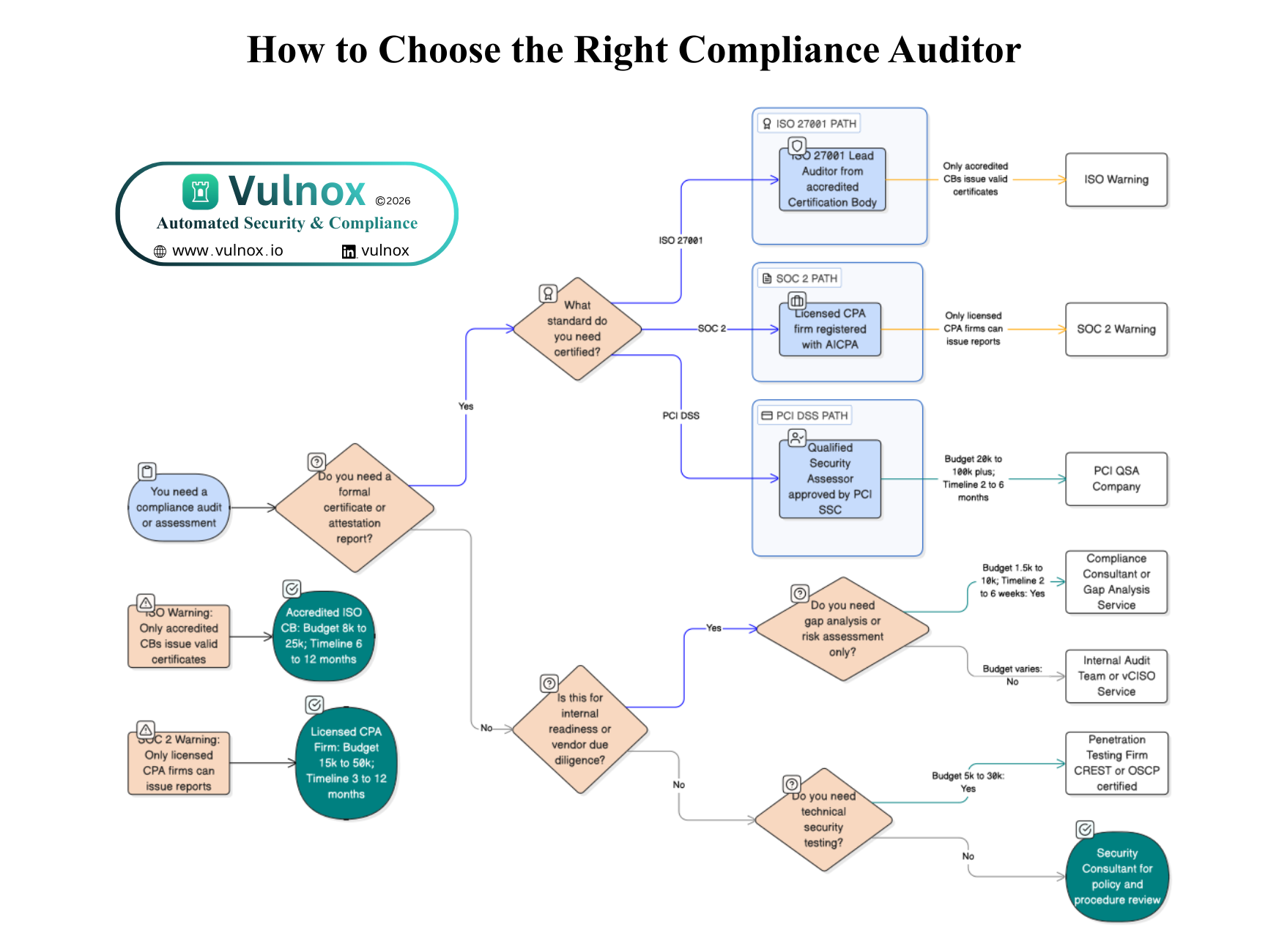
Selecting the wrong compliance auditor — one without the credentials that ISO 27001, SOC 2, or PCI DSS legally require — produces assessment artifacts that fail at the moment they are needed most. This guide resolves the auditor selection decision across every major framework pathway, with budget ranges, timeline expectations, and credential verification steps that compliance teams can apply immediately.
Ready to Secure Your Digital Assets?
Get a comprehensive vulnerability assessment for your website today.