FedRAMP baselines explained: R4, R5, Low, Moderate, High, and LI-SaaS
 Julian ThorneApril 30, 2026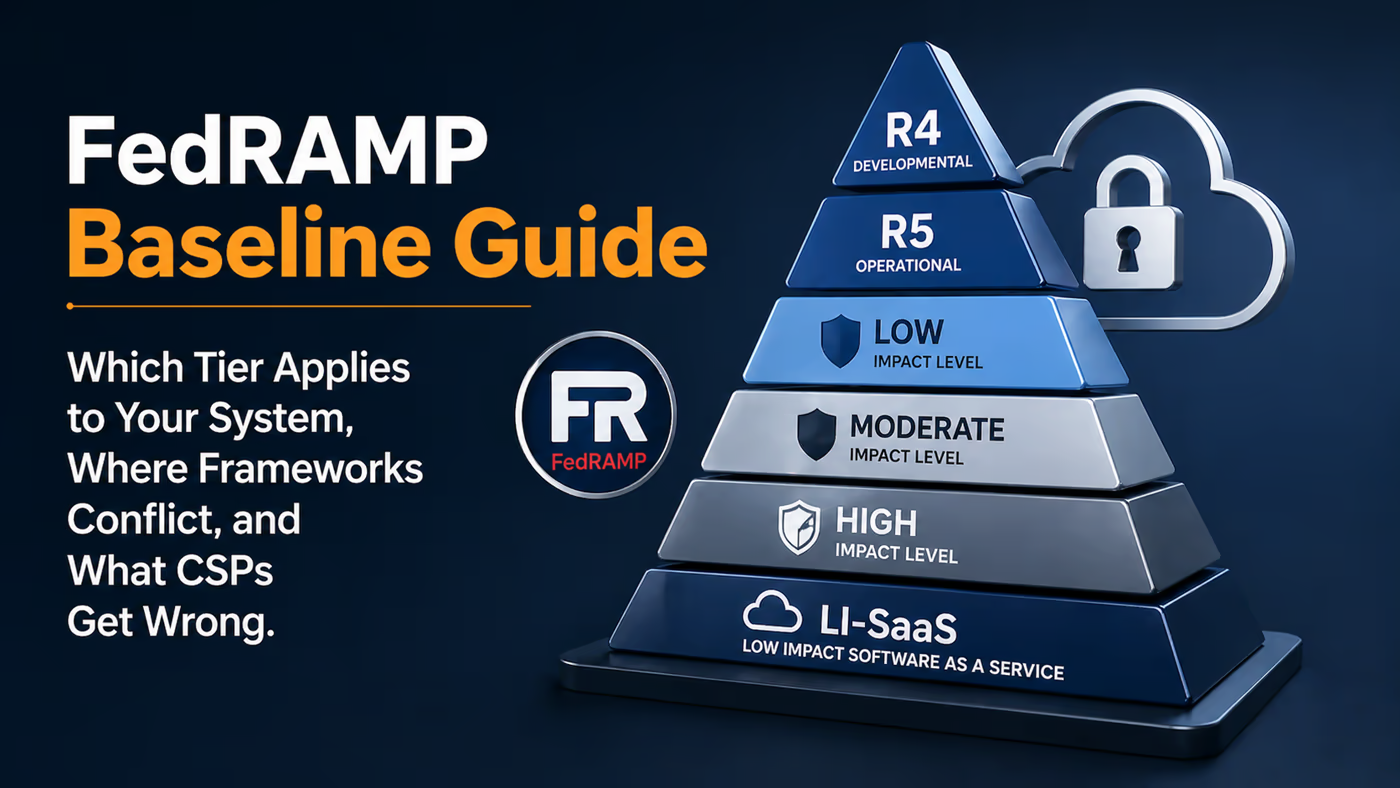
Key takeaways
FedRAMP has ten active baseline variants across R4 and R5: Low, Moderate, High, and LI-SaaS at each revision, plus the base R4 framework still held by transitioning CSPs. Every cloud service entering the federal market must land in one of these tiers.
FIPS 199 high-water-mark categorisation drives baseline selection. One MODERATE-rated information type in any of the three objectives (confidentiality, integrity, availability) escalates the entire system out of Low baseline -- regardless of how few records are involved.
FedRAMP R5 Moderate introduces 12 new Supply Chain Risk Management (SR) controls with no R4 equivalent. SR-4 (Provenance) and SR-6 (Supplier Assessments) require operational evidence -- an SBOM and documented vendor review records -- not policy documents.
LI-SaaS eligibility is lost the moment a federal agency stores operational content in the system. Intended use does not determine eligibility; actual use does. CSPs that skip the actual-use interview with federal customers and rely on product descriptions are routinely surprised during assessment.
The R4-to-R5 transition is not a control mapping exercise. The SR family controls require genuine new implementations -- CI/CD pipeline SBOM generation, signed container images, vendor assessment records -- that take months to operationalise, not days to document.
FedRAMP R5 High''s CA-8 now requires adversarial simulation (red team exercises mimicking nation-state TTPs) in addition to standard penetration testing. This is a qualitatively different assessment capability that most 3PAOs cannot deliver -- verify before engaging.
A FedRAMP Moderate ATO and CMMC Level 2 share approximately 70-80% control overlap. CSPs serving both civilian agencies and DoD contractors who run these as separate programmes are duplicating 70-80% of their compliance effort unnecessarily.
TL;DR
FedRAMP is not one framework -- it is ten overlapping ones, each with different control counts, enforcement mechanisms, and failure modes. The hard part is not reading them. The hard part is knowing which one actually applies to your system, why the adjacent tier you assumed you qualified for is wrong, and where pursuing two tiers simultaneously turns into conflicting documentation that confuses your 3PAO and delays your ATO by six months. This article maps the whole structure.
The wrong baseline costs more than starting over
A mid-sized SaaS company spent eight months building an SSP for FedRAMP Moderate. Their sponsoring agency reviewed the package and asked one question: does your system process any Controlled Unclassified Information? The answer, which nobody had checked against NIST SP 800-60 Volume II, was no. Their system qualified for Low. The Moderate SSP was not transferable. The 325-control implementation effort, the 3PAO engagement, and the $900,000 in preparation costs were largely sunk. They restarted at Low -- a 125-control baseline -- and reached ATO ten months later. The budget impact was real. But what is less visible is the market time lost: a federal contract they had been pursuing for eighteen months was awarded to a competitor who had a Low ATO ready.
Baseline selection is not a compliance formality. It is a strategic decision with direct revenue and resource implications, and the inputs that drive it -- FIPS 199 categorisation, information type analysis, actual-use interviews with federal customers -- are frequently skipped or performed after the SSP is already in progress.
What this framework group covers and how the tiers relate
The FedRAMP framework group contains ten distinct authorisation variants, all ultimately grounded in the NIST SP 800-53 control catalogue but differentiated by control count, parameter stringency, eligible system types, and the revision of NIST 800-53 they reference. The ten variants fall into two revision branches -- R4 (based on NIST 800-53 Revision 4) and R5 (based on NIST 800-53 Revision 5) -- and within each branch, four tiers: Low, Moderate, High, and LI-SaaS. The base FedRAMP R4 framework (without a specific baseline designation) represents the overall R4 programme and is relevant primarily to CSPs managing transition from R4 to R5.
The tiers are nested, not parallel. High is a superset of Moderate, which is a superset of Low. LI-SaaS is a tailored subset of Low, eligible only to SaaS systems meeting specific data scope criteria. This nesting means that a CSP operating at High baseline satisfies all Low and Moderate control requirements by definition -- but the converse is not true. Low baseline compliance does not satisfy Moderate requirements, and the difference is not just additional controls: Moderate imposes more stringent parameter values on controls shared with Low.
The R4-to-R5 transition adds a vertical axis. All new authorisations must use R5. Existing R4 ATOs remain valid during a structured transition period but will require R5 packages. Understanding both branches is operationally necessary for any CSP with existing federal customers on R4 and new customers expecting R5.
Geographically, FedRAMP applies exclusively to US federal civilian agencies. DoD operates parallel frameworks (Impact Levels 4, 5, and 6) with substantial but not complete overlap with FedRAMP. The relationship between FedRAMP High and DoD IL4/IL5 is strategically important for CSPs targeting both markets and is covered in the overlap section below.
FedRAMP R4
FedRAMP R4 (Low)
FedRAMP R4 (Moderate)
FedRAMP R4 (High)
FedRAMP R4 (LI-SaaS)
FedRAMP R5
FedRAMP R5 (Low)
FedRAMP R5 (Moderate)
FedRAMP R5 (High)
FedRAMP R5 (LI-SaaS)
Framework-by-framework breakdown
Frameworks
FedRAMP R4
Cloud service providers maintaining existing FedRAMP authorisations issued under NIST SP 800-53 Revision 4, and those currently executing the R4-to-R5 transition. R4 as a standalone designation is a maintenance-only status -- no new R4 packages are being accepted. Federal agency CISOs managing R4-authorised services and planning transition timelines.
Treating significant changes as minor to avoid the notification and re-assessment process. Architecture changes, boundary expansions, and new subcontractor integrations frequently happen without FedRAMP impact assessments. The 3PAO discovers these undocumented changes during annual assessment and the resulting findings -- often systemic -- require months of remediation.
FedRAMP R4 is NIST RMF operationalised for multi-tenant cloud. The core deliverables are the System Security Plan (SSP), Security Assessment Plan (SAP), Security Assessment Report (SAR), and Plan of Action and Milestones (POA&M). The assessment requires an A2LA-accredited 3PAO. Post-authorisation, monthly ConMon deliverables include vulnerability scans, POA&M updates, and inventory changes. Annual deliverables include a full 3PAO reassessment. Significant change notifications are required before major system modifications and can trigger partial re-assessment.
JAB P-ATOs are overseen by the Joint Authorization Board (DoD, DHS, GSA). Agency ATOs are maintained by the sponsoring agency''s authorising official. Failure to meet ConMon SLAs -- particularly the 30-day remediation window for High findings -- can trigger agency review of ATO status and in serious cases, suspension. The FedRAMP programme does not itself have regulatory enforcement authority; consequences flow through the agency contract relationship.
FedRAMP R4 is the parent framework for all R4 baseline variants (Low, Moderate, High, LI-SaaS). It establishes the boundary-first philosophy, the authorisation pathway structure (JAB vs Agency ATO), the 3PAO requirement, and the ConMon model that all four R4 baselines implement at different intensities. R5 is its successor; R4 and R5 ATOs coexist during the transition period but are not interchangeable.
FedRAMP R4 (Low)
Cloud service providers operating systems where all three FIPS 199 objectives -- confidentiality, integrity, and availability -- are rated LOW. Practically: public websites, open data platforms, collaboration tools handling no sensitive federal data, and systems whose unavailability would cause only limited mission disruption. Federal agency CISOs evaluating whether a procurement qualifies for Low-baseline treatment.
Boundary over-scoping. CSPs include corporate IT systems, third-party SaaS tools, and external services in the Low-baseline boundary that do not need to be there. Each component in scope adds assessment surface and ConMon obligation. A well-scoped Low boundary covers only what stores, processes, or transmits federal data and the security controls protecting it. Overly broad boundaries are the primary cause of Low-baseline assessments taking longer and costing more than necessary.
Approximately 125 controls across all NIST 800-53 control families present in higher baselines, at reduced stringency. IA-2 (identification and authentication) requires MFA for privileged accounts over network access. AU-2/AU-3 require audit logging of defined event categories. SI-2 (flaw remediation) requires patch management with defined SLAs. Monthly ConMon: vulnerability scans, POA&M updates. Vulnerability remediation SLAs are identical to Moderate and High: Critical 15 days, High 30 days, Moderate 90 days. The SLAs do not scale with baseline level.
Agency ATOs are the typical pathway for Low-baseline systems; JAB P-ATOs at Low are rare. Agency authorising officials hold the risk acceptance authority. An active Low ATO can be reused by other agencies via the FedRAMP Marketplace without re-assessment -- the consuming agency reviews the existing package and issues a local ATO. This reuse mechanism is structurally underused: agencies routinely re-assess services that already have Low ATOs rather than leveraging existing packages.
Low is the foundational tier. All Moderate and High controls are a superset of Low. LI-SaaS is a subset of Low for eligible SaaS systems. A CSP transitioning from LI-SaaS to Low because their federal data scope expanded faces a genuine implementation gap -- 89 additional controls beyond LI-SaaS''s 36, many with Moderate-equivalent stringency for some parameters.
FedRAMP R4 (Moderate)
The majority of federal cloud services -- any system where at least one information type is categorised MODERATE under FIPS 199. This includes systems processing Controlled Unclassified Information (CUI), personally identifiable information subject to the Privacy Act, financial transaction data, export-controlled technical data, and systems whose unavailability would cause serious disruption to agency mission functions.
SSP vagueness that blocks 3PAO assessment. The single largest cause of Moderate authorisation delays is SSPs that describe controls with generic language -- ''the system implements access controls in accordance with policy'' -- rather than specifying the technology, configuration, and process that delivers each control. A 3PAO cannot design a test for a vague claim. SSPs written at this level of abstraction require multiple remediation cycles before assessment can begin, adding months to the timeline.
Approximately 325 controls. The five most demanding families by implementation effort are Access Control (AC, 25 controls), System and Communications Protection (SC, 39 controls), Configuration Management (CM, 11 controls), Audit and Accountability (AU, 12 controls), and Contingency Planning (CP, 10 controls). IA-2 at Moderate extends MFA to all user accounts, not just privileged ones. CP-4 requires annual contingency plan tests that include actual recovery operations -- tabletop exercises alone are insufficient. Penetration testing must be performed by the accredited 3PAO annually, following FedRAMP Penetration Testing Guidance.
The commercially dominant FedRAMP tier. Most federal contracts for cloud services specify Moderate as the minimum. A JAB P-ATO at Moderate signals broad federal reusability and typically accelerates agency adoption. Agency ATOs are faster to obtain but may require additional agency-specific reviews for each new customer. Preparation costs typically range from $500,000 to $2 million. The investment is justified by an addressable market spanning the entire federal civilian agency landscape.
Moderate is the engine of the FedRAMP programme by volume. It is a superset of Low and a subset of High. R4 Moderate and R5 Moderate use different NIST 800-53 control identifiers and R5 adds 12 SR controls and 8 PT controls with no R4 equivalent. An existing R4 Moderate ATO does not satisfy R5 Moderate requirements without transition.
FedRAMP R4 (High)
Cloud systems supporting the most sensitive unclassified federal missions: law enforcement databases, emergency response platforms, sensitive healthcare records, financial transaction processing, and intelligence community unclassified workloads. Authorising officials at DHS, DOJ, HHS, Treasury, DoD components. 3PAOs with documented High-baseline assessment experience -- not all 3PAOs accept High engagements.
Underestimating the personnel security requirements. PS-3 at High requires background investigations for personnel with privileged access to the system. These investigations take 3-6 months and must be completed before personnel have unsupervised access. CSPs that begin High-baseline preparation without initiating personnel investigations immediately face a 3-6 month delay that no technical preparation can accelerate.
Approximately 421 controls -- 96 more than Moderate -- with significantly tightened parameter values throughout. AC-2 account reviews quarterly (not annually at Moderate). IA-2 requires replay-resistant MFA for all access. IA-3 requires device authentication, not just user authentication. SI-4 (information system monitoring) requires host-based intrusion detection, network behaviour analysis, and integration with CISA''s CDM programme where applicable. SC-12 cryptographic key management effectively mandates HSM use. CP-4 annual contingency tests must be full system recovery exercises, not tabletops. ConMon at High requires a SOC capability -- internal, managed, or hybrid.
High-baseline assessments typically cost significantly more than Moderate and take 6-12 months. The market is smaller by volume but higher in contract value. A High ATO grants access to the most sensitive federal workloads and positions CSPs for DoD IL4/IL5 pursuit. FedRAMP High was introduced in 2016 -- before it existed, agencies with high-impact missions could not move critical systems to cloud platforms. Non-compliance or ConMon failure at High carries greater scrutiny and faster agency response than at lower baselines.
High is the apex tier of FedRAMP. It is a superset of both Low and Moderate. The approximately 80% overlap between FedRAMP R4 High and DoD IL4/IL5 makes it a strategic stepping stone for CSPs targeting the DoD market. R5 High adds supply chain controls (SR family) and adversarial simulation requirements (CA-8) that R4 High does not contain.
FedRAMP R4 (LI-SaaS)
SaaS vendors -- exclusively SaaS, not IaaS or PaaS -- offering low-risk productivity, collaboration, or utility tools where the system stores no federal operational data beyond identity metadata and service usage logs. Video conferencing platforms that do not record or retain content, project management tools used only for non-sensitive task tracking, and survey platforms that do not collect sensitive response data are archetypal LI-SaaS candidates.
Approximately 36 controls, the lowest count in the FedRAMP programme. The reduced count is only sustainable because of aggressive inherited control use -- LI-SaaS systems must be built on FedRAMP-authorised IaaS or PaaS, inheriting physical security, environmental controls, and infrastructure security from the underlying platform. A real 3PAO assessment is still required: SAP, SAR, and POA&M. Assessment timelines are 4-8 weeks rather than months. Costs typically range from $75,000 to $200,000 total, including 3PAO fees and internal preparation.
LI-SaaS authorisations are issued by individual agencies as agency ATOs, not by the JAB. Each agency reviews the CSP''s package and issues their own ATO, potentially with agency-specific additional requirements layered on top. A CSP may hold simultaneous ATOs from multiple agencies for the same LI-SaaS system. ConMon obligations are lighter -- monthly scans and POA&M updates, annual 3PAO assessment -- but vulnerability remediation SLAs are identical to all other baselines.
LI-SaaS is a tailored subset of Low, not an independent tier. The eligibility criteria are strict and the failure mode is data scope creep: once a federal agency stores operational content in a LI-SaaS system, the system is out of scope and requires a full Low or higher authorisation. LI-SaaS documentation artefacts are different enough from Low that a subsequent upgrade to Low requires essentially a fresh SSP -- the LI-SaaS package is not a stepping stone in terms of reusable documentation.
FedRAMP R5
All cloud service providers initiating new FedRAMP authorisations (R5 is now mandatory for new packages). CSPs with existing R4 ATOs executing the structured transition. Federal agency CISOs, authorising officials, 3PAOs, and acquisition teams who work with cloud services under the current FedRAMP standard.
Treating the R4-to-R5 transition as a documentation update rather than a genuine security programme change. The SR family controls require real operational implementations that take months to build: SBOM generation in CI/CD pipelines, signed container images, vendor assessment programmes, supply chain incident response procedures. CSPs that start documentation without standing up these operational capabilities fail 3PAO assessments for SR controls.
R5 is the base framework for all current FedRAMP activity. Its most significant additions over R4 are the Supply Chain Risk Management (SR) family -- 12 new controls with no R4 equivalent -- and the PII Processing and Transparency (PT) family -- 8 controls integrated throughout the catalogue rather than isolated in an appendix. R5 also restructured several control families, updated parameter values to address current threats, and explicitly addressed cloud-native architectures (containers, microservices, serverless) in ways that R4 did not. Zero Trust Architecture principles are reflected throughout the enhanced IA, AC, SC, and monitoring controls.
No new R4 packages are accepted. Existing R4 ATOs remain valid during the transition period, but agencies are updating procurement requirements to specify R5. CSPs who complete R5 transition proactively are better positioned than those who wait until agency requirements force the transition. The FedRAMP Authorization Act of 2022 formalised the programme''s legislative foundation.
R5 is the current branch of the programme. All new activity -- new authorisations, new control baselines, new 3PAO assessment guidance -- occurs on R5. R4 and R5 coexist during transition but are moving toward R5 as the sole active standard. The cross-framework insight described later in this article is only visible when the R4 and R5 branches are examined together.
FedRAMP R5 (Low)
Cloud service providers seeking new FedRAMP Low authorisations under current requirements, and those with existing R4 Low ATOs executing mandatory transition. Federal agency compliance teams evaluating R5 Low packages for agency ATO issuance.
Configuration drift between assessment and ongoing operations. R5 Low explicitly requires continuous configuration monitoring, not point-in-time hardening. Systems that pass assessment with clean CM-6 findings then accumulate misconfigurations through normal operational changes. Monthly vulnerability scans catch vulnerable software but not configuration drift -- a separate automated configuration compliance tool is needed and frequently missing from Low-baseline ConMon programmes.
Approximately 125 controls, updated to R5 identifiers and parameter values. The R5 additions specific to Low baseline are: SR-1 (Supply Chain Risk Management Policy -- a documented policy, not a full programme), SR-2 (Supply Chain Risk Management Plan at a basic, foundational level), and PT-1 (Privacy Policy, if PII is processed). Configuration management requirements under CM-6 tighten expectations around ongoing drift detection -- the system must be monitored for configuration changes against the documented baseline, not just hardened at assessment time. The basic SR requirements reflect a recognition that supply chain attacks do not respect impact level boundaries.
Agency ATOs are the primary pathway. ConMon obligations are identical in structure to R4 Low: monthly vulnerability scans and POA&M updates, annual 3PAO assessment. Remediation SLAs unchanged. The R5 Low transition from R4 is lighter than higher-baseline transitions -- most of the work is documentation updates plus SR-1 and SR-2 policy creation.
R5 Low is the current version of the entry tier. It adds supply chain and privacy baseline requirements absent from R4 Low, establishing a floor that applies universally regardless of impact level. LI-SaaS R5 is a subset of R5 Low with the same eligibility criteria as R4 LI-SaaS.
FedRAMP R5 (Moderate)
The majority of active federal cloud procurement. Any system with a MODERATE FIPS 199 categorisation must pursue R5 Moderate for new authorisations. This is the most commercially significant FedRAMP tier -- most federal contracts for cloud services specify Moderate as the minimum requirement. Also applicable to the large installed base of R4 Moderate ATOs executing mandatory transition.
SR family assessment failures caused by policy-only implementations. SR-4 (Provenance) requires an SBOM and the process that generates and maintains it -- 3PAOs ask to see the SBOM file and run queries against it. SR-6 (Supplier Assessments) requires documented evidence of periodic supplier security reviews -- SOC 2 Type II report reviews with sign-off are typically acceptable. CSPs that produce policy documents for SR controls without standing up the underlying operational processes fail assessment at the SR section.
Approximately 323 controls. The major R5 additions over R4 Moderate are the complete SR family (all 12 controls, not just SR-1/SR-2 as at Low), the full PT family (8 controls where PII is processed), and updated IA controls requiring phishing-resistant MFA -- FIDO2/WebAuthn or PIV/CAC -- for privileged access. SMS-based OTP is explicitly no longer sufficient at Moderate. SI-4 monitoring now requires telemetry sharing with agency security monitoring infrastructure, not just internal monitoring. AU-2 audit event requirements were updated to include container lifecycle events, API gateway logs, and identity provider authentication events reflecting cloud-native architectures.
The transition from R4 Moderate to R5 typically requires 9-15 months elapsed time and costs roughly 30-50% of the original authorisation effort. Agency procurement requirements are being updated to specify R5. CSPs who delay transition will face increasing procurement barriers as agencies move to R5-only requirements. CMMC Level 2 shares approximately 70-80% control overlap with R5 Moderate -- running both as separate compliance programmes duplicates most of the effort.
R5 Moderate is the current commercial standard and the de facto entry ticket to the federal cloud market. It is a superset of R5 Low and a subset of R5 High. Its overlap with CMMC Level 2 creates the dual-use compliance opportunity described in the coverage path section.
FedRAMP R5 (High)
Cloud systems supporting the most sensitive unclassified federal missions. The FedRAMP High market is smaller by volume than Moderate but higher in individual contract value: FBI criminal justice databases, DHS national security platforms, HHS public health emergency systems, Treasury financial transaction infrastructure, ODNI intelligence community unclassified workloads.
Underestimating the operational cost of ConMon at High. R5 High ConMon requires weekly vulnerability scans for critical asset categories, real-time SIEM alerting with documented response SLAs, semi-annual contingency plan tests (full recovery exercises), annual adversarial simulation exercises, and SOC integration with agency security infrastructure. Sustaining this programme requires a dedicated 2-4 person FedRAMP compliance function and 24/7-capable SOC. CSPs who achieve High authorisation without building out this operational infrastructure find their first annual ConMon cycle unsustainable.
Approximately 421 controls at maximum stringency. Beyond what R4 High required, R5 High adds: the complete SR family at maximum stringency (SR-9 Tamper Resistance requires active detection of hardware and software tampering, not just policy against it; SR-11 Component Authenticity requires positive cryptographic verification of all software components); CA-8 now requires adversarial simulation -- structured red team exercises simulating nation-state TTPs using MITRE ATT&CK -- in addition to standard penetration testing; IA-2 mandates phishing-resistant MFA for all access, not just privileged access; SI-4 requires threat intelligence integration and UEBA-based anomalous behaviour detection. Personnel security requires Tier 3 investigations minimum for privileged roles, Tier 5 for highest-privilege roles.
The number of FedRAMP High-authorised services in the Marketplace is significantly smaller than Moderate, primarily because the investment to achieve and maintain High authorisation is substantially greater. This creates a less competitive market for CSPs who do achieve it. Agencies reviewing High packages conduct more thorough reviews than Moderate -- requesting full SSP and SAR access, security team briefings, and often imposing contractual requirements beyond the FedRAMP baseline. Budget 3-6 months for the agency ATO review process at High.
R5 High is the apex tier of the current programme. The approximately 80-85% overlap with DoD IL5 makes it strategically valuable beyond the civilian agency market. R5 High and DoD IL5 can be pursued as a combined programme with shared evidence, reducing duplicate effort for CSPs targeting both markets.
FedRAMP R5 (LI-SaaS)
SaaS vendors offering low-risk productivity, collaboration, or utility tools to federal agencies where the service stores no federal operational data. The eligibility criteria are identical to R4 LI-SaaS: SaaS delivery only, no CUI, no Privacy Act data, no federal operational content. The product categories that typically qualify are unchanged from R4: collaboration tools without persistent content storage, survey platforms, project management tools for non-sensitive work.
Eligibility loss through undocumented actual use. The eligibility test that matters is not ''what is this product designed for'' but ''how are federal agencies actually using it.'' Federal users store sensitive information in systems not designed for it with surprising regularity. A survey platform used to collect sensitive policy feedback, a project management tool used to track sensitive procurement activities, a collaboration tool used to share documents with controlled content -- each of these takes the system out of LI-SaaS scope. CSPs that do not conduct structured actual-use interviews with their federal customers and document the results in the SSP are taking an eligibility risk that their 3PAO will not catch.
Approximately 36 controls, updated to R5 identifiers. The changes from R4 LI-SaaS are intentionally modest: control identifiers updated to R5 numbering, SR-1 (Supply Chain Risk Management Policy) added at a foundational level (a policy document, not a full programme), privacy threshold analysis obligations clarified, IA-2 parameters updated. The assessment process is unchanged: A2LA-accredited 3PAO, SAP, SAR, POA&M, 4-8 week assessment timeline, $75,000-$200,000 total cost. The R4-to-R5 LI-SaaS transition is the lightest in the entire FedRAMP programme -- most CSPs complete it in 2-4 months.
Agency ATOs issued individually per agency. A CSP may hold simultaneous ATOs from multiple agencies. Each agency''s ATO may include agency-specific additional requirements. When transitioning from R4 to R5, each agency customer with an active ATO referencing the R4 package needs notification and a local ATO update -- primarily a communication and documentation exercise.
R5 LI-SaaS is a tailored subset of R5 Low. Upgrading from LI-SaaS to full Low requires a new SSP -- the documentation architectures are different. For SaaS companies with growing federal business, the LI-SaaS-to-Low transition is the most common pathway change in the FedRAMP programme.
Where these frameworks overlap and where they conflict
Overlaps
FedRAMP R4 (Moderate)
FedRAMP R5 (Moderate)
CMMC Level 2
CMMC Level 2 uses NIST 800-171 control identifiers, which are different from FedRAMP''s NIST 800-53 identifiers even when they address the same security objective. Documentation formats, assessment methodologies (C3PAO for CMMC vs A2LA-accredited 3PAO for FedRAMP), and evidence packages are non-transferable. A CSP cannot submit a FedRAMP SSP to satisfy CMMC requirements or vice versa, even though the underlying security controls substantially overlap.
Access control, configuration management, audit logging, incident response, identification and authentication, system and communications protection. These control families appear in both FedRAMP Moderate baselines and CMMC Level 2 (which is derived from NIST 800-171, itself derived from NIST 800-53 Moderate). The control overlap is approximately 70-80%.
FedRAMP R4 (High)
FedRAMP R5 (High)
DoD IL4
DoD IL5
DoD assessments (PA -- Provisional Authorization) are conducted by DISA-approved assessors under DoD-specific frameworks, not A2LA-accredited 3PAOs. DoD imposes specific contractual terms (DFARS clauses), data handling requirements, and infrastructure separation obligations not present in FedRAMP. IL5 adds requirements for separation of National Security System workloads from general-purpose cloud infrastructure. IL6 covers classified information and is outside FedRAMP scope entirely.
The full NIST 800-53 control set at high stringency, physical security, personnel security, cryptographic requirements, continuous monitoring, incident response. Approximately 80-85% overlap between FedRAMP High and DoD IL4/IL5 in terms of implemented security controls.
FedRAMP R5 (all baselines)
EO 14028 requirements
OMB M-22-09 Zero Trust Strategy
EO 14028 and OMB M-22-09 are agency-facing requirements that impose ZTA maturity targets on agency information systems. FedRAMP authorises CSP platforms -- the CSP must provide a capable platform, but ZTA implementation obligations fall on the agency using the platform. A FedRAMP R5 Moderate ATO does not automatically satisfy an agency''s ZTA maturity requirements under M-22-09. CSPs who document their ZTA alignment mapping are better positioned in agency evaluations, but it is supplementary to the FedRAMP authorisation, not equivalent.
Supply chain risk management (R5 SR family directly responds to EO 14028 SBOM requirements), identity-centric access (R5 enhanced IA controls align with ZTA identity pillar), continuous monitoring (R5 SI-4 telemetry sharing aligns with ZTA continuous monitoring pillar), micro-segmentation (R5 SC-7 boundary protection addresses ZTA network pillar).
The most operationally significant conflict zone is between FedRAMP''s boundary-first philosophy and Zero Trust Architecture''s assumption that there is no meaningful boundary. FedRAMP R4 -- and to a meaningful extent R5 -- is built around defining an authorisation boundary and applying controls within it. ZTA rejects the boundary concept as a security primitive and instead focuses on identity verification, device trust, and micro-segmentation for every access request regardless of network location. A CSP implementing true ZTA internal architecture -- no implicit trust between microservices, no network-level access control, all access controlled through identity and policy -- may struggle to satisfy FedRAMP''s SC-7 boundary protection documentation requirements because the concept of a ''boundary'' does not cleanly map to their architecture. This is not a theoretical problem: 3PAOs have flagged ZTA-architected systems for boundary definition deficiencies because the SSP language assumes a perimeter that does not exist in the system. The R5 controls are more ZTA-compatible than R4, but the documentation framework has not fully caught up with the architecture.
A second conflict zone sits between GDPR and FedRAMP data residency for cloud services operating in both EU and US federal markets. GDPR requires that personal data of EU residents be stored within the EEA or in jurisdictions with adequate protections. FedRAMP does not mandate US-only data residency by default, but agency customers -- particularly for Moderate and High baselines -- routinely impose data residency requirements in their contractual terms that restrict data to US-based infrastructure. A CSP serving both EU customers under GDPR and US federal agencies with contractual data residency requirements may find that satisfying both simultaneously requires geographic data separation that significantly increases infrastructure costs and architectural complexity.
What assessment data actually shows
Assessment base: Vulnox assessment data, 2023-2024, covering SaaS and cloud platform assessments across US-federal-facing cloud services. Findings reflect first-attempt assessment results and active ConMon programme reviews.
LI-SaaS eligibility lost by 34% of assessed SaaS systems claiming it
In Vulnox assessment work covering SaaS systems seeking LI-SaaS or LI-SaaS-equivalent authorisations, approximately 34% of systems assessed were storing federal data categories that took them outside LI-SaaS eligibility. In every case, the CSP was unaware. The data scope exceeded the LI-SaaS boundary not through intentional design but through agency users storing sensitive content in fields or features not intended for that purpose -- meeting notes in collaboration tools, sensitive procurement details in project management boards, policy feedback in survey responses. The common thread: no CSP had conducted a structured actual-use interview with federal customers before preparing their LI-SaaS documentation. They relied on their product''s intended use specification.
LI-SaaS eligibility determination cannot be completed from the CSP side of the table. It requires asking federal customers how they actually use the product, not how the product is designed to be used. A CSP that discovers this mid-assessment faces a decision: withdraw and rebuild for full Low baseline, or attempt to scope out the non-conforming use through contractual restrictions on federal customers. The contractual restriction approach rarely satisfies agencies or 3PAOs in practice.
SR family controls failed in 61% of first R5 Moderate assessment attempts reviewed
In reviewing R5 Moderate assessment reports from CSPs in transition from R4, SR-family findings appeared in 61% of first-attempt assessments -- the highest deficiency rate of any new control family. The failure pattern was consistent: CSPs had produced policy documents for SR-1 through SR-12 but had not operationalised the underlying processes. SR-4 (Provenance) failures were most common: CSPs documented an SBOM requirement in their SSP but had not implemented SBOM generation in their CI/CD pipeline before the 3PAO engagement began. 3PAOs asked for the SBOM file and found it did not exist. SR-6 (Supplier Assessments) failures were the second most common: CSPs listed critical suppliers but had no documented evidence of periodic security reviews.
The SR family requires 3-5 months of operational implementation before a 3PAO engagement begins -- not 3-5 months of documentation. CSPs who scope their R4-to-R5 transition timeline from the date they engage a 3PAO are starting the clock too late. The implementation work for SR controls needs to precede the 3PAO engagement by enough time to generate operational evidence: SBOM outputs across multiple build cycles, supplier assessment records, supply chain incident response test results.
Configuration drift accounts for 41% of ConMon findings in Low and Moderate systems
Across Low and Moderate systems under active ConMon, 41% of findings identified in monthly monitoring cycles were configuration drift findings -- deviations from the documented baseline configuration that accumulated through normal operational changes. These findings are not discovered by vulnerability scanning. They require dedicated configuration compliance tooling that continuously compares running configurations against the SSP-documented baseline. The majority of assessed systems were running vulnerability scans on schedule but had no automated configuration compliance checking. The drift went undetected until an assessor or auditor manually reviewed running configurations against SSP documentation.
FedRAMP ConMon programmes designed around vulnerability scanning as the primary detection mechanism have a systematic blind spot. Configuration drift is how hardened systems become soft targets between assessments. A system scanned monthly for vulnerabilities but never checked for configuration deviations can accumulate significant security degradation over 12 months while generating clean ConMon reports. The solution is a second automated layer: AWS Config, Azure Policy, GCP Security Command Center, or an equivalent tool integrated into the monthly ConMon reporting cycle.
Significant change notifications missed in 27% of systems with active ATOs
In assessments of systems with active FedRAMP ATOs across both R4 and R5, 27% had implemented changes meeting FedRAMP''s definition of ''significant'' -- boundary expansions, new third-party integrations with privileged access, architecture modifications -- without submitting the required significant change notification to the authorising agency. In most cases, the engineering teams making the changes were unaware of the FedRAMP notification requirement. The changes were made through normal change management processes that did not include a FedRAMP impact assessment step.
FedRAMP compliance is an engineering process problem, not just a security team problem. Engineering teams making infrastructure and architecture changes are the first line of FedRAMP scope control. Without a change management gate that includes a FedRAMP significant change impact assessment as a required step, undocumented scope changes accumulate and are discovered at annual assessment as a cluster of findings. Embedding the FedRAMP significant change checklist into the engineering change control process -- as a required checkbox before deployment approval -- is more effective than relying on security team review after changes are made.
The mistakes that actually delay authorisations
Mistakes
Selecting a baseline before completing FIPS 199 categorisation
CSPs enter the FedRAMP process with a target baseline already selected -- usually Moderate, because that is what most federal contracts specify. They build the SSP for Moderate, engage a 3PAO, and then the 3PAO or sponsoring agency asks for the FIPS 199 categorisation documentation. When the categorisation is done properly, using NIST SP 800-60 Volume II information type tables, the result sometimes differs from the assumed baseline. The categorisation was never the starting point -- it was an afterthought that had to match the pre-selected baseline.
Rebuilding documentation for the correct baseline mid-process. If the correct baseline turns out to be Low rather than Moderate, 200 controls of implementation and documentation work is largely wasted. If the correct baseline is High rather than Moderate, the CSP is already 12-18 months into an authorisation process that cannot reach the target without fundamentally different infrastructure, personnel security programmes, and assessment scope. The cost is not just the sunk documentation -- it is the market time lost.
Treating inherited controls as implementation-free
The FedRAMP inheritance model is genuinely powerful: a CSP building on AWS GovCloud inherits physical security, environmental controls, hardware maintenance, and infrastructure-level controls from AWS. This inheritance covers a meaningful portion of the total control set. CSPs extending this logic assume that if a control is listed as ''inherited'' or ''partially inherited'' in the SSP template, no CSP-level implementation is needed. This assumption is wrong for partial inheritance. SC-28 (protection of information at rest), for example: AWS can provide the encryption capability, but the CSP must configure it correctly for their specific workloads. Claiming full inheritance without verifying the specific configuration is an assessment finding.
3PAO findings during assessment that require implementation work -- work that should have been done during preparation. These findings create remediation cycles that push assessment completion dates back by months. More consequentially, they sometimes reveal that controls the SSP claims are inherited are actually not implemented at all, because the CSP assumed the inheritance handled it. Finding this during assessment rather than preparation is expensive.
Beginning the R4-to-R5 transition without operationalising SR controls first
The natural instinct for a compliance team managing an R4-to-R5 transition is to start with what they know: updating control descriptions in the SSP. They map R4 control identifiers to R5 equivalents, update parameter values, and produce an R5-compliant documentation set. When they reach the SR family, they write policy documents and plan documents. The documents look complete. They engage a 3PAO with what appears to be a ready package. The 3PAO requests evidence of SR control implementation -- an SBOM file, supplier assessment records, tamper detection logs for R5 High -- and finds nothing.
A failed assessment cycle with findings across the entire SR section. The CSP must implement the missing capabilities, generate operational evidence across sufficient time to demonstrate ongoing compliance (not just a one-time run), and re-engage the 3PAO. This adds 3-6 months and the cost of a partial re-assessment to the transition timeline. The clients who avoid this failure are the ones who treat the SR implementation as a 6-month engineering project that precedes documentation, not follows it.
Underestimating the per-agency ATO overhead for LI-SaaS
LI-SaaS is marketed (including by FedRAMP programme materials) as the lightweight pathway. The 36-control set, the shorter assessment, and the lower cost create an accurate picture of the authorisation effort. What is less visible is that each agency customer requires their own ATO. A CSP with 15 agency customers under LI-SaaS has 15 separate legal instruments to maintain, each potentially with different agency-specific requirements layered on top of the baseline. When the CSP transitions from R4 to R5 LI-SaaS, each of those 15 agencies needs to be notified, briefed, and guided through a local ATO update. This is a significant programme management burden that scales with the number of agency customers.
CSPs with large federal agency customer bases under LI-SaaS discover that the ongoing programme management overhead -- tracking ATO expiration dates, managing agency-specific requirement variations, coordinating R5 transition notifications across multiple agencies simultaneously -- requires dedicated compliance resources that were not factored into the business model when they chose LI-SaaS as their authorisation pathway.
What only becomes visible when you map all ten tiers together
Every FedRAMP baseline tier has the same vulnerability remediation SLAs -- Critical findings within 15 days, High within 30 days, Moderate within 90 days -- regardless of whether the system holds law enforcement data or publicly available information. A LI-SaaS system with 36 controls and a video conferencing use case has the same 30-day High finding remediation obligation as an R5 High system with 421 controls supporting national security infrastructure. But the ConMon programme infrastructure required to meet that SLA differs by approximately an order of magnitude between tiers. An R5 High system has dedicated SOC coverage, automated scan pipelines, and a compliance team. An LI-SaaS system is typically run by a 2-5 person SaaS startup with no dedicated security headcount. The SLA is identical; the operational capacity to meet it is not. When you map all ten tiers together, you see that the FedRAMP programme applies a single remediation clock to systems with fundamentally different operational capacities. This creates a structural compliance gap at the lower tiers that is invisible when you examine any single baseline in isolation -- because the documentation at each tier is internally consistent. The gap only appears when you compare across tiers.
LI-SaaS and Low-baseline CSPs should design their vulnerability management and POA&M programmes with the 30-day High and 15-day Critical SLAs as hard constraints from day one, not as targets to be achieved ''eventually.'' This means automated scan-to-POA-M pipelines and automated alerting for High and Critical findings are not optional enhancements -- they are operational necessities for meeting programme requirements that are identical to what the largest, most resourced High-baseline CSPs must meet. The ConMon budget for a LI-SaaS system cannot be sized based on its 36-control scope. It must be sized based on the remediation SLAs it shares with every other FedRAMP system.
Each baseline''s documentation is written to describe what that baseline requires. No single baseline document compares its ConMon obligations to another baseline''s. A CSP reading only the LI-SaaS guidance sees '30-day High finding remediation' and treats it as an LI-SaaS-proportionate requirement. A CSP reading only the High baseline guidance sees the same SLA and treats it as part of a SOC-backed programme. Only when all baselines are laid side by side does it become apparent that the SLA is a programme constant applied identically across a 12x variation in control count and an approximately 10x variation in expected compliance infrastructure investment.
The most efficient path through this framework group
The question is never ''which FedRAMP framework'' -- it is ''which baseline, on which revision, via which authorisation pathway.'' Getting these three decisions right before writing a single SSP section saves months.
Baseline selection comes first. Perform the FIPS 199 categorisation before anything else, using NIST SP 800-60 Volume II to categorise every information type the system processes or will process. Apply the high-water-mark rule. Document the result. Only then scope the SSP. If you are not certain of the federal data types your system will process, interview 3-5 representative federal customers about their actual intended use -- not the product''s intended use -- and document the results. This is the single most effective pre-engagement investment a CSP can make.
Revision selection is straightforward for new authorisations: R5 only, no exceptions. For existing R4 ATOs, the transition timeline depends on the baseline. LI-SaaS transitions in 2-4 months. Low transitions in 3-6 months. Moderate transitions in 9-15 months. High transitions in 12-18+ months. Begin the SR family implementation work at least 6 months before planned 3PAO engagement for Moderate and High.
Authorisation pathway selection: LI-SaaS eligible SaaS tools should pursue agency ATO. Low and Moderate CSPs without significant existing federal agency demand should pursue Agency ATO. CSPs with demonstrated multi-agency demand and the resources for an 18-month process should evaluate JAB P-ATO for the government-wide reusability signal it provides.
For CSPs targeting both civilian agencies (FedRAMP Moderate) and DoD contractors (CMMC Level 2), design a unified compliance programme from the start. Use a single control framework, common evidence collection, and shared monitoring infrastructure. The 70-80% overlap between FedRAMP R5 Moderate and CMMC Level 2 makes a dual-certification programme meaningfully cheaper than two separate programmes, provided the architecture is designed for it from the beginning.
FIPS 199 categorisation first. Boundary definition second -- before SSP drafting begins. SR family implementation third, at least 6 months before 3PAO engagement for Moderate and High. SSP drafting fourth, with control descriptions written at the specificity level that a knowledgeable assessor can design a test without asking clarifying questions. 3PAO engagement fifth, only when the SSP is substantively complete and SR operational evidence exists. ConMon programme design in parallel with SSP drafting -- not after authorisation.
Engaging a 3PAO to help scope the SSP. 3PAOs are assessors, not consultants -- the FedRAMP programme prohibits the same 3PAO from both consulting on and assessing a system. CSPs who engage their eventual 3PAO early for ''readiness assessment'' work and then use that 3PAO for the formal assessment create an independence problem that requires changing 3PAOs mid-process. The shortcut saves time in the short term and costs significantly more in time and money when the independence issue is caught. Use a separate readiness consultant if pre-assessment support is needed, and save the 3PAO relationship for the formal assessment.
Where this framework group is heading
By 2027, at least one significant federal supply chain compromise will be traced to a FedRAMP-authorised system whose SR-family controls were implemented on paper but not operationally. The affected CSP will have passed R5 assessment with documented SR policies but will have had no functional SBOM programme, no real supplier assessment evidence, and no runtime integrity monitoring.
The SR family is new enough that 3PAO assessment methodologies for it are still maturing. Assessment evidence standards for SR controls -- what constitutes adequate proof of SBOM maintenance, supplier assessment, or component authenticity -- are less standardised than for established control families. CSPs that produce convincing documentation without operational implementation will pass assessments in the near term. The SolarWinds and Kaseya compromises both exploited exactly the kind of software supply chain attack vectors that SR controls are designed to detect. The vector exists. The controls are unevenly implemented. The probability of exploitation is non-trivial.
Confidence: mediumA published CISA or FedRAMP incident report by 2027 identifying a FedRAMP-authorised service as a supply chain attack vector, with root cause analysis showing SR control implementation gaps.FedRAMP will introduce a new ''cloud-native'' baseline variant within 3 years that specifically addresses containerised, serverless, and microservices architectures with different control parameterisations than the current Low/Moderate/High structure. The boundary-first documentation framework will be restructured to accommodate Zero Trust architectures that have no meaningful network perimeter.
The tension between FedRAMP''s boundary-based documentation model and ZTA is already generating operational friction in assessments. OMB M-22-09 ZTA mandates are pushing agencies to require ZTA-aligned cloud services. R5 made progress but did not resolve the fundamental documentation incompatibility between a boundary-defined SSP and a truly identity-centric, perimeter-less architecture. The NIST 800-53 R5 control set is cloud-aware but was not designed for cloud-native architectures specifically. Agency procurement requirements are already beginning to specify ZTA alignment alongside FedRAMP status. The programmatic response to this pressure will be a ZTA-compatible documentation framework.
Confidence: mediumFedRAMP programme announcement of a ZTA-specific documentation overlay or new baseline framework by 2028, or absence of such announcement by 2028 despite continued ZTA mandate pressure.
Where the programme actually works and where it does not
FedRAMP''s reuse model -- do once, use many -- is the programme''s most genuine contribution to federal security. The alternative, which existed before FedRAMP, was each agency independently assessing the same CSPs with inconsistent methodologies and no shared results. That model wasted enormous resources and produced inconsistent security outcomes. The FedRAMP Marketplace is a real improvement. The ATO reuse mechanism, where consuming agencies review existing packages rather than reassessing CSPs from scratch, is correctly designed and genuinely accelerates cloud adoption when used as intended.
Where the programme falls short is at the intersection of impact calibration and operational reality. The LI-SaaS pathway -- and to a lesser extent Low baseline -- applies the same ConMon SLA structure as High-baseline systems to organisations that have a fraction of the security operational capacity. This is not proportionate. A 15-person SaaS startup with a LI-SaaS authorisation and a 24/7-capable SOC are both measured against the same 30-day High finding remediation clock. The startup will miss this clock regularly, their POA&M will show it, and their authorisations will remain technically valid while their de facto ConMon compliance deteriorates. The programme should tier its remediation SLAs by baseline level the same way it tiers its control counts.
Counterargument
The strongest counterargument is that remediation urgency should not depend on baseline level -- a Critical vulnerability in a LI-SaaS system is just as exploitable as one in a High-baseline system, and federal users of both systems deserve the same protection. Tiering SLAs by baseline level would create a class of federal systems where known Critical vulnerabilities are acceptable for longer periods simply because the CSP is small. This is a reasonable position. It holds less well when examined against the alternative: under the current uniform SLA structure, small CSPs with LI-SaaS authorisations routinely accumulate ageing POA&M items because they cannot operationally meet the High-baseline remediation cadence. The paperwork shows compliance failures; the actual security posture is no better than it would be under tiered SLAs. A tiered SLA structure with proportionate resources attached -- or a programme requirement for minimum ConMon infrastructure capacity that scales with baseline -- would produce better actual security outcomes than uniform SLAs that small CSPs structurally cannot meet.
One thing you can do this week
Every CSP in the FedRAMP process or planning to enter it has a FIPS 199 categorisation document somewhere -- either completed, in progress, or not yet started. Pull it out and answer three questions: Was it completed before the SSP baseline was selected, or after? Does it include a structured information type analysis using NIST SP 800-60 Volume II, or does it simply assert impact levels without showing the derivation? And was it validated by interviewing actual or prospective federal customers about their intended use, not just the product design team about the product''s intended purpose? If the answer to any of these is ''no'' or ''I''m not sure,'' the categorisation should be redone before any further SSP work proceeds. A wrong baseline discovered at assessment costs 6-18 months. A wrong baseline discovered this week costs an afternoon.
Further Reading
3PAO assessment process and how to select and work with an accredited assessor
FedRAMP 3PAO assessment processComparison of Low, Moderate, and High impact levels and how FIPS 199 drives selection
FedRAMP impact levels comparedDeep dive into FedRAMP High baseline controls, CA-8 red team requirements, and DoD IL4/IL5 overlap
FedRAMP High baseline requirementsHow to run a FedRAMP gap analysis before SSP drafting to avoid baseline selection errors
FedRAMP gap analysisPost-ATO ConMon obligations: vulnerability scan cadence, POA&M management, and remediation SLAs
FedRAMP continuous monitoring requirementsDecision framework for choosing between LI-SaaS and Moderate authorisation paths
FedRAMP LI-SaaS vs Moderate authorisation pathsCost and scope comparison between FedRAMP Low baseline and LI-SaaS for small SaaS vendors
FedRAMP Low baseline vs LI-SaaSR4-to-R5 migration strategy: SR family implementation, transition timelines, and cost planning
FedRAMP R4 to R5 migration strategyFedRAMP Rev 4 compliance guide for CSPs maintaining existing R4 ATOs during transition
FedRAMP Rev 4 complianceStep-by-step FedRAMP Moderate authorisation roadmap including SSP, 3PAO engagement, and JAB vs Agency ATO pathways
FedRAMP Moderate authorisation roadmap
Frequently Asked Questions
Which FedRAMP baseline does my cloud system need?
Run a FIPS 199 categorisation first, using NIST SP 800-60 Volume II to categorise every information type your system processes. Apply the high-water-mark rule: the system''s overall rating for each of the three objectives (confidentiality, integrity, availability) equals the highest rating among all information types. If all three are LOW, you qualify for Low baseline. One MODERATE rating in any objective means Moderate baseline. One HIGH rating means High baseline. LI-SaaS is only available to SaaS systems that store no federal operational data beyond identity metadata and usage logs. Select your baseline before drafting a single SSP section.
What is the difference between FedRAMP R4 and FedRAMP R5?
FedRAMP R4 is grounded in NIST SP 800-53 Revision 4 (2013). R5 updates to NIST SP 800-53 Revision 5 (2020). The most significant additions in R5 are: the Supply Chain Risk Management (SR) family with 12 new controls covering SBOM, vendor assessments, component authenticity, and tamper detection -- none of which exist in R4; and the PII Processing and Transparency (PT) family with 8 privacy controls integrated throughout rather than isolated in an appendix. R5 also tightens authentication parameters (phishing-resistant MFA required at Moderate and above) and adds container and microservices-specific guidance. No new R4 packages are accepted. All new FedRAMP authorisations must use R5.
How long does FedRAMP Moderate authorisation take?
A JAB P-ATO for FedRAMP R5 Moderate typically requires 12-18 months from initiation to authorisation. An Agency ATO pathway can reach 6-12 months if the sponsoring agency has strong FedRAMP expertise and the CSP SSP is well-prepared before 3PAO engagement. The single biggest variable is SSP quality. CSPs that engage a 3PAO with an incomplete or vague SSP experience the longest timelines due to remediation cycles. For R4-to-R5 Moderate transition: 9-15 months elapsed, at roughly 30-50% of the original authorisation cost.
Does FedRAMP LI-SaaS require a 3PAO assessment?
Yes. FedRAMP LI-SaaS requires an assessment by an A2LA-accredited 3PAO producing a Security Assessment Plan (SAP), Security Assessment Report (SAR), and Plan of Action and Milestones (POA&M). The assessment is substantially lighter than full Low or Moderate assessments -- typically 4-8 weeks versus months -- because it covers the tailored 36-control set rather than 125+ controls. Total authorisation cost is typically $75,000-$200,000. LI-SaaS is a real assessment, not a self-attestation. The authorisation is issued by individual agencies as agency ATOs, not by the JAB.
What are the FedRAMP R5 SR supply chain controls and what do they require?
The SR (Supply Chain Risk Management) family is a new set of 12 controls introduced in NIST 800-53 R5 and adopted into FedRAMP R5. At R5 Moderate (all 12 controls apply), the key requirements are: SR-2 (documented Supply Chain Risk Management Plan), SR-4 (Provenance -- SBOM maintenance with CI/CD pipeline integration), SR-5 (security requirements in procurement contracts), SR-6 (periodic assessments of critical suppliers, with documented evidence), SR-9 (tamper resistance and detection for critical components), SR-11 (cryptographic verification of component authenticity). These require operational implementation -- SBOM generation, supplier assessment records -- not just policy documents. 61% of first R5 Moderate assessment attempts reviewed show SR-family deficiencies (Vulnox assessment data, 2023-2024).
Can a FedRAMP ATO be reused across multiple federal agencies?
Yes. A CSP with a FedRAMP-authorised system -- whether a JAB P-ATO or Agency ATO -- can be reused by other agencies through the FedRAMP Marketplace. The consuming agency reviews the existing ATO package, performs their own risk acceptance review, confirms the controls satisfy their specific use case, and issues a local ATO. The consuming agency may add agency-specific requirements but cannot reduce baseline requirements. This reuse model is the core value proposition of FedRAMP. JAB P-ATOs signal broader federal reusability and are more frequently reused than Agency ATOs. Agencies that treat consumption of a FedRAMP-authorised service as equivalent to a full new assessment are misapplying the framework.
What is the FedRAMP vulnerability remediation timeline?
FedRAMP remediation SLAs are fixed across all baselines: Critical findings must be remediated within 15 days, High within 30 days, Moderate within 90 days, and Low within 180 days. These timelines apply identically to LI-SaaS systems and High-baseline systems. Operating outside these windows without an approved documented deviation request is a ConMon compliance failure. Vulnox assessment data shows configuration drift -- not caught by vulnerability scanning -- accounts for 41% of ConMon findings in Low and Moderate systems. Automated configuration compliance monitoring is required alongside vulnerability scanning to meet full ConMon obligations.
How much does FedRAMP compliance overlap with CMMC?
FedRAMP R5 Moderate and CMMC Level 2 share approximately 70-80% control overlap. Both are grounded in NIST 800-53 Moderate (FedRAMP directly; CMMC through NIST 800-171 which is derived from 800-53). The control identifiers differ (800-53 vs 800-171 numbering) and the documentation formats, assessment methodologies, and evidence packages are non-transferable -- a FedRAMP SSP does not satisfy CMMC requirements. However, CSPs who design a unified compliance programme targeting both frameworks simultaneously -- shared control framework, common evidence collection, shared monitoring infrastructure -- can reduce total compliance cost by 40-60% versus running two separate programmes.
Related Articles
NIST framework group: the complete guide to 800-53, CSF 2.0, 800-171, OT overlays, supply chain, AI, and identity
Vulnox assessments show that 71% of organizations subject to multiple NIST frameworks are satisfying the wrong one first. This guide maps all 34 NIST frameworks -- from 800-53 baselines to the AI RMF and OT overlays -- showing where they overlap, where they conflict, and which controls buy you the most coverage across the group.
US federal cybersecurity frameworks: the complete guide to all 37 mandates
The US federal compliance landscape spans 37 active frameworks — from CJIS and NERC CIP to the SEC Cybersecurity Rule and GLBA Safeguards Rule. In our assessments, most organizations are unknowingly subject to 4 or more simultaneously. This guide maps every framework, who it applies to, where they conflict, and the fastest path to multi-framework coverage.
PCI DSS SAQ types explained: which one applies to your organization
Most merchants filing under SAQ A or SAQ B have never verified they actually qualify. In our assessments, SAQ misclassification is the single most common PCI DSS error we find — and it voids the compliance claim entirely.
Ready to Secure Your Digital Assets?
Get a comprehensive vulnerability assessment for your website today.