How to Choose the Right Compliance Auditor in 2026
 Geert WarmenbolFebruary 20, 2026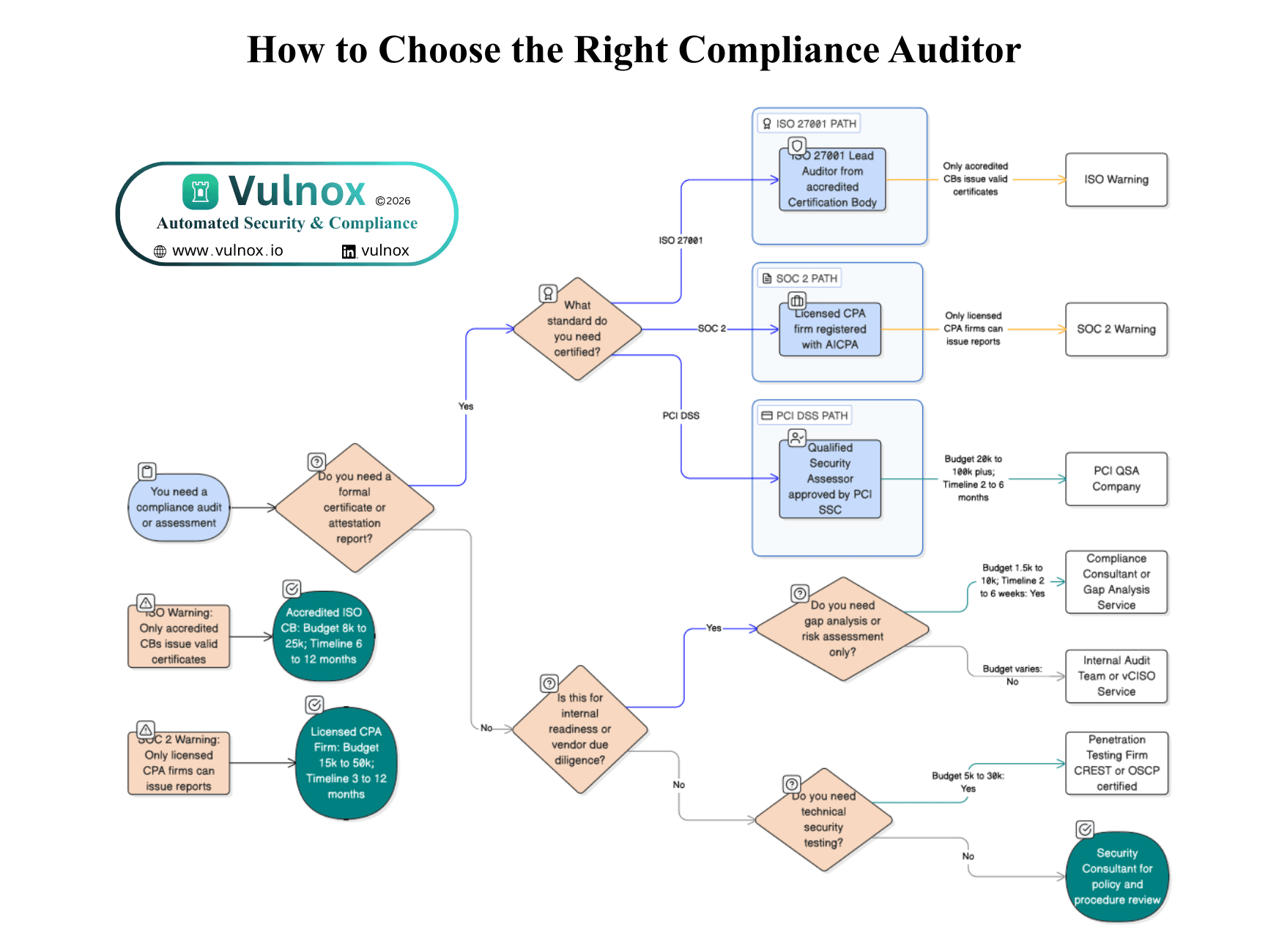
TL;DR
Choosing the wrong compliance auditor is one of the most expensive mistakes a security program can make, and it is more common than the industry acknowledges. The auditor selection decision is not a single question , it is a branching decision tree that starts with whether you need a formal certificate or attestation report, then resolves to framework-specific credentialing requirements that are non-negotiable by design. ISO 27001 certification is only valid when issued by an ISO-accredited Certification Body; SOC 2 reports are only valid when issued by a licensed CPA firm registered with the AICPA; PCI DSS Reports on Compliance are only valid when conducted by a Qualified Security Assessor approved by the PCI Security Standards Council. For organizations that do not need formal certification , those seeking gap analysis, internal readiness assessment, vendor due diligence, or technical security testing , the credentialing requirements are different and the budget and timeline parameters differ substantially. Getting this decision right at the start determines whether your compliance investment produces a usable artifact or requires a complete restart with a credentialed provider.
The compliance auditor market in 2026 is more fragmented and more difficult to navigate than it was five years ago. The expansion of mandatory compliance obligations , EU AI Act high-risk system requirements, NIS2 Directive Article 21 security measure obligations, DORA ICT risk management requirements for financial entities, CMMC 2.0 third-party assessment requirements for defense contractors, and the continued proliferation of state-level privacy laws , has generated significant demand for compliance services and attracted a correspondingly diverse supply of providers with highly variable credentials, methodologies, and quality. The practical consequence for buyers of compliance services is that the credential verification step, which many organizations treat as a formality, has become a genuine risk management decision. An ISO 27001 certificate issued by a non-accredited body has no market recognition and no legal standing as evidence of conformity. A SOC 2 report issued by a firm that is not a licensed CPA practice registered with the AICPA is not a SOC 2 report in any meaningful sense , it is an assessment document that uses SOC 2 terminology without the professional accountability framework that gives SOC 2 its value to enterprise customers and regulators. Understanding the credentialing requirements for each major framework, and the assessment pathways available for organizations that do not need formal certification, is the foundational knowledge for making auditor selection decisions that produce durable compliance outcomes.
The most operationally consequential insight in compliance auditor selection is that the formal certification frameworks , ISO 27001, SOC 2, and PCI DSS , each have a legally and institutionally defined auditor credential that cannot be substituted. These credentials exist because the value of the certification artifact depends entirely on the accountability structure that the credentialing body imposes on the auditor. An ISO 27001 certificate derives its market value from the International Accreditation Forum multilateral recognition arrangement, which means a certificate issued by an IAF-accredited Certification Body is recognized in every IAF member country without additional verification. A SOC 2 report derives its professional reliability from the AICPA attestation standards , AT-C Section 205 , and the professional liability that licensed CPA firms carry for the opinions they issue. A PCI DSS Report on Compliance derives its regulatory standing from the PCI SSC QSA qualification and oversight program. Remove the credentialing layer and you remove the institutional foundation that gives the artifact its function.
The First Branch: Certificate or Attestation Report Versus Everything Else
The first and most consequential decision in compliance auditor selection is whether the organization needs a formal certificate or attestation report as the output of the engagement. This question is more nuanced than it appears. Organizations that need ISO 27001 certification for enterprise customer procurement requirements, regulatory recognition, or market positioning need a certificate issued by an accredited Certification Body , there is no functional substitute. Organizations that need SOC 2 reports to satisfy enterprise customer security questionnaire requirements, investor due diligence requirements, or contractual security obligations need a SOC 2 Type I or Type II report issued by a licensed CPA firm , no other document satisfies those requirements. Organizations that need PCI DSS Report on Compliance for Level 1 merchant or service provider validation need a QSA-conducted assessment , self-assessment questionnaires are not available at Level 1 transaction volumes.
The organizations that do not need formal certification represent the majority of compliance assessment buyers in 2026, and for them the auditor selection decision flows through a completely different set of criteria. Internal readiness assessments, vendor due diligence reviews, gap analyses against NIST CSF, ISO 27002, NIST 800-53, or NIS2 requirements, vCISO engagements, and technical security testing programs do not require the specific credentials that formal certification frameworks mandate , but they do require different competencies, methodologies, and quality indicators that buyers frequently do not evaluate rigorously enough. A gap analysis conducted by a firm without practitioners holding CISSP, CISA, or relevant framework-specific credentials against a control framework the firm has limited experience assessing produces findings that may be incomplete, incorrectly prioritized, or inconsistent with how the framework is interpreted by actual assessors , which creates remediation work based on flawed analysis rather than genuine gaps.
ISO 27001 Path: Accredited Certification Bodies and What Accreditation Actually Means
ISO 27001 certification requires an audit conducted by an ISO 27001 Lead Auditor employed by or contracted to a Certification Body that holds accreditation from a national accreditation body that is a member of the International Accreditation Forum. In the United States, ANAB and A2LA are the primary accreditation bodies. In the UK, UKAS issues CB accreditation. In Germany, DAkkS. The accreditation status of the CB is the quality assurance mechanism for the entire ISO 27001 certification market , accredited CBs undergo regular surveillance assessments by their accreditation body, their auditor competency is verified, their audit methodologies are evaluated, and their certification decisions are subject to oversight. A certificate issued by a non-accredited CB does not carry IAF multilateral recognition, will not satisfy enterprise procurement requirements that specifically require ISO 27001 certification from an accredited CB, and may not be accepted by regulators that reference ISO 27001 as a compliance pathway.
The budget and timeline parameters for ISO 27001 certification through an accredited CB , typically 8,000 to 25,000 USD for the certification audit itself, with a six to twelve month timeline from gap analysis initiation to certificate issuance , reflect the structured two-stage audit process that ISO 17021, the standard governing management system certification bodies, requires. Stage 1 is the documentation review , the CB auditor assesses the organization Statement of Applicability, risk assessment methodology, risk treatment plan, and management system documentation for readiness before the Stage 2 on-site audit. Stage 2 is the conformity assessment , the auditor evaluates whether the implemented controls satisfy the ISO 27001 requirements and the controls selected in the Statement of Applicability. The timeline variance within the six to twelve month range is driven primarily by the maturity of the organization existing security controls at the point gap analysis begins, the scope of the ISMS being certified, and the remediation capacity the organization can deploy between gap analysis findings and Stage 1 audit. Organizations that attempt to compress the timeline by skipping or abbreviating gap analysis and remediation consistently encounter Stage 1 or Stage 2 findings that extend the timeline beyond what the original compression was intended to save.
SOC 2 Path: AICPA Registration, CPA Licensing, and Why the AT-C 205 Framework Matters
SOC 2 reports are governed by the AICPA Statement on Standards for Attestation Engagements , SSAE 18 , and specifically by AT-C Section 205, which covers examination engagements. The professional standard requirement is unambiguous: SOC 2 reports must be issued by a CPA firm that is licensed to practice public accounting in the jurisdiction where it operates and registered with the AICPA. The firm must have a quality control system that meets AICPA standards, and the engagement partner must hold an active CPA license. This is not a market convention , it is a professional standards requirement that determines whether the document produced is a SOC 2 report in the technical and legal sense or an assessment document that uses SOC 2 terminology without the professional accountability structure. The practical consequence for buyers is that any firm offering SOC 2 assessments that is not a licensed CPA practice registered with the AICPA cannot produce a valid SOC 2 report , it can produce a readiness assessment, a gap analysis against the AICPA Trust Service Criteria, or a pre-audit assessment, but the resulting document cannot be represented as a SOC 2 report to enterprise customers or regulators.
The budget range for a SOC 2 Type II examination , 15,000 to 50,000 USD with a three to twelve month timeline depending on organization complexity, scope of Trust Service Categories included, and observation period length , reflects the professional liability that licensed CPA firms carry for the opinions they issue. A SOC 2 Type II report contains a professional opinion from the CPA firm on whether the organization controls were suitably designed and operating effectively throughout the observation period. That opinion carries professional liability under AICPA standards and state CPA licensing law , the firm and the engagement partner can face professional sanctions, license revocation, and civil liability for opinions that do not meet professional standards. This accountability structure is the foundation of SOC 2 value to enterprise customers: when a customer receives a SOC 2 Type II report, they are receiving a professionally accountable opinion from a licensed firm, not a self-assessment or a report from an unaccountable advisory practice. In 2026, with SOC 2 increasingly required as a baseline vendor security qualification by enterprise procurement teams and embedded in Master Service Agreement security exhibits, the distinction between a valid SOC 2 report and an assessment document that resembles one has material commercial consequences.
PCI DSS Path: QSA Credentials, Budget Realities, and the v4.0.1 Assessment Landscape
PCI DSS assessments conducted by Qualified Security Assessors are required for Level 1 merchants processing more than six million Visa or Mastercard transactions annually and for Level 1 service providers. The QSA credential is issued by the PCI Security Standards Council, and only QSA-employed assessors working for PCI SSC-approved QSA Companies can produce a valid Report on Compliance. The PCI SSC maintains a public list of approved QSA Companies on its website , verifying that a prospective assessor firm appears on this list before engagement is a baseline due diligence step that a surprising number of organizations skip. The budget range for a PCI DSS QSA assessment , 20,000 to 100,000 USD or more, with a two to six month assessment timeline , reflects the scope of the assessment environment, the number of systems in scope, the complexity of the cardholder data environment network architecture, and whether the organization has invested in scope reduction through network segmentation.
The PCI DSS v4.0.1 assessment landscape in 2026 is defined by the March 2025 deadline that made all future-dated requirements from PCI DSS v4.0 mandatory. Requirements that were listed as best practices during the 2022 to 2025 transition period are now full assessment requirements, including Requirement 6.4.1 mandating automated technical solutions to detect and protect against web-based attacks on payment pages, Requirement 10.7.1 mandating detection of failures of critical security control systems, and Requirement 11.6.1 mandating a change and tamper detection mechanism for payment page HTTP headers and scripts. Organizations whose QSA assessments were conducted before March 2025 against the transitional requirement set are operating against an outdated assessment , their current Report on Compliance does not reflect the full v4.0.1 requirement set, and their next assessment will include requirements that may not yet be implemented. QSA firms with strong PCI DSS v4.0.1 assessment experience are the appropriate choice for organizations entering their first full-scope v4.0.1 assessment cycle.
The Non-Certification Paths: Gap Analysis, Readiness, Due Diligence, and Technical Testing
Organizations that need compliance assessment services but do not need formal certification have four primary pathways, each with distinct provider requirements, budget parameters, and appropriate use cases. Gap analysis and risk assessment services , budget range 1,500 to 10,000 USD with a two to six week timeline for focused engagements , are appropriate for organizations preparing for formal certification, assessing their posture against a new regulatory framework such as NIS2 or EU AI Act, or conducting internal readiness evaluation before a formal audit. The quality differentiator for gap analysis providers is framework-specific assessment experience and practitioner credentials , CISA for audit-oriented assessments, CISSP for security architecture-oriented assessments, and framework-specific credentials such as ISO 27001 Lead Auditor for gap analyses intended to prepare for ISO 27001 certification. A gap analysis conducted by practitioners who have not personally conducted or supported formal assessments against the target framework will systematically underestimate the evidence requirements and control maturity thresholds that formal assessors apply.
Internal audit team support and vCISO services , budget varies significantly based on scope and engagement model , are appropriate for organizations that need ongoing compliance program management rather than point-in-time assessment. The vCISO engagement model has matured substantially since 2020, and in 2026 the leading vCISO providers combine compliance program management with continuous control monitoring capabilities that provide real-time visibility into control effectiveness rather than annual point-in-time assessment snapshots. Penetration testing firms for technical security testing , budget range 5,000 to 30,000 USD for scoped engagements , should be evaluated on the basis of CREST membership or OSCP-certified practitioner credentials, as these credentials represent the closest thing to a quality assurance standard that exists in the penetration testing market. CREST-accredited firms undergo organizational quality assessments and their practitioners must pass rigorous technical examinations , the CREST credential provides meaningful assurance about technical methodology quality that self-described penetration testing firms without accreditation cannot offer. For organizations that need security policy and procedure review without technical testing, a security consultant with GRC specialization and documented experience implementing the target frameworks is the appropriate provider type.
Pro tip
Before engaging any ISO 27001 Certification Body, verify their accreditation status directly through the IAF CertSearch database at certificationSearch.iaf.nu or through the accreditation body in their country of registration. Do not rely on the CB own website claim of accreditation , the IAF CertSearch query takes two minutes and provides authoritative confirmation of accreditation scope, including whether the CB holds accreditation specifically for ISO 27001 in the relevant industry sector codes. Some CBs hold accreditation for ISO 27001 in specific industry sectors but not others, and an assessment conducted outside the CB accredited scope produces a certificate that may not be recognized for your industry sector.
Pro tip
When evaluating SOC 2 CPA firms, request the firm AICPA peer review report before engagement. AICPA peer review is a mandatory quality program for CPA firms that issue attest reports , firms must undergo peer review every three years, and the peer review report is a public document that assesses whether the firm quality control system meets AICPA standards. A firm that cannot produce its most recent peer review report or that has received a peer review report with significant findings is a material quality risk for a SOC 2 engagement. This single document request screens out the substantial number of firms that represent themselves as SOC 2 providers without the professional quality infrastructure that SOC 2 engagements require.
Compliance auditor selection in 2026 is a structured decision with framework-specific credentialing requirements that are non-negotiable for formal certification pathways and competency requirements that are critical for non-certification assessment pathways. The decision branches are clear: ISO 27001 certification requires an IAF-accredited Certification Body; SOC 2 attestation requires an AICPA-registered licensed CPA firm; PCI DSS Level 1 assessment requires a PCI SSC-approved QSA Company. For organizations that need gap analysis, readiness assessment, vCISO support, or technical security testing, the appropriate provider depends on the target framework, the organization risk profile, and the intended use of the assessment output. Vulnox gap analysis engagements are conducted by practitioners with direct experience supporting formal certification assessments across SOC 2, ISO 27001, HIPAA, NIS2, CMMC, and NIST CSF , which means the findings from a Vulnox gap analysis reflect the evidence standards and control maturity thresholds that formal assessors apply, not a generic interpretation of framework language that leaves organizations underprepared for the certification engagement that follows.
Further Reading
Gap Analysis
gap analysisVulnerability Assessment
vulnerability assessmentAICPA SOC Suite of Services and CPA Firm Requirements
AICPA SOC 2 attestation standardsPCI SSC Qualified Security Assessor Program
PCI SSC Qualified Security Assessor programIAF CertSearch Accredited Certification Body Registry
IAF CertSearch accreditation registry
Frequently Asked Questions
What credentials must a compliance auditor have to issue a valid SOC 2 report?
A valid SOC 2 report can only be issued by a CPA firm that holds an active license to practice public accounting in its operating jurisdiction and is registered with the AICPA. This requirement flows from SSAE 18 and AT-C Section 205, the AICPA attestation standards that govern SOC 2 examinations. The engagement partner must hold an active CPA license, and the firm must maintain a quality control system that meets AICPA standards, including participation in the mandatory AICPA peer review program every three years. Firms that are not licensed CPA practices — including technology consulting firms, cybersecurity advisory firms, and managed security service providers — cannot produce a valid SOC 2 report regardless of their technical expertise or the depth of their assessment methodology. Documents produced by non-CPA firms that use SOC 2 terminology and Trust Service Criteria structure are assessment reports, not SOC 2 reports, and will not satisfy enterprise customer, investor, or regulatory requirements that specifically require a SOC 2 attestation. Buyers can verify firm credentials by requesting the firm AICPA peer review report and confirming CPA licensure in the firm state of registration.
How do you verify that an ISO 27001 Certification Body is properly accredited?
ISO 27001 Certification Body accreditation should be verified directly through the IAF CertSearch database, which is the authoritative public registry of accredited certification bodies maintained by the International Accreditation Forum. The search returns the CB accreditation status, the accreditation body that issued the accreditation, the scope of accreditation including the standards and industry sector codes covered, and the accreditation validity period. In the United States, accreditation is issued by ANAB or A2LA. In the UK, UKAS issues CB accreditation. A certificate issued by a CB that does not appear in the IAF CertSearch database with current accreditation status for ISO 27001 in the relevant industry sector is not a valid ISO 27001 certificate under the IAF multilateral recognition arrangement and will not be recognized by enterprise procurement teams that require accredited certification or by regulators that reference ISO 27001 as a compliance pathway. CB accreditation scope matters as well — some CBs hold accreditation for ISO 27001 in specific industry sectors but not others, and organizations should confirm that the CB scope covers their industry before engagement.
When does a company need a QSA for PCI DSS versus a self-assessment questionnaire?
PCI DSS validation methodology is determined primarily by transaction volume and entity type. Level 1 merchants — those processing more than six million Visa or Mastercard transactions annually — and Level 1 service providers are required to complete an annual Report on Compliance conducted by a PCI SSC-approved Qualified Security Assessor Company. Self-Assessment Questionnaires are available to merchants at lower transaction volume thresholds, and the specific SAQ form applicable depends on the payment processing architecture — SAQ A for fully outsourced card-not-present merchants, SAQ B for imprint machine or standalone dial-out terminal merchants, SAQ D for all other merchants and service providers not requiring a QSA ROC. Organizations that incorrectly use a SAQ when their transaction volume or service provider status requires a QSA ROC are out of compliance with card brand validation requirements regardless of how thoroughly they complete the SAQ. The PCI SSC maintains a public list of approved QSA Companies that organizations should verify before engaging any firm for a PCI DSS assessment — QSA Company approval status should be confirmed at the time of engagement rather than relying on historical approval that may have lapsed.
Related Articles
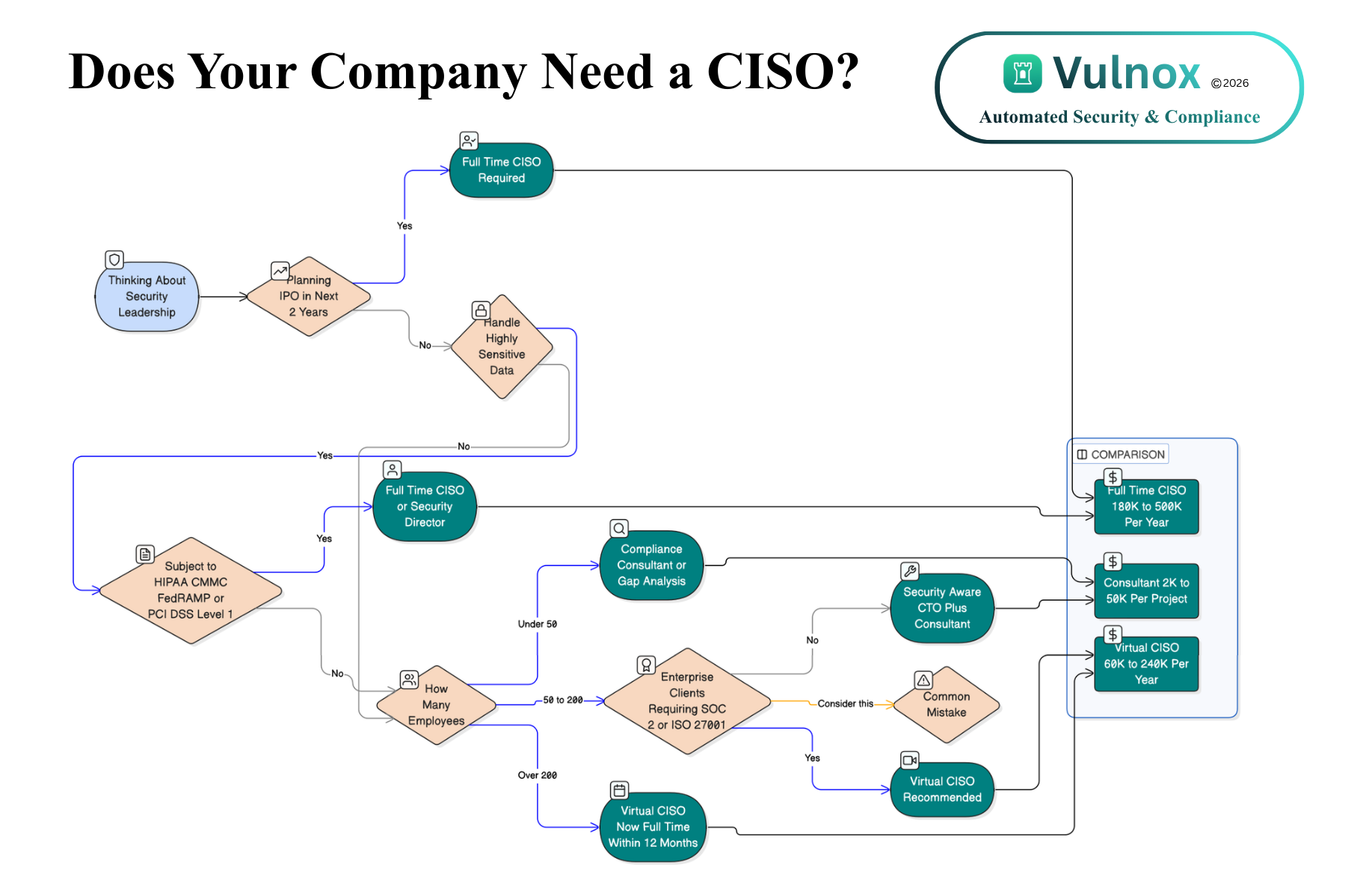
Does Your Company Need a CISO? The Complete Decision Guide
The CISO decision is not a hiring question — it is a risk governance question. Full-time CISO, virtual CISO, or compliance consultant: each model serves a specific company profile, and the $180K to $500K annual cost gap between them is dwarfed by the cost of choosing wrong. This guide maps the complete decision logic so you arrive at the right answer before a regulatory inquiry or a lost enterprise deal makes it for you.
Ready to Secure Your Digital Assets?
Get a comprehensive vulnerability assessment for your website today.