Your Company Just Got Hit by Ransomware: What Now

TL;DR
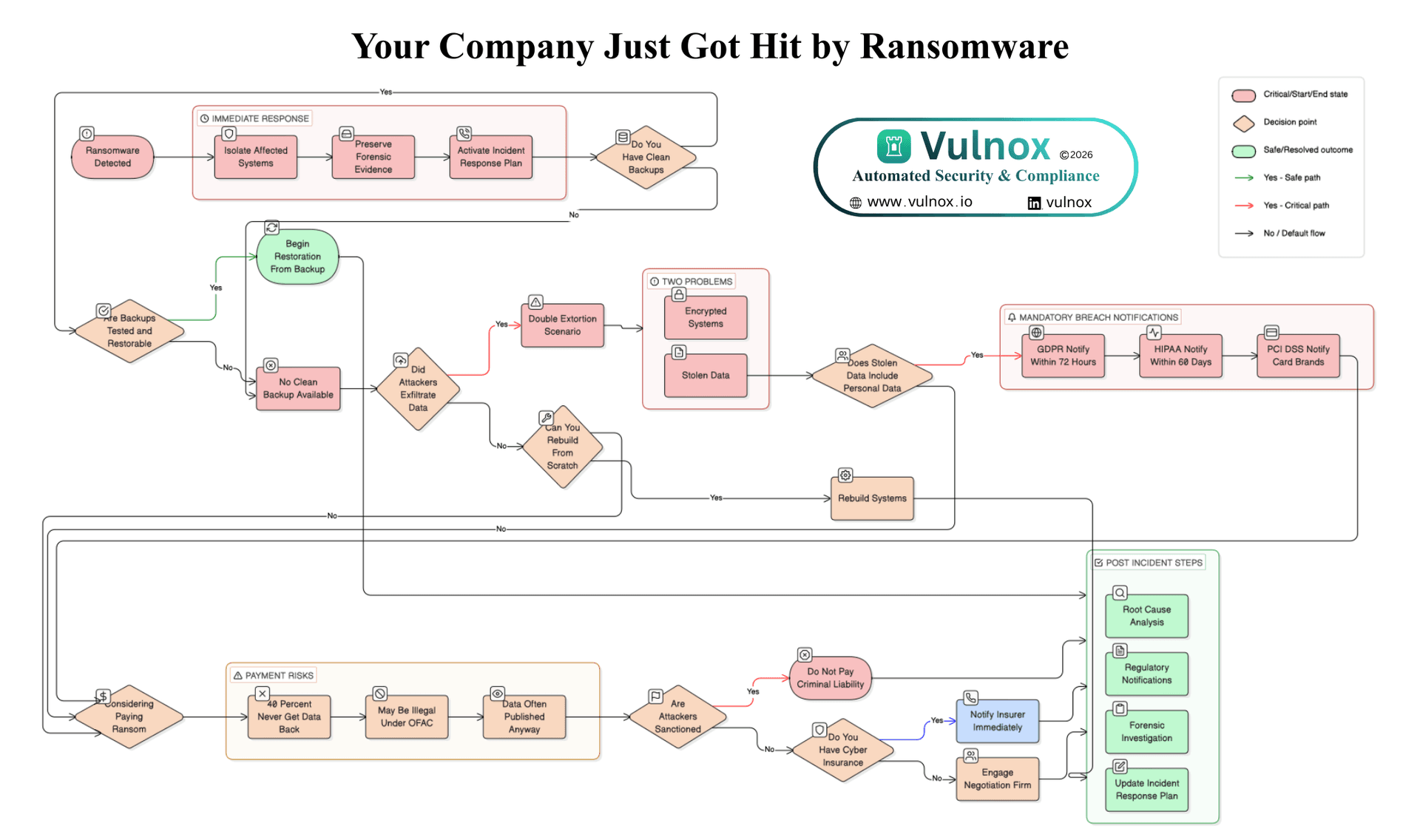
A ransomware attack in 2026 is not a single crisis , it is four simultaneous crises that must be managed in parallel: a technical recovery crisis, a regulatory notification crisis, a legal liability crisis, and a ransom payment decision crisis. The technical response sequence is well understood , isolate affected systems, preserve forensic evidence, activate the incident response plan, assess backup integrity, and begin restoration or rebuild. What most organizations are not operationally prepared for is the simultaneous activation of mandatory breach notification obligations under GDPR, HIPAA, and PCI DSS the moment exfiltrated data is confirmed to include personal information, the OFAC sanctions screening obligation that attaches before any ransom payment decision is made, and the cyber insurance notification requirement that conditions coverage on timely insurer engagement. Getting the technical response right while failing the regulatory or legal response tracks produces outcomes that are worse than the ransomware attack itself: regulatory enforcement action, insurance coverage denial, and potential criminal liability for sanctions violations that occur when ransom is paid to a designated threat actor group without the required OFAC analysis.
The ransomware threat landscape in 2026 has matured in two directions that compound the compliance burden on breached organizations. Technically, the dominant attack pattern shifted definitively to double extortion beginning around 2020 and has since evolved toward triple extortion models in which attackers encrypt systems, exfiltrate data for threatened publication, and simultaneously conduct denial-of-service attacks against the victim organization to maximize pressure for ransom payment. Legally and regulatorily, the sanctions enforcement environment has intensified significantly: OFAC has designated multiple ransomware threat actor groups and cryptocurrency infrastructure providers under the Cyber-Related Sanctions Program, and the October 2020 OFAC advisory on ransomware payments , updated in September 2021 , established that US persons and companies face civil penalties for ransom payments to sanctioned entities even when the payer did not know the recipient was sanctioned, applying a strict liability standard to the sanctions compliance analysis. The interaction between the technical pressure of double extortion, the regulatory pressure of mandatory breach notification timelines, and the legal pressure of OFAC sanctions screening creates a decision environment that cannot be navigated correctly without preparation, and cannot be navigated at all without legal counsel engaged from the first hours of the incident.
The most consequential architectural principle in ransomware response is that the backup integrity assessment and the data exfiltration assessment must occur simultaneously within the first hours of incident detection, because the answers to these two questions determine every subsequent decision branch. Whether clean, tested, restorable backups exist determines whether recovery without ransom payment is operationally feasible. Whether attackers exfiltrated data before deploying the encryption payload determines whether the incident is a recovery problem, a double extortion problem, or a full regulatory breach notification problem. Organizations that sequence these assessments , completing the backup assessment before beginning the exfiltration assessment , consistently discover that they have spent 24 to 48 hours on recovery planning before learning that exfiltrated personal data has already triggered GDPR notification timelines that are partially or fully expired. The parallel assessment architecture is not a best practice recommendation , it is the structural requirement that prevents the regulatory track from falling behind the technical track irreparably.
Immediate Response: The Four Actions That Must Happen Before Anything Else
Ransomware detection triggers four immediate actions that must be executed in sequence within the first hour of confirmed detection, before any other response activity begins. Isolation of affected systems , network segmentation to prevent lateral movement of the ransomware payload to unaffected systems , is the first and most time-critical action. The isolation decision must be made rapidly and conservatively: systems that might be affected should be isolated as if confirmed affected rather than remaining connected while investigation proceeds. NIST SP 800-61 Rev 2 incident handling guidance and CIS Control 17 on incident response management both emphasize that the containment phase must prioritize stopping ongoing damage over preserving operational continuity, which is the correct prioritization even when isolation of critical systems creates significant business disruption.
Forensic evidence preservation must begin immediately after isolation and before any remediation activity touches affected systems. This sequencing is operationally counterintuitive , the instinct of technical teams is to begin remediation as soon as systems are isolated , but evidence overwritten during remediation cannot be recovered, and its absence will prevent root cause analysis from reaching accurate conclusions, prevent forensic investigators from establishing the full scope of data exfiltration, and potentially prevent the organization from establishing facts that limit regulatory liability. ISO 27001:2022 Control 5.28 on collection of evidence and NIST SP 800-86 on integrating forensic techniques into incident response provide the procedural framework. Memory images of affected systems, preserved before reboot or shutdown, frequently contain decryption keys, attacker tooling artifacts, and network connection records that disk forensics alone cannot recover. Incident response plan activation , the third immediate action , must include notification of legal counsel and the DPO or privacy officer in the first hour, not as a downstream step after technical assessment is complete.
The Backup Decision Branch: Tested and Restorable Versus No Clean Backup
The backup integrity assessment is the decision branch that most directly determines the organization operational timeline and its exposure to ransom payment pressure. The assessment question is not whether backups exist , it is whether backups are tested, verified clean of the ransomware payload, and restorable to production within an operationally acceptable recovery time objective. Backups that have not been tested recently are backups of unknown quality: ransomware groups have increasingly incorporated backup targeting into their attack methodology, using the dwell time between initial access and payload deployment to identify and corrupt or encrypt backup repositories before the primary attack executes. Ransomware groups including LockBit, BlackCat, and Cl0p have documented tactics for identifying and destroying backup infrastructure during the reconnaissance phase, which means organizations that have not validated backup integrity through recent restoration testing may discover during the incident that their backup infrastructure was compromised weeks before the ransomware payload deployed.
When backups are confirmed clean and restorable, the recovery path is clear , begin restoration from backup while the parallel regulatory and forensic assessment tracks continue. The restoration-from-backup path does not close the regulatory notification track: if data was exfiltrated before the encryption payload deployed, which is the defining characteristic of double extortion attacks, the breach notification obligation is active regardless of whether systems are restored from backup. The technical recovery and the regulatory response are independent workstreams, and completing one does not satisfy or defer the other. When no clean backup is available, the organization faces a binary choice between rebuilding systems from scratch , which requires a clean environment build, data restoration from whatever partial or external sources exist, and application reconfiguration that may take weeks to months depending on environment complexity , or negotiating with the attacker, which triggers the full payment risk and sanctions compliance analysis before any payment decision can be made.
Double Extortion: The Two-Problem Scenario That Changes Everything
Double extortion ransomware attacks present two simultaneous problems that require two simultaneous response tracks: encrypted systems that prevent business operations and exfiltrated data that creates regulatory notification obligations and attacker leverage for continued extortion. The structural significance of confirmed data exfiltration is that it converts the incident from a recovery problem into a breach , with all the regulatory notification, forensic investigation, and potential enforcement consequences that attach to a personal data breach regardless of whether a ransom is paid or systems are restored. GDPR Article 33 does not distinguish between breaches caused by encryption and breaches caused by unauthorized access and exfiltration , both trigger the 72-hour supervisory authority notification obligation when personal data of EU residents is involved. The HIPAA Breach Notification Rule similarly does not provide an exception for ransomware incidents where data was exfiltrated rather than merely accessed , HHS guidance published in July 2016 and reaffirmed in subsequent OCR enforcement activity confirms that ransomware incidents involving PHI are presumptively reportable breaches unless the four-factor risk assessment affirmatively demonstrates low probability of compromise.
The exfiltration confirmation question , whether attackers actually removed data from the environment before deploying the encryption payload , is a forensic determination that takes time, and it is time that the regulatory notification clock does not pause for. The practical response architecture for double extortion incidents is to treat exfiltration as confirmed from the moment the attack is attributed to a threat actor group known to use double extortion methodology, and to begin the regulatory notification preparation track immediately on that basis. If forensic investigation subsequently establishes that exfiltration did not occur, the regulatory notification preparation work is wasted but the notification obligation is avoided. If forensic investigation confirms exfiltration after the organization delayed initiating the notification track, the GDPR 72-hour clock may have partially or fully expired before notification preparation begins. The asymmetric cost of these two outcomes , wasted preparation work versus expired notification deadline , makes the conservative assumption the only defensible operational choice.
Mandatory Breach Notifications: GDPR, HIPAA, and PCI DSS Running Simultaneously
When exfiltrated data is confirmed or presumed to include personal data, three mandatory notification frameworks activate simultaneously and operate on independent timelines that cannot be consolidated or sequenced. GDPR Article 33 requires notification to the competent supervisory authority within 72 hours of becoming aware of the breach , and in a ransomware incident where exfiltration is the triggering event, awareness is established when the organization has reasonable grounds to believe personal data of EU residents was among the exfiltrated data, not when forensic investigation conclusively quantifies the affected population. HIPAA requires notification to HHS and affected individuals within 60 calendar days of discovery, with media notification required when more than 500 residents of a single US state are affected , the 60-day timeline is longer than GDPR but it begins running from discovery, which in a ransomware incident is typically the date the ransomware payload deploys or the date exfiltration is detected, whichever is earlier. PCI DSS requires immediate notification to card brands through the acquiring bank when cardholder data is confirmed or suspected compromised , the PCI notification obligation operates on an hours timeline through the contractual mechanism of the card brand operating regulations rather than a statutory notification window.
The operational challenge of managing three simultaneous notification tracks under time pressure cannot be solved during the incident , it can only be executed during the incident if it has been designed, templated, and rehearsed before the incident. Each notification track requires different content, different recipients, different notification portals, and coordination with different external parties: the GDPR notification requires DPA portal submission with Article 33(3) content including categories and approximate numbers of affected data subjects and records, likely consequences of the breach, and measures taken; the HIPAA notification requires a specific breach notification letter to affected individuals and an HHS breach portal submission; the PCI notification requires acquirer contact and potentially PCI Forensic Investigator engagement. Organizations that enter a ransomware incident with pre-built notification templates for each framework, pre-identified DPA contacts for each EU supervisory authority relevant to their data subject population, and a pre-designated legal counsel for each jurisdiction execute these three tracks in parallel without losing time to drafting from scratch under attacker pressure.
The Ransom Payment Decision: OFAC, Insurance, and the 48 Percent Reality
The ransom payment decision is the most legally consequential decision in ransomware response, and it is one that most organizations approach with inadequate preparation for the sanctions compliance dimension. The OFAC Cyber-Related Sanctions Program has designated multiple ransomware threat actor groups, cryptocurrency mixing services, and virtual currency exchanges used by ransomware operators , designations that impose strict liability on US persons and entities that make payments to designated parties, even when the payer did not know the recipient was sanctioned at the time of payment. The September 2021 OFAC updated advisory on ransomware payments explicitly states that OFAC may impose civil penalties on those who engage in transactions with sanctioned entities regardless of whether they knew they were dealing with a sanctioned party. This strict liability standard means that sanctions screening must precede any ransom payment decision , screening the attacker group attribution against the OFAC Specially Designated Nationals list and the broader sanctions programs is not optional due diligence, it is the prerequisite to making a legally permissible payment decision.
The statistical reality of ransom payment efficacy compounds the legal risk of payment. Industry data consistently establishes that approximately 48 percent of organizations that pay ransom do not recover their data fully , decryptors provided by attackers are frequently incomplete, corrupt data during decryption, or are deliberately designed to recover only a portion of affected files to maintain attacker leverage for continued extortion. The attacker data publication threat does not reliably resolve with payment , documented cases of attackers accepting payment and subsequently publishing or selling the exfiltrated data have been reported across LockBit, Cl0p, and ALPHV operations. Payment therefore carries three simultaneous risks: potential OFAC sanctions liability if the attacker group is designated, no guarantee of data recovery or decryption, and continued extortion risk if attackers retain the exfiltrated data regardless of payment. The payment decision should be made only after legal counsel has completed the sanctions screening analysis, the cyber insurance carrier has been notified and its coverage position on ransom payment confirmed, and a professional negotiation firm has been engaged to assess whether the attacker group has a history of honoring payment commitments.
Cyber insurance notification is a separate obligation from the ransom payment decision and must occur regardless of whether ransom payment is being considered. Most cyber insurance policies impose a timely notification requirement as a condition of coverage , notification delays that the insurer can characterize as material have been used to deny or reduce coverage in documented enforcement disputes. When the attacker group is confirmed not sanctioned and ransom payment is being considered, the insurer must be notified immediately and its coverage position confirmed before payment proceeds, because many cyber insurance policies impose requirements on the payment process including insurer approval of the negotiation firm and payment mechanism. When the attacker group is confirmed sanctioned, ransom payment cannot proceed , the organization must rebuild from scratch or restore from whatever partial backup or alternative recovery mechanism is available, and the OFAC sanctions compliance analysis must be documented as the basis for the no-payment decision.
Pro tip
Test your backups against a ransomware recovery scenario specifically , not against a hardware failure scenario. Most organizations conduct backup restoration tests that verify files can be recovered from a clean backup to a clean environment. Ransomware recovery requires something different: verifying that the backup repository itself was not compromised during the attacker dwell period, verifying that the backup can be restored to an isolated environment without reintroducing the ransomware payload, and verifying that the restoration timeline meets the organization recovery time objective under conditions where the production environment cannot be used during restoration. NIST SP 800-184, the Guide for Cybersecurity Event Recovery, provides the framework for ransomware-specific recovery testing. Organizations that conduct ransomware tabletop exercises that include the backup recovery path , with an explicit test of backup isolation, integrity verification, and restoration timeline , discover gaps in their recovery architecture before a ransomware incident reveals them under operational pressure.
Pro tip
Establish your OFAC sanctions screening process for ransomware attacker attribution before you need it, and document the process in your incident response plan. The OFAC advisory on ransomware payments identifies that voluntary self-disclosure of potential sanctions violations, implementation of a sanctions compliance program, and cooperation with OFAC are significant mitigating factors in civil penalty determinations , which means having a documented sanctions screening process that was followed provides meaningful legal protection even in ambiguous attacker attribution situations. The screening process should include: identifying the threat actor group from forensic indicators, checking the group against the OFAC SDN list and Cyber-Related Sanctions Program designations, consulting legal counsel on any ambiguous attribution, and documenting the screening analysis and its conclusions before any payment decision is made. The OFAC SDN list search tool is publicly available and the search itself takes minutes , the documentation that demonstrates the search was conducted and the methodology that was applied is what transforms the search into a sanctions compliance artifact.
Ransomware response in 2026 requires an incident response architecture that treats the technical recovery track, the regulatory notification track, the forensic investigation track, and the legal and payment decision track as four simultaneous workstreams that activate at detection and run in parallel through resolution. The decision branches , backup integrity, data exfiltration, personal data involvement, attacker sanctions status, cyber insurance coverage , cannot be resolved sequentially under time pressure from a standing start. They can only be executed correctly if the decision logic, the pre-built notification templates, the OFAC screening process, the pre-selected forensic investigator and negotiation firm relationships, and the cyber insurance notification protocol have been embedded in the incident response plan before the ransomware deploys. Vulnox gap analysis assessments evaluate ransomware response readiness against NIST SP 800-61, ISO 27001:2022 incident management controls, HIPAA Security Rule administrative safeguard requirements, and GDPR Article 32 organizational measure obligations , identifying the specific gaps in backup architecture, notification template completeness, and legal response protocol that determine whether a ransomware incident is resolved as a contained operational disruption or escalates into a multi-front regulatory enforcement matter.
Further Reading
Gap Analysis
gap analysisVulnerability Assessment
vulnerability assessmentOFAC Updated Advisory on Potential Sanctions Risks for Facilitating Ransomware Payments
OFAC advisory on ransomware payment sanctions risksHHS OCR Ransomware and HIPAA Fact Sheet
HHS OCR ransomware and HIPAA guidanceNIST SP 800-184 Guide for Cybersecurity Event Recovery
NIST SP 800-184 cybersecurity event recovery guide
Frequently Asked Questions
Does paying ransom violate OFAC sanctions laws and what is the legal risk?
Paying ransom to a ransomware threat actor group that has been designated under the OFAC Cyber-Related Sanctions Program constitutes a sanctions violation subject to civil penalties under a strict liability standard — meaning the payer can face penalties even if they did not know the recipient was sanctioned at the time of payment. OFAC has designated multiple ransomware groups including Evil Corp, Lazarus Group, and infrastructure providers used by ransomware operators. The September 2021 OFAC updated advisory on ransomware payments established that US persons and entities face this strict liability exposure and identified that voluntary self-disclosure, implementation of a documented sanctions compliance program, and cooperation with OFAC are significant mitigating factors that can reduce penalty severity. The practical consequence is that sanctions screening — checking the attacker group attribution against the OFAC SDN list and Cyber-Related Sanctions Program designations — must occur before any ransom payment decision is made, and the screening analysis and its conclusions must be documented as a compliance artifact. Legal counsel with sanctions expertise should conduct or supervise this screening in any significant ransomware incident, because attacker attribution is frequently ambiguous and the legal analysis of ambiguous attribution cases requires sanctions law expertise that most internal legal teams do not possess.
When does a ransomware attack trigger GDPR breach notification obligations?
A ransomware attack triggers GDPR Article 33 supervisory authority notification obligations when the attack involves personal data of EU residents and meets the threshold of a personal data breach — defined under GDPR Article 4(12) as a breach of security leading to accidental or unlawful destruction, loss, alteration, unauthorised disclosure of, or access to, personal data. In a double extortion ransomware attack, both the encryption of systems containing personal data and the exfiltration of that data independently satisfy this definition. The EDPB Guidelines 01/2021 on examples regarding personal data breach notification confirm that ransomware attacks affecting personal data are notifiable breaches unless the controller can demonstrate that the breach is unlikely to result in a risk to the rights and freedoms of natural persons — a threshold that is difficult to meet when data exfiltration is confirmed or suspected. The 72-hour notification clock runs from the point the controller has reasonable grounds to believe personal data was involved, not from forensic confirmation of the full scope of affected data. Controllers should treat the conservative assumption of personal data involvement as the trigger for initiating notification preparation, supplementing the initial notification with additional information as the forensic investigation progresses under the Article 33(4) phased notification mechanism.
What should a ransomware incident response plan include to satisfy NIST and ISO 27001 requirements?
A ransomware incident response plan that satisfies NIST SP 800-61 Rev 2 incident handling guidance and ISO 27001:2022 incident management controls — specifically Controls 5.24 through 5.28 covering incident management planning, assessment, response, learning, and evidence collection — must address the full ransomware response lifecycle across technical, regulatory, legal, and communications dimensions. The technical track must include network isolation procedures, forensic evidence preservation sequencing that occurs before remediation, backup integrity verification procedures specific to ransomware scenarios, and rebuild-from-scratch procedures for environments where clean backups are unavailable. The regulatory track must include pre-built GDPR Article 33 notification templates for each relevant supervisory authority, HIPAA breach notification letter templates, HHS portal submission procedures, and PCI DSS acquirer notification scripts. The legal track must include a documented OFAC sanctions screening process for attacker attribution, pre-designated legal counsel with sanctions expertise, and a cyber insurance notification protocol with contact information and coverage confirmation procedures. The plan must also identify a pre-selected PCI Forensic Investigator from the PCI SSC approved list and a pre-vetted ransomware negotiation firm for scenarios where payment is being considered. NIST SP 800-184 on cybersecurity event recovery provides the additional framework for ransomware-specific backup testing and recovery planning that supplements the general incident handling guidance in NIST SP 800-61.
Related Articles
Vulnerability assessment vs penetration testing cost: what you are actually buying
Real technical and cost difference between vulnerability assessment and penetration testing. What each finds, what neither catches, and the right sequence.
Ready to Secure Your Digital Assets?
Get a comprehensive vulnerability assessment for your website today.