The 7 Security Framework Bundles Every Business Must Know
 Julian ThorneFebruary 20, 2026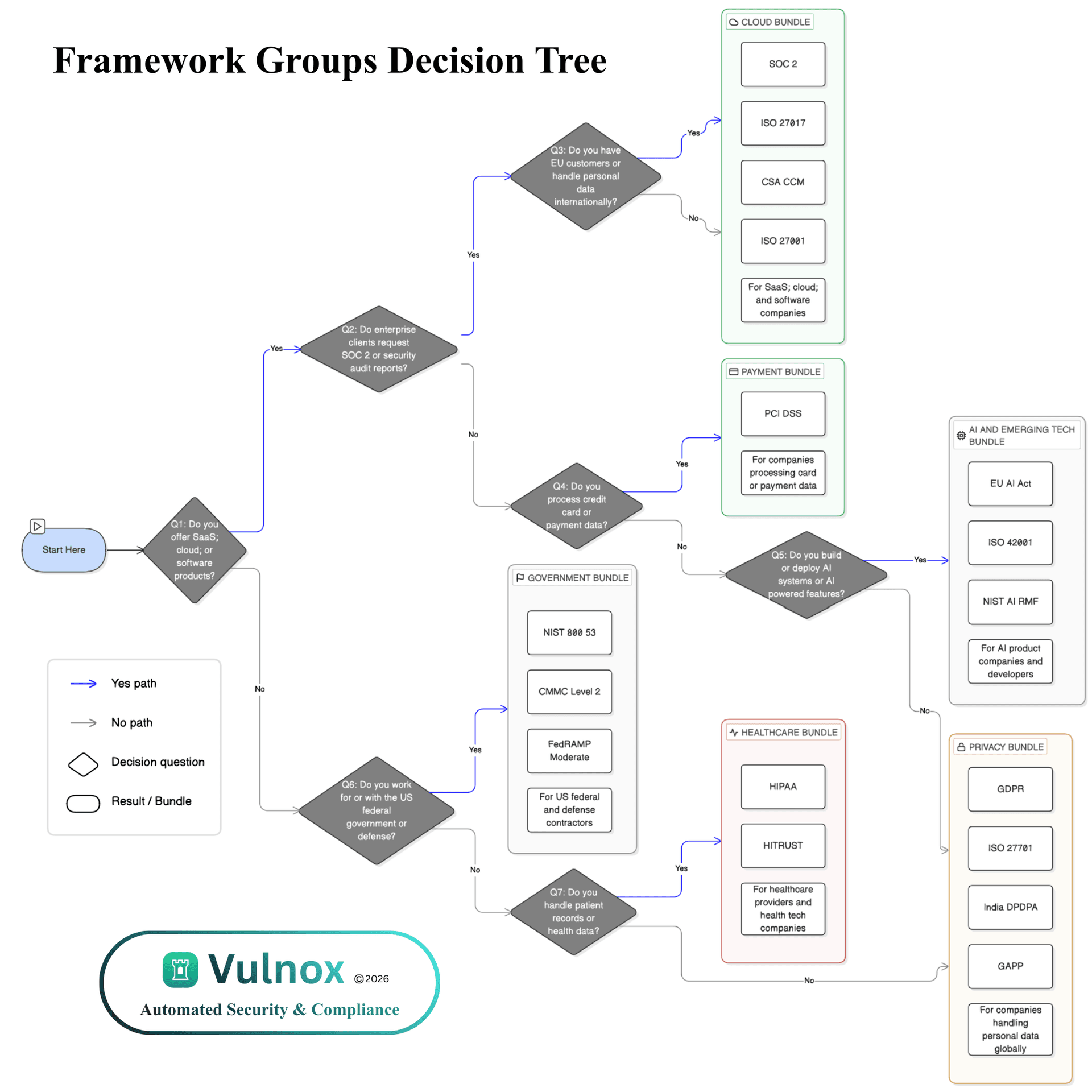
TL;DR
Most compliance programs fail not because organizations lack resources but because they start with the wrong framework. The seven framework bundles , Cloud, Payment, Government, AI and Emerging Tech, Healthcare, Privacy, and a global Privacy baseline , each apply to a distinct business model profile, and the branching logic that determines which bundle you land in comes down to seven questions about what your company does, who it sells to, and what kind of data it processes. Selecting the wrong bundle at the outset means auditors will surface gaps that a properly scoped program would have addressed from day one.
Every six months, a version of the same conversation happens inside companies preparing for their first serious compliance program. Someone in leadership has decided the company needs SOC 2. Someone in legal thinks GDPR is the priority. Someone in sales has a customer asking for HIPAA attestation. And the security team is trying to figure out how to satisfy all three with a team of two people and a budget approved before anyone understood what any of these frameworks actually require. The underlying problem is almost never resource scarcity. It is the absence of a structured framework selection methodology that maps the company actual business model , what it builds, who it sells to, what data it processes, and what regulatory environment it operates in , to the specific compliance obligations those facts generate. Framework selection is not a matter of picking the most prestigious certification. It is a diagnostic process, and when that diagnosis is wrong, every subsequent investment in controls, policies, and audit preparation is partially misdirected.
The seven compliance bundle architecture is not a taxonomy of certifications to collect. It is a map of regulatory exposure by business model, and the most important insight it surfaces is that the majority of companies operating with any complexity sit inside two or three bundles simultaneously, which means their gap analysis must address the intersection of those bundles rather than treating each as an independent workstream.
Key takeaway
A compliance program designed around a single framework bundle will satisfy auditors until the moment a customer, regulator, or enterprise procurement team from outside that bundle scope asks a question it was not designed to answer. The organizations that maintain compliance across multi-bundle exposure without proportional cost increases are the ones who mapped the intersection of all applicable bundles before writing a single policy.
The First Branch: SaaS, Cloud, and Software Products Change Everything
The entire framework selection logic begins with a single question that sounds deceptively simple: does your company offer SaaS, cloud, or software products? The reason this question sits at the root of the decision tree is that software and cloud businesses have a fundamentally different compliance exposure than traditional enterprises. They process customer data continuously at scale, they operate infrastructure that other companies depend on, and their enterprise clients routinely require evidence of security controls as a condition of doing business. A manufacturing company and a SaaS platform can both process payment data, but the SaaS platform compliance obligations are shaped primarily by the fact that it is a software business first, and everything else follows from that foundational characteristic.
For companies that answer yes to the SaaS question, the next branch is Q2: do enterprise clients request SOC 2 or security audit reports? This question is not asking whether SOC 2 is legally required , it almost never is in a strict statutory sense. It is asking whether your commercial reality demands it. Enterprise procurement teams at Fortune 500 companies, regulated financial institutions, and healthcare systems have standardized on SOC 2 Type II as the minimum security attestation they will accept from software vendors. Companies that cannot produce a current SOC 2 Type II report are disqualified from a growing percentage of enterprise deals regardless of how mature their security program actually is. The answer to Q2 for most SaaS companies with enterprise ambitions is yes, which routes them into either the Cloud Bundle or the Payment Bundle depending on whether payment card data is in scope.
The Cloud Bundle , SOC 2, ISO 27017, CSA Cloud Controls Matrix, and ISO 27001 , is designed for SaaS, cloud, and software companies that have enterprise clients, handle personal data internationally or have EU customers, and do not primarily process payment card data. SOC 2 provides the trust services criteria attestation that enterprise procurement demands. ISO 27001:2022 provides the internationally recognized information security management system certification that European and Asian enterprise clients expect alongside or instead of SOC 2. ISO 27017:2015 extends the ISO 27001 control set specifically to cloud service providers and cloud service customers, addressing cloud-specific risks that base ISO 27001 Annex A does not fully cover , including virtual machine hardening, cloud administration tool controls, and segregation in virtual computing environments. CSA Cloud Controls Matrix v4 provides the cloud security assurance framework that maps directly to both ISO 27017 and SOC 2, enabling organizations to satisfy multiple framework requirements from a unified control set rather than building separate programs for each standard.
Payment Processing, Government Work, and the Bundles With No Flexibility
The Payment Bundle occupies a special position in the framework landscape because PCI DSS is not a voluntary standard , it is a contractual obligation imposed by the card brands through payment processor agreements. Any company that processes, stores, or transmits cardholder data is subject to PCI DSS regardless of size, industry, or geographic location. PCI DSS v4.0.1, which became the only valid version in March 2024 when v3.2.1 was retired, introduced 64 new requirements , 13 effective immediately upon adoption and 51 future-dated requirements that became mandatory in March 2025. The March 2025 deadline has now passed, meaning all 64 requirements are mandatory for any organization completing a current PCI DSS assessment. Companies that completed their last assessment under v3.2.1 and have not assessed against v4.0.1 are operating with an expired compliance posture regardless of what their last QSA report says.
The new v4.0.1 requirements most commonly found as gaps during assessment include the targeted risk analysis methodology, which replaces prescriptive frequency requirements from v3.2.1 with a risk-based approach that organizations must document and justify. Requirement 6.4.1 mandates automated technical solutions for detecting and protecting against web-based attacks on payment pages, effectively requiring WAF or equivalent technology for all entities with e-commerce payment flows. Requirement 8.4.2 mandates multi-factor authentication for all access into the cardholder data environment, removing the previous exception for personnel with access only to one cardholder data element. These are not minor administrative updates , they require infrastructure changes, vendor procurement, and documented risk analysis processes that organizations cannot retrofit in weeks.
The Government Bundle , NIST 800-53, CMMC Level 2, and FedRAMP Moderate , applies to companies working for or with the US federal government or defense sector, and it represents the most technically demanding compliance profile in the entire framework group architecture. CMMC Level 2 corresponds to the 110 practices from NIST SP 800-171, and the shift from self-attestation to third-party C3PAO assessment for most Level 2 contractors , formalized in the CMMC final rule published in October 2024 , has fundamentally changed what it costs and how long it takes to achieve CMMC certification. FedRAMP Moderate authorization requires achieving 325 controls from NIST 800-53 Rev 5 at the moderate baseline, a process that typically takes 12 to 18 months with a 3PAO and costs between $500,000 and $2 million depending on the cloud service architecture. Companies that enter the defense contracting market without understanding the Government Bundle full scope consistently underestimate their compliance investment by an order of magnitude.
AI and Emerging Tech: The Newest Bundle and the Most Rapidly Changing
The AI and Emerging Tech Bundle , EU AI Act, ISO 42001, and NIST AI RMF , is the newest framework group in the compliance landscape and the one with the most active regulatory development. The EU AI Act entered into force in August 2024 with a phased implementation timeline: the prohibited AI practices provisions applied from February 2025, the high-risk AI system requirements apply from August 2026, and general-purpose AI model obligations are already in effect. For companies building or deploying AI systems or AI-powered product features, the EU AI Act risk classification methodology , which categorizes AI systems as unacceptable risk, high risk, limited risk, or minimal risk based on their application domain and deployment context , determines whether a full conformity assessment is required before the system can be placed on the EU market.
ISO 42001:2023, published in December 2023, is the international standard for artificial intelligence management systems and provides the governance framework that organizations can implement to demonstrate systematic AI risk management regardless of whether the EU AI Act applies to their specific system. ISO 42001 follows the same high-level structure as ISO 27001 , a plan-do-check-act management system approach , which means organizations that have already achieved ISO 27001 certification can integrate their AI management system into their existing ISMS infrastructure rather than building a parallel program. NIST AI RMF 1.0 provides the map-measure-manage-govern framework that many US government contractors and enterprises are adopting as their internal AI risk management methodology. The intersection of EU AI Act legal obligations, ISO 42001 management system requirements, and NIST AI RMF operational guidance creates a compliance architecture that addresses AI risk from regulatory, standards, and operational perspectives simultaneously.
The practical challenge for companies in the AI and Emerging Tech Bundle is that the regulatory landscape is evolving faster than compliance programs can adapt. Companies building AI-powered features into existing software products , which describes the majority of B2B SaaS companies in 2025 , need to assess whether those features constitute a high-risk AI system under the EU AI Act Annex III classification, whether their model qualifies as a general-purpose AI model under Article 3(63), and what documentation and transparency obligations apply to their specific deployment context. That assessment requires legal analysis of the Act text combined with technical analysis of the AI system architecture, risk classification, and data processing activities. Organizations that defer this classification analysis until their product is in market are making a more expensive problem for themselves , retrofitting conformity assessment requirements into a deployed AI system costs substantially more than addressing them during the design phase.
Healthcare: Why HIPAA Compliance Alone Will Not Win Enterprise Deals
The Healthcare Bundle , HIPAA and HITRUST , applies to healthcare providers, health tech companies, and any organization that handles protected health information as defined under HIPAA. The HHS Office for Civil Rights has increased HIPAA enforcement activity significantly in recent years, with penalty settlements reaching into the millions for organizations that failed to implement required administrative, physical, and technical safeguards. The 2024 HIPAA Security Rule NPRM, published in December 2024, proposes the most significant updates to the Security Rule since 2003, including mandatory multi-factor authentication, network segmentation requirements, and enhanced audit log retention standards that will substantially increase the technical control burden for covered entities and business associates.
HITRUST CSF is not a legal requirement under HIPAA, but it has become the de facto assurance standard that healthcare enterprise clients require from their technology vendors. The HITRUST r2 Certified assessment, which provides a two-year certification, evaluates an organization controls against HITRUST CSF control categories that incorporate requirements from HIPAA, NIST 800-53, ISO 27001, and PCI DSS into a unified control set. The value of HITRUST certification for health tech companies is that a single r2 assessment satisfies the security due diligence requirements of most large health systems, insurance companies, and pharmaceutical companies that would otherwise require separate questionnaires, audits, and documentation packages from each enterprise client. The gap analysis for a company entering the Healthcare Bundle must address both the mandatory HIPAA requirements and the HITRUST CSF control requirements simultaneously, because achieving HIPAA compliance without HITRUST certification will satisfy regulators but will not satisfy enterprise procurement teams.
The Privacy Bundle: The Global Default for Personal Data Processors
The Privacy Bundle , GDPR, ISO 27701, India DPDPA, and GAPP , functions as the compliance destination for companies that handle personal data from individuals across multiple jurisdictions without a dominant single-country regulatory exposure. GDPR remains the reference privacy regulation globally not because it has the broadest enforcement reach but because it has shaped the design of virtually every national privacy law enacted since 2018. India DPDPA 2023, Brazil LGPD, Thailand PDPA, and the California Consumer Privacy Act all share GDPR structural DNA while diverging meaningfully on lawful basis categories, data subject rights scope, and enforcement mechanisms.
ISO 27701:2019, the Privacy Information Management System standard, extends ISO 27001 to address privacy-specific controls for both data controllers and data processors. The standard maps directly to GDPR requirements for data protection by design and by default under Article 25, records of processing activities under Article 30, and data protection impact assessments under Article 35. Organizations that have achieved ISO 27001 certification can implement ISO 27701 as an extension to their existing ISMS scope, typically requiring three to six months of additional implementation work to address the privacy-specific controls and establish the data processing inventory, consent management workflows, and data subject rights fulfillment processes that ISO 27701 requires.
India DPDPA 2023 deserves particular attention within the Privacy Bundle because it represents one of the most significant new privacy enforcement regimes globally. The Data Protection Board of India will have authority to impose penalties up to INR 250 crore , approximately $30 million , for failures to implement reasonable security safeguards. The DPDPA 2023 approach to consent is more prescriptive than GDPR in several respects: consent requests must be in plain language, consent cannot be bundled with terms of service, and the data fiduciary must provide a withdrawal mechanism as simple as the consent mechanism itself. For companies with Indian users, DPDPA 2023 compliance must be built alongside GDPR compliance rather than after it , the two frameworks share enough surface similarity to enable a unified privacy program design but diverge enough in the details to require jurisdiction-specific implementation.
Multi-Bundle Reality and Building Controls That Span All of Them
The framework groups decision tree presents seven bundles, but the operational reality for most companies with any complexity is that they occupy multiple bundles simultaneously. A B2B SaaS company that processes payments, has EU customers, and is selling into the healthcare market sits in the Cloud Bundle, the Payment Bundle, the Healthcare Bundle, and the Privacy Bundle at the same time. The compliance architecture for that company must satisfy SOC 2 Trust Service Criteria, PCI DSS v4.0.1 requirements, HIPAA Security and Privacy Rule obligations, HITRUST CSF control categories, GDPR data subject rights requirements, and ISO 27001 Annex A controls , and it must do so with a unified control set that generates overlapping evidence artifacts rather than four parallel compliance programs with four separate audit trails.
The control mapping work that enables multi-bundle compliance is where the gap analysis deliverable earns its value. SOC 2 Common Criteria map directly to ISO 27001 Annex A controls across a significant portion of the control set , CC6 Logical and Physical Access Controls maps to ISO 27001 A.9 Access Control, CC7 System Operations maps to A.12 Operations Security, and CC9 Risk Mitigation maps to A.8 Asset Management and A.15 Supplier Relationships. NIST 800-53 Rev 5 controls map to both HIPAA Security Rule safeguards and FedRAMP requirements, enabling organizations to satisfy Government Bundle requirements while simultaneously addressing Healthcare Bundle obligations from a unified control baseline. A properly executed cross-framework control mapping exercise typically reveals that 60 to 70 percent of the control work required across multiple bundles can be addressed by a single underlying control implementation , the remaining 30 to 40 percent represents the genuinely framework-specific requirements that must be addressed individually.
The practical output of this analysis is a Remediation Roadmap that sequences control implementation to maximize cross-bundle coverage per unit of effort. Organizations that implement ISO 27001 as their foundational controls framework first, before addressing any bundle-specific requirements, gain the structural advantage that ISO 27001 Annex A controls provide partial coverage of SOC 2, PCI DSS, HIPAA, NIST 800-53, and GDPR simultaneously. Subsequent bundle-specific implementation then addresses the incremental gaps above the ISO 27001 baseline rather than building from zero for each framework. This sequencing approach consistently reduces total remediation effort for multi-bundle organizations by 30 to 40 percent compared to frameworks-in-sequence approaches where each standard is addressed independently and cross-framework overlap is discovered only during audit preparation.
Pro tip
Before scoping any compliance program, run a cross-framework control mapping exercise against all bundles you plausibly occupy. Use NIST 800-53 Rev 5 as the reference control catalog because it has published crosswalks to ISO 27001, SOC 2, HIPAA, PCI DSS, FedRAMP, and CMMC , using it as a reference reveals the actual incremental work each additional bundle requires above your baseline rather than treating each framework as an independent project.
Pro tip
For companies entering the AI and Emerging Tech Bundle, complete your EU AI Act risk classification assessment before implementing any ISO 42001 controls. The risk classification determines whether you face conformity assessment obligations, CE marking requirements, and post-market monitoring mandates , and those obligations shape the scope of the ISO 42001 management system you need to build. Implementing ISO 42001 before the risk classification is complete often results in a management system scoped to the wrong set of AI systems.
Framework selection is the most consequential decision in a compliance program, and it is also the decision most frequently made on the basis of customer requests, analyst recommendations, or competitive benchmarking rather than a structured analysis of what the business model actually requires. The seven bundle architecture provides a decision methodology that replaces those arbitrary inputs with a systematic diagnosis of compliance exposure. Companies that complete this diagnosis before scoping their compliance program consistently achieve their target frameworks faster, spend less on remediation, and face fewer audit surprises than those who reverse-engineer their framework selection from the gaps their first auditor finds.
Further Reading
Gap Analysis
gap analysisVulnerability Assessment
vulnerability assessmentPCI DSS v4.0.1 Official Documentation
PCI DSS v4.0.1 official documentationHHS HIPAA Security Rule
HIPAA Security RuleEU AI Act Regulatory Framework
EU AI Act regulatory framework
Frequently Asked Questions
Which compliance framework bundle applies to my SaaS or cloud software company?
SaaS, cloud, and software companies typically fall into the Cloud Bundle, which requires SOC 2, ISO 27017, CSA Cloud Controls Matrix, and ISO 27001. If your enterprise clients request SOC 2 reports or security audits — which most B2B SaaS companies encounter — the Cloud Bundle is your primary compliance profile. If you also process payment card data, PCI DSS v4.0.1 is added through the Payment Bundle. If you have EU customers or handle personal data internationally, GDPR and ISO 27701 from the Privacy Bundle apply as an overlay. The starting point for any SaaS company is a gap analysis that maps current controls against the Cloud Bundle requirements and identifies where incremental requirements from any additional applicable bundles create gaps above that baseline.
What PCI DSS v4.0.1 requirements changed from v3.2.1 and when did they become mandatory?
PCI DSS v4.0.1 introduced 64 new requirements. Thirteen were effective immediately for assessments against v4.0.1, while 51 were future-dated requirements that became mandatory in March 2025. All 64 are now mandatory for any organization completing a current PCI DSS assessment. The most significant changes include Requirement 6.4.1, which mandates automated technical solutions to detect and protect against web-based attacks on payment pages. Requirement 8.4.2 removes previous MFA exceptions and mandates multi-factor authentication for all access into the cardholder data environment. The targeted risk analysis methodology under Requirement 12.3.1 replaces the prescriptive frequency requirements from v3.2.1 with a documented risk-based approach that organizations must justify to their QSA.
How should a company approach compliance when it falls into multiple framework bundles at once?
Companies that occupy multiple framework bundles simultaneously should begin with a comprehensive cross-framework gap analysis that maps their controls against all applicable bundle requirements before building any compliance program. The analysis should identify which controls can satisfy requirements across multiple bundles from a single implementation — research consistently shows that 60 to 70 percent of multi-bundle control work can be addressed with unified controls, with the remaining 30 to 40 percent representing framework-specific requirements. ISO 27001:2022 is the strongest foundational framework because it has published crosswalks to SOC 2, PCI DSS, HIPAA, NIST 800-53, and GDPR simultaneously. Building ISO 27001 first and then addressing bundle-specific incremental gaps sequentially reduces total remediation effort by 30 to 40 percent compared to treating each framework as an independent project.
Related Articles

GovRAMP Moderate authorization: why the Significant Change Request process catches providers off guard
GovRAMP Moderate is the first tier where you need a government sponsor, annual 3PAO reassessment, and a Significant Change Request process that can pause normal product releases for months. Most providers who stall post-authorization were not prepared for what maintaining Moderate status actually costs operationally.

GovRAMP Low+ authorization: the impact level that punishes providers who get the CUI boundary wrong
GovRAMP Low+ is where providers handling limited Controlled Unclassified Information land — or discover they should not be there. The defining failure is not a missing control. It is a CUI boundary that was drawn before anyone asked what data the government actually sends through the system.

GovRAMP High authorization: why FIPS-validated crypto and personnel security controls catch providers off guard
GovRAMP High is where cloud providers discover that having strong encryption is not the same as having FIPS 140-2 validated encryption — and that distinction alone has derailed authorizations from vendors who passed every other control family. The architectural constraints at High are qualitatively different from every lower tier.
Ready to Secure Your Digital Assets?
Get a comprehensive vulnerability assessment for your website today.