The Security Framework Family Tree: GDPR, NIST, ISO, and PCI Lineage Explained
 Geert WarmenbolFebruary 20, 2026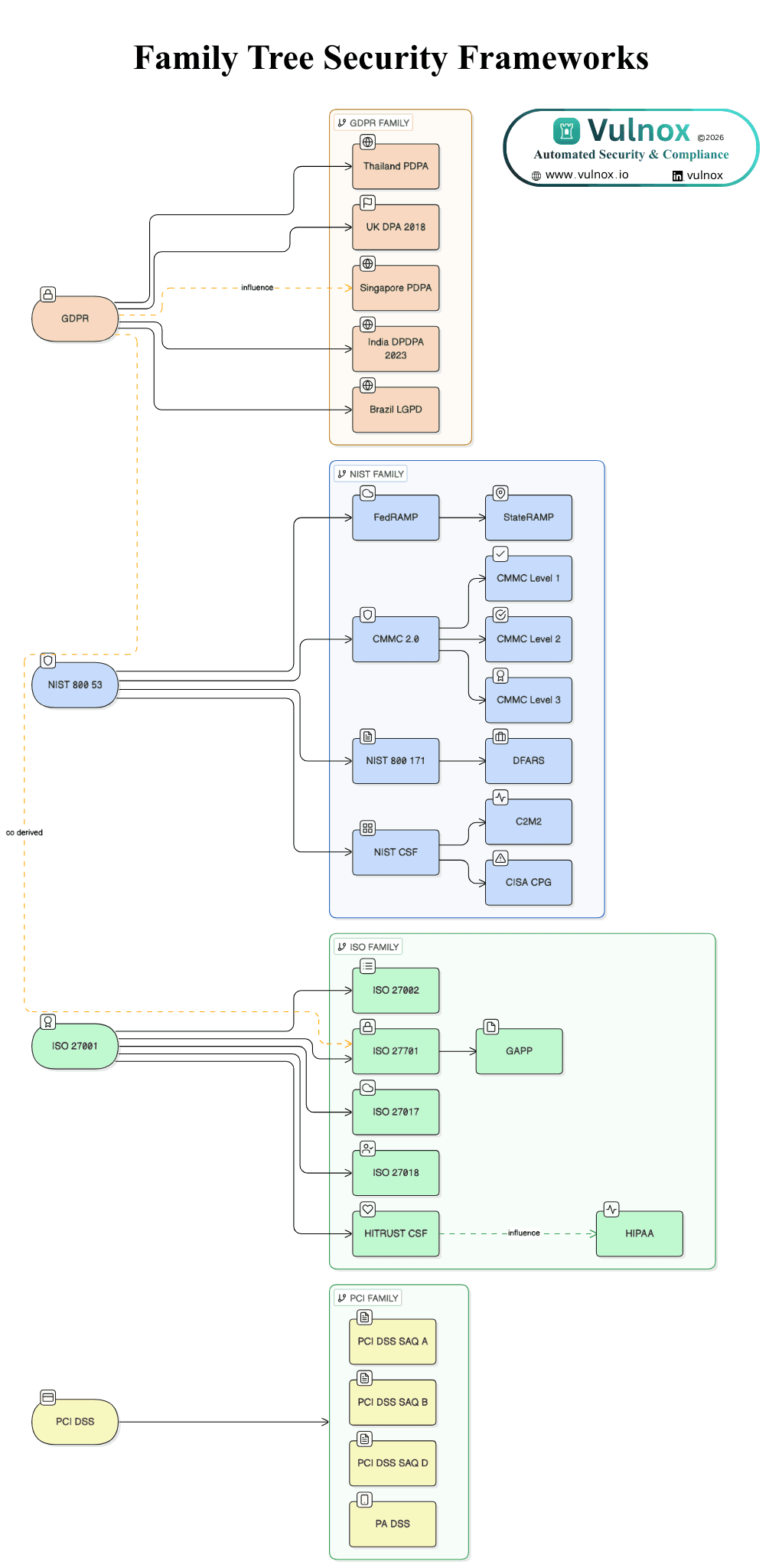
TL;DR
The compliance framework landscape looks overwhelming until you understand that it is organized around four parent frameworks , GDPR, NIST 800-53, ISO 27001, and PCI DSS , each of which spawned a family of derived standards, sector-specific adaptations, and regional implementations. Every framework your company is likely to encounter traces its lineage to one or more of these four parents, and understanding those lineage relationships changes how you design compliance programs. Controls that satisfy a parent framework provide partial or complete coverage of its children, which means the cross-framework control overlap that enables efficient multi-standard compliance is a structural feature of how these frameworks were designed rather than a fortunate coincidence.
Compliance teams that treat each security framework as an independent object , a standalone set of requirements with no relationship to anything else , consistently build programs that are more expensive, more complex, and more difficult to maintain than necessary. The reality is that the security framework ecosystem has a genealogy. GDPR did not emerge from nothing in 2018; it was preceded by the EU Data Protection Directive of 1995 and it has since generated a documented family of national implementations and derivative laws that share its structural DNA. NIST 800-53 is the control catalog from which CMMC, FedRAMP, StateRAMP, and NIST 800-171 all derive their requirements. ISO 27001 is the management system parent of ISO 27002, ISO 27017, ISO 27018, ISO 27701, and HITRUST CSF. PCI DSS generated the SAQ self-assessment variants and PA DSS for payment application security. Understanding these family relationships is not academic , it is the foundation for building compliance programs that address multiple frameworks without building multiple programs.
The most operationally significant insight in the framework family tree is the co-derived relationship between NIST 800-53 and ISO 27001. These two frameworks are not competing standards from different traditions , they were developed with cross-referencing and mutual influence, and NIST has published official mapping documents that identify the control-level correspondence between NIST 800-53 Rev 5 and ISO 27001:2022 Annex A. Organizations that understand this relationship can design a single control implementation that satisfies requirements from both framework families simultaneously, which provides coverage across CMMC, FedRAMP, HIPAA, SOC 2, and GDPR from a unified control baseline.
The GDPR Family: One Regulation, Five Major Derivatives, and a Global Influence Map
GDPR entered into force in May 2018 and almost immediately became the reference architecture for data protection legislation globally. The mechanism of that influence operated through two channels simultaneously. The first was direct derivation: countries with existing EU relationships or EU market ambitions enacted laws that transposed GDPR principles into national law while adapting them to local legal traditions, enforcement structures, and political contexts. The UK Data Protection Act 2018 is the clearest example , enacted in parallel with GDPR to maintain regulatory alignment while establishing UK-specific derogations and the ICO as an independent supervisory authority operating outside EU GDPR one-stop-shop mechanism. Post-Brexit, the UK GDPR and DPA 2018 together form a regime that is substantially equivalent to EU GDPR but administered independently, which matters practically for companies transferring data between the UK and EU because separate adequacy determinations and transfer mechanisms now apply in each direction.
Brazils Lei Geral de Proteção de Dados , LGPD , enacted in 2018 and effective from September 2020, represents the most structurally faithful GDPR derivative outside Europe. The LGPD adopts GDPR lawful basis framework almost verbatim, with ten processing bases that mirror GDPR six bases plus additional Brazilian-specific grounds. The LGPD data subject rights , access, correction, deletion, portability, information about sharing, and the right to revoke consent , map directly to GDPR Articles 15 through 22. The primary structural divergence is enforcement: LGPD national data protection authority, the ANPD, has been slower to establish its enforcement posture than European supervisory authorities, but its penalty framework , up to 2 percent of Brazilian revenue per violation capped at BRL 50 million , creates meaningful financial exposure for companies with significant Brazilian operations.
India Digital Personal Data Protection Act 2023 and Singapore PDPA represent the Asian branch of the GDPR family, though both demonstrate more adaptation from the GDPR template than the UK and Brazil derivatives. Singapore PDPA predates GDPR , its original enactment was in 2012, before GDPR existed , and the 2020 amendments that brought it into closer GDPR alignment represent a convergence rather than a direct derivation. India DPDPA 2023 shares GDPR consent-centricity and data principal rights architecture but departs from GDPR on lawful basis categories, notably excluding legitimate interests as a standalone processing basis and treating state processing with significantly lighter obligations than private sector processing. Thailand PDPA, enacted in 2019 with full enforcement from June 2022, is the most directly GDPR-influenced Asian privacy law, adopting the data controller and data processor distinction, the consent and legitimate interests lawful bases, and the 72-hour breach notification requirement that are core GDPR architectural elements.
The NIST Family: From 800-53 to FedRAMP, CMMC, and the Civilian Frameworks
NIST Special Publication 800-53 is the most consequential security control catalog ever published, not because of its direct applicability , it applies directly only to US federal information systems , but because of the framework family it generated. The current version, NIST 800-53 Rev 5, contains 20 control families covering every dimension of organizational security from access control and audit to supply chain risk management and program management. Every subsequent framework in the NIST family draws its control requirements from this catalog, which is why compliance professionals with deep NIST 800-53 expertise find the incremental learning curve for CMMC, FedRAMP, StateRAMP, and NIST 800-171 substantially lower than those approaching these frameworks without the 800-53 foundation.
FedRAMP , the Federal Risk and Authorization Management Program , is the cloud security authorization program that applies to cloud service providers seeking to offer services to US federal agencies. FedRAMP Moderate baseline requires achieving 325 controls from NIST 800-53 Rev 5, and FedRAMP High baseline requires 421 controls. The program operates on the authorize once, use many times principle: a cloud service provider that achieves FedRAMP authorization can offer its authorized service to any federal agency without undergoing agency-specific security assessments. StateRAMP is the state government equivalent, applying FedRAMP-equivalent controls to cloud services purchased by state and local government agencies. As state governments have standardized on StateRAMP over the past three years, cloud providers that have achieved FedRAMP authorization have been able to leverage that existing authorization documentation to accelerate StateRAMP review processes, because the underlying control requirements are structurally identical.
CMMC 2.0 , the Cybersecurity Maturity Model Certification , is the defense industrial base implementation of NIST 800-171, which is itself a subset of NIST 800-53 tailored for non-federal organizations processing Controlled Unclassified Information. The CMMC 2.0 level structure maps directly to NIST 800-171 practice counts: Level 1 covers 17 practices from the basic safeguarding requirements in FAR 52.204-21, Level 2 covers all 110 practices from NIST 800-171 Rev 2, and Level 3 adds requirements from NIST 800-172 for organizations handling the most sensitive CUI. DFARS clause 252.204-7012, the contractual mechanism through which DoD imposes NIST 800-171 requirements on contractors, has been in force since 2017 , CMMC 2.0 adds the third-party assessment requirement on top of the existing DFARS self-attestation obligation rather than introducing new control requirements. The CMMC final rule published in October 2024 formalized the C3PAO assessment pathway for Level 2 contractors, ending the self-attestation option for most defense contractors handling CUI.
NIST CSF, C2M2, and CISA CPG: The Civilian and Critical Infrastructure Branch
NIST Cybersecurity Framework sits in a different position within the NIST family than the 800-53 derivatives. Where CMMC, FedRAMP, and NIST 800-171 are compliance frameworks with specific control requirements and assessment processes, NIST CSF is a risk management framework , it provides a common language and structure for organizations to assess and communicate their cybersecurity posture without prescribing specific controls. The February 2024 update to NIST CSF v2.0 added the Govern function as a sixth core function alongside Identify, Protect, Detect, Respond, and Recover. The Govern function elevated organizational cybersecurity roles, policies, oversight structures, and supply chain risk management to the same structural level as the operational security functions , a change that reflects the increasing recognition that security program failures are as often governance failures as they are technical ones.
The Cyber Resilience Review Methodology , C2M2, maintained by the Department of Energy , applies the NIST CSF principles to operational technology environments in energy, manufacturing, and critical infrastructure sectors. C2M2 version 2.1 organizes its practices into ten domains including asset, change, and configuration management, identity and access management, threat and vulnerability management, and situational awareness , domains that map directly to NIST CSF functions but with OT-specific implementation guidance that NIST CSF technology-agnostic language cannot provide. CISA Cybersecurity Performance Goals , CPG , published in October 2022 represent CISA translation of NIST CSF into a prioritized set of baseline cybersecurity practices specifically for critical infrastructure operators. The CPGs are explicitly designed to be achievable by organizations that lack the resources for comprehensive NIST CSF implementation, and they identify the subset of practices that CISA assessment data suggests provide the greatest risk reduction per unit of implementation effort.
The ISO Family: How One Management System Standard Became an Ecosystem
ISO 27001 occupies a unique position in the global security framework landscape because it is simultaneously a management system standard, a certification framework, and the parent of a family of domain-specific extensions that cover cloud security, privacy, healthcare information security, and privacy information management. The ISO 27001 family operates through a deliberate extension architecture: ISO 27001 provides the management system requirements and the Annex A control framework, while the domain-specific standards in the 27000 series provide additional controls and implementation guidance for specific sectors or technology environments. Organizations implementing ISO 27001 can extend their certification scope to include ISO 27017 for cloud services, ISO 27018 for public cloud PII processing, and ISO 27701 for privacy information management , each extension adds domain-specific controls to the base ISO 27001 Annex A without requiring a separate management system.
ISO 27002:2022 , the implementation guidance companion to ISO 27001 , underwent its most significant structural revision in over a decade when it was updated in 2022. The revision reorganized the control set from 14 clauses and 114 controls to four themes , organizational, people, physical, and technological , containing 93 controls. Eleven controls were added that had no equivalent in the 2013 version, covering areas including threat intelligence, information security for cloud services, ICT readiness for business continuity, physical security monitoring, and configuration management. The ISO 27002:2022 reorganization was designed to better reflect the current technology and threat landscape, and organizations still certified against ISO 27001:2013 that have not yet transitioned to the 2022 version are operating against a control framework that predates widespread cloud adoption, modern supply chain attack techniques, and the current regulatory environment.
ISO 27701:2019 is the privacy extension to ISO 27001 and ISO 27002 that provides the Privacy Information Management System framework. Its relationship to GDPR is the most direct of any ISO standard , the standard includes an explicit Annex D that maps ISO 27701 controls to GDPR articles, allowing organizations to use ISO 27701 certification as documented evidence of GDPR Article 32 security implementation. GAPP , Generally Accepted Privacy Principles, published by AICPA and CPA Canada , is connected to the ISO family through ISO 27701 conceptual alignment with the same privacy management principles that GAPP encodes. The GAPP privacy principles , management, notice, choice and consent, collection, use and retention, access, disclosure to third parties, security, quality, and monitoring and enforcement , appear in various forms in both ISO 27701 and GDPR, creating a privacy framework convergence that allows organizations implementing ISO 27701 to satisfy GAPP requirements with the same control implementation.
HITRUST CSF and Its Dual Lineage from ISO 27001 and HIPAA
HITRUST CSF occupies a singular position in the framework family tree because it is explicitly a synthesized framework , designed from inception to incorporate requirements from multiple parent frameworks into a single, unified control set that satisfies the security due diligence requirements of the healthcare industry. The HITRUST CSF control categories draw requirements from ISO 27001, NIST 800-53, HIPAA Security Rule, PCI DSS, COBIT, and state-specific regulations, and the HITRUST assessment process weights these requirements based on the organization profile , its size, complexity, regulatory environment, and risk profile. An organization with HIPAA obligations operating in a state with additional healthcare privacy requirements will receive a different assessment scope than a health tech startup with limited regulatory exposure, even though both assessments are conducted against the same HITRUST CSF control framework.
The influence relationship between HITRUST CSF and HIPAA runs in both directions. HIPAA Security Rule requirements are embedded within the HITRUST CSF control categories, which is why achieving HITRUST r2 certification is widely accepted as demonstrating HIPAA Security Rule compliance , the HITRUST assessment has evaluated the controls that HIPAA requires as a subset of its broader assessment scope. Conversely, HITRUST has influenced how healthcare organizations interpret and implement HIPAA requirements by providing the specific, testable control implementations that HIPAA principles-based language does not prescribe. HIPAA tells covered entities they must implement reasonable and appropriate safeguards; HITRUST CSF tells them specifically what those safeguards should look like in a healthcare technology environment, with control maturity levels that provide a roadmap from basic compliance to optimized security program.
The PCI Family: Validation Types, Application Security, and What Merchants Get Wrong
PCI DSS is the parent of a validation framework family rather than a family of derived substantive standards. The PCI DSS core requirements apply to all entities that store, process, or transmit cardholder data, but the validation methodology varies based on transaction volume and payment processing architecture. SAQ A , Self-Assessment Questionnaire A , is the simplest validation form, applicable to card-not-present merchants that have fully outsourced all cardholder data functions to PCI DSS compliant third-party service providers. SAQ A contains 22 requirements, a fraction of the 250-plus requirements in the full PCI DSS assessment, because its scope is limited to the controls that a merchant retains responsibility for when all payment processing is handled by a third party. The scope reduction that SAQ A provides is significant and frequently misunderstood , it does not mean the merchant has no PCI DSS obligations, it means the merchant specific obligations are narrow and focused on the security of their relationship with their payment service provider.
SAQ B covers merchants that process cardholder data via imprint machines or standalone dial-out terminals with no electronic cardholder data storage, while SAQ D is the most comprehensive self-assessment questionnaire, applicable to all other merchants and all service providers. SAQ D for service providers covers all PCI DSS requirements , it is functionally equivalent to a full Report on Compliance for entities that do not meet the transaction volume thresholds requiring a QSA-conducted assessment. PA DSS , Payment Application Data Security Standard , was the payment application security framework that governed the development and distribution of payment applications before it was retired in October 2022 and superseded by the PCI Software Security Framework, which includes the Secure Software Standard and the Secure Software Lifecycle Standard. Organizations still referencing PA DSS compliance in their vendor security questionnaires are citing a retired standard, and their payment application vendors should be assessed against the current SSF standards instead.
The most consequential misunderstanding in the PCI family is the scope reduction fallacy , the belief that using a third-party payment processor eliminates PCI DSS obligations. PCI DSS v4.0.1 Requirement 12.8 mandates that entities maintain a list of all third-party service providers with whom cardholder data is shared, confirm annually that those providers maintain PCI DSS compliance, and have written agreements acknowledging the providers responsibility for cardholder data security. Requirement 6.4.1 mandates automated security solutions on payment pages regardless of whether the payment processing itself is outsourced. The scope of PCI DSS for a merchant using a fully outsourced payment processor is narrower than for a merchant that stores cardholder data, but it is never zero, and the March 2025 mandatory deadline for all PCI DSS v4.0.1 future-dated requirements has closed the transition period that allowed organizations to defer the most demanding new technical requirements.
Pro tip
When assessing your organization against any framework in the NIST family , CMMC, FedRAMP, StateRAMP, or NIST 800-171 , begin your gap analysis using NIST 800-53 Rev 5 as the reference catalog rather than the derivative framework directly. NIST 800-53 has the most comprehensive published crosswalk mappings to other frameworks, and conducting your initial gap analysis at the 800-53 control level allows you to identify gaps once and map the findings to CMMC practices, FedRAMP controls, and HIPAA safeguards simultaneously rather than running separate gap analyses against each derivative framework.
Pro tip
For organizations implementing ISO 27001 that also need to address GDPR compliance, build your Article 30 Records of Processing Activities before completing your ISO 27001 asset inventory. The ROPA requires you to document every processing activity, the categories of personal data involved, the purposes of processing, the recipients of data, and the retention periods , information that maps directly to the information asset inventory and data classification requirements in ISO 27001 Clause 8.1. Completing the ROPA first means your ISO 27001 asset inventory is built on a foundation of documented data flows rather than an IT asset list that misses the data dimension entirely.
The framework family tree is the most useful mental model available for building compliance programs that scale efficiently across multiple standards. Recognizing that CMMC Level 2 is a subset of NIST 800-53, that ISO 27701 is an extension of ISO 27001, that HITRUST synthesizes ISO 27001 and HIPAA, and that every GDPR derivative shares the same architectural DNA as its parent allows compliance teams to design control programs that address framework families rather than individual standards. Vulnox gap analysis applies this family tree logic operationally , mapping client control environments against parent frameworks first, identifying the incremental requirements each derivative adds, and building remediation roadmaps that sequence implementation to maximize cross-family coverage from each unit of effort.
Further Reading
Gap Analysis
gap analysisVulnerability Assessment
vulnerability assessmentNIST SP 800-53 Rev 5 Final Publication
NIST SP 800-53 Rev 5ISO 27001 Information Security Management
ISO 27001 information security management standardPCI SSC Document Library including SAQ forms
PCI SSC document library
Frequently Asked Questions
What is the relationship between NIST 800-53, CMMC, and FedRAMP?
NIST 800-53 is the parent control catalog from which both CMMC and FedRAMP derive their requirements. FedRAMP Moderate baseline requires 325 controls from NIST 800-53 Rev 5, and FedRAMP High requires 421 controls. CMMC Level 2 derives from NIST 800-171, which is itself a subset of NIST 800-53 tailored for non-federal organizations processing Controlled Unclassified Information — CMMC Level 2 covers the 110 practices from NIST SP 800-171 Rev 2. This lineage relationship means organizations that conduct their gap analysis against the full NIST 800-53 Rev 5 control catalog can identify gaps that are simultaneously relevant to CMMC, FedRAMP, and HIPAA Security Rule requirements, because all three derive their control requirements from the same parent catalog. NIST has published official crosswalk mappings between 800-53 Rev 5 and ISO 27001:2022, enabling organizations to identify the control-level correspondence between the two framework families.
How does ISO 27001 relate to ISO 27701 and GDPR compliance?
ISO 27701:2019 is a privacy extension to ISO 27001 that provides the Privacy Information Management System framework. It extends ISO 27001 Annex A controls with privacy-specific requirements for both data controllers and data processors and includes an explicit Annex D mapping ISO 27701 controls to GDPR articles. Organizations that achieve ISO 27001 certification can extend their scope to include ISO 27701 as an integrated assessment without building a parallel management system, typically requiring three to six months of additional implementation work. ISO 27701 certification is accepted by many supervisory authorities and enterprise clients as documented evidence of GDPR Article 32 security implementation, though it does not substitute for the legal compliance analysis that GDPR requires for lawful basis documentation, data subject rights workflows, and breach notification procedures.
What is the difference between PCI DSS SAQ A, SAQ B, and SAQ D?
The PCI DSS Self-Assessment Questionnaires are validation instruments for merchants that do not meet the transaction volume thresholds requiring a QSA-conducted Report on Compliance. SAQ A applies to card-not-present merchants that have fully outsourced all cardholder data functions to PCI DSS compliant third-party service providers — it covers 22 requirements and is the narrowest scope validation form. SAQ B applies to merchants processing cardholder data via imprint machines or standalone dial-out terminals with no electronic cardholder data storage. SAQ D is the most comprehensive questionnaire, covering all PCI DSS requirements, and applies to all merchants and service providers that do not qualify for a more limited SAQ. The appropriate SAQ is determined by payment processing architecture and transaction volume — using the wrong SAQ represents an incorrect scope determination that creates compliance gaps regardless of how thoroughly the selected questionnaire is completed.
Related Articles

GovRAMP Moderate authorization: why the Significant Change Request process catches providers off guard
GovRAMP Moderate is the first tier where you need a government sponsor, annual 3PAO reassessment, and a Significant Change Request process that can pause normal product releases for months. Most providers who stall post-authorization were not prepared for what maintaining Moderate status actually costs operationally.

GovRAMP Low+ authorization: the impact level that punishes providers who get the CUI boundary wrong
GovRAMP Low+ is where providers handling limited Controlled Unclassified Information land — or discover they should not be there. The defining failure is not a missing control. It is a CUI boundary that was drawn before anyone asked what data the government actually sends through the system.

GovRAMP High authorization: why FIPS-validated crypto and personnel security controls catch providers off guard
GovRAMP High is where cloud providers discover that having strong encryption is not the same as having FIPS 140-2 validated encryption — and that distinction alone has derailed authorizations from vendors who passed every other control family. The architectural constraints at High are qualitatively different from every lower tier.
Ready to Secure Your Digital Assets?
Get a comprehensive vulnerability assessment for your website today.