Thailand Compliance: Which Frameworks Apply to You
 Sienna VanceFebruary 20, 2026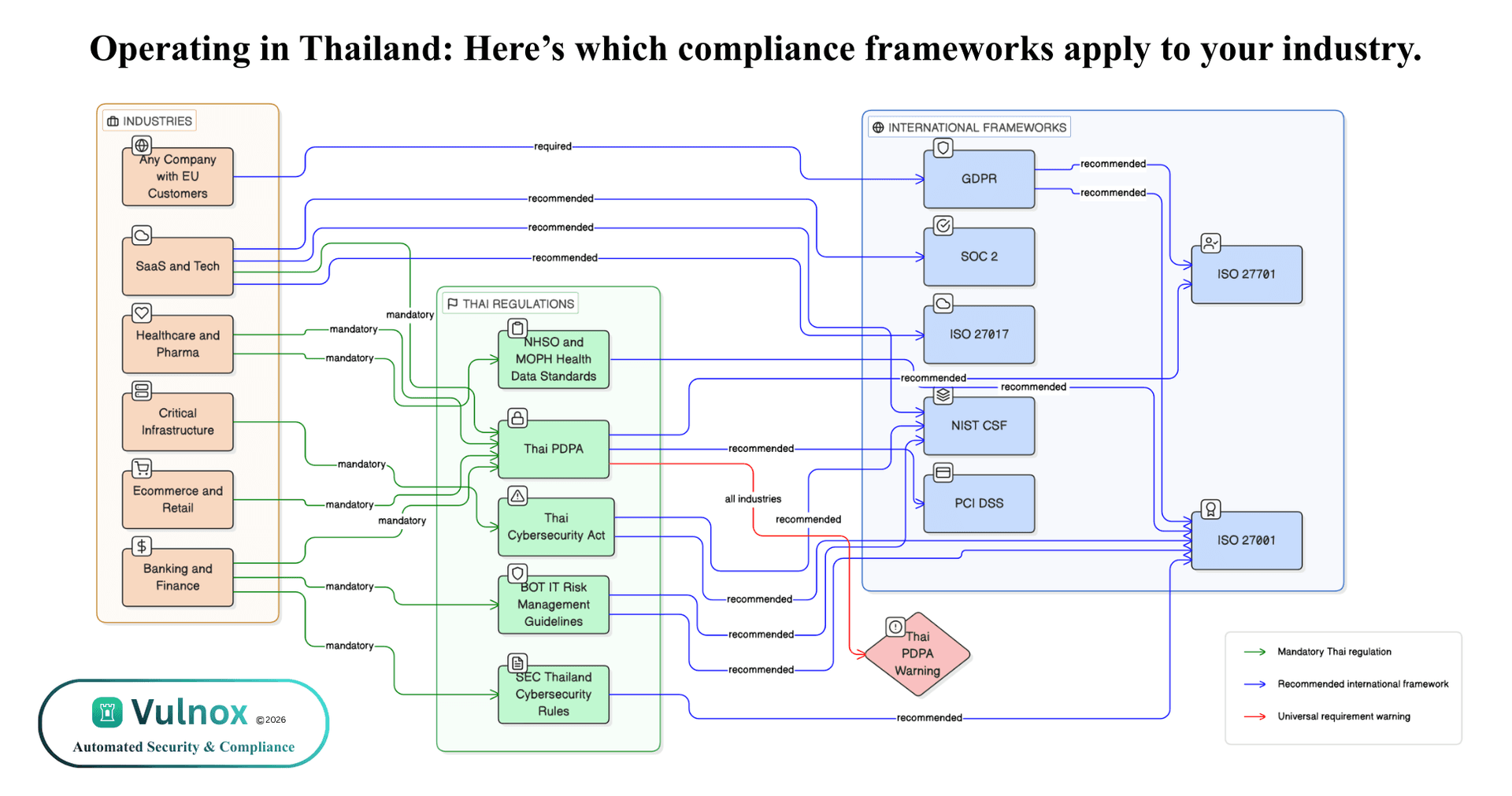
TL;DR
Operating in Thailand means navigating a layered compliance obligation stack: mandatory Thai regulations that vary by industry sector, an international framework layer that is either required or strongly recommended depending on your customer base and data handling practices, and a universal Thai PDPA obligation that applies across every sector without exception. The Thai Cybersecurity Act applies to all critical information infrastructure operators regardless of industry, while sector-specific mandates like BOT IT Risk Management Guidelines for banking and NHSO and MOPH Health Data Standards for healthcare create additional obligations on top of the universal baseline. Companies with EU customers face GDPR as a hard requirement that sits alongside , not instead of , Thai domestic obligations.
Thailand has built a compliance framework architecture that operates on two distinct layers simultaneously, and organizations that fail to understand the structural relationship between those layers consistently miscalculate their obligations. The first layer is Thai domestic regulation: a set of mandatory requirements that differ by industry sector and that carry enforcement authority from Thai regulatory bodies including the Bank of Thailand, the Securities and Exchange Commission Thailand, the National Health Security Office, and the Office of the National Cybersecurity Committee. The second layer is international frameworks: a set of standards that range from legally required , GDPR for any company processing personal data of EU residents , to strongly recommended based on industry risk profile and customer expectations. These two layers are not alternatives. A Bangkok-based SaaS company serving European enterprise customers must satisfy Thai PDPA and the Thai Cybersecurity Act from the domestic layer while simultaneously meeting GDPR requirements from the international layer, and the overlapping scope of those obligations requires deliberate compliance architecture rather than sequential checkbox completion.
The most operationally significant structural feature of Thailand compliance obligations is the distinction between the Thai PDPA as a universal cross-sector mandate and the sector-specific regulations that layer additional requirements on top of it. Thai PDPA , enacted in 2019 and fully enforced from June 2022 , applies to every organization that collects, uses, or discloses personal data in Thailand or processes personal data of Thai residents, regardless of industry. The Thai Cybersecurity Act similarly applies as a universal requirement to critical information infrastructure operators across sectors. What differentiates healthcare from banking from ecommerce is not whether PDPA applies , it always does , but what additional sector-specific obligations stack on top of it. Healthcare and pharma organizations face both NHSO and MOPH Health Data Standards and Thai PDPA as mandatory requirements. Banking and finance organizations face BOT IT Risk Management Guidelines and SEC Thailand Cybersecurity Rules as mandatory sector requirements in addition to PDPA. Understanding this additive structure is the foundation for accurate scope determination.
Key takeaway
The most common compliance architecture failure for Thailand operations is treating Thai domestic regulations and international frameworks as a sequential compliance problem rather than a simultaneous one. Organizations that complete Thai PDPA implementation and then begin GDPR implementation typically discover that their PDPA control implementations made architectural choices , particularly around consent management, data retention, and processor agreements , that require significant rework to satisfy GDPR requirements. The correct approach is to design the control framework against the most demanding applicable standard first , typically GDPR for companies with EU customers , and then verify that the resulting implementation satisfies Thai PDPA requirements, which it almost always does with minor additions because Thai PDPA was drafted with explicit reference to GDPR architecture.
Thai PDPA: The Universal Baseline That No Sector Escapes
Thai PDPA is modeled architecturally on GDPR, adopting the data controller and data processor distinction, a lawful basis framework for processing personal data, and a set of data subject rights including access, rectification, erasure, and portability. The enforcement body , the Personal Data Protection Committee, or PDPC , has authority to impose administrative fines of up to five million Thai baht per violation and criminal penalties of up to one year imprisonment for intentional violations. The PDPA applies extraterritorially to organizations outside Thailand that offer goods or services to individuals in Thailand or that monitor the behavior of individuals in Thailand, which is the provision that brings international SaaS providers and ecommerce operators into scope regardless of where their servers are located or where they are incorporated.
The Thai PDPA Warning that appears as a universal caution across all industry-to-international-framework pathways reflects a compliance reality that enforcement data from the first two years of full PDPA enforcement has confirmed: organizations consistently underestimate the operational complexity of PDPA compliance because they treat it as a legal document exercise rather than a data governance program. PDPA Article 37 requires data controllers to implement appropriate security measures to prevent unauthorized access, disclosure, alteration, or destruction of personal data , language that maps directly to ISO 27001 Annex A controls and to NIST CSF Protect function practices. The PDPA does not prescribe specific technical controls, which means organizations must determine for themselves what appropriate security looks like in their risk context, and that determination is where compliance programs most frequently fail. ISO 27001 certification is the most widely accepted demonstration of PDPA Article 37 compliance in the Thai market, which is why ISO 27001 appears as a recommended international framework for every industry sector operating in Thailand.
Sector-Specific Mandatory Obligations: Healthcare, Banking, Finance, and Critical Infrastructure
Healthcare and pharma organizations operating in Thailand face the most complex mandatory obligation stack of any sector. NHSO , National Health Security Office , and MOPH Health Data Standards together govern the handling of health data within the Thai public health system and impose requirements on hospitals, clinics, health technology platforms, and pharmaceutical companies that process patient data. These standards address health data classification, access control requirements for patient records, data sharing protocols between healthcare providers, and breach notification obligations that operate independently of , and sometimes with shorter timelines than , PDPA breach notification requirements. Organizations that handle both general personal data under PDPA and health data under NHSO and MOPH standards must maintain compliance programs that address both regulatory regimes simultaneously, because health data is a special category under PDPA Article 26 that requires explicit consent and heightened security measures in addition to whatever the NHSO and MOPH standards require.
Banking and finance organizations in Thailand operate under two distinct mandatory frameworks beyond Thai PDPA. Bank of Thailand IT Risk Management Guidelines , issued under the BOT authority granted by the Financial Institutions Business Act , require licensed financial institutions to implement IT governance structures, information security management systems, IT risk assessment processes, and business continuity management programs that meet BOT-prescribed standards. The guidelines align substantively with ISO 27001 and NIST CSF control domains, and BOT examination teams assess compliance with these guidelines during regular supervisory examinations , making them a hard compliance obligation enforced through the banking license rather than through a separate civil penalty framework. SEC Thailand Cybersecurity Rules , issued by the Securities and Exchange Commission under the Securities and Exchange Act , impose parallel obligations on capital market participants including brokers, dealers, asset managers, and securities registrars. The SEC rules focus specifically on cybersecurity incident management, third-party risk management for technology service providers, and cybersecurity testing requirements including penetration testing at prescribed frequencies.
Critical infrastructure operators face the Thai Cybersecurity Act as their primary mandatory domestic obligation, administered by the National Cybersecurity Committee and the Office of the National Cybersecurity Committee. The Cybersecurity Act identifies eight critical information infrastructure sectors , national security, significant public services, banking and finance, information technology and telecommunications, transportation and logistics, energy and public utilities, public health, and other sectors designated by the committee , and imposes tiered cybersecurity standards on operators in those sectors. Tier 1 critical information infrastructure requires compliance with a baseline security standard. Tier 2 requires compliance with a standard level. Tier 3 requires compliance with a strict level that includes third-party audit requirements, incident response capability standards, and regular cybersecurity drill exercises. NIST CSF is the international framework most directly recommended alongside the Cybersecurity Act because the Thai national cybersecurity standards were developed with explicit reference to NIST CSF functions and subcategories.
SaaS, Tech, and Ecommerce: Where GDPR and Thai PDPA Collide
SaaS and technology companies operating in Thailand face a compliance architecture where the international framework layer is not merely recommended but functionally mandatory based on commercial reality. GDPR applies as a legal requirement to any Thai-based SaaS provider that offers services to EU customers , GDPR Article 3 extraterritorial scope is not theoretical for Thai SaaS companies with European enterprise or consumer customers, and GDPR enforcement actions against non-EU companies have been executed through the Article 65 consistency mechanism and through EU-based customer contract requirements. Beyond GDPR, SOC 2 Type II reports have become the de facto procurement requirement for enterprise SaaS sales in North American and European markets, meaning Thai SaaS companies that cannot produce a SOC 2 Type II report frequently cannot close enterprise contracts regardless of their actual security posture.
ISO 27017 , the cloud security extension to ISO 27001 , is the recommended international framework for SaaS and tech companies because it addresses the specific control requirements that apply to cloud service providers rather than organizations generally. ISO 27017 Clause 6.3 provides cloud-specific implementation guidance for the ISO 27001 Annex A controls, adding cloud provider-specific controls covering virtual machine hardening, administrative operations security, monitoring of cloud services, and the alignment of virtual and physical security boundaries. Thai SaaS companies that implement ISO 27001 as their foundation and extend to ISO 27017 for cloud-specific controls position themselves to satisfy Thai PDPA Article 37 security requirements, GDPR Article 32 technical and organizational measures requirements, and enterprise customer security questionnaire requirements from a single integrated control framework. Ecommerce and retail organizations face the additional mandatory overlay of Thai PDPA for customer data and PCI DSS as a recommended framework for any operation that processes payment card transactions , a recommendation that becomes effectively mandatory for any ecommerce operator whose card brand agreements require PCI DSS compliance as a contractual obligation.
International Framework Selection: Required, Recommended, and Universal Paths
The framework selection logic for Thailand operations follows a structured decision path based on three variables: the organization industry sector, its customer geography, and its data handling scope. GDPR is the only international framework that appears as required rather than recommended, and its requirement status is triggered by a single condition , processing personal data of EU residents , regardless of industry sector. A Thai manufacturing company with no EU customers has no GDPR obligation. A Thai SaaS startup with ten EU enterprise customers is fully subject to GDPR extraterritorial scope and must implement the complete GDPR compliance program including Article 30 Records of Processing Activities, Data Protection Impact Assessments for high-risk processing under Article 35, and Data Processing Agreements with all processors under Article 28.
ISO 27001 is the most universally recommended international framework across all Thai industry sectors because it provides the documented information security management system that multiple Thai regulators , BOT, SEC, PDPC , treat as evidence of appropriate security implementation. Organizations that have achieved ISO 27001 certification can present their Statement of Applicability and certification evidence in response to BOT IT Risk Management Guideline assessments, SEC cybersecurity rule examinations, and PDPA compliance inquiries because the underlying control framework addresses the security requirements that each of these regulatory regimes impose. ISO 27701 , the privacy information management system extension to ISO 27001 , is recommended specifically for companies with significant personal data processing obligations, because its Annex mapping connects ISO 27701 controls to GDPR articles and PDPA-equivalent privacy principles in a single documented framework. NIST CSF receives specific recommendation for critical infrastructure and healthcare sectors because its function-based structure , Identify, Protect, Detect, Respond, Recover, and the recently added Govern , provides a risk management vocabulary that aligns with the Thai Cybersecurity Act tier assessment methodology and with NHSO health data security assessment processes.
Pro tip
When scoping a Thailand compliance program for a company that operates in both banking or finance and handles EU customer data, begin the gap analysis by mapping controls against BOT IT Risk Management Guidelines and GDPR simultaneously rather than sequentially. BOT guidelines require an information security management system that aligns with ISO 27001 domain structure, and GDPR Article 32 requires technical and organizational measures that map to the same ISO 27001 controls. A single ISO 27001-aligned control baseline satisfies the security implementation requirements of both regulators, and identifying the gaps in that baseline once , against the combined requirement set , is significantly more efficient than running two separate gap analyses and reconciling the findings afterward.
Pro tip
For SaaS companies that need both SOC 2 Type II and ISO 27001 certification to satisfy customer requirements in North American and Asian markets respectively, design your control environment against ISO 27001 Annex A first and then map those controls to AICPA Trust Service Criteria. The SOC 2 Trust Service Criteria for Security , CC1 through CC9 , have well-documented mapping to ISO 27001 Annex A controls, and the AICPA has published guidance on this correspondence. Organizations that implement the ISO 27001 control framework first typically find that 70 to 80 percent of SOC 2 Security criteria are addressed by existing ISO 27001 controls, reducing the incremental effort for SOC 2 to the criteria that address availability, confidentiality, and processing integrity beyond the security baseline.
Thailand compliance is not a single framework selection problem , it is a multi-layer obligation mapping exercise that requires understanding which Thai domestic regulations are mandatory for your sector, which international frameworks are legally required versus strongly recommended based on your customer geography and data handling, and how those layers interact at the control level. Companies that approach this mapping systematically , starting with the universal Thai PDPA and Cybersecurity Act baseline, adding sector-specific obligations for healthcare, banking, or critical infrastructure, and then overlaying international framework requirements driven by EU customer data or enterprise market access , build compliance programs that are both comprehensive and efficient. Vulnox gap analysis applies this layered mapping methodology to Thailand-operating clients, identifying the complete obligation stack by sector and designing control implementations that satisfy multiple regulatory requirements from a unified baseline.
Further Reading
Gap Analysis
gap analysisVulnerability Assessment
vulnerability assessmentThailand Personal Data Protection Committee Official Site
Personal Data Protection CommitteeBank of Thailand IT Risk Management Guidelines
BOT IT Risk Management GuidelinesNational Cybersecurity Committee Thailand
Office of the National Cybersecurity Committee
Frequently Asked Questions
Is Thai PDPA mandatory for all companies operating in Thailand?
Thai PDPA applies to every organization that collects, uses, or discloses personal data in Thailand or that processes personal data of Thai residents, regardless of industry sector, company size, or country of incorporation. There is no small business exemption equivalent to some other privacy regimes. The PDPA also applies extraterritorially under its Section 5 provisions to organizations outside Thailand that offer goods or services to individuals in Thailand or that monitor the behavior of individuals in Thailand — the same extraterritorial mechanism that GDPR Article 3 uses. For companies already subject to GDPR, Thai PDPA compliance is substantially achievable through GDPR-aligned control implementations because Thai PDPA was drafted with explicit reference to GDPR architecture, including the data controller and processor distinction, lawful basis requirements, data subject rights, and security obligation under Article 37 that maps to GDPR Article 32. The primary areas where PDPA requires separate analysis from GDPR are cross-border transfer mechanisms under Section 29, which are still developing their enforcement posture, and the Thai-specific consent requirements that differ in some respects from GDPR consent standards.
What does the BOT IT Risk Management Guidelines require from Thai banks?
Bank of Thailand IT Risk Management Guidelines require licensed financial institutions to implement four primary program areas: IT governance structures with board-level accountability for technology risk, an information security management system that addresses the control domains aligned with ISO 27001, IT risk assessment processes that identify, measure, and monitor technology risks on a continuous basis, and business continuity management programs with tested recovery capabilities for critical systems. The guidelines impose specific requirements on third-party technology service providers, requiring financial institutions to conduct due diligence assessments before onboarding technology vendors, maintain contractual protections for data security and audit rights, and monitor ongoing vendor compliance. BOT examination teams assess compliance with these guidelines during regular supervisory examinations, and deficiencies identified during examination can result in remediation orders and restrictions on technology initiatives until deficiencies are addressed. Financial institutions that have achieved ISO 27001 certification find that certification evidence significantly streamlines the BOT examination process because the ISO 27001 management system structure addresses the governance, risk assessment, and security management requirements that the BOT guidelines prescribe.
Does GDPR apply to Thai companies that have EU customers?
GDPR applies to Thai companies that offer goods or services to EU residents or that monitor the behavior of EU residents, regardless of where the Thai company is incorporated or where its servers are located. This extraterritorial application under GDPR Article 3 is not theoretical — EU supervisory authorities have issued enforcement actions against non-EU companies, and EU-based enterprise customers routinely require GDPR-compliant Data Processing Agreements as a condition of their vendor contracts. A Thai SaaS company with EU customers must implement the complete GDPR compliance program including Article 30 Records of Processing Activities, Data Processing Agreements with processors under Article 28, Data Protection Impact Assessments for high-risk processing under Article 35, and breach notification within 72 hours of discovery under Article 33. Thai companies subject to GDPR must also designate an EU representative under Article 27 unless an exemption applies. The overlap between GDPR requirements and Thai PDPA requirements is substantial because Thai PDPA was modeled on GDPR architecture, but the two regimes are not identical and each requires its own legal compliance analysis for lawful basis documentation, data subject rights workflows, and transfer mechanisms.
Related Articles

GovRAMP Moderate authorization: why the Significant Change Request process catches providers off guard
GovRAMP Moderate is the first tier where you need a government sponsor, annual 3PAO reassessment, and a Significant Change Request process that can pause normal product releases for months. Most providers who stall post-authorization were not prepared for what maintaining Moderate status actually costs operationally.

GovRAMP Low+ authorization: the impact level that punishes providers who get the CUI boundary wrong
GovRAMP Low+ is where providers handling limited Controlled Unclassified Information land — or discover they should not be there. The defining failure is not a missing control. It is a CUI boundary that was drawn before anyone asked what data the government actually sends through the system.

GovRAMP High authorization: why FIPS-validated crypto and personnel security controls catch providers off guard
GovRAMP High is where cloud providers discover that having strong encryption is not the same as having FIPS 140-2 validated encryption — and that distinction alone has derailed authorizations from vendors who passed every other control family. The architectural constraints at High are qualitatively different from every lower tier.
Ready to Secure Your Digital Assets?
Get a comprehensive vulnerability assessment for your website today.