US federal cybersecurity frameworks: the complete guide to all 37 mandates
 Julian ThorneApril 30, 2026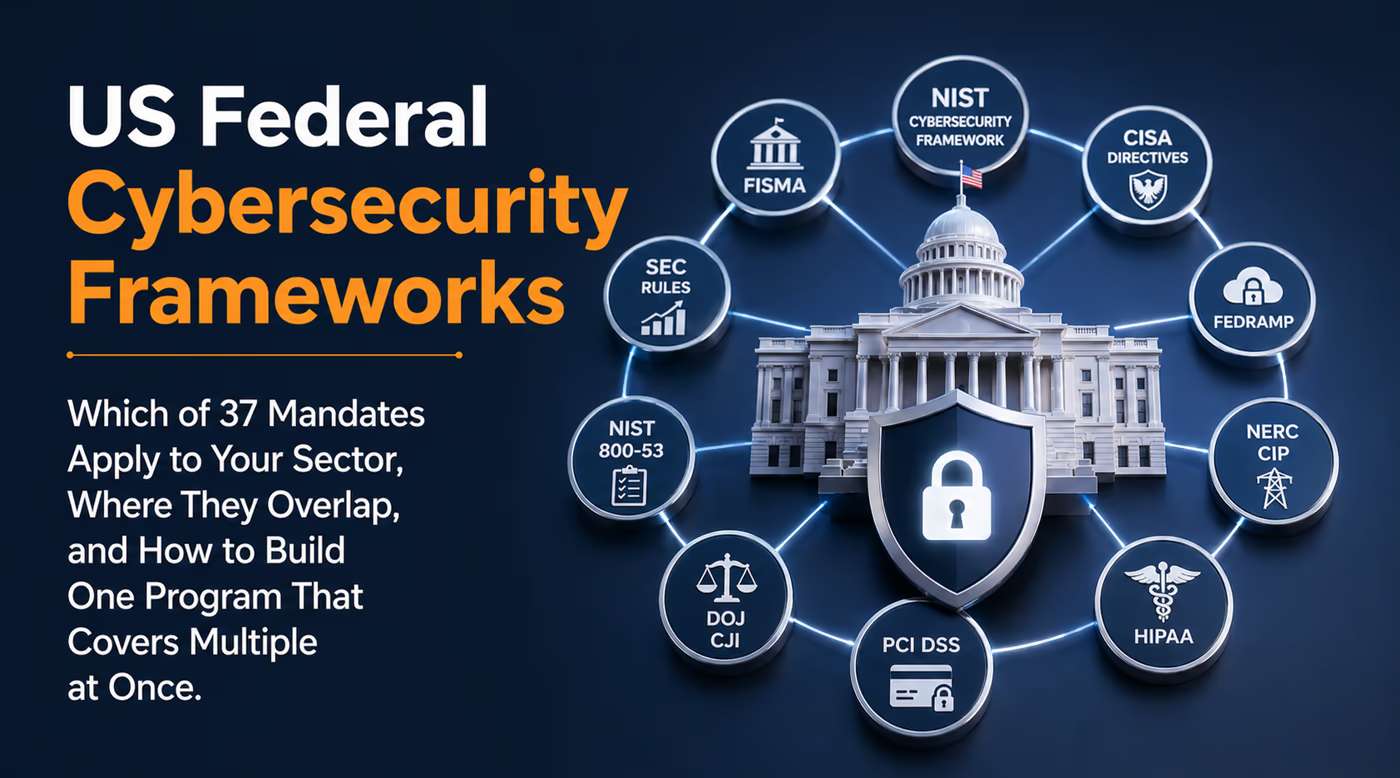
Key takeaways
37 active US federal cybersecurity frameworks span sectors from defence contracting to rail transit — most organizations subject to more than one are unknowingly non-compliant with at least one.
IRS 1075, SSA EIESR, and CJIS Security Policy are functionally near-identical NIST SP 800-53 implementations, but each requires a completely separate audit evidence package with no cross-acceptance.
DFARS 252.204-70xx mandates cyber incident reporting to DoD within 72 hours — a shorter clock than the SEC''s 4-business-day rule, GLBA''s 30-day FTC notification, and significantly shorter than most organizations'' actual IR process.
FAR 52.204-21 self-attestation accuracy is poor: in Vulnox assessments of federal contractors who attested full compliance, an average of 3.2 of the 15 required controls were unimplemented or only partially implemented.
Building a NIST SP 800-53 Moderate baseline first reduces the incremental compliance work for IRS 1075, SSA EIESR, CJIS, MARS-E, and DFARS to framework-specific documentation and reporting pipeline work rather than net-new security control implementation.
The SEC Cybersecurity Rule''s 4-business-day disclosure clock starts at materiality determination, not incident discovery — companies without a pre-defined materiality determination process face SEC scrutiny for the determination delay itself.
Supply chain compliance clauses (FAR 889, FAR 52.204-27, ITAR, DFARS) require reasonable inquiry into vendor practices, not just vendor self-attestation — questionnaire programmes do not satisfy these obligations.
TL;DR
The US federal compliance landscape has 37 active frameworks, and the hard part is not implementing any single one — it is discovering that you carry four simultaneously and that their incident reporting clocks are incompatible, their audit evidence requirements do not cross-apply, and none of them acknowledge the others exist. Most organizations find out how many they carry during an incident or a due diligence process, not before. The article maps all 37, the overlaps that create double work, the conflicts that create real operational problems, and the one starting point that reduces the overall compliance burden for most of them.
The call nobody is prepared for
A 180-person defence technology company discovers at 11pm on a Tuesday that an attacker has been moving laterally in their environment for nine days. They hold a DoD contract with CUI. They are publicly traded. Their HR platform processes Federal Tax Information for payroll. Their office building''s managed security system uses cameras from a manufacturer on the Section 889 prohibited list. Their legal team has never heard of dibnet.dod.mil.
Within the next 24 hours they need to begin the DoD''s 72-hour DFARS incident reporting process. Within 4 business days they need to determine whether the incident is material to SEC investors and potentially file a Form 8-K. Within 30 days they need to notify the FTC under GLBA if customer financial data was involved. And they need to inform the IRS''s Office of Safeguards immediately if FTI was accessed. Four clocks. Four different government recipients. Four different content requirements. One incident. Nobody has ever walked through this scenario.
What this framework group covers and how it is organized
The US federal cybersecurity framework group contains 37 active authorities spanning mandatory regulations, acquisition clauses, executive orders, industry-specific standards, and voluntary guidance. They are not a coherent system — they are the accumulated output of decades of sector-specific legislation and regulatory rulemaking that references each other inconsistently and enforced by at least 12 different government bodies.
The group divides roughly into five clusters. The data-sharing trio — CJIS, IRS 1075, SSA EIESR — governs federal data shared with state agencies and contractors and are all NIST 800-53 implementations enforced by different federal offices with no mutual recognition. The defence contractor stack — FAR 52.204-21, FAR 52.204-27, FAR 889, DFARS, NISPOM, NNPI — governs information security and supply chain integrity for companies selling to the federal government, with CMMC providing third-party verification for the CUI tier. The financial services cluster — GLBA, FFIEC, FINRA, FACTA, FCA CRM, FTC Act, SOX, SEC Cybersecurity Rule — covers banks, broker-dealers, non-bank financial institutions, and public companies. The critical infrastructure group — NERC CIP, C2M2, CISA CPG, TSA 1580/82-2022-01, CERT RMM — addresses sector-specific operational technology and resilience requirements. And the privacy and cross-cutting frameworks — COPPA, FERPA/NSPM-33, DPF, FIPPs, HHS 45 CFR 155.260, CMS MARS-E, FDA 21 CFR Part 11 — cover specific data types, transfer mechanisms, or regulated industry processes.
Overlapping with all of them: EO 14028, the DoD Zero Trust documents, DHS ZTCF, CISA SSDAF, TIC 3.0, and ITAR, which represent the US government''s architecture for modernizing federal and defence supply chain security.
The challenge for most organizations is not understanding any single framework. It is identifying which subset of the 37 applies, where they overlap versus where they genuinely require separate work, and how to build a programme that satisfies multiple without treating each as an independent compliance project.
CJIS Security Policy 5.9.3
HHS 45 CFR 155.260
FFIEC
FINRA
CMS MARS-E v2.0
Data Privacy Framework (DPF)
DoD Zero Trust Execution Roadmap
DoD Zero Trust Reference Architecture v2.0
IRS 1075
EO 14028
NNPI (unclass)
FAR 52.204-21
FAR 52.204-27
FACTA / FCRA
GLBA CFR 314 (Dec 2023)
FAR Section 889
FCA CRM
FDA 21 CFR Part 11
C2M2 v2.1
CERT RMM v1.2
CISA CPG v2022
COPPA
FERPA / NSPM-33
ITAR Part 120
FIPPs
DFARS Cybersecurity 252.204-70xx
DHS CISA SSDAF
DHS CISA TIC 3.0
DHS ZTCF
FTC Act Section 5
NERC CIP 2024
NISPOM
NSTC NSPM-33
SEC Cybersecurity Rule
SOX
SSA EIESR v8.0
TSA / DHS 1580/82-2022-01
Every framework in this group: what it requires and who it catches
Frameworks
CJIS Security Policy 5.9.3
Any agency or private vendor with access to FBI Criminal Justice Information — criminal history records, biometric databases, national crime systems. This includes cloud providers hosting law enforcement applications, managed service providers supporting police departments, and software vendors whose products query CJIS systems.
MSPs and cloud vendors who win law enforcement contracts without understanding that CJIS compliance obligations flow to them through the Criminal Justice Information Services agreement. The vendor signs the agreement, assumes the agency handles compliance, and then fails the first audit on encryption and MFA requirements they never implemented.
13 policy areas covering access control, awareness training, audit and accountability, configuration management, identification and authentication, incident response, maintenance, media protection, physical protection, system and communications protection, system and information integrity, formal audits, and personnel security. MFA is required for remote access. Encryption must meet FIPS 140-2. Personnel with unescorted access to CJIS data require fingerprint-based background checks.
State CJIS Systems Agencies conduct compliance audits. Non-compliant agencies can lose access to CJIS systems — operationally catastrophic for law enforcement. Vendors lose contracts. There is no civil penalty structure, but the operational consequence of access termination is severe.
Shares access control and encryption requirements with IRS 1075 and SSA EIESR. All three use NIST SP 800-53 as a technical reference but apply it to different data types with different audit mechanisms. An organization holding all three data types needs three separate compliance tracks despite near-identical technical controls.
HHS 45 CFR 155.260
Health Insurance Exchanges (federal and state-based), navigators, certified application counselors, agents, brokers, web-brokers, and any technology vendor that touches applicant PII during the enrollment process. The chain-of-accountability requirement means this flows to subcontractors.
Scope creep in the wrong direction — organizations assume HIPAA compliance covers them and do not build a separate 155.260 programme. HIPAA covers medical records. 155.260 covers enrollment data. The data types are distinct, the use limitation principles are different, and a HIPAA-compliant vendor can simultaneously be non-compliant with 155.260.
Administrative, technical, and physical safeguards appropriate to the sensitivity of enrollment data — income, immigration status, household composition, Social Security numbers. Use limitation: data collected for enrollment cannot be repurposed. Contractual requirements must flow to all partners. Breach notification to the Exchange and potentially affected individuals.
HHS oversight. Unauthorized use or disclosure of Exchange data can result in civil and criminal penalties under the ACA. CMS oversight reviews for state-based Exchanges.
Sits alongside MARS-E 2.0 for state-based Exchange technology vendors. The two frameworks use different scoping mechanisms — MARS-E scopes by system authorization boundary, 155.260 scopes by data flow — creating gaps when vendors are in scope for one but not the other.
FFIEC
US banks, credit unions, savings associations, and other federally regulated financial institutions examined by OCC, Federal Reserve, FDIC, NCUA, or CFPB. The Cybersecurity Assessment Tool (CAT) is used by examiners across all these agencies.
Institutions treat FFIEC CAT as a self-assessment checkbox exercise rather than an examiner''s lens. Examiners do not just review the CAT scores — they test whether the controls behind the scores actually function. Institutions that score Intermediate maturity on paper but cannot demonstrate control operation in an examination routinely receive MRAs.
IT governance, information security programme management, business continuity planning, and third-party risk management aligned to the FFIEC IT Examination Handbook. The CAT provides a maturity assessment across five domains: Cyber Risk Management and Oversight, Threat Intelligence and Collaboration, Cybersecurity Controls, External Dependency Management, and Cyber Incident Management and Resilience.
Examination findings can result in Matters Requiring Attention (MRAs), formal enforcement actions, civil money penalties, and in severe cases consent orders. Examination results directly affect an institution''s CAMELS rating.
Maps closely to NIST CSF, which means FFIEC-compliant institutions have a head start on CISA CPG requirements. GLBA Safeguards Rule obligations for bank holding companies run parallel to FFIEC requirements — banks subject to OCC examination and FTC jurisdiction simultaneously carry both.
FINRA
Broker-dealers and registered investment firms regulated by FINRA. Rule 4370 applies specifically to business continuity planning. FINRA cybersecurity guidance applies across all member firms regardless of size.
Small broker-dealers assume that because FINRA does not have a prescriptive cybersecurity rule — unlike GLBA or the SEC Cybersecurity Rule — they have more flexibility. What they miss is that FINRA examiners use the annual examination priorities report as a de facto standard, and firms that have not reviewed it are routinely surprised by examination focus areas.
FINRA Rule 4370 requires written business continuity plans covering data backup, mission-critical systems, alternative communications, and regulatory reporting continuity. Broader cybersecurity expectations from FINRA examination guidance cover risk assessments, access controls, data encryption, vendor management, and incident response. FINRA publishes annual examination priorities that signal what examiners will actually test.
FINRA can impose fines, suspensions, bars, and expulsion from membership. Cybersecurity deficiencies identified during examinations are increasingly resulting in formal disciplinary actions rather than just findings.
Firms that are both FINRA members and SEC registrants carry both FINRA and SEC Cybersecurity Rule obligations. The SEC Rule''s 4-business-day material incident disclosure requirement applies to public companies — broker-dealers that are subsidiaries of public companies carry both disclosure timelines simultaneously.
CMS MARS-E v2.0
State-based health insurance exchanges, federal exchange contractors, and technology vendors supporting ACA marketplace systems that handle PII or PHI. Annual security and privacy assessments are required for all Exchange entities.
Vendors that support both state-based and federally-facilitated exchanges discover mid-assessment that the two have slightly different MARS-E implementation requirements. CMS provides supplemental guidance that state-based exchanges may interpret differently, creating control gaps that only surface during cross-exchange audits.
Based directly on NIST SP 800-53 Revision 4, MARS-E specifies security and privacy controls across 17 control families. System authorization (ATO equivalent) is required for Exchange systems. Annual assessments must be conducted by independent assessors for high-impact systems.
CMS can withhold federal funds and require remediation before systems are permitted to process Exchange data. Non-compliant state exchanges risk losing federal operational support.
MARS-E and 45 CFR 155.260 both apply to Exchange vendors but scope differently. MARS-E is a technical security framework; 155.260 is a privacy and contractual accountability framework. Organizations need both, and the annual MARS-E assessment does not satisfy 155.260 obligations.
Data Privacy Framework (DPF)
US companies that receive personal data transfers from the EU, UK, or Switzerland for commercial purposes. Self-certification with the Department of Commerce is required. The DPF list is publicly maintained and searchable.
Companies self-certify, post the privacy policy update, and then do not update their onward transfer agreements with subprocessors. The accountability for onward transfer principle requires that when DPF-certified companies send EU personal data to third parties, those third parties are either DPF-certified or bound by contracts that provide equivalent protections. Most companies audit their own certification annually but do not audit their subprocessor chain.
Seven principles: notice, choice, accountability for onward transfer, security, data integrity and purpose limitation, access, and recourse/enforcement/liability. Onward transfer to third parties requires either DPF certification by the recipient or contractual protections equivalent to DPF principles. Annual re-certification is required.
FTC and Department of Transportation enforcement. False claims of DPF certification are prosecuted as deceptive practices under the FTC Act. The European Commission can suspend the adequacy decision if enforcement is deemed inadequate — as happened with Privacy Shield in 2020.
DPF sits alongside GLBA and FTC Act obligations for US financial companies receiving EU customer data. A US bank with EU operations may carry GLBA Safeguards Rule, FTC Act, and DPF simultaneously. The security controls required under each overlap substantially, but the accountability mechanisms and breach notification obligations differ.
DoD Zero Trust Execution Roadmap
DoD components, military services, combatant commands, and defence agencies. The FY2027 Target Level Zero Trust deadline applies across the enterprise. Defence contractors are not directly subject to the Roadmap but should expect its capability requirements to flow into future contract requirements.
DoD components treat zero trust as an identity project and build robust MFA and conditional access while leaving device health attestation and data-layer controls unaddressed. The Roadmap requires capability maturity across all seven pillars — identity-only programmes score well on two pillars and poorly on five.
45 zero trust capabilities organized across seven pillars: user, device, network/environment, application/workload, data, visibility and analytics, and automation and orchestration. Foundational activities must be completed before advanced activities. Progress is tracked against specific milestones with annual reporting to the DoD CIO.
DoD CIO oversight. Components that miss milestone targets face budget and programme review implications. The FY2027 deadline is hard — components that fail to reach Target Level will be operating out of compliance with a direct DoD mandate.
The Roadmap and DoD Zero Trust Reference Architecture v2.0 are companion documents — the Roadmap sets the timeline and milestones, the Reference Architecture defines the technical design. The DHS ZTCF mirrors the same seven-pillar structure, meaning organizations working across DoD and DHS environments can align their zero trust architectures, though the specific capability definitions differ.
DoD Zero Trust Reference Architecture v2.0
DoD enterprise architects, system designers, and technology programme managers. Defence contractors providing zero trust products and services to DoD components must understand the architecture to design compliant solutions.
Procurement teams use the Reference Architecture as a vendor checklist — verifying that individual products address specific capability areas — without assessing whether the products integrate into a functioning zero trust architecture. Seventeen products that individually address zero trust capabilities but do not share telemetry or enforce consistent policy do not constitute zero trust.
Technical design guidance across the seven zero trust pillars. Defines zero trust capabilities and the activities required to achieve them. Specifies integration patterns between identity, device management, network segmentation, application access control, and data protection.
Compliance is assessed against the Execution Roadmap milestones. The Reference Architecture provides the technical standard against which capability demonstrations are evaluated.
Paired with the Execution Roadmap. The DHS ZTCF references the same architecture. EO 14028 drove the development of the federal zero trust strategy that both documents implement.
IRS 1075
State and local government agencies that receive Federal Tax Information (FTI) from the IRS — including tax agencies, child support enforcement agencies, and Medicaid programmes — plus their technology contractors. The IRS Office of Safeguards conducts periodic reviews.
State agencies that outsource FTI processing to cloud vendors assume the vendor''s FedRAMP authorization satisfies IRS 1075 requirements. FedRAMP and IRS 1075 share NIST 800-53 as a base but IRS 1075 has additional requirements — particularly around physical security, personnel screening, and incident reporting to the IRS Office of Safeguards — that FedRAMP authorization does not cover.
NIST SP 800-53-based controls covering access management, encryption, audit logging, incident response, media protection, and physical security for systems handling FTI. Encryption of FTI at rest and in transit is mandatory. Unauthorized disclosure must be reported to the IRS immediately. Annual safeguard reviews are required.
IRS can terminate FTI sharing agreements, which eliminates the agency''s ability to verify income and tax status for programme eligibility. Criminal penalties apply to unauthorized disclosure of FTI.
IRS 1075, CJIS, and SSA EIESR form a trio of federal data-sharing compliance frameworks built on NIST 800-53 but operated by different agencies with different audit mechanisms. A state human services agency can simultaneously hold FTI, SSA data, and criminal history records — requiring three separate compliance programmes with near-identical technical controls.
EO 14028
Federal agencies implementing the cybersecurity mandates, and technology vendors selling software to the federal government. The software supply chain attestation requirements in OMB M-22-18 apply directly to commercial software vendors.
Commercial software vendors focus on completing the CISA attestation form without actually implementing SSDF practices. The attestation is a legal representation — vendors who attest falsely face False Claims Act liability. The form is not a compliance checkbox; it is a sworn statement.
Zero trust architecture adoption across federal agencies. Endpoint detection and response deployment. Enhanced logging standards. Software supply chain security requirements, including vendor attestation of SSDF-aligned development practices. The CISA SSDAF implements the attestation requirement. EO 14028 also drove NIST''s SSDF, the OMB zero trust strategy memorandum, and CISA''s Binding Operational Directives.
False attestations are subject to False Claims Act prosecution. Agencies can debar contractors who submit materially false attestations. The FCA''s qui tam provisions mean that employees who know an attestation is false can file suit on the government''s behalf.
EO 14028 is the policy engine that drove the DoD Zero Trust documents, the CISA SSDAF, and CISA CPG into existence. Organizations implementing all four are largely building the same programme — EO 14028 is the why, the others are the what.
NNPI (unclass)
Defence contractors and subcontractors supporting the US Naval Nuclear Propulsion Program. Directed by Naval Reactors (NR). Programme participation requires compliance as a condition of contract.
Contractors with active CMMC Level 2 programmes assume NNPI compliance is covered. CMMC addresses CUI broadly. NNPI has additional need-to-know verification requirements and access authorization controls that go beyond standard CUI handling. The failure mode is assuming one covers the other.
Strict access controls based on need-to-know verification. Physical and cyber safeguards for systems handling unclassified NNPI. Personnel must be specifically authorized for NNPI access — general clearance status is insufficient. Technology control programmes must prevent unauthorized access to NNPI data, including by foreign nationals.
Naval Reactors can terminate programme participation. Given the limited number of contractors qualified for NNPI work, termination is commercially severe. There is no published penalty schedule — consequences are contractual.
Sits alongside NISPOM in the defence contractor space. NISPOM covers classified information under NISP. NNPI covers unclassified but highly sensitive nuclear propulsion data. Contractors working in both domains carry both, and the access control mechanisms, while similar in principle, are operated by different oversight bodies.
FAR 52.204-21
Federal contractors and subcontractors whose information systems process, store, or transmit Federal Contract Information (FCI). Included in most federal contracts involving FCI. Forms the baseline from which CMMC Level 1 is derived.
In Vulnox assessments of small federal contractors who attested full compliance, an average of 3.2 of the 15 controls were unimplemented or partially implemented. The most common gaps: audit log review processes, unsuccessful logon attempt lockout, and physical access restrictions to FCI systems. Compliance was declared; it was not operational.
15 basic safeguarding requirements covering access control, identification and authentication, configuration management, media protection, and system communications protection. No formal assessment required — contractors self-attest compliance.
False statements in federal contracting can result in False Claims Act liability. Contracting officers can terminate contracts for non-compliance. As CMMC enforcement ramps up, FAR 52.204-21 baseline deficiencies are increasingly visible during CMMC pre-assessments.
FAR 52.204-21 is the floor. DFARS 252.204-70xx and CMMC build on it for CUI environments. Contractors that cannot demonstrate FAR 52.204-21 compliance have no realistic path to CMMC Level 2.
FAR 52.204-27
Federal contractors and subcontractors of all sizes performing work on federal contracts. The restriction flows to subcontractors via required flowdown.
Contractors enforce the prohibition on corporate-managed devices but not on personal devices employees use for work. The clause prohibits ByteDance applications on IT used to perform the contract — not just corporate-owned IT. BYOD programmes that permit VPN or email access on personal devices are the gap.
Prohibition on ByteDance-owned TikTok or any application developed by ByteDance Limited on any information technology used to perform federal contract work. Contractors must represent compliance at time of offer. MDM policies must enforce the prohibition.
False representation at time of offer is a False Claims Act exposure. Contracting officers have discretion to require evidence of compliance. The operational risk is contract termination.
FAR 52.204-27 and FAR Section 889 are companion technology restriction clauses in the federal acquisition framework. Both require reasonable inquiry into the supply chain. Together they establish a pattern of US government technology exclusion requirements that will likely expand.
FACTA / FCRA
Financial institutions, creditors, consumer reporting agencies, and businesses that use consumer credit reports. The Red Flags Rule applies specifically to financial institutions and creditors that offer or maintain covered accounts.
Companies implement Red Flags programmes at initial FACTA compliance and do not update them. The Red Flags Rule requires annual review and update of the programme. Most programmes reviewed in financial services assessments have not been substantively updated since initial implementation — Red Flag categories have not been revisited as fraud patterns evolved.
Red Flags Rule: written identity theft prevention programme covering at least 26 Red Flag categories. Secure disposal: consumer information derived from credit reports must be securely disposed of. Credit score disclosure requirements. Fraud alert requirements for consumer reporting agencies.
FTC and federal banking regulators enforce FACTA. Civil penalties up to $2,500 per violation. State attorneys general can also bring enforcement actions.
FACTA and GLBA Safeguards Rule both apply to financial institutions handling consumer information. GLBA addresses the security programme broadly. FACTA adds identity theft-specific requirements. Organizations subject to both cannot satisfy FACTA''s Red Flags requirements through their GLBA programme alone.
GLBA CFR 314 (Dec 2023)
Non-bank financial institutions subject to FTC jurisdiction — mortgage companies, payday lenders, student loan servicers, tax preparers, and auto dealers. The 2023 amendments significantly expanded the rule''s reach and specificity.
Non-bank financial institutions that were previously GLBA-subject under the older, vaguer Safeguards Rule assume their existing programmes satisfy the 2023 requirements. The 2023 amendments added specific controls — penetration testing, continuous vulnerability scanning, MFA, 30-day FTC notification — that the original rule did not require by name. The gap between old programme and new requirements is frequently 12 to 18 months of remediation work.
Qualified Individual designation (CISO equivalent). Annual board/senior officer reporting. Encryption of customer financial data in transit and at rest. MFA for anyone accessing customer information. Annual penetration testing. Continuous vulnerability scanning. Incident response plan. FTC notification within 30 days of discovering a breach affecting 500 or more customers.
FTC enforcement. Civil penalties, consent orders, and mandatory third-party assessors. The FTC has significantly increased GLBA enforcement activity since the 2023 amendments took effect.
GLBA 2023 requires penetration testing and vulnerability scanning. FFIEC requires similar activities for bank-regulated institutions. The technical requirements are substantially equivalent, but GLBA is FTC-enforced and FFIEC is prudential regulator-enforced. A non-bank that is also a FINRA member carries GLBA and FINRA obligations simultaneously.
FAR Section 889
Federal contractors and subcontractors at all tiers. The restriction applies to telecommunications equipment and services from Huawei, ZTE, Hytera, Hikvision, Dahua, and their subsidiaries — anywhere in contract performance.
Contractors conduct reasonable inquiry of their direct IT procurement but not of their physical infrastructure — IP cameras, building access control readers, and network switches from affected manufacturers. Hikvision and Dahua cameras are ubiquitous in commercial real estate. Contractors whose offices are in managed facilities with third-party security systems have Section 889 exposure they do not know about.
Prohibition on use of covered telecommunications equipment or services. Reasonable inquiry to identify prohibited equipment in the supply chain. Representation of compliance at time of offer. Flowdown to subcontractors. Disclosure and remediation if prohibited equipment is discovered post-award.
False Claims Act liability for false representations. Contract termination. In practice, post-award discovery that triggers disclosure and remediation is treated differently than knowing non-disclosure.
FAR 52.204-27 and FAR Section 889 together define the US government''s technology exclusion framework for contractors. Both require flowdown to subcontractors and reasonable inquiry. Together they establish a supply chain vetting obligation that will likely be the template for future technology exclusion requirements.
FCA CRM
Banks, credit unions, money services businesses, broker-dealers, and other US financial institutions subject to Bank Secrecy Act and AML requirements. The Customer Due Diligence Rule applies to covered financial institutions.
Institutions implement CDD at onboarding and then treat customer risk profiles as static. FinCEN''s CDD Rule requires ongoing monitoring and updating of risk assessments as customer behaviour and circumstances change. Profiles that were accurate at onboarding but have not been reviewed in three years do not satisfy the ongoing monitoring obligation.
Risk-based customer due diligence at onboarding and ongoing. Beneficial ownership identification for legal entity customers. Enhanced due diligence for higher-risk customers. Updated customer risk profiles as circumstances change. Integration with the institution''s overall AML programme.
FinCEN, OCC, Federal Reserve, and state regulators enforce BSA/AML requirements. Penalties for systemic AML failures reach into the hundreds of millions of dollars. Individual compliance officers can face personal liability.
FCA CRM intersects with FFIEC IT examination expectations — examiners review AML system controls as part of IT examinations. GLBA''s information security requirements apply to the customer data held in AML systems. An institution failing FCA CRM obligations often has underlying FFIEC IT control deficiencies.
FDA 21 CFR Part 11
Pharmaceutical, biotech, medical device, and food companies using electronic records and electronic signatures in FDA-regulated processes — including clinical trial data, manufacturing batch records, and laboratory information systems.
Companies validate systems at implementation and do not revalidate after significant changes. A SaaS provider''s update that was not captured in the client''s change management process creates a validation gap. In life sciences assessments, this is the most consistent finding.
Validated computer systems for all FDA-regulated electronic records. Audit trails that are computer-generated, date- and time-stamped, and cannot be disabled. Access controls limiting system access to authorized individuals. Electronic signatures that bind the signer''s name, date, and meaning of the signature. System documentation sufficient to support FDA inspection.
FDA can issue 483 observations and Warning Letters during inspections. Repeated or uncorrected 21 CFR Part 11 deficiencies can result in import alerts, consent decrees, and criminal referrals for falsification of records.
21 CFR Part 11 audit trail requirements overlap with SOX IT general controls for public pharmaceutical companies — both require tamper-evident audit logs for systems affecting financial data or regulated records. Companies can design unified audit logging architectures that satisfy both, but the validation documentation requirements differ.
C2M2 v2.1
Electric utilities, oil and gas companies, and other energy sector operators. Self-assessment framework — not a mandatory compliance requirement with its own enforcement mechanism, but increasingly referenced by sector regulators and used as a board reporting tool.
Energy operators conduct C2M2 self-assessments internally with teams who are also responsible for the programmes being assessed. The resulting scores consistently overestimate actual maturity by 0.5 to 1 full MIL level. When independent assessors or regulators conduct their own evaluation, the gap is operationally significant.
Self-assessment across 10 domains using a Maturity Indicator Level (MIL) scale of 0-3. The domains cover asset and change management, identity and access management, threat and vulnerability management, situational awareness, information sharing, incident response and continuity, supply chain management, workforce management, and cybersecurity programme management.
No direct enforcement mechanism. However, NERC CIP auditors and DOE programme reviewers use C2M2 as a reference. Significant gaps between self-assessed and examiner-assessed maturity attract increased regulatory scrutiny.
C2M2 and NERC CIP 2024 both apply to electric utilities. NERC CIP is mandatory and prescriptive. C2M2 is voluntary and maturity-based. Utilities that use C2M2 as their primary self-assessment tool find NERC CIP audit preparation requires translating C2M2 maturity evidence into NERC CIP-specific control documentation — the evidence formats are different.
CERT RMM v1.2
Organizations seeking an integrated approach to managing cybersecurity, business continuity, and IT operations resilience. Common in critical infrastructure, financial services, and government. Not a mandatory compliance requirement but used as an assessment methodology by many regulated sectors.
Organizations adopt CERT RMM for the integrated view and then bifurcate implementation back into separate security and continuity teams. The integration point — ensuring that security controls are designed to remain effective during continuity events — is precisely where most organizations have gaps.
Capability maturity assessment across 26 process areas, grouped into enterprise management, operations management, asset definition and management, and service continuity. Unlike most frameworks that separate security from continuity, CERT RMM integrates them — a single process area covers both the security control and the continuity of the service it protects.
No direct enforcement. Used as a reference by CERT/CC, government agencies, and some sector regulators for assessment and programme design.
CERT RMM and CISA CPG cover overlapping ground in critical infrastructure contexts. CERT RMM provides the maturity measurement framework; CISA CPG provides the prioritized control baseline. Organizations using both can use CISA CPG to identify what to implement and CERT RMM to assess how well they have implemented it.
CISA CPG v2022
Critical infrastructure operators across all 16 CISA-designated sectors. Voluntary, but increasingly referenced in sector-specific regulatory guidance as an expectation. Designed for organizations at any maturity stage.
Organizations treat CPG compliance as a destination. CISA designed the CPGs as a floor, not a ceiling. Operators that achieve full CPG implementation and stop there have a solid baseline but are often missing sector-specific requirements visible only in NERC CIP, TSA directives, or sector-specific guidance.
A prioritized subset of NIST CSF controls focused on the highest-impact risk reduction, organized into five goal areas mirroring the NIST CSF functions: Govern, Identify, Protect, Detect, Respond, and Recover. Each goal has specific, measurable practices with implementation guidance.
Voluntary. No direct enforcement. However, CISA CPG compliance is increasingly cited in post-incident regulatory reviews. Organizations that suffered significant breaches while failing to meet CPG baseline practices face regulatory and legal scrutiny.
CISA CPG maps directly to NIST CSF, which means CPG-compliant organizations have substantial overlap with FFIEC CAT requirements. CISA CPG is the fastest path to a defensible baseline across multiple frameworks in this group.
COPPA
Operators of websites, apps, and online services directed at children under 13, or general audience platforms with actual knowledge they are collecting data from children under 13. Applies regardless of operator location if US children are being reached.
General audience platforms rely on date-of-birth gates as their COPPA compliance mechanism. The FTC has repeatedly found this insufficient — platforms with actual knowledge of underage users cannot rely on age gates they know are being circumvented. ''We asked their age'' is not a defence when the platform has other signals that children are present.
Verifiable parental consent before collecting, using, or disclosing personal information from children under 13. Clear and prominent privacy notice directed at parents. No conditioning service access on collection of more information than necessary. Reasonable procedures to protect the confidentiality, security, and integrity of personal information collected from children. Data retention only as long as necessary.
FTC enforcement. Civil penalties up to $51,744 per violation per day. Recent FTC actions have reached $275 million (Google/YouTube, 2019) and $1.1 million (Epic Games, 2023, COPPA portion).
COPPA intersects with FERPA for educational technology companies that serve school-age children. EdTech companies often carry both. The consent mechanisms differ — COPPA requires parental consent, FERPA routes consent through the educational institution.
FERPA / NSPM-33
US universities, research institutions, and national laboratories receiving federal research funding. This row in the database maps to NSPM-33 implementation. Research compliance officers and institutional security officers are the primary implementation owners.
Institutions implement disclosure requirements for grant-funded researchers but do not extend vetting and monitoring to unfunded visiting scholars, post-doctoral fellows funded through non-federal sources, or industry-sponsored researchers who share laboratory space. The access these individuals have to federally funded research data is functionally equivalent to that of grant recipients.
NSPM-33: Disclosure requirements for foreign affiliations, travel, and funding for researchers receiving federal grants. Formal research security programmes at covered institutions. Research security training for all personnel. Technology control programmes. Vetting of foreign talent recruitment programme participants.
Federal funding agencies can debar institutions from receiving federal grants. FBI and DOJ have investigated and prosecuted cases involving undisclosed foreign government affiliations at US research institutions.
NSPM-33 intersects with ITAR Part 120 for research involving defence articles or technical data. Universities conducting ITAR-controlled research must implement ITAR technology control programmes that overlap significantly with NSPM-33 research security requirements.
ITAR Part 120
US and foreign companies that manufacture, export, import, or broker defence articles or defence services on the US Munitions List. Aerospace companies, defence contractors, and technology companies whose products touch USML categories.
Companies register with DDTC, implement export licences for hardware, and then fail to control technical data in IT systems accessible to foreign national employees or contractors. An uncontrolled SharePoint with ITAR-controlled design files and foreign national read access is a violation regardless of whether anything was exported.
Registration with DDTC as a condition of manufacturing or exporting USML items. Export licences for controlled items and technical data. Technology control programmes (TCPs) preventing unauthorized foreign national access to ITAR-controlled data. Written authorizations for foreign national employees. Screening programmes for new hires.
DDTC civil penalties up to $1.3 million per violation. Criminal penalties up to $1 million per violation and 20 years imprisonment. Debarment from government contracting. DDTC has imposed consent agreements with monitoring requirements for significant violations.
ITAR and DFARS/CMMC both apply to defence contractors. DFARS/CMMC addresses CUI protection. ITAR addresses export-controlled technical data. A company can achieve CMMC Level 2 and simultaneously be ITAR non-compliant because the access control models are different — CMMC focuses on system authorization, ITAR focuses on nationality-based access restrictions.
FIPPs
US federal agencies and their systems handling PII. Privacy officers, IT architects, and system developers within federal agencies. FIPPs are codified into the Privacy Act of 1974 and numerous other statutes, making their practical effect legally binding.
Federal agencies conduct PIAs at system deployment and do not update them when systems are significantly modified. A system deployed under a 2018 PIA that has had its data sharing expanded, its retention period extended, and its user population changed is operating under a stale privacy authorization.
Eight principles: transparency, individual participation, purpose specification, data minimization, use limitation, data quality and integrity, security, and accountability. Operationalized through Privacy Impact Assessments (PIAs) for new systems, Systems of Records Notices (SORNs), and privacy programme governance.
OMB oversight. Inspector general audits. Congressional oversight. Non-compliance with Privacy Act requirements (which codify FIPPs) can result in civil liability — individuals can sue agencies for intentional or willful violations.
FIPPs are the foundation from which SSA EIESR, IRS 1075, CJIS, and 45 CFR 155.260 data protection requirements are derived. All of those frameworks implement FIPPs principles in sector-specific ways. An organization that understands FIPPs has the conceptual architecture to interpret all of them.
DFARS Cybersecurity 252.204-70xx
DoD prime contractors and subcontractors at all tiers handling Controlled Unclassified Information. Mandatory 72-hour cyber incident reporting applies regardless of CMMC status.
Contractors implement 800-171 controls but have not built the 72-hour reporting pipeline. In tabletop exercises, fewer than 20% of DFARS-covered contractors had ever walked through the mechanics of DoD reporting via dibnet.dod.mil before the exercise. Most had not registered on the portal or confirmed their reporting credentials. The 72-hour clock does not pause for administrative issues.
NIST SP 800-171 implementation (110 security requirements) for covered contractor information systems. 72-hour cyber incident reporting to DoD via dibnet.dod.mil. Preservation of images of compromised systems for 90 days. Submission of damage assessments at DoD request. Flow-down to subcontractors that handle CUI.
False Claims Act exposure for false representations about NIST 800-171 compliance. Contract termination. DoD contractor debarment. The Department of Justice Civil Cyber-Fraud Initiative has pursued DFARS non-compliance cases aggressively since 2021.
DFARS is the contractual vehicle; CMMC is the verification mechanism for the same underlying 800-171 requirements. FAR 52.204-21 is the floor; DFARS builds the structure above it. Organizations achieving CMMC Level 2 certification are demonstrating DFARS compliance through third-party assessment.
DHS CISA SSDAF
Software vendors selling to US federal agencies. The form must be completed by the CEO or a designee with authority to bind the organization.
Product security teams complete the attestation without legal review. The SSDAF is a legal representation by the CEO — false attestation is False Claims Act exposure. Product security professionals who fill out the form without involving legal counsel and without verifying that the development practices claimed are actually in place are creating liability, not resolving it.
CEO-level attestation that the software is developed in accordance with NIST SSDF (SP 800-218). Specific attestation items cover software supply chain security, use of automated security testing, protection of software development environments, and the organization''s ability to identify and report vulnerabilities.
False attestations are subject to False Claims Act prosecution. CISA can refer cases to DOJ. Agencies can stop purchasing from vendors who submit materially false attestations.
SSDAF implements EO 14028''s software supply chain requirements. Vendors already subject to DFARS supply chain risk management requirements have overlapping obligations — the SSDF practices required by SSDAF overlap with DFARS 252.204-7012 supply chain provisions.
DHS CISA TIC 3.0
US federal agencies and their cloud service providers and managed security service providers. Agencies must apply TIC 3.0 security capabilities when accessing external services, connecting remote workers, and using cloud platforms.
Agencies that migrated to cloud under TIC 2.0 exemptions are still operating under those exemptions rather than implementing TIC 3.0 architectures. TIC 3.0 has been available since 2020. Agencies still citing legacy TIC 2.0 approaches are operating under stale security architectures.
Security capabilities aligned to use case scenarios: traditional (on-premise), cloud, and remote user. The Security Capabilities Catalog defines specific capabilities that must be implemented for each scenario. Unlike TIC 2.0, traffic does not need to be routed through Trusted Internet Connection points.
OMB oversight. DHS CISA can conduct assessments and issue recommendations. Persistent non-compliance surfaces in FISMA reporting.
TIC 3.0 implements aspects of the zero trust architecture required by EO 14028 and the DoD Zero Trust frameworks. Agencies implementing TIC 3.0 cloud use cases are simultaneously building zero trust foundations. The capability overlap is substantial but the documentation and reporting requirements differ.
DHS ZTCF
DHS components, programme managers, and IT system owners. The ZTCF is DHS-internal but directly relevant to DHS contractors whose systems must integrate with DHS zero trust architecture.
DHS components implement identity and network pillars first — where existing investment is concentrated — and defer data and application pillars. The data pillar requires data classification and data flow mapping that most agencies have not completed.
Zero trust capability implementation across the standard pillars — identity, devices, networks, applications, and data — using DHS-specific implementation guidance. Aligns with the DoD Zero Trust Reference Architecture and OMB federal zero trust strategy memorandum.
DHS CIO oversight. Zero trust progress is tracked against OMB M-22-09 milestones, which apply across all CFO Act agencies including DHS.
ZTCF and the DoD Zero Trust documents share the same architectural pillars. Organizations delivering IT to both DoD and DHS can build unified zero trust architectures, though the specific capability requirements and assessment mechanisms differ.
FTC Act Section 5
Any US company handling consumer data. The FTC''s Section 5 data security authority applies across industries and company sizes with no sector exclusion.
Organizations assume that because the FTC Act has no prescriptive standard, it imposes no real obligation. The FTC''s enforcement record says otherwise. Reasonable practices are partly defined by what the FTC has accepted in consent agreements — those agreements establish the de facto standard.
Reasonableness standard — no prescriptive controls. The FTC assesses whether security practices were reasonable given the sensitivity of data held, the size of the organization, the cost of protective measures, and the availability of alternatives.
FTC can seek injunctive relief and civil penalties for violating consent orders — up to $51,744 per violation per day. The FTC''s track record includes actions against companies of all sizes.
FTC Act Section 5 is the catch-all that applies to companies not covered by sectoral rules. But it also applies alongside GLBA, COPPA, and FACTA. A mortgage company subject to GLBA is also subject to Section 5. Satisfying GLBA does not immunize a company from Section 5 enforcement for practices outside GLBA''s scope.
NERC CIP 2024
Electric utilities, transmission operators, balancing authorities, generation owners, and their vendors with assets connected to the North American bulk electric system. Assets are classified as high, medium, or low impact.
Utilities maintain strong compliance posture for High and Medium impact assets and neglect Low impact assets. Current assessment data consistently shows Low impact asset inventories are incomplete and Low impact controls are either undocumented or unenforced.
14 active CIP standards covering electronic security perimeters, access management, incident reporting, recovery plans, configuration change management, supply chain risk management, and physical security. The 2024 updates added requirements around low-impact assets that were previously under-regulated.
NERC Regional Entities conduct audits. Violations are reported to FERC. Penalties can reach $1 million per violation per day. NERC has levied penalties exceeding $10 million in single cases. NERC makes violation and settlement data publicly available.
NERC CIP and C2M2 both apply to electric utilities. NERC CIP is prescriptive and audited; C2M2 is maturity-based and self-assessed. Using C2M2 to prepare for NERC CIP audits is common, but the control documentation formats required for NERC CIP audit evidence are specific — a C2M2 self-assessment does not substitute for them.
NISPOM
US defence contractors, subcontractors, and facilities with Facility Clearances accessing, storing, or processing classified national security information. Oversight by DCSA. Mandatory for all NISP participants.
Contractors build NISPOM compliance programmes around the Facility Security Officer''s domain — physical security, personnel clearances, classified document handling — and under-invest in the insider threat programme''s technical monitoring requirements. The 2020 NISPOM codification added explicit user activity monitoring requirements that many contractors have not fully implemented.
Personnel security clearance procedures. Facility accreditation. Classified information handling procedures covering storage, transmission, destruction, and access. Mandatory insider threat programmes with reporting mechanisms, training, and user activity monitoring. Self-inspections at least annually.
DCSA can revoke Facility Clearances, which terminates classified contract eligibility. Personal liability for individuals who willfully violate classified information handling requirements. Criminal penalties under 18 U.S.C. § 1001 for false statements to DCSA.
NISPOM and DFARS/CMMC both apply to defence contractors but address different information types. NISPOM covers classified information. DFARS/CMMC covers CUI. The access control architectures must be kept separate — classified systems cannot share infrastructure with CUI systems.
NSTC NSPM-33
US research institutions receiving federal funding above a threshold set by funding agencies. Research compliance officers and export control managers are the primary implementation owners.
Institutions focus NSPM-33 compliance on disclosure requirements for senior researchers and miss the export control integration requirement. Research security plans that do not address the export control dimension are non-compliant with the guidance.
Formal research security programme with four components: cybersecurity, foreign travel security, research security training, and export control. Disclosure requirements for researchers covering foreign affiliations, foreign talent recruitment programme participation, and foreign funding. Policy prohibiting participation in foreign government talent recruitment programmes for researchers with access to federally funded research.
Federal funding agencies can debar institutions. The Departments of Justice, State, and Commerce have prosecuted cases involving undisclosed foreign affiliations at US research institutions.
NSPM-33 and ITAR Part 120 overlap substantially for research institutions working on defence-related projects. The technology control programme required by ITAR and the research security programme required by NSPM-33 share access control, foreign national vetting, and data protection requirements.
SEC Cybersecurity Rule
Publicly traded companies registered with the SEC and foreign private issuers. The 4-business-day Form 8-K disclosure applies to material cybersecurity incidents. Annual Form 10-K disclosures on risk management and governance apply to all registrants.
Companies build their SEC incident response around a binary materiality determination without defining who makes that call, what criteria trigger the determination process, or how long the process is expected to take. In our assessments, the general expectation is that materiality will be ''obvious.'' It is not obvious, and the SEC''s posture suggests extended deliberations about materiality are themselves a problem.
Form 8-K Item 1.05: disclose material cybersecurity incidents within 4 business days of determining materiality. Form 10-K: annual disclosure of cybersecurity risk management and strategy, material risks from cybersecurity threats, board oversight, and management''s role. Disclosure of board member cybersecurity expertise.
SEC enforcement. Civil penalties for late, incomplete, or misleading disclosures. Form 10-K cybersecurity disclosure deficiencies have attracted SEC comment letters. Companies that disclose incidents materially earlier in some channels than in their 8-K face additional securities law exposure.
SEC Rule and SOX both apply to public companies but address different aspects of the same event. A ransomware attack at a public company requires a 4-business-day 8-K disclosure and may require updating the SOX ITGC risk assessment if financial systems were affected. Legal and IT audit teams must coordinate both in real time.
SOX
Publicly traded US companies and foreign private issuers listed on US exchanges, plus their external auditors. Section 404 assessments are mandatory. Smaller reporting companies have reduced external auditor attestation requirements.
SOX ITGC programmes scope based on financial system categories and miss SaaS applications integrated into financial workflows without going through the SOX scoping process. ERP migrations and finance department SaaS adoption regularly outpace SOX scoping reviews. External auditors find scope gaps during walkthroughs that management did not catch.
IT general controls covering access management, change management, computer operations, and data backup for systems that process or report financial data. Annual management assessment of ITGC effectiveness. External auditor attestation for accelerated filers. Quarterly certification by CEO and CFO.
SEC enforcement. External auditor reporting of ITGC material weaknesses in the audit opinion directly affects stock price and management credibility. Material weaknesses in ITGC require public disclosure. Willful certification of false reports carries personal criminal liability for CEOs and CFOs.
SOX and the SEC Cybersecurity Rule both apply to public companies and both require board-level governance of technology risk. A major cybersecurity incident at a public company implicates both — the incident response must address both the 8-K disclosure deadline and any SOX ITGC implications simultaneously.
SSA EIESR v8.0
State agencies, healthcare organizations, financial institutions, and other entities receiving SSA data through electronic information exchange agreements. Attestation to EIESR compliance is required before SSA data sharing begins.
Organizations attest EIESR compliance at the time of agreement execution and do not update their control implementation as the EIESR version advances. SSA periodically issues new EIESR versions with updated control requirements. Organizations running EIESR v6.x implementations when v8.0 is current have compliance gaps they may not discover until an SSA security review.
NIST SP 800-53-based controls across access control, audit logging, incident response, media protection, and system protection for systems handling SSA-provided data. SSA security reviews at periodic intervals. Immediate reporting of unauthorized disclosures.
SSA can terminate data sharing agreements. Given that SSA data is often required for benefits programme eligibility verification, termination is operationally severe.
SSA EIESR, IRS 1075, and CJIS form the trio of federal data-sharing compliance frameworks that state human services agencies most commonly carry simultaneously. All three are NIST 800-53-based, all three use different audit mechanisms, and none of them accept the others'' audit results as evidence of compliance.
TSA / DHS 1580/82-2022-01
Passenger railroad carriers, freight railroad carriers, and rail transit systems designated by TSA. Designation is based on ridership and cargo volumes. The directive affects approximately 30 to 40 entities.
Rail operators implement the IT-side controls and treat OT network segmentation as a future-state initiative. The 24-hour reporting requirement creates pressure to have clear OT visibility before an incident, not after. Operators who cannot determine within 24 hours whether an OT system has been affected by a detected IT incident cannot meet the reporting requirement.
Cybersecurity incident reporting to CISA within 24 hours. Designated cybersecurity coordinator reachable 24/7. Cybersecurity incident response plan. Vulnerability assessments. Network segmentation between IT and OT environments. Access control measures. Continuous monitoring. Annual cybersecurity assessments.
TSA can impose civil penalties up to $25,000 per day per violation. In 2023, TSA began issuing civil penalties for non-compliance with security directive requirements. Criminal penalties for obstruction of TSA enforcement.
TSA''s 24-hour reporting requirement is the shortest incident reporting clock in this group. Rail operators that are subsidiaries of publicly traded companies carry both the 24-hour TSA report and the 4-business-day SEC materiality determination simultaneously.
Where these frameworks share requirements and where they conflict
Overlaps
IRS 1075
SSA EIESR v8.0
CJIS Security Policy 5.9.3
Audit mechanisms are completely separate. IRS conducts safeguard reviews through the Office of Safeguards. SSA conducts its own security reviews. CJIS audits are conducted by State CJIS Systems Agencies. None accepts the others'' evidence. An organization passing all three audits in the same year submits three separate evidence packages for controls that are materially identical.
All three are NIST SP 800-53-based frameworks governing federal data sharing with state agencies and contractors. Access control, encryption, audit logging, incident response, and media protection requirements are functionally near-identical across all three. A state human services agency carrying all three implements the same technical controls three times.
DFARS 252.204-70xx
FAR 52.204-21
FAR Section 889
FAR 52.204-27
CMMC provides third-party verification for DFARS requirements; FAR 52.204-21 is self-attested. DFARS includes a 72-hour incident reporting obligation that CMMC does not independently require. A contractor can achieve CMMC Level 2 certification and still fail a DFARS audit for missing an incident report.
The federal contractor compliance stack. FAR 52.204-21 is the baseline. DFARS builds on it for CUI environments. FAR Section 889 and FAR 52.204-27 apply technology restriction layers across all.
SEC Cybersecurity Rule
SOX
GLBA CFR 314
Disclosure timelines are incompatible for overlapping incidents. SEC requires 4-business-day Form 8-K disclosure of material incidents. GLBA requires FTC notification within 30 days of discovering a breach. SOX does not have a disclosure timeline but requires quarterly CEO/CFO certification. A publicly traded non-bank financial institution facing a breach on January 1 must notify the FTC by January 31 but disclose materially to the SEC within 4 business days of materiality determination — these are different events with different clocks.
Financial company technology governance and incident disclosure. All three require some combination of board oversight, incident response capabilities, and disclosure to external parties following a material cyber incident.
DoD Zero Trust Execution Roadmap
DoD Zero Trust Reference Architecture v2.0
DHS ZTCF
EO 14028
DoD and DHS have separate milestone timelines, separate assessment mechanisms, and separate reporting chains. A technology vendor supporting both DoD and DHS components must demonstrate zero trust compliance against both sets of requirements. The evidence packages are different even when the underlying technical implementation is identical.
Zero trust implementation across the US government. All four require implementation of zero trust capabilities across the same seven pillars. The technical architecture is substantially equivalent.
The most operationally damaging conflict in this group is between the data residency and access control requirements of CJIS, IRS 1075, and SSA EIESR versus the cloud-native architectures that DoD and CISA are actively pushing through TIC 3.0 and the Zero Trust frameworks. CJIS, IRS 1075, and SSA EIESR all have specific requirements around where data is stored and who can access it that are difficult to satisfy in multi-tenant cloud environments. Meanwhile, the federal government''s zero trust mandates actively encourage cloud adoption and distributed access models. An organization serving both law enforcement (CJIS) and defence (DFARS) is caught between a legacy data residency model and a cloud-first zero trust model. There is no published reconciliation between these requirements. Organizations are left to resolve the tension on their own.
What we actually found: assessment data versus client assumptions
Assessment base: Vulnox assessment data, 2023-2025, across federal contractor, financial services, healthcare, and critical infrastructure client environments.
FAR 52.204-21 self-attestation accuracy: average 3.2 of 15 controls non-compliant
In assessments of small and mid-size federal contractors (15 to 200 employees) who had self-attested FAR 52.204-21 compliance as a condition of their contracts, we consistently found an average of 3.2 controls either not implemented or only partially implemented. The most common gaps were: audit log review processes (logs existed but were not reviewed), unsuccessful logon attempt lockout (policy existed but was not consistently enforced on all systems), and physical access restrictions to FCI systems (policy existed but shared office environments meant the control was not operationally enforced). All had self-attested full compliance. None believed they were non-compliant going in.
The self-attestation model for FAR 52.204-21 produces compliance declarations that do not reflect operational reality. As the DOJ Civil Cyber-Fraud Initiative matures, these attestation gaps are becoming False Claims Act exposure for companies that would describe themselves as fully compliant.
CJIS/IRS 1075/SSA EIESR triple-carry: 2.2 FTEs of compliance overhead for one technical implementation
In assessments of state human services agencies carrying all three federal data-sharing frameworks simultaneously, we found the technical control environments were effectively identical — same NIST 800-53 control families, same encryption standards, same access control architectures. Yet each agency maintained three separate audit evidence packages, three separate policy documents, and three separate compliance calendars. Average compliance overhead for the triple carry: approximately 2.2 full-time equivalents per year dedicated to compliance documentation that would be reduced to 0.6 FTEs under a unified evidence framework. None of the three federal agencies accept shared evidence.
The audit evidence isolation requirement across functionally equivalent frameworks is a structural inefficiency with no apparent security benefit. Organizations carrying all three are paying a significant compliance tax to satisfy procedural separation that does not reduce risk.
DFARS 72-hour reporting pipeline: fewer than 20% of contractors had tested it before a tabletop exercise
In tabletop incident response exercises with DFARS-covered contractors, fewer than 20% had actually walked through the mechanics of DoD cyber incident reporting via dibnet.dod.mil before the exercise. Most had documented the 72-hour requirement in their IR plans. Most had not registered on the reporting portal, confirmed their reporting credentials, or determined internally who had authority to submit. In two cases, organizations discovered during the exercise that their portal registration had lapsed. The 72-hour clock does not pause for administrative issues.
DFARS incident reporting is a technical and administrative pipeline, not just a policy requirement. Contractors who have never sent a test submission are treating a compliance obligation that starts the moment an incident is detected as a future problem.
SEC materiality determination: most public companies have not pre-defined the process
In assessments of publicly traded companies'' SEC Cybersecurity Rule readiness, most had updated their IR plans to reference the 4-business-day disclosure requirement but had not defined a materiality determination process. Specifically: they had not identified who makes the materiality call, what criteria trigger the determination process, or how long the process is expected to take. The general expectation was that materiality would be ''obvious.'' It is not obvious, and the SEC''s enforcement posture suggests extended deliberation is itself a problem.
The SEC Cybersecurity Rule requires a decision process, not just a disclosure mechanism. Companies that have built the 8-K plumbing without building the materiality determination process have addressed the symptom but not the underlying operational requirement.
The structural mistakes that appear across every assessment type
Mistakes
Treating framework applicability as a one-time determination
Organizations assess which frameworks apply during contract award, regulatory examination, or initial compliance programme design — and then treat the result as stable. In reality, applicability changes when new contract vehicles are added, when data flows change, when corporate structure changes, or when a vendor relationship begins. A company that wins its first DoD contract with CUI picks up DFARS overnight. An insurance subsidiary that starts offering tax preparation services picks up GLBA expansion provisions. Nobody revisited applicability.
Compliance gaps that are contractually invisible until an examination, an incident, or a due diligence process surfaces them. At that point the organization is remediating controls it did not know it needed, often under time pressure and sometimes under regulatory scrutiny.
Building compliance programmes against the framework text rather than the examiner''s perspective
Compliance teams read the framework documentation and build programmes against the stated requirements. Examiners operate from a different lens — they have seen what the failures look like across hundreds of organizations and test specifically for the failure modes they have seen most. FFIEC examiners do not test whether you have an MFA policy; they test whether MFA is actually enforced on all privileged access paths, including legacy systems that the policy team forgot about.
Programmes that pass internal self-assessments and fail external examinations. The gap between documented compliance and demonstrated compliance is the gap between the framework text and the examiner''s playbook.
Assuming sector-specific framework compliance covers the FTC Act
Companies in heavily regulated sectors build compliance programmes around their primary regulator''s requirements and assume coverage. GLBA compliance does not immunize a financial institution from FTC Act Section 5 enforcement. The FTC''s reasonableness standard applies in the gaps and around the edges of every sectoral framework.
FTC enforcement actions against companies that believed they were compliant with their primary regulatory framework. The FTC Act applies to practices that sectoral frameworks do not address — consumer-facing security representations, third-party SDK data collection, marketing analytics that process sensitive data without appropriate disclosure.
Treating supply chain compliance as a vendor questionnaire programme
Organizations implement vendor risk management programmes that send questionnaires to critical vendors, receive responses, and file them as evidence of due diligence. FAR Section 889 requires reasonable inquiry into the supply chain. DFARS requires flowdown. ITAR requires technology control over foreign national access. None of these obligations are satisfied by a vendor''s self-attestation that they are compliant.
Organizations that are technically non-compliant with supply chain requirements because their vendors'' attestations do not accurately reflect actual practices. The organization has documentation; it does not have compliance. When a Section 889 or ITAR violation surfaces through a vendor, the prime contractor faces enforcement exposure for the vendor''s conduct.
The incident reporting timing problem no single framework reveals
This group contains six distinct incident reporting timelines operating simultaneously: CJIS requires reporting to the State CJIS Systems Agency within hours of discovery; DFARS requires DoD reporting within 72 hours; TSA 1580/82-2022-01 requires CISA reporting within 24 hours; GLBA requires FTC notification within 30 days of discovery; the SEC Cybersecurity Rule requires 8-K filing within 4 business days of materiality determination; and IRS 1075 requires immediate reporting for unauthorized disclosures. An organization that simultaneously holds a DoD contract with CUI, is publicly traded, operates a rail transit system, and processes Federal Tax Information faces four separate reporting obligations with four different clocks, four different recipients, and four different content requirements triggered by the same event.
Organizations carrying three or more of these frameworks need a single incident classification and routing decision at the moment of detection — not after containment. The first 60 minutes of response must include a framework applicability triage: which reporting clocks are running, to whom, with what content, and who is responsible for each. Organizations that build this triage into their IR playbooks before an incident are materially better positioned than those that discover the multi-clock problem during an active response.
No single framework''s documentation acknowledges the others. Reading DFARS in isolation, the 72-hour clock looks manageable. Reading the TSA directive in isolation, the 24-hour clock looks aggressive but achievable. The collision only becomes visible when you map the same incident through all applicable frameworks simultaneously. Most organizations have not done this mapping. Most IR plans are organized around a single reporting obligation.
The most efficient path through this framework group
For most organizations in this group, NIST SP 800-53 is the right starting point regardless of which specific frameworks apply. IRS 1075, SSA EIESR, CJIS, MARS-E, and DFARS all derive their technical control requirements from NIST 800-53. An organization that builds its security programme against the NIST 800-53 Moderate baseline has technical controls that satisfy the core requirements of all five simultaneously. The remaining work is framework-specific: audit documentation formats, reporting pipelines, and programme governance requirements that differ even when the underlying controls are identical.
For financial services organizations, GLBA CFR 314 (2023) is the best single starting point. Its explicit requirements for penetration testing, vulnerability scanning, MFA, and encryption overlap substantially with FFIEC CAT expectations, FINRA examination priorities, and SOX ITGC requirements. An organization that builds a GLBA-compliant programme has a strong foundation for FFIEC examination readiness and SOX ITGC coverage.
For publicly traded companies, the SEC Cybersecurity Rule''s annual 10-K governance disclosure requirements force a documentation exercise that also satisfies FINRA''s board reporting expectations and creates the foundation for SOX audit committee reporting. Build the SEC governance documentation first — it surfaces gaps in board-level cybersecurity oversight that affect compliance across all applicable frameworks.
NIST 800-53 baseline first. Framework-specific delta documentation second. Reporting pipeline testing third. The sequence matters because organizations that build reporting pipelines before their controls are in place are testing plumbing with no water behind it.
The shortcut that consistently fails is attempting to satisfy multiple frameworks through a single third-party certification. Organizations that achieve FedRAMP authorization and attempt to use it as evidence for IRS 1075, CJIS, and SSA EIESR compliance discover that none of the three federal agencies accept FedRAMP authorization as evidence. FedRAMP and all three frameworks share NIST 800-53 as a technical reference, but each maintains its own audit evidence requirements and none of them accept another''s findings. Organizations that spend 18 months achieving FedRAMP authorization expecting it to clear their other federal data-sharing compliance requirements have invested heavily in a certification that does not translate.
Where this framework group is heading
By 2027, the SEC will bring its first enforcement action specifically targeting the quality of a company''s materiality determination process — not just the timeliness of disclosure, but the documented basis on which the company decided an incident was or was not material.
The SEC''s 2023 rule commentary explicitly addressed the concern that companies would game the materiality determination to delay disclosure. The first wave of enforcement actions has focused on disclosure timing. The logical next step is scrutiny of the determination process itself. Companies currently treating materiality as a judgment call with minimal documentation are creating the paper trail the SEC will eventually request.
Confidence: highSEC enforcement actions against public companies through 2027 — specifically whether any action cites the quality or process of materiality determination rather than only disclosure timing.Within three years, a major US rail or energy company will experience a significant OT security incident that reveals a structural compliance gap between audited IT-side controls and unaddressed OT network segmentation requirements — despite passing their most recent NERC CIP or TSA directive audit.
Current assessment data consistently shows OT network segmentation trailing IT control maturity by 18 to 36 months across critical infrastructure operators. The audit pass rates for High and Medium impact assets mask significant Low impact and OT-IT boundary deficiencies. The gap is structural and predictable.
Confidence: highOT security incident disclosures and post-incident regulatory findings for NERC CIP-covered utilities and TSA-designated rail operators between 2025 and 2028.The multi-clock incident reporting problem will produce a widely reported enforcement failure within two years — an organization that met some reporting obligations while missing others from the same incident, resulting in multiple concurrent regulatory actions.
No widely adopted playbook exists for managing concurrent reporting obligations from a single incident. Most IR plans address a single primary regulator. The organizations most likely to carry all four timelines simultaneously are also the organizations with the most complex incident response governance. Complexity and time pressure is a reliable failure generator.
Confidence: mediumPublic regulatory enforcement actions between 2025 and 2027 that cite concurrent multi-framework reporting failures from a single triggering incident.
An honest position on whether this complexity is justified
The multiplicity of US federal cybersecurity frameworks is not primarily a security design decision. It is the accumulated output of 40 years of sector-specific legislation, agency rulemaking, and programmatic compliance requirements that were never rationalized against each other. The result is that a state agency carrying CJIS, IRS 1075, and SSA EIESR data implements the same NIST 800-53 controls three times, documents them three ways, and submits to three separate audits. The compliance overhead does not produce meaningfully better security outcomes than a single unified audit against the shared technical baseline would. The security benefit is in implementing the controls. The audit separation is administrative overhead, not security value.
Counterargument
The strongest counterargument is that unified frameworks already exist and work well. The NIST CSF provides a sector-neutral baseline that most of these frameworks reference. FedRAMP provides a cloud security baseline that most federal programmes theoretically accept. If the federal government chose to accept cross-framework evidence for functionally identical controls — if an IRS 1075 audit accepted FedRAMP P-ATO as evidence for overlapping controls, for example — the compliance overhead would fall dramatically without reducing security outcomes. The argument that sector differences justify complete audit isolation does not survive scrutiny when the actual control requirements are nearly identical.
Where to start
Thirty-seven frameworks is an intimidating number. It stops being intimidating when you map them by the data types they protect and the technical baseline they reference. Most of the technical controls in this group derive from NIST SP 800-53. Most of the sector-specific requirements add a delta, not a different architecture. The real complexity is in the documentation, the audit mechanisms, and the incident reporting pipelines — not the underlying security controls.
This week: map every federal data type your organization handles and every federal contract vehicle you hold. For each one, identify the applicable framework from this group. List the reporting obligations and their timelines. If you carry more than two frameworks with incident reporting requirements, test your ability to triage and route a hypothetical incident through all applicable reporting channels simultaneously. Most organizations have never done this. Most discover a gap before they finish the exercise.
Further Reading
FDA electronic records and signatures compliance in regulated industries
21 CFR Part 11 compliance requirementsCISA Cybersecurity Performance Goals and baseline federal security expectations
CISA cybersecurity performance goalsTrusted Internet Connections modernization and zero trust architecture
TIC 3.0 compliance requirementsDHS Zero Trust Cybersecurity Framework implementation for federal agencies
DHS zero trust framework requirementsResearch security and compliance under NSPM-33
NSPM-33 compliance requirementsProtection requirements for Naval Nuclear Propulsion Information (NNPI)
NNPI security requirementsSupply chain security and prohibited telecommunications equipment under FAR 889
FAR Section 889 complianceBaseline safeguarding requirements for federal contractors
FAR 52.204-21 requirementsCMS MARS-E security requirements for state healthcare exchanges
MARS-E compliance requirementsUS Data Privacy Framework for international data transfers
US data privacy framework complianceEU-US Data Privacy Framework and cross-border compliance
EU-US data privacy frameworkFinancial sector cyber risk management and regulatory expectations
financial cyber risk management requirements
Frequently Asked Questions
Which US federal cybersecurity frameworks apply to my organization?
It depends on your sector, data types, and contracting relationships. Defense contractors handling CUI carry DFARS, FAR 52.204-21, and potentially CMMC and ITAR simultaneously. Public companies add the SEC Cybersecurity Rule. Organizations processing Federal Tax Information carry IRS 1075; those handling Social Security data carry SSA EIESR; criminal justice data triggers CJIS. Financial institutions layer GLBA, FFIEC, and potentially FINRA and SOX. The most reliable starting point is mapping your data flows and contracting relationships before selecting a compliance baseline — most organizations discover they carry four or more frameworks simultaneously only when they do this exercise deliberately.
What is the difference between DFARS, FAR 52.204-21, and CMMC?
FAR 52.204-21 is a contract clause requiring 15 baseline safeguarding controls for federal contractor information systems — it applies broadly and relies on self-attestation. DFARS 252.204-70xx is the DoD-specific clause stack that applies when a contract involves Controlled Unclassified Information, requiring NIST 800-171 implementation, a System Security Plan, a SPRS score submission, and 72-hour cyber incident reporting to DoD via dibnet.dod.mil. CMMC 2.0 adds third-party assessment verification on top of DFARS obligations for contracts that specifically require it — Level 2 requires a C3PAO assessment of 800-171 R3 implementation rather than self-attestation. The three frameworks stack: FAR 52.204-21 is the floor, DFARS raises it for CUI, and CMMC verifies it independently.
How does the SEC Cybersecurity Rule 4-business-day disclosure clock work?
The clock starts at materiality determination, not at incident discovery. An organization that discovers an intrusion on Monday and takes three weeks to determine whether it is material before filing has not violated the 4-day rule — but the SEC has indicated it will scrutinize unreasonable delays in the materiality determination process itself. Organizations without a pre-defined materiality assessment framework are exposed on two fronts: the disclosure deadline and the determination process. The rule requires Form 8-K Item 1.05 disclosure for material cybersecurity incidents, and a separate annual Form 10-K disclosure of cybersecurity risk management processes. The 4-day clock is operationally incompatible with most organizations actual incident response timelines, which is why the determination process — not the filing process — is where most companies fall short.
Are CJIS, IRS 1075, and SSA EIESR interchangeable since they all use NIST 800-53?
No. All three use NIST SP 800-53 as their technical control reference, but they are enforced by different federal offices — the FBI CJIS Division, the IRS Office of Safeguards, and the Social Security Administration respectively — with no mutual recognition between them. An organization holding all three data types needs three separate compliance programs, three separate audit evidence packages, and three separate reporting relationships with federal oversight bodies. The technical controls overlap substantially, which means a mature 800-53 Moderate implementation reduces the incremental effort significantly. But the documentation, reporting pipelines, and audit processes are entirely separate. Treating one authorization as coverage for the others is the most common scoping error in organizations that handle multiple federal data types.
What happens if a DFARS-covered vendor misses the 72-hour cyber incident reporting deadline?
DFARS 252.204-7012 requires reporting to DoD via dibnet.dod.mil within 72 hours of discovery of a cyber incident affecting covered defense information or the contractors ability to perform. Missing this deadline is a contract compliance failure that can trigger cure notices, contract termination for default, and suspension or debarment proceedings. In practice, most vendors miss the deadline because they have never rehearsed the reporting process — dibnet.dod.mil registration, the specific data elements required in the report, and the parallel obligation to preserve and potentially provide forensic images to DoD are all unfamiliar until the incident occurs. The 72-hour clock is also shorter than the SECs 4-business-day rule and far shorter than GLBAs 30-day FTC notification window, creating genuine operational conflicts for organizations subject to multiple reporting obligations simultaneously.
What is the fastest path to satisfying multiple US federal frameworks at once?
Build to NIST SP 800-53 R5 Moderate first. IRS 1075, SSA EIESR, CJIS, and CMS MARS-E are all 800-53 implementations — a verified Moderate baseline reduces the incremental work for each to framework-specific documentation, reporting pipeline setup, and a gap analysis against the overlay controls each framework adds. DFARS and CMMC Level 2 require 800-171 R3 implementation, which shares approximately 78% of its control count with 800-53 Moderate by Vulnox gap analysis data — the delta is documentable rather than requiring net-new security control implementation. The frameworks that do not derive from 800-53 — NERC CIP, ITAR, TSA pipeline security — require separate treatment. The single most inefficient approach is treating each framework as an independent compliance project and building separate control libraries for each.
Does FAR 52.204-21 self-attestation create legal exposure if controls are not fully implemented?
Yes. FAR 52.204-21 self-attestation is a representation made in a federal contract. False claims about compliance status can trigger liability under the False Claims Act, which carries civil penalties of up to three times the contract value plus per-claim penalties. In Vulnox assessments of federal contractors who attested full FAR 52.204-21 compliance, an average of 3.2 of the 15 required controls were unimplemented or only partially implemented. The most commonly missing controls at attestation are system boundary documentation, configuration management processes for contractor-owned systems, and protection of contractor information system access. The FCA risk is not theoretical — the DoD Cyber Crime Center and DOJ have both pursued cases against contractors who attested compliance without verifying it.
What does GLBA Safeguards Rule require and who does it apply to?
The GLBA Safeguards Rule (16 CFR Part 314, December 2023 revision) applies to non-bank financial institutions — mortgage brokers, auto dealers, tax preparers, payday lenders, investment advisors not covered by SEC rules, and any company that receives consumer financial information in connection with providing financial products or services. The 2023 revision significantly expanded requirements beyond the original 2003 rule: organizations with 5,000 or more customer records must now designate a qualified individual responsible for the information security program, conduct annual penetration testing and bi-annual vulnerability assessments, implement multi-factor authentication for systems containing customer financial information, and notify the FTC within 30 days of a breach affecting 500 or more customers. Many organizations subject to GLBA are unaware they are covered because they do not self-identify as financial institutions.
Related Articles
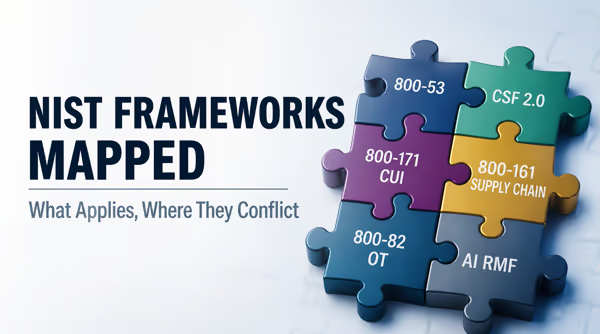
NIST framework group: the complete guide to 800-53, CSF 2.0, 800-171, OT overlays, supply chain, AI, and identity
Vulnox assessments show that 71% of organizations subject to multiple NIST frameworks are satisfying the wrong one first. This guide maps all 34 NIST frameworks -- from 800-53 baselines to the AI RMF and OT overlays -- showing where they overlap, where they conflict, and which controls buy you the most coverage across the group.
PCI DSS SAQ types explained: which one applies to your organization
Most merchants filing under SAQ A or SAQ B have never verified they actually qualify. In our assessments, SAQ misclassification is the single most common PCI DSS error we find — and it voids the compliance claim entirely.
NIST security and privacy framework group: all 34 publications mapped
Organizations subject to NIST requirements routinely implement the wrong framework or miss entire publications that apply to them. This maps all 34 NIST frameworks, their relationships, and the gaps that only appear when you read them together.
Ready to Secure Your Digital Assets?
Get a comprehensive vulnerability assessment for your website today.