What Happens When You Get a Data Breach in 2026
 Julian ThorneFebruary 20, 2026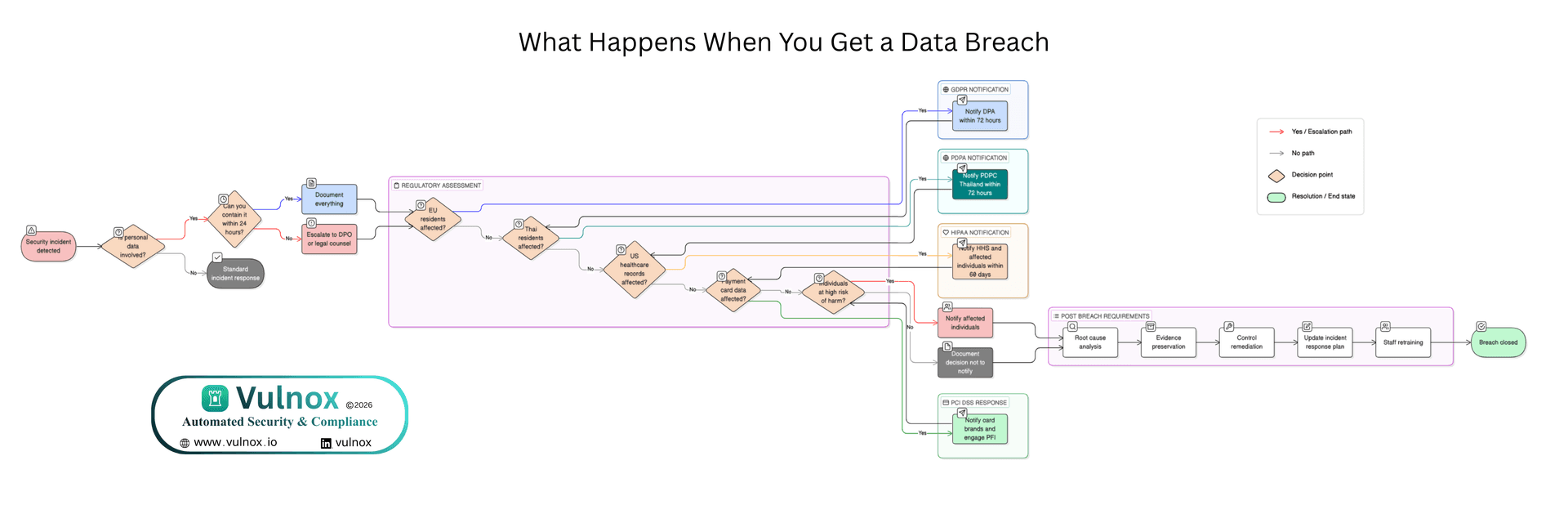
TL;DR
A data breach activates a multi-jurisdiction regulatory response sequence that most organizations are not operationally prepared to execute correctly under time pressure. The sequence begins with two containment decisions , whether personal data is involved and whether the breach can be contained within 24 hours , and branches immediately into parallel regulatory notification obligations that operate on incompatible timelines. GDPR requires supervisory authority notification within 72 hours of becoming aware of a breach. Thailand PDPA requires PDPC notification within 72 hours. HIPAA requires HHS notification within 60 days and individual notification within the same window, with media notification required when more than 500 residents of a single state are affected. PCI DSS requires immediate card brand notification and forensic investigator engagement. These timelines run simultaneously and independently , a breach affecting EU residents who are also US healthcare patients and who made card payments triggers all four frameworks concurrently. The organizations that execute breach response correctly are the ones that have built the decision tree into their incident response plan before the breach occurs, not the ones that construct the regulatory analysis from scratch while the clock runs.
The data breach response process in 2026 is a compliance execution problem disguised as a security incident problem. Security teams understand how to contain breaches , isolate affected systems, preserve forensic evidence, identify the attack vector, and remediate the vulnerability. What most security teams are not trained to execute under time pressure is the parallel regulatory notification analysis that activates the moment personal data involvement is confirmed. The regulatory analysis is not sequential , it does not wait for the security investigation to conclude before notification deadlines begin running. GDPR Article 33 notification obligation is triggered by awareness of the breach, not by completion of forensic investigation. The 72-hour clock starts when the organization has reasonable grounds to believe a breach affecting personal data of EU residents has occurred, even if the full scope of the breach is not yet known. Building breach response as a purely technical process and adding regulatory notification as a downstream step is the single most common structural error in incident response planning, and it is the error that produces the most costly regulatory enforcement outcomes.
The most operationally significant architectural principle in multi-jurisdiction breach response is that the regulatory assessment must run in parallel with containment, not after it. The moment a security incident is confirmed to involve personal data, the Data Protection Officer or legal counsel must be escalated to simultaneously , the containment track and the regulatory assessment track are parallel workstreams, not sequential phases. This parallel architecture is not optional under GDPR: Article 33(1) requires notification to the supervisory authority without undue delay and, where feasible, not later than 72 hours after becoming aware of the breach. An organization that spends the first 48 hours focused exclusively on technical containment and then begins its regulatory analysis with 24 hours remaining on the GDPR clock will produce an incomplete notification that understates the scope of affected data and the likely consequences of the breach , both of which are mandatory notification content under Article 33(3) , and will face supervisory authority scrutiny for the quality of its notification documentation.
The First 24 Hours: Containment, Documentation, and the DPO Escalation Decision
The breach response sequence begins with two questions that must be answered within the first hours of incident detection. The first is whether personal data is involved , and this question must be answered conservatively, treating ambiguous situations as personal data involvement until evidence clearly establishes otherwise. Personal data under GDPR Article 4 is any information relating to an identified or identifiable natural person, a definition broad enough to capture IP addresses, device identifiers, behavioral data, and pseudonymized data that can be re-identified when combined with other information the controller holds. The second question is whether the breach can be fully contained within 24 hours. This is not a question about whether containment can begin within 24 hours , it is a question about whether the threat can be fully neutralized and the attack vector closed within that window. If the answer is no, or if there is meaningful uncertainty, the correct path is immediate escalation to the DPO or legal counsel and initiation of the regulatory assessment track in parallel with ongoing technical containment.
Documentation must begin at the moment of detection, not at the moment the breach is fully understood. GDPR Article 33(5) requires controllers to document any personal data breaches, including the facts relating to the breach, its effects, and the remedial action taken , and this documentation obligation applies regardless of whether the breach ultimately meets the threshold for supervisory authority notification. ISO 27001:2022 Control 5.26 on response to information security incidents and Control 5.28 on collection of evidence provide the management system framework for building the documentation discipline that this regulatory obligation requires. Organizations that reconstruct their breach timeline after the fact from system logs and email threads rather than maintaining a contemporaneous incident log from the point of detection consistently produce notification documentation that contains internal inconsistencies , inconsistencies that supervisory authorities treat as indicators of inadequate incident response governance rather than as honest reconstruction artifacts.
The Regulatory Assessment: Four Parallel Notification Tracks That Run Simultaneously
The regulatory assessment phase activates when personal data involvement is confirmed and resolves into jurisdiction-specific notification obligations based on the population of affected data subjects. The EU resident question triggers GDPR Article 33 supervisory authority notification within 72 hours and, where the breach is likely to result in high risk to the rights and freedoms of natural persons under Article 34, direct notification to affected individuals without undue delay. The 72-hour clock is measured from awareness, and supervisory authorities have consistently interpreted awareness as the point at which the organization has sufficient information to know a breach affecting personal data has occurred , not the point at which the full scope is quantified. GDPR Recital 87 establishes that the controller should verify whether all appropriate technical protection measures were implemented and should use those measures to assess whether a notification to the supervisory authority is necessary, but this verification does not pause the notification timeline. Incomplete notifications submitted within 72 hours with a follow-up supplement as additional information becomes available are explicitly contemplated by Article 33(4) and are far preferable to complete notifications submitted after the deadline.
Thailand Personal Data Protection Act notification obligations run on the same 72-hour timeline as GDPR but are administered by the PDPC , the Personal Data Protection Committee , rather than by EU supervisory authorities. The Thailand PDPA, which reached full enforcement in June 2022, applies to any organization that collects, uses, or discloses personal data of data subjects located in Thailand, including organizations headquartered outside Thailand that process Thai resident data. The PDPA breach notification requirement under Section 37 requires the data controller to notify the PDPC within 72 hours of becoming aware of the breach unless the breach is unlikely to result in risk to the rights and freedoms of individuals , a risk threshold assessment that mirrors GDPR Article 33(1) language but is assessed independently by the PDPC under Thai law. For organizations operating across both EU and Thai data subject populations, the 72-hour notifications to the EU supervisory authority and the PDPC are separate filings with different content requirements, different notification portals, and different supervisory authority relationships , a dual-track notification process that must be coordinated simultaneously.
HIPAA breach notification obligations under 45 CFR Part 164 Subpart D apply when the breach affects protected health information , individually identifiable health information held by a HIPAA covered entity or business associate. The HIPAA notification timeline is structurally different from GDPR and PDPA: covered entities must notify HHS and affected individuals within 60 calendar days of discovery of the breach, with media notification required when more than 500 residents of a single state or jurisdiction are affected. Business associates must notify the covered entity within 60 days, with the covered entity notification clock to individuals running from the covered entity discovery date rather than the business associate discovery date. The HIPAA Breach Notification Rule distinguishes between breaches and security incidents that do not constitute breaches , specifically, the Rule provides that impermissible uses or disclosures of PHI are presumed to be breaches unless the covered entity or business associate demonstrates through a four-factor risk assessment that there is a low probability that the PHI has been compromised. That four-factor risk assessment , evaluating the nature and extent of PHI involved, the unauthorized person who used the PHI, whether the PHI was actually acquired or viewed, and the extent to which risk has been mitigated , must be documented as the basis for any decision not to provide HIPAA breach notification.
PCI DSS Breach Response: Card Brand Notification and the Forensic Investigator Requirement
PCI DSS breach response obligations activate when payment card data is confirmed or suspected to be in scope of the breach , and the PCI DSS response track operates on a faster timeline than any of the regulatory notification frameworks. PCI DSS Requirement 12.10.5 mandates that the incident response plan include alerts from security monitoring systems and escalation procedures, but the card brand response obligation is contractual rather than regulatory , it flows from the merchant or service provider agreement with the acquiring bank, which incorporates card brand operating regulations by reference. Visa and Mastercard operating regulations require merchants to notify their acquiring bank immediately upon confirmation or reasonable suspicion of a compromise of cardholder data, and the acquirer is responsible for notifying the card brands. The practical consequence is that PCI DSS breach response operates on an hours timeline, not a days timeline , the acquirer notification obligation is effectively immediate, which means the forensic investigator engagement and card brand notification must be initiated before the GDPR 72-hour clock has expired in many breach scenarios.
PCI DSS v4.0.1 Requirement 12.10.4 requires that incident response personnel receive training at least once every 12 months, and Requirement 12.10.6 requires that the incident response plan be modified and evolved to incorporate lessons from previous incidents and industry developments. The forensic investigation requirement , engaging a PCI Forensic Investigator from the PCI SSC approved PFI list , applies when card brands determine that a forensic investigation is necessary, which in practice means any confirmed or suspected account data compromise triggers PFI engagement. PFI engagements are conducted under card brand rules rather than client direction, and the PFI report is delivered to the card brands rather than exclusively to the breached entity , a structural feature of PCI forensic investigation that many organizations discover for the first time during an actual breach. Organizations that have pre-selected a PFI and established the engagement parameters before a breach occurs are significantly better positioned than those who begin PFI selection under breach conditions, because PFI capacity is limited and response times are contractually defined for organizations with pre-established relationships.
Individual Notification: The High Risk of Harm Assessment
The decision to notify affected individuals directly , as distinct from notifying regulatory authorities , is determined by a harm probability assessment that each regulatory framework structures differently. Under GDPR Article 34, individual notification is required when the breach is likely to result in high risk to the rights and freedoms of natural persons. The Article 29 Working Party guidance, now maintained by the European Data Protection Board through Guidelines 9/2022 on personal data breach notification, identifies factors that elevate breach risk to the high risk threshold: the nature of the personal data involved, including special category data under Article 9 such as health data, biometric data, racial or ethnic origin data, and political opinions; the volume of affected records; the ease of identification of individuals from the compromised data; the severity of consequences including financial harm, reputational damage, discrimination risk, and physical harm; and whether the data has been accessed by unauthorized parties with the capacity and apparent intent to misuse it.
When the regulatory assessment determines that individual notification is not required , because the breach does not meet the high risk threshold, or because the data was encrypted with keys not compromised in the breach, or because the HIPAA four-factor risk assessment concludes low probability of PHI compromise , the decision not to notify must be documented with the specific rationale that supports it. This documentation is not optional governance hygiene: it is the evidentiary record that demonstrates the organization applied the required regulatory analysis rather than simply choosing not to notify. GDPR Article 33(5) documentation obligations apply to breaches that do not meet the notification threshold as well as those that do, and the EDPB has been explicit in enforcement decisions that undocumented decisions not to notify are treated as evidence of inadequate breach response governance rather than as legitimate exercise of the regulatory exception. The documented decision not to notify , with a completed risk assessment, identified rationale, and approval by the DPO or legal counsel , is as important a compliance artifact as the notification itself.
Post-Breach Requirements: The Six Steps That Determine Whether the Breach Is Truly Closed
The post-breach requirements sequence , root cause analysis, evidence preservation, control remediation, incident response plan update, and staff retraining , represents the compliance obligations that determine whether a breach is genuinely closed or merely contained. Root cause analysis is not optional following a significant breach: GDPR Article 32 requires that controllers implement appropriate technical and organizational measures to ensure a level of security appropriate to the risk, and a breach that is not followed by documented root cause analysis and remediation provides supervisory authorities with evidence that the controller failed to maintain appropriate security rather than that the controller experienced an unavoidable incident. NIST SP 800-61 Rev 2, the Computer Security Incident Handling Guide, provides the methodological framework for root cause analysis that most compliance practitioners reference, and the root cause documentation produced under this framework serves as both the internal remediation driver and the regulatory evidence that the organization has addressed the vulnerability that enabled the breach.
Evidence preservation must be initiated before remediation begins , a sequencing requirement that creates practical tension in breach response because the instinct of technical teams is to remediate the vulnerability as quickly as possible. Forensic evidence that is overwritten during remediation is unrecoverable, and its absence can prevent both the root cause analysis from reaching accurate conclusions and the organization from establishing facts that limit regulatory liability. ISO 27001:2022 Control 5.28 on collection of evidence and NIST SP 800-86, the Guide to Integrating Forensic Techniques into Incident Response, provide the procedural framework for evidence preservation that must be completed before system restoration begins. Staff retraining as a post-breach requirement is not a generic cybersecurity awareness refresher , it is targeted retraining on the specific control failure or human behavior that the root cause analysis identified as a contributing factor, documented in a way that demonstrates the organization addressed the human element of the breach rather than treating it as purely a technical failure.
Pro tip
Map your data flows before you need to execute a breach response, and organize that map by jurisdiction of data subject residence rather than by data type or system location. The regulatory notification analysis that activates in a breach , EU residents affected, Thai residents affected, US healthcare records affected, payment card data affected , requires knowing which populations of data subjects are represented in each system, database, and data store. A data flow map organized by system architecture tells you where data lives but not which regulatory frameworks activate when that data is compromised. A data flow map organized by data subject jurisdiction tells you immediately, at the point of breach, which notification tracks are active and which DPAs, regulators, and card brands must be contacted. Building this map as part of your GDPR Article 30 Records of Processing Activities exercise produces a document that serves both ongoing GDPR compliance and breach response readiness simultaneously.
Pro tip
Conduct a tabletop breach response exercise at least annually that specifically tests the regulatory notification decision sequence rather than the technical containment sequence. Most tabletop exercises focus heavily on the technical response , isolating systems, identifying the attack vector, restoring from backup , and treat the regulatory notification as a brief final step. The exercises that produce the most improvement in breach response capability are those that force the DPO, legal counsel, CISO, and communications team to work through the regulatory assessment simultaneously with the technical response, making real-time decisions about which notification tracks are active, what the 72-hour clock status is, and what notification content can be assembled from available information. NIST SP 800-84 on guide to test, training, and exercise programs for IT plans and capabilities provides the exercise design framework, and the exercise findings should be used to update the incident response plan under PCI DSS Requirement 12.10.6 and HIPAA 164.308(a)(6) administrative safeguard requirements.
Data breach response in 2026 is a multi-jurisdiction regulatory execution problem that must be solved before the breach occurs, not during it. The decision sequence , confirming personal data involvement, initiating parallel containment and regulatory assessment tracks, escalating to DPO or legal counsel immediately, executing jurisdiction-specific notification obligations on their respective timelines, making and documenting the individual notification harm assessment, and completing the post-breach requirements sequence through root cause analysis, evidence preservation, remediation, plan update, and staff retraining , is executable under pressure only if it has been designed, documented, rehearsed, and pre-populated with the notification templates, regulatory contacts, and forensic investigator relationships the organization will need. Vulnox gap analysis engagements assess breach response readiness against the GDPR Article 33 and 34 requirements, HIPAA Breach Notification Rule obligations, PDPA notification requirements, and PCI DSS incident response requirements simultaneously, identifying the specific gaps in notification templates, DPO escalation procedures, and regulatory contact inventories that determine whether an organization executes breach response correctly or reconstructs it under enforcement scrutiny.
Further Reading
Gap Analysis
gap analysisVulnerability Assessment
vulnerability assessmentEDPB Guidelines 9/2022 on Personal Data Breach Notification
EDPB Guidelines 9/2022 on personal data breach notificationHHS HIPAA Breach Notification Rule
HHS HIPAA Breach Notification RuleNIST SP 800-61 Rev 2 Computer Security Incident Handling Guide
NIST SP 800-61 Computer Security Incident Handling Guide
Frequently Asked Questions
When does the GDPR 72-hour breach notification clock start running?
The GDPR Article 33 72-hour notification clock starts when the controller becomes aware of the breach — meaning when the organization has reasonable grounds to believe that a breach affecting personal data of EU residents has occurred. Supervisory authorities have consistently interpreted awareness as the point at which sufficient information exists to know a breach has occurred, not the point at which the full scope of the breach has been quantified through forensic investigation. This interpretation means that organizations cannot pause the 72-hour clock by citing an ongoing investigation. The practical consequence is that the regulatory assessment track must run in parallel with technical containment from the moment personal data involvement is confirmed. GDPR Article 33(4) explicitly accommodates incomplete initial notifications — a controller that cannot provide all required information within 72 hours may provide it in phases without undue delay, which means filing a timely incomplete notification with a supplement to follow is compliant, while filing a complete notification after the deadline is not. The notification must be made to the supervisory authority in the EU member state where the controller has its main establishment, or where the affected data subjects are located for controllers without an EU establishment.
What is the difference between HIPAA breach notification and GDPR breach notification requirements?
HIPAA and GDPR breach notification obligations differ on timeline, threshold, notification recipients, and the risk assessment methodology used to determine whether notification is required. GDPR requires supervisory authority notification within 72 hours of awareness and individual notification without undue delay when the breach is likely to result in high risk to the rights and freedoms of natural persons — the risk threshold is assessed using EDPB guidance factors including data sensitivity, volume, and likelihood of harm. HIPAA requires notification to HHS and affected individuals within 60 calendar days of breach discovery, with media notification required when more than 500 residents of a single state are affected — the timeline is longer but applies to a defined category of protected health information rather than all personal data. The threshold determination under HIPAA uses a four-factor risk assessment — evaluating the nature and extent of PHI, the identity of the unauthorized person, whether PHI was acquired or viewed, and the extent of mitigation — and impermissible disclosures are presumed to be reportable breaches unless this risk assessment affirmatively demonstrates low probability of compromise. A breach affecting individuals who are both EU residents and US healthcare patients triggers both frameworks simultaneously with different timelines, different notification recipients, and different content requirements that must be managed as parallel compliance workstreams.
What must an incident response plan include to satisfy PCI DSS v4.0.1 breach response requirements?
PCI DSS v4.0.1 Requirement 12.10 governs incident response planning and specifies that the plan must be implemented and ready to be activated in the event of a system breach. Requirement 12.10.1 requires a documented incident response plan that covers roles and responsibilities, communication and contact strategies, specific incident response procedures, business recovery and continuity procedures, data backup processes, analysis of legal requirements for reporting compromises, coverage and responses for all critical system components, and reference to or inclusion of incident response procedures from card brands. Requirement 12.10.4 requires that incident response personnel receive annual training. Requirement 12.10.5 requires that the plan include alerts from security monitoring systems. Requirement 12.10.6 requires that the plan be reviewed and updated following lessons from previous incidents and industry developments. Beyond the documented plan requirements, PCI DSS breach response obligates entities to notify their acquiring bank immediately upon confirmed or suspected cardholder data compromise, which triggers card brand notification and potential PCI Forensic Investigator engagement under card brand operating regulations. Pre-selecting a PFI from the PCI SSC approved list and establishing engagement parameters before a breach occurs is a significant operational advantage because PFI capacity is limited and response times are faster for entities with pre-established relationships.
Related Articles

GovRAMP Moderate authorization: why the Significant Change Request process catches providers off guard
GovRAMP Moderate is the first tier where you need a government sponsor, annual 3PAO reassessment, and a Significant Change Request process that can pause normal product releases for months. Most providers who stall post-authorization were not prepared for what maintaining Moderate status actually costs operationally.

GovRAMP Low+ authorization: the impact level that punishes providers who get the CUI boundary wrong
GovRAMP Low+ is where providers handling limited Controlled Unclassified Information land — or discover they should not be there. The defining failure is not a missing control. It is a CUI boundary that was drawn before anyone asked what data the government actually sends through the system.

GovRAMP High authorization: why FIPS-validated crypto and personnel security controls catch providers off guard
GovRAMP High is where cloud providers discover that having strong encryption is not the same as having FIPS 140-2 validated encryption — and that distinction alone has derailed authorizations from vendors who passed every other control family. The architectural constraints at High are qualitatively different from every lower tier.
Ready to Secure Your Digital Assets?
Get a comprehensive vulnerability assessment for your website today.