CIS CSC v8.1 IG2 compliance: what hands-on testing actually finds
 Amara OkaforMay 5, 2026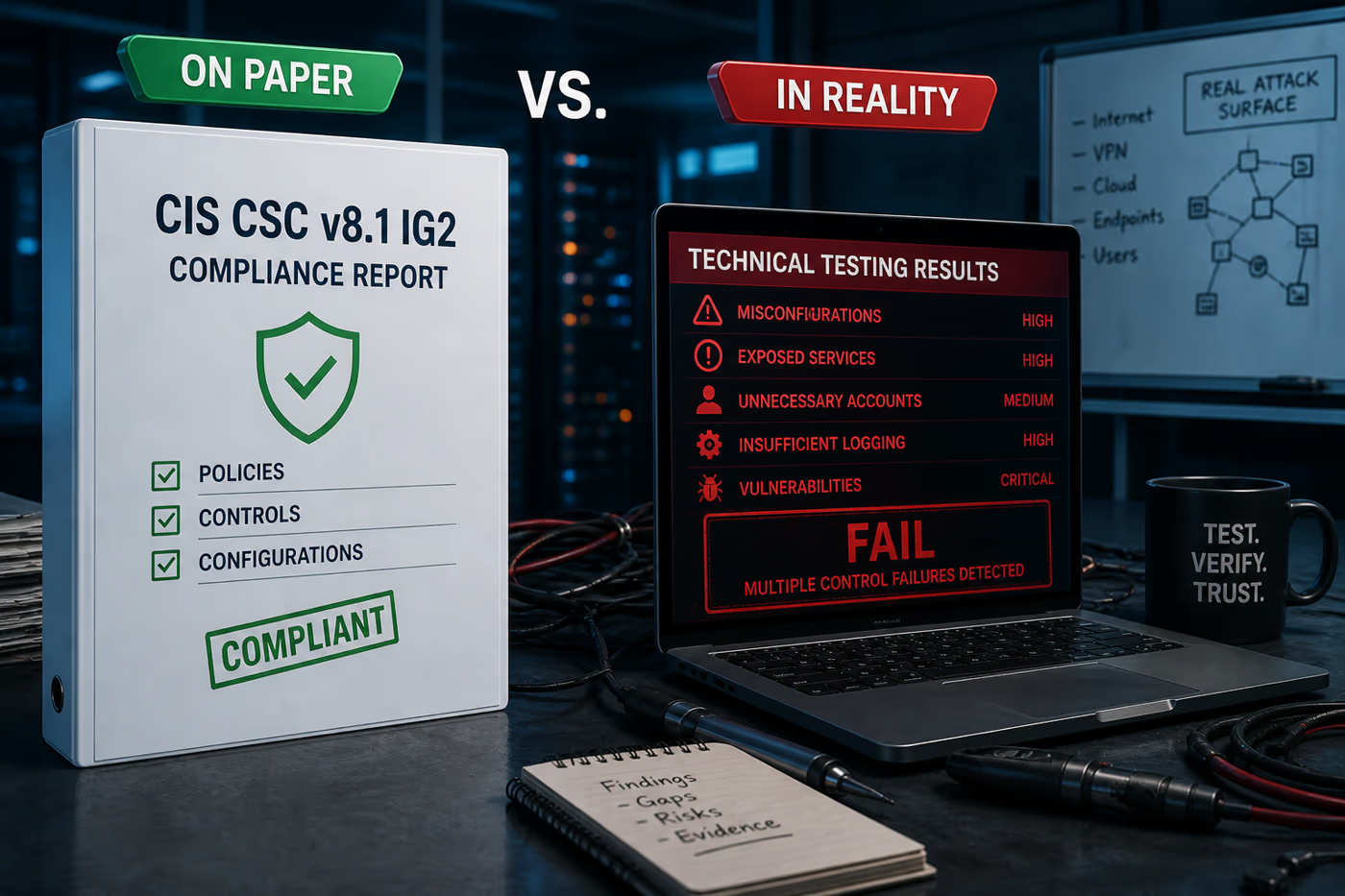
Key takeaways
CIS CSC v8.1 IG2 covers 72 Safeguards across 18 Controls, targeting organizations with moderate risk exposure and IT staff who are not dedicated security specialists.
Organizations that self-report full IG2 compliance fail hands-on validation of CIS Control 1 (asset inventory) in the majority of Vulnox assessments — undiscovered assets average 23% of the actual environment.
CIS v8.1 changed the control structure from v7.1 significantly: Controls are now technology-agnostic, and IG2 explicitly excludes 11 Safeguards reserved for IG3 — knowing which ones matters for scoping.
MFA enforcement gaps are the most common finding in IG2 assessments. Self-assessment says MFA is enabled; hands-on testing finds it enforced only on primary SSO login, not on legacy protocols, backup admin consoles, or API access.
Log coverage under CIS Control 8 (Audit Log Management) is routinely miscounted. Organizations log the systems they know about. Undiscovered assets generate no logs — meaning the log coverage percentage is calculated against an artificially small denominator.
IG2 has no mandatory penetration testing requirement. That is the one structural gap that distinguishes it from IG3 and the one gap attackers exploit most reliably.
TL;DR
CIS CSC v8.1 IG2 is a serious framework for mid-market organizations that have outgrown basic hygiene but are not running a full security operations function. The problem is not the framework — it is that IG2 evidence collection relies heavily on self-assessment and documentation review. When you test the controls rather than the documentation, a consistent set of failures appears across asset inventory, MFA enforcement, and log completeness. Those three gaps are not random. They are structural artifacts of how IG2 gets implemented under resource pressure.
What a passing IG2 assessment actually looks like
A 200-person professional services firm comes into an assessment self-reporting full CIS IG2 compliance. They have documentation for every Safeguard. The asset inventory spreadsheet is current as of last quarter. MFA is listed as enabled across all systems. Log retention is set to 13 months. On paper, this organization is exactly where IG2 wants them.
Three hours into the technical validation phase, the inventory count is already wrong. A subnet used by the facilities management vendor has 14 active hosts that are not on any list. The MDM solution that tracks endpoints only covers company-issued devices — contractor laptops running on the same network segment are invisible to it. By end of day, the undiscovered asset count is at 31 devices, approximately 18% of the environment the organization thought they had.
The MFA finding comes later. MFA is enforced on the primary SSO portal. It is not enforced on the legacy VPN concentrator still used by three field engineers who never migrated to the new solution. It is not enforced on the backup administrative interface for the network management platform, which has a different credential store from the main SSO. It is not enforced on the API tokens used by three internal automation scripts, which authenticate with static secrets stored in environment variables.
None of this is negligence. The organization did what IG2 asks. They implemented the controls. They documented them. What they did not do — and what IG2 does not explicitly require — is test whether the controls behave as documented under realistic conditions. That is the structural gap this framework inherits from its evidence model.
What IG2 actually requires and where the evidence model breaks
CIS CSC v8.1 reorganized the control structure substantially from v7.1. The 20 controls became 18. The sub-controls became Safeguards, each assigned to an Implementation Group. IG2 inherits all 56 IG1 Safeguards and adds 74 more, for a total of 130 Safeguards across the 18 Controls. IG3 adds a further 23 on top of that.
The intent behind IG2 is a recognizable organizational profile: moderate risk exposure, some dedicated IT staff, no full security operations center, and sensitivity to data loss or service disruption even if not subject to the heaviest regulatory regimes. Think a regional law firm, a mid-sized healthcare MSO, a 150-person SaaS company handling financial data. These organizations have real exposure and real staff capable of implementing meaningful controls, but they are not running 24/7 threat detection programs.
The Safeguards in IG2 are technically substantive. Control 1 (Inventory and Control of Enterprise Assets) requires active discovery, not passive enumeration. Control 3 (Data Protection) requires data classification and handling procedures that go beyond labeling. Control 8 (Audit Log Management) requires central log collection, not just local logging enabled. Control 12 (Network Infrastructure Management) requires documented network architecture, segmentation, and traffic filtering — not just a firewall at the perimeter.
The evidence model is where IG2 runs into problems at scale. CIS does not prescribe a specific audit methodology. Organizations demonstrating compliance typically produce documentation, configuration screenshots, and policy artifacts. Assessors reviewing these artifacts are evaluating whether the documentation describes a compliant control — not whether the control behaves as documented under real conditions. That distinction is where the gap lives.
Example
CIS Control 4 (Secure Configuration of Enterprise Assets and Software) requires organizations to establish and maintain a secure configuration process using a configuration assessment tool. The IG2 Safeguard 4.1 calls for establishing and maintaining a secure configuration process. Safeguard 4.2 requires establishing and maintaining a secure configuration process for network infrastructure. What an assessor reviewing documentation sees: a configuration standard document, a list of approved baselines, a reference to the tool used. What hands-on testing finds: the configuration standard was last updated 14 months ago, the tool runs monthly scans, and the drift between current configs and the baseline averages 6 deviations per device — with zero remediation workflow attached to the scan output.
CIS v8.1 introduced implementation notes and procedures for each Safeguard that v7.1 lacked. These notes describe what implementation looks like in practice. Reading the notes alongside the Safeguard text is not optional if you want to know what the framework actually requires — the Safeguard title alone systematically understates the work.
What technical validation finds that documentation review misses
Assessment base: Findings based on Vulnox technical assessments of mid-market organizations (50 to 500 employees) across professional services, fintech, healthcare technology, and SaaS verticals, 2023 to 2024.
Asset inventory undercounts average 23% across IG2-assessed environments
In Vulnox assessments of organizations self-reporting IG2 compliance, active network discovery consistently surfaces assets not present in the documented inventory. The sources are predictable: IoT and facilities management devices on corporate subnets, contractor and BYOD endpoints connected to segmented networks that MDM does not cover, legacy servers running internal tools that were migrated from but never decommissioned, and cloud instances spun up outside the formal provisioning process. The average undercount across assessed environments is 23% of total discovered assets (Vulnox assessment data, 2024).
The client assumption going in is almost always the same: ''our MDM covers endpoints and our CMDB covers servers, so inventory is handled.'' The actual root cause is that both tools only discover what connects through managed channels. Anything that authenticates differently, runs on a different subnet, or was provisioned outside the formal process is invisible. CIS Control 1 requires active discovery specifically to catch these gaps — but ''active discovery'' in many implementations means running a scan against the known IP ranges, not against the full routable address space.
MFA enforcement is partial in the majority of IG2-compliant environments tested
MFA enforcement findings break into three consistent categories. First, legacy protocol bypass: MFA is enforced at the SSO layer but legacy authentication protocols (basic auth, NTLM, IMAP) remain enabled on services that do not support modern authentication. Disabling legacy protocols is documented as a prerequisite step in most MFA deployment guides and is consistently skipped. Second, secondary console exposure: network management platforms, backup solutions, and virtualization management interfaces often have independent credential stores and admin consoles that were not included in the SSO integration. Third, API and service account exemption: automation scripts, monitoring agents, and CI/CD pipelines authenticate with static tokens or service account credentials with no MFA equivalent. These accounts frequently have elevated permissions.
The client self-assessment marks MFA as complete because MFA is enabled. Enabled and enforced are different states. An attacker with a valid credential for a legacy protocol or a service account does not encounter MFA at any point in the authentication flow. IG2 Safeguard 6.3 requires MFA for externally-exposed applications; Safeguard 6.4 requires it for remote network access. Neither Safeguard specifies enforcement against legacy protocol paths, which is the most common attack route.
Log coverage is calculated against a denominator that excludes undiscovered assets
This finding is structurally linked to the inventory gap. Organizations report log coverage as a percentage of known systems sending logs to the SIEM. If 80% of known systems are forwarding logs, that is the reported coverage figure. Undiscovered assets generate events. Those events go nowhere. The actual coverage figure — calculated against the full discovered asset inventory — is consistently lower than the self-reported figure, sometimes by a significant margin. In one assessment of a 300-person fintech running a self-reported 85% log coverage rate, post-discovery coverage against the full asset inventory was 61% (Vulnox assessment data, 2024).
The log completeness gap is not a SIEM configuration problem. It is an inventory problem that expresses itself as a log problem. Fixing it requires fixing asset discovery first. Organizations that remediate log gaps by tuning their SIEM without expanding their discovery scope close a documentation gap, not a security gap.
Configuration drift from CIS benchmarks is near-universal by the six-month mark
CIS publishes benchmarks for most major operating systems, applications, and cloud platforms. IG2 Control 4 requires secure configuration processes tied to these benchmarks. Assessments find that organizations implement benchmark hardening at provisioning time and then drift. Patch cycles, application updates, vendor support calls, and emergency changes all introduce deviations. Without continuous configuration assessment and a documented exception process, the benchmark state becomes historical within months. In assessed environments, the average number of benchmark deviations per server-class asset at the 6-month post-hardening mark is 7 (Vulnox assessment data, 2024). Most organizations have no workflow for detecting or remediating these deviations between formal assessments.
The assumption is that a hardened build stays hardened. It does not. Configuration drift is not a failure of the hardening process — it is the expected behavior of maintained systems in environments where change management does not include configuration compliance checks. IG2 Safeguard 4.1 requires maintaining the secure configuration process, not just establishing it. The maintenance requirement is the part that gets dropped.
The control most organizations implement correctly is not the one that matters most
Common belief
Organizations treat CIS Control 16 (Application Software Security) as the high-effort, high-value control in IG2. It covers secure development practices, third-party code review, vulnerability management for applications. It is the control that gets the most internal discussion, the most tooling investment, and the most representation in security program roadmaps. The assumption is that application security is where the real exposure lives.
What we found
In Vulnox assessments where a specific initial access vector could be identified, undiscovered or misconfigured infrastructure assets accounted for the majority of cases. Application-layer vulnerabilities were present but rarely the path of least resistance given the state of the infrastructure controls in the same environments.
In practice, the controls that generate attacker access in mid-market breaches are not application security failures. They are Control 1 failures (undiscovered assets running unpatched services), Control 4 failures (configuration drift that re-enables attack surface), and Control 6 failures (credential compromise enabled by partial MFA enforcement). These three controls are procedurally unglamorous. They do not involve secure coding practices or dependency scanning. They involve running discovery scans against the full address space, validating configuration state continuously, and confirming that authentication enforcement applies to every path into a system, not just the primary one.
Application security is the right thing to invest in. It is also the control where mid-market organizations have the strongest existing processes — because development teams have been running SAST tools and dependency scanners for years, driven by developer toolchain defaults rather than security program decisions. The controls that are actually weak are the infrastructure hygiene controls that predate the modern toolchain culture and have been ''implemented'' through documentation rather than continuous validation.
The IG2 blind spots that the framework does not address
No penetration testing requirement
IG2 does not require penetration testing. IG3 Safeguard 18.3 requires external penetration testing and 18.5 requires internal testing. IG2 stops at vulnerability scanning (Safeguard 7.5 and 7.6). The distinction matters because vulnerability scanning identifies known vulnerabilities against signatures and version fingerprints. Penetration testing identifies whether those vulnerabilities are actually exploitable given the specific configuration of the environment, whether chained misconfigurations create access that no individual vulnerability scan would flag, and whether the defensive controls actually detect the activity. An organization at full IG2 compliance can have a network that is exploitable end-to-end and never know it because nothing in the framework requires confirming that the controls hold against a simulated attacker.
Cloud and SaaS asset coverage is ambiguous
CIS v8.1 made the controls technology-agnostic, which was the right call. The implementation guidance for cloud and SaaS environments is less precise than for on-premises infrastructure. Control 1 asset inventory requirements technically apply to cloud instances and SaaS applications — but the tooling that most organizations use for asset discovery does not enumerate cloud assets by default. Organizations running hybrid environments frequently have one inventory process for on-premises assets and a separate (and usually less mature) process for cloud assets. The gap between them is where undiscovered assets live.
Third-party and supply chain access is underscoped
IG2 Control 15 (Service Provider Management) is the relevant control for third-party risk. The Safeguards under IG2 require classifying service providers, establishing policies, and maintaining contracts with security requirements. What they do not require is technical validation of whether third-party access to your environment is actually scoped correctly. In assessed environments, vendor remote access accounts frequently have broader permissions than the vendor relationship requires, are not subject to MFA enforcement because the vendor uses a different authentication path, and are not deprovisioned after project completion. The control framework asks whether contracts contain the right language. It does not ask what the vendor can actually reach.
The evidence standard advantages documentation over demonstrated behavior
This is not unique to CIS. It applies to most framework assessments that rely on documentation review and interviews rather than technical testing. The evidence standard for most IG2 Safeguards is satisfied by a policy document, a configuration screenshot, or a vendor attestation. None of these confirm that the control operates as described under load, after a configuration change, or against an actual authentication attempt using an unexpected protocol path. Organizations that have invested in documentation can pass IG2 assessment with controls that would fail under realistic testing conditions.
Where IG2 compliance goes from here
By 2027, at least one major cyber insurance carrier will require technical control validation — not documentation review — as a condition of IG2-aligned policy pricing for mid-market clients.
Cyber insurers are already tightening underwriting requirements. The current model relies heavily on self-reported questionnaires, which produce the same documentation-over-reality gap that framework assessments do. Carriers who have access to post-breach forensic data are seeing the pattern: organizations that self-reported compliant control states had controls that failed under attack conditions. The financial incentive to close the gap between self-reported and validated compliance is already present. Validation requirements are the mechanism to close it.
Confidence: highCheck cyber insurance underwriting guidelines from the five largest mid-market carriers in 2027. If none require technical validation as a pricing or eligibility condition, the prediction is wrong.The term ''compliance-validated'' versus ''compliance-documented'' will become a distinct market category within the CIS Controls ecosystem within three years, driven by organizations that have experienced breaches despite passing IG2 assessments.
The category does not yet have a widely used name. But the distinction is already present in how assessments are being scoped at the high end of the market. Organizations that have gone through a breach and then looked at their pre-breach compliance posture are asking for a different kind of assessment — one that tests rather than documents. The demand exists before the label does. Once enough organizations have the same conversation with their assessors, the label follows.
Confidence: mediumSearch CIS community forums, assessor certification program updates, and major framework provider documentation for the terms ''validated compliance'' or ''tested compliance'' as a distinct service or evidence standard category by 2027.
The framework is not the problem — the evidence model is
This is worth stating directly because the alternative interpretation is that CIS CSC v8.1 IG2 is a weak framework and organizations should look elsewhere. That is the wrong conclusion. The 18 Controls and the IG2 Safeguard set describe a genuinely useful security program for the organizational profile they target. The specific technical requirements — active asset discovery, authenticated scanning, centralized log collection, benchmark-based configuration management — are the right things to be doing. The problem is not what the framework requires. The problem is what counts as evidence that you are doing it.
A policy document describing your asset discovery process is not the same as a scan report showing what your discovery process actually found. A MFA policy document is not the same as an authentication log showing that MFA was challenged on every login attempt including the ones using legacy protocols. The framework does not prevent organizations from producing the latter. It also does not require it. And under resource pressure, organizations consistently produce the former.
The counterargument is that requiring technical validation for every IG2 Safeguard would make compliance inaccessible to the mid-market organizations the framework targets. That is a legitimate concern. Full technical validation of 130 Safeguards is expensive. The resolution is not to abandon the evidence standard improvement — it is to prioritize validation effort on the Safeguards where documentation is most likely to diverge from operational reality. Asset inventory, MFA enforcement coverage, and log completeness are the three. Those three Safeguards should always be technically validated, regardless of what documentation exists. Everything else can use the lighter evidence standard.
Counterargument
Requiring technical validation raises the cost of compliance assessment in ways that disproportionately burden the small and mid-market organizations IG2 is designed for. If validation requirements price organizations out of formal compliance programs, the net result is less security, not more.
One thing to do this week
Pull your current asset inventory and run an active discovery scan against your full routable address space — not just the IP ranges in your CMDB. Compare the two lists. The gap between them is the number that tells you whether your IG2 compliance posture is documented or real. If the gap is zero, your inventory process is working. If it is not zero, you have undiscovered assets generating no logs, covered by no EDR, and excluded from your vulnerability scanning scope. That gap is where the argument for documentation-based compliance falls apart fastest, and it is the one finding you can confirm or close before any formal assessment process begins.
Further Reading
Qatar Personal Data Privacy Law compliance
Qatar Personal Data Privacy Law: Complete PDPPL Compliance GuideCIS CSC v8.1 IG3 requirements
CIS CSC v8.1 IG3 requirements: the external attack surface your program still ignoresSB1386 compliance assessment
CA SB1386 Breach Notification Compliance GuideCIS critical security controls v8.1: IG1, IG2, and IG3 explained
CIS CSC v8.1 IG2 compliance gaps that hands-on testing consistently uncovers
Frequently Asked Questions
What is CIS CSC v8.1 IG2 and who is it designed for?
CIS CSC v8.1 IG2 (Implementation Group 2) covers 130 Safeguards across 18 Controls and targets organizations with moderate risk exposure, some dedicated IT staff, and sensitivity to data loss or service disruption. It is designed for mid-market organizations — typically 50 to 500 employees — that have outgrown basic hygiene controls but are not operating a full security operations center.
What is the difference between CIS IG2 and IG3?
IG3 adds 23 Safeguards to the 130 in IG2, targeting organizations with the highest risk exposure and dedicated security teams. The most significant practical difference is that IG3 requires penetration testing (Safeguards 18.3 and 18.5) while IG2 only requires vulnerability scanning. Organizations at IG2 can have fully exploitable environments and satisfy the framework''s testing requirements because nothing in IG2 requires confirming that controls hold against a simulated attacker.
What do organizations most commonly fail in a CIS IG2 technical assessment?
The three most common failure points in technical validation of CIS IG2 controls are: asset inventory accuracy (undiscovered assets averaging 23% of the actual environment in Vulnox assessments), MFA enforcement completeness (enforced on SSO but not on legacy protocols, backup admin consoles, or API access), and log coverage completeness (calculated against known assets only, with undiscovered assets generating unmonitored events).
Does CIS CSC v8.1 require penetration testing?
No. CIS CSC v8.1 IG2 does not require penetration testing. The framework requires vulnerability scanning under Control 7 (Safeguards 7.5 and 7.6). Penetration testing is an IG3 requirement under Control 18. This means organizations fully compliant with IG2 have no framework obligation to test whether their controls hold against a real attacker attempting to chain misconfigurations or bypass authentication controls.
How does CIS v8.1 differ from v7.1 in structure?
CIS v8.1 reorganized the framework from 20 Controls in v7.1 to 18 Controls, renamed sub-controls as Safeguards, and made the controls explicitly technology-agnostic to address cloud and SaaS environments. Each Safeguard in v8.1 includes implementation notes and procedures that v7.1 lacked. Reading only the Safeguard title without the implementation notes systematically understates what the control actually requires.
Why is CIS IG2 asset inventory compliance so commonly overstated?
Asset inventory overstating happens because organizations build their inventory from managed channels — MDM for endpoints, CMDB for servers, cloud console for cloud instances. Anything that authenticates differently, runs on an unmanaged subnet, or was provisioned outside the formal process is invisible to these tools. CIS Control 1 requires active discovery specifically to catch these gaps, but ''active discovery'' in many implementations means scanning known IP ranges rather than the full routable address space.
What is the biggest structural gap in how CIS IG2 compliance is typically assessed?
The evidence standard for most IG2 Safeguards is satisfied by documentation: policies, configuration screenshots, vendor attestations. None of these confirm that the control operates as described under realistic conditions. Organizations that invest in documentation can pass IG2 assessment with controls that would fail under actual testing. The framework does not prevent technical validation — it does not require it, and under resource pressure, documentation consistently substitutes for demonstrated control behavior.
Related Articles

GovRAMP Moderate authorization: why the Significant Change Request process catches providers off guard
GovRAMP Moderate is the first tier where you need a government sponsor, annual 3PAO reassessment, and a Significant Change Request process that can pause normal product releases for months. Most providers who stall post-authorization were not prepared for what maintaining Moderate status actually costs operationally.

GovRAMP Low+ authorization: the impact level that punishes providers who get the CUI boundary wrong
GovRAMP Low+ is where providers handling limited Controlled Unclassified Information land — or discover they should not be there. The defining failure is not a missing control. It is a CUI boundary that was drawn before anyone asked what data the government actually sends through the system.

GovRAMP High authorization: why FIPS-validated crypto and personnel security controls catch providers off guard
GovRAMP High is where cloud providers discover that having strong encryption is not the same as having FIPS 140-2 validated encryption — and that distinction alone has derailed authorizations from vendors who passed every other control family. The architectural constraints at High are qualitatively different from every lower tier.
Ready to Secure Your Digital Assets?
Get a comprehensive vulnerability assessment for your website today.