ISO framework group: ISO 27001, 27002, 27017, 27018, 27701, 22301, 31000, 42001 and more

Key takeaways
ISO 27001:2022 is the only certifiable standard in this group that governs the management system itself — all other ISO standards in this family either extend it, support it technically, or operate in adjacent domains.
ISO 27002:2022 restructured from 114 controls across 14 domains to 93 controls across 4 themes, introducing an attribute tagging system that maps directly to NIST CSF functions — the most underused multi-framework efficiency tool in the ISO family.
ISO 27701:2025 requires an existing ISO 27001-compatible ISMS as a prerequisite — organizations that pursue 27701 without a mature 27001 foundation consistently underestimate the remediation scope by 40 to 60 percent in our assessments.
ISO 27017 and ISO 27018 address cloud security and cloud privacy respectively — both extend ISO 27002, but they address opposite sides of the shared responsibility boundary: 27017 covers the security split between provider and customer, 27018 covers what the provider cannot do with the data at all.
ISO 42001:2023, the AI management system standard, shares the same High Level Structure as ISO 27001 — organizations already certified can integrate AI governance without a parallel management system, but fewer than 10 percent of ISO 27001-certified organizations have mapped this overlap and used it.
ISO 22301:2019 and ISO 27001 are the most commonly paired standards in this group, yet fewer than half of organizations that hold both certifications have integrated their Business Impact Analysis outputs with their ISO 27001 risk treatment decisions — they exist as parallel documents, not a connected system.
ISO 31000 and ISO 31010 are referenced but rarely implemented as working tools — most organizations cite them in their risk methodology documentation while actually performing qualitative heat-map exercises that satisfy neither standard''s intent.
TL;DR
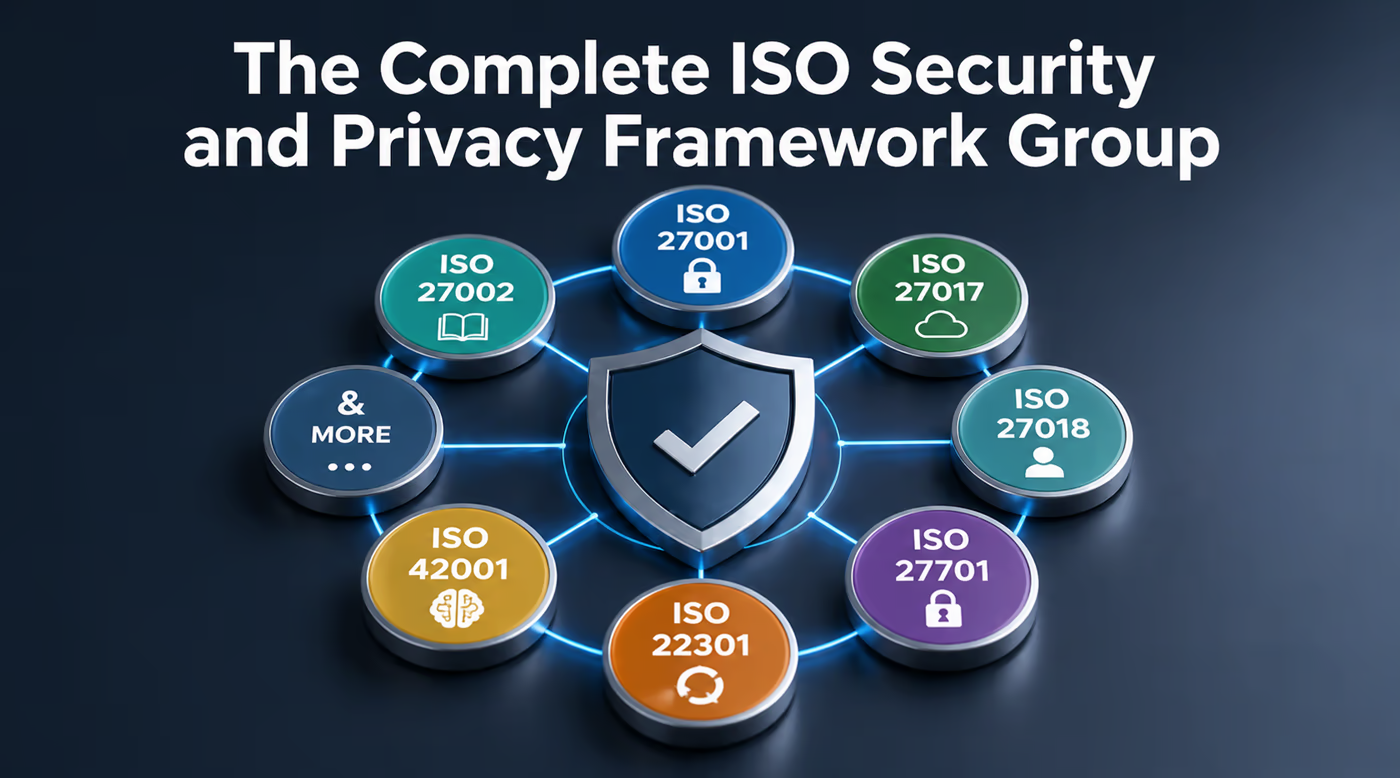
The ISO framework group is not a flat set of independent standards. It is a layered architecture with ISO 27001 at the centre, ISO 27002 as its control catalogue, and ISO 27017, 27018, 27701, and 29100 as domain extensions. ISO 22301, 31000, and 31010 feed into the risk and resilience infrastructure. ISO 42001 is the newest layer, sitting above information security and requiring its own governance additions. What organizations consistently get wrong is treating these as separate compliance checkboxes rather than a single interconnected system — and that mistake produces the exact compliance gaps that auditors and attackers both exploit.
The company that held four ISO certifications and still failed a GDPR processor audit
A SaaS provider in the Netherlands came to us after a GDPR processor audit by a large enterprise customer identified 23 open findings. They held ISO 27001, ISO 27017, ISO 27018, and ISO 22301 certifications. Their last external audit had produced no major nonconformities. The problem was not that their controls did not exist. The problem was that their ISO 27018 certification covered a different service scope than the processing activities described in their data processing agreements. Their ISO 27701 extension had never been completed. Their ISO 27002 Statement of Applicability excluded data masking and data leakage prevention with a one-line justification. And their ISO 22301 BIA had been conducted at the application tier without including the sub-processors who actually held the customer data at rest.
Four certifications, each individually defensible under audit, collectively producing a picture that did not match operational reality. This is not unusual. It is, in our experience, the normal outcome when ISO frameworks are pursued sequentially as compliance milestones rather than designed as an integrated system from the start.
The ISO framework group: what it covers and how the pieces connect
The ISO standards in this group span information security management, privacy, cloud security, risk methodology, business continuity, AI governance, and automotive cybersecurity. What unifies them is architectural: most were designed to interoperate, and many explicitly build on or extend others within the family.
ISO 27001:2022 is the anchor. It specifies what an Information Security Management System must do — establish a governance structure, assess risks, select and implement controls, monitor effectiveness, and improve continuously. ISO 27002:2022 specifies what those controls look like. ISO 27017, ISO 27018, and ISO 27701 extend the control environment into cloud security, cloud privacy, and privacy management respectively. ISO 29100 provides the foundational privacy principles that underpin all of them.
ISO 31000 and ISO 31010 sit beneath the risk assessment layer of ISO 27001 — they define the process and the techniques by which risks are identified, analysed, and evaluated. ISO 22301 covers the continuity dimension: what happens when controls fail and operations must be maintained or recovered.
ISO 42001 is the newest addition, bringing AI governance into the family using the same High Level Structure — meaning it can be bolted onto an existing ISO 27001 ISMS without duplicating the management system infrastructure.
ISO/SAE 21434 sits apart from the rest. It addresses automotive cybersecurity engineering specifically, and while it applies the same risk-thinking principles, it has its own methodology, its own lifecycle scope, and its own regulatory dependency in the form of UN Regulation 155. It is ISO in name and methodology but automotive in application.
ISO/IEC 27001:2022
ISO/IEC 27002:2022
ISO/IEC 27017:2015
ISO/IEC 27018:2014
ISO/IEC 27701:2025
ISO/IEC 29100:2024
ISO/IEC 22301:2019
ISO/IEC 31000:2009
ISO/IEC 31010:2009
ISO/IEC 42001:2023
ISO/SAE 21434:2021
Framework by framework: what each one actually requires
Frameworks
ISO/IEC 27001:2022
Any organisation that wants a certifiable, internationally recognised information security management system. Applies across all industries and sizes. Most commonly pursued by technology companies, financial services firms, healthcare providers, and government contractors where customers or regulators require it as a baseline qualification.
The Statement of Applicability becomes a documentation exercise disconnected from operational controls. Controls are listed as implemented because they exist somewhere in the organisation, not because they are effective. Risk treatment decisions are not revisited when the threat landscape or business context changes. The ISMS exists on paper; the security programme exists in IT.
A documented ISMS scope, a risk assessment methodology that is defined and repeatable, a Statement of Applicability mapping Annex A controls to risk treatment decisions with justification for exclusions, evidence of top management involvement in security decisions, an internal audit programme, and management review meetings with documented outputs. The 2022 revision added requirements around planning for changes, attributes on controls aligned to ISO 27002:2022, and a stronger emphasis on demonstrating that controls are effective, not just implemented.
Certification is voluntary but commercially enforced through procurement requirements. Loss of certification triggers customer notification obligations under many enterprise contracts. Surveillance audits occur annually; full recertification every three years. Nonconformities identified during surveillance can result in certification suspension.
ISO 27001 is the certifiable management system that gives the rest of the group its authority. ISO 27002 is its control catalogue. ISO 27017, 27018, 27701, and 42001 are all implemented as extensions of or alongside an ISO 27001 ISMS. ISO 22301 uses the same High Level Structure. ISO 31000 informs the risk assessment methodology. ISO/SAE 21434 borrows the management system concept but operates in a separate regulatory context.
ISO/IEC 27002:2022
Security architects, control owners, and assessors implementing or evaluating controls within an ISO 27001 ISMS. Not certifiable independently — used as a reference standard during implementation and audit. Also used by anyone mapping controls across multiple frameworks.
The 11 new controls in the 2022 revision — threat intelligence, data masking, data leakage prevention, secure coding, web filtering, cloud service security, ICT readiness for business continuity, physical security monitoring, configuration management, information deletion, and monitoring activities — are the ones most commonly excluded without adequate justification. They were added because they became critical in the decade since 2013. Excluding them requires documented rationale tied to the organisation''s risk context, not a generic ''not applicable'' statement.
The 2022 edition provides 93 controls across four themes: 37 organisational, 8 people, 14 physical, and 34 technological. Each control entry includes purpose, the control statement, implementation guidance, and other information. The attribute system tags each control with cybersecurity concept (aligned to NIST CSF Identify-Protect-Detect-Respond-Recover), control type, information security properties, operational capability, and security domain — enabling multi-dimensional filtering and cross-framework mapping.
No direct enforcement. ISO 27001 auditors use ISO 27002 as the reference when assessing whether Annex A controls are adequately implemented. Inadequate implementation guidance in the Statement of Applicability, where controls are listed without substance, produces audit findings against ISO 27001.
ISO 27002 is the implementation specification for ISO 27001 Annex A controls. ISO 27017 extends 37 of those controls with cloud-specific guidance and adds 7 cloud-only controls. ISO 27018 extends the control set with PII-specific requirements. ISO 27701 adds a privacy layer to the control environment. The attribute system in ISO 27002:2022 is the most practical tool available for mapping controls to NIST CSF, CIS Controls, or other frameworks.
ISO/IEC 27017:2015
Cloud service providers (IaaS, PaaS, SaaS) demonstrating security assurance to enterprise customers, and cloud service customers defining and managing provider security obligations. Both perspectives are addressed explicitly within the standard.
The shared responsibility documentation required by the seven cloud-only controls is rarely maintained at the granularity the standard intends. Providers produce a generic shared responsibility matrix covering IaaS, PaaS, and SaaS in aggregate — not the customer-specific, service-specific allocation of responsibilities that a genuine ISO 27017 implementation requires. Customers accept the generic matrix without verifying it applies to their actual service configuration.
Cloud-specific implementation guidance for 37 ISO 27002 controls, covering how those controls differ in cloud contexts — virtual resource inventory, cloud management plane access controls, API call logging, split key management. Seven additional controls with no ISO 27002 equivalent: shared roles and responsibilities documentation, asset return on contract termination, virtual environment segregation, virtual machine hardening, monitoring of administrative operations, security policy alignment between customer and provider, and virtual network security.
No standalone certification. Implemented as a scope extension of ISO 27001 certification. Enterprise procurement increasingly references ISO 27017 alongside ISO 27001 as a cloud supplier baseline. Absence of alignment is frequently raised as a finding in cloud security assessments.
Extends ISO 27002 with cloud-specific control guidance. Typically implemented alongside ISO 27018 for cloud providers serving regulated industries. The split key management and provider administrative access monitoring controls directly address risks that ISO 27001 alone does not adequately cover in cloud environments.
ISO/IEC 27018:2014
Public cloud service providers acting as PII processors — organisations that process personal data on behalf of enterprise customers but do not determine the purposes of that processing. Does not apply to controllers.
The prohibition on using customer PII for the provider''s own purposes is commercially significant and frequently misunderstood. Providers with analytics products built on aggregated customer data have faced the question of whether anonymisation is sufficient to satisfy this requirement — the answer depends on whether re-identification is technically feasible, and that determination is rarely made with the rigour the standard contemplates.
Purpose limitation: PII processed only for purposes specified in the contract, with no use for the provider''s own advertising, analytics, or marketing without explicit customer consent. Transparency: disclosure of sub-processor locations, notification of law enforcement requests to the extent legally permitted, breach notification to customers within defined timeframes. Data subject rights support: mechanisms for locating, retrieving, correcting, and deleting PII on customer request. PII-specific security: need-to-know access restriction, logging of all PII system access, encryption in transit and at rest, staff confidentiality obligations.
Available as a scope extension of ISO 27001 certification. Major cloud providers including Microsoft Azure, AWS, and Google Cloud hold ISO 27018 certification. Procurement teams in regulated industries use it as a qualifier for processing contracts involving personal data. Failure to maintain certification creates audit exposure under GDPR processor agreements.
Extends ISO 27002 from the processor privacy perspective. Complements ISO 27017 (which covers the security split) by covering what cannot be done with the data at all. ISO 27701 covers the controller-and-processor privacy management system; ISO 27018 covers the processor-specific operational controls. ISO 29100 provides the principled foundation that 27018 operationalises.
ISO/IEC 27701:2025
Any organisation that processes personal data — controllers who determine processing purposes and processors who handle data on behalf of others. Requires an existing ISO 27001-compatible ISMS as a prerequisite. Particularly relevant for organisations subject to GDPR, CCPA, Thailand PDPA, Singapore PDPA, and similar privacy regulations.
Organisations treat ISO 27701 as an add-on to an existing ISO 27001 programme without revisiting the ISMS scope. If the ISO 27001 scope excludes certain processing activities or business units, the ISO 27701 extension inherits those exclusions — creating a PIMS that certifiably covers the wrong scope for the actual privacy risk.
A Privacy Information Management System built on the ISO 27001 ISMS foundation, adding privacy-specific controls for both controllers and processors. Controller requirements cover lawful basis for processing, consent management, privacy notices, data subject rights (access, erasure, portability), and privacy by design. Processor requirements cover contracts, sub-processor management, data breach notification, and demonstrating compliance to customers. The 2025 revision aligns with ISO 27001:2022 and updates guidance for cloud computing, AI systems, and complex data sharing arrangements.
Certifiable through accredited bodies, typically conducted alongside an ISO 27001 audit. ISO 27701 certification does not constitute GDPR compliance but provides strong, independently verified evidence that privacy obligations are systematically implemented. Increasingly referenced in DPA enforcement actions as evidence of accountability under GDPR Article 5(2).
The management system layer that ISO 27018 and ISO 27017 operate within. ISO 27018 provides processor-specific operational controls; ISO 27701 provides the management system governance for both controllers and processors. ISO 29100 is the principled foundation. ISO 27002:2022 controls are extended with privacy-specific implementation guidance through ISO 27701.
ISO/IEC 29100:2024
Technology architects, software developers, product managers, and compliance professionals designing systems that handle personal data. Standards bodies and policymakers developing sector-specific privacy requirements. Organisations establishing a shared privacy vocabulary across functions. Not certifiable.
Treated as a theoretical document rather than a practical design tool. Engineering teams who have never read it produce systems that violate its principles through architectural decisions made early in the design phase — decisions that are expensive to reverse once the system is in production. Purpose limitation violations in particular are almost always architectural, not operational.
Adherence to eleven privacy principles: Consent and Choice, Purpose Legitimacy and Specification, Collection Limitation, Data Minimisation, Use/Retention/Disclosure Limitation, Accuracy and Quality, Openness/Transparency/Notice, Individual Participation and Access, Accountability, Information Security, and Privacy Compliance. The 2024 revision updates the framework for cloud computing, AI, and IoT environments that have emerged since the 2011 original. Defines roles: PII Principal (the individual), PII Controller, PII Processor.
No enforcement mechanism and no certification. Used as a design reference and as the foundational layer for other ISO privacy standards. Referenced by regulators and policymakers developing privacy requirements. Organisations that design systems against ISO 29100 principles build compliance foundations for GDPR and similar frameworks without duplicating effort.
The foundational principles document that ISO 27018, ISO 27701, and other privacy standards operationalise. The eleven principles map closely to GDPR requirements. Reading ISO 29100 first provides the conceptual framework that makes the control requirements in ISO 27701 and ISO 27018 legible.
ISO/IEC 22301:2019
Organisations of any size or sector requiring a structured business continuity management system. Heavily adopted in financial services, healthcare, critical infrastructure, and government under regulatory requirements. Executive leadership carries explicit accountability under the standard.
The BIA is conducted at the application or IT tier without mapping to actual business functions and their owners. RTOs and RPOs are set based on technical feasibility rather than business tolerance — IT says they can restore in four hours, nobody asked the business what four hours of outage actually costs. Exercise programmes become annual tabletop exercises that do not test the assumption that actual recovery is achievable within the stated objectives.
A formal Business Impact Analysis identifying critical functions, their maximum tolerable period of disruption, and minimum resource requirements for resumption. Recovery Time Objectives and Recovery Point Objectives defined per function, driving all continuity strategy and plan design. Documented plans covering activation triggers, roles, communication procedures, and step-by-step recovery procedures. A programme of exercises validating plan effectiveness — tabletop through live failover — with results fed back into plan improvement. Ongoing monitoring of BCMS performance against stated objectives.
Certifiable through accredited bodies. Two-stage audit: Stage 1 assesses documentation; Stage 2 assesses implementation and effectiveness. Annual surveillance audits, full recertification every three years. Required or strongly preferred by financial regulators, government procurement frameworks, and enterprise customers in critical supply chains. Certification suspension for unresolved nonconformities.
Shares the ISO High Level Structure with ISO 27001, enabling integrated BCMS and ISMS implementation with a single governance structure. ISO 27001 Annex A control 5.30 (ICT readiness for business continuity, new in 2022) requires the ISO 27001 programme to address continuity of information security functions — ISO 22301 provides the full continuity management system that gives that control substance. ISO 31000 underpins the risk assessment component.
ISO 31000:2009
Risk managers, chief risk officers, governance professionals, and executive leadership across any industry and any risk domain. Applicable to financial, operational, strategic, reputational, information security, and safety risk. Not certifiable.
Cited as the methodological basis for ISO 27001 risk assessments while the actual assessment process is a qualitative heat map completed in a spreadsheet with no defined criteria for consequence assessment, no documented likelihood basis, and no connection between the risk register and the treatment decisions recorded in the Statement of Applicability. ISO 31000 is in the methodology documentation; the methodology described in ISO 31000 is not in the assessment.
Eleven principles of effective risk management including that risk management creates value, is integral to decision-making, is dynamic and responsive to change, and is based on the best available information. A framework covering mandate and commitment, framework design, implementation, monitoring and review, and continual improvement. A risk management process: establish context, identify risks, analyse risks, evaluate risks, treat risks, communicate and consult throughout, monitor and review.
No certification, no enforcement. Referenced by ISO 27001, ISO 22301, and numerous sector-specific frameworks as the foundational risk management methodology. Organisations claiming ISO 31000 alignment in their risk documentation are rarely assessed against its principles in any rigorous way.
The parent risk framework for the ISO standards family. ISO 27001''s risk assessment requirements are designed to be compatible with ISO 31000. ISO 22301 applies ISO 31000 principles to continuity risk. ISO 31010 provides the technical toolkit for the risk assessment step of the ISO 31000 process. ISO 42001 applies the same risk process to AI-specific risks.
ISO/IEC 31010:2009
Risk practitioners, safety engineers, information security professionals, and any practitioner selecting and applying risk assessment techniques. Used by ISO 27001 implementers justifying their risk assessment methodology, by ISO 22301 implementers conducting Business Impact Analyses, and by safety-critical industries requiring documented technique selection rationale. Not certifiable.
The technique catalogue is consulted during ISMS documentation creation and then ignored in practice. The organisation selects a likelihood-consequence matrix for its ISO 27001 risk assessment — a reasonable default — but applies it without defining the scale anchors, without calibrating likelihood estimates against historical data, and without revisiting whether the technique is appropriate as the risk environment changes. The method is documented; the discipline of applying it is not.
Structured guidance on selecting appropriate techniques based on: which phase of risk assessment is being performed (identification, analysis, evaluation); whether qualitative, semi-quantitative, or quantitative outputs are needed; data availability; resource constraints; and regulatory requirements. A catalogue covering 30-plus techniques including brainstorming, SWIFT, fault tree analysis, bow-tie analysis, FMEA, Monte Carlo simulation, and scenario analysis, with strengths, limitations, inputs, and outputs for each.
No certification, no direct enforcement. ISO 27001 auditors may question the basis for technique selection if an organisation''s risk assessment methodology documentation references ISO 31010 but the actual technique applied is demonstrably inappropriate for the risk context.
The technical implementation layer for ISO 31000''s risk assessment step. Referenced by ISO 27001 practitioners selecting risk assessment methods. The bow-tie analysis technique in the catalogue is particularly useful for ISO 22301 threat and consequence modelling and for ISO/SAE 21434 TARA analysis — a connection that is rarely made explicit but produces significantly better outputs when it is.
ISO/IEC 42001:2023
Organisations that develop AI systems, organisations that deploy AI systems in their operations, and organisations that provide AI as a service. Compliance officers, AI governance teams, and risk managers navigating AI regulation including the EU AI Act. Applies at any scale — from a single AI-powered internal tool to a full AI development programme.
AI impact assessments are scoped to the organisation''s risk of regulatory exposure rather than the actual societal impact of the AI system. A system with significant potential to produce discriminatory outcomes in hiring or credit decisions is assessed against the probability that a regulator investigates, not against the actual harm caused. This is the opposite of what the standard requires.
An Artificial Intelligence Management System: documented AI policy, AI impact assessments evaluating effects on individuals and society, systematic AI risk assessment covering algorithmic bias, model performance drift, opacity, misuse, and accountability gaps. Lifecycle controls across data acquisition, model development, validation, deployment, monitoring, and decommissioning. Human oversight mechanisms with documented accountability for AI-influenced decisions. Transparency obligations for affected parties. Supply chain assessment for third-party AI systems.
Certifiable against the standard through accredited bodies. No current mandatory regulation directly mandates ISO 42001, but the EU AI Act''s requirements for high-risk AI systems — risk management systems, data governance, transparency, human oversight, accuracy — map closely to the standard''s requirements. ISO 42001 certification provides structured evidence of AI governance maturity relevant to regulatory compliance, though formal harmonisation with the EU AI Act is still developing.
Shares the ISO High Level Structure with ISO 27001 and ISO 22301, enabling integrated implementation for organisations already operating ISO management systems. AI data governance overlaps significantly with ISO 27001 information security controls, ISO 27701 privacy controls, and ISO 29100 privacy principles — particularly around data quality, data minimisation, and purpose limitation. An organisation with a mature ISO 27001 and ISO 27701 programme can implement ISO 42001 with substantially less additional governance infrastructure than one starting from scratch.
ISO/SAE 21434:2021
Automotive OEMs, Tier 1 and Tier 2 suppliers, and engineering service providers developing vehicle systems and components with electronic or software elements. Cybersecurity engineers, systems architects, and homologation teams responsible for UN R155 compliance.
The TARA is treated as a documentation deliverable rather than an engineering input. Attack feasibility assessments are completed at the item level using generic threat scenarios rather than being informed by vehicle-specific attack surface analysis and component-level threat intelligence. The result is a TARA that passes documentation review but does not inform cybersecurity requirement derivation in any meaningful way — and the gap becomes visible when penetration testers identify attack paths that the TARA rated as low feasibility.
A Cybersecurity Management System as an organisational capability demonstrated to type approval authorities. Threat Analysis and Risk Assessment (TARA) as the core engineering methodology — identifying vehicle assets, enumerating damage scenarios and threat scenarios, assessing attack path feasibility using defined criteria (elapsed time, expertise, knowledge, opportunity, equipment), and determining risk values that drive treatment decisions. Cybersecurity requirements derived from TARA outputs and allocated to system, hardware, and software levels. Supply chain management with documented cybersecurity interfaces and supplier capability assessments. Post-production cybersecurity monitoring, incident response, and over-the-air update capability where applicable.
ISO 21434 itself does not mandate certification, but UN Regulation 155 requires OEMs to have an approved Cybersecurity Management System as a condition of vehicle type approval in UNECE member states. UN R155 became mandatory for new vehicle type approvals from July 2022 and for all new vehicles from July 2024. Type approval withdrawal for non-compliance is commercially equivalent to a market ban.
Sits apart from the rest of the ISO group in its regulatory context and automotive specificity. The TARA methodology applies the same risk identification-analysis-evaluation-treatment logic as ISO 31000 and ISO 31010 — bow-tie analysis from the ISO 31010 catalogue is directly applicable to TARA threat scenario and damage scenario modelling. The CSMS organisational requirements parallel the management system requirements in ISO 27001 but are implemented within the automotive type approval process rather than the ISO certification ecosystem.
Where the frameworks overlap and where following one creates friction with another
Overlaps
ISO/IEC 27001:2022
ISO/IEC 22301:2019
ISO 27001 risk treatment focuses on protecting information assets — the question is whether a control reduces the likelihood or impact of a security event. ISO 22301 continuity strategy focuses on restoring critical functions — the question is whether a recovery capability meets the RTO and RPO defined in the BIA. These are related but distinct questions, and organisations that merge the risk registers without separating the objectives end up with a document that answers neither question well.
Risk assessment and risk treatment. Both standards require identifying threats to critical assets or functions, assessing likelihood and consequence, and selecting treatments. ISO 27001 Annex A control 5.30 (ICT readiness for business continuity) explicitly requires the information security programme to address continuity scenarios. ISO 22301 requires a BIA that identifies critical IT systems and their recovery dependencies.
ISO/IEC 27701:2025
ISO/IEC 27018:2014
ISO 27018 is more operationally specific about what a cloud processor cannot do — using customer PII for its own purposes without consent is explicitly prohibited in a way that ISO 27701''s processor controls do not state with equivalent directness. ISO 27701 covers the management system infrastructure; ISO 27018 covers the specific prohibitions on data use that arise from the processor role. A cloud provider needs both to cover the full scope.
Processor obligations. Both standards address organisations that process personal data on behalf of others. ISO 27018 specifies operational controls for PII handling in public cloud environments. ISO 27701 specifies the management system governance for processors broadly.
ISO/IEC 42001:2023
ISO/IEC 27001:2022
ISO 27001 governs security of information assets — confidentiality, integrity, availability. ISO 42001 governs the safety and ethics of AI decision-making — bias, transparency, accountability, societal impact. A system can be perfectly secure against external attack and still violate ISO 42001 requirements through opaque decision-making that produces discriminatory outcomes. These are different failure modes requiring different governance.
Data governance, access control, and supplier management. AI systems process data — often sensitive data — and the governance of that data overlaps substantially with ISO 27001 information security controls. AI supplier and third-party AI system assessment requirements in ISO 42001 parallel ISO 27001 supplier security requirements.
ISO 31000:2009
ISO/IEC 27001:2022
ISO 31000 defines risk as ''the effect of uncertainty on objectives'' — positive and negative. ISO 27001 risk assessment focuses on threats to confidentiality, integrity, and availability — an inherently negative framing. Organisations implementing ISO 27001 using ISO 31000 as their methodology sometimes struggle to reconcile the positive-risk dimension of ISO 31000 with the threat-focused scope of ISO 27001 risk assessment.
Risk management process. ISO 27001 requires a defined, repeatable risk assessment process compatible with ISO 31000. The identification, analysis, and evaluation steps in both frameworks are aligned.
ISO/IEC 29100:2024
ISO/IEC 27701:2025
ISO 29100 is technology-neutral and non-certifiable — it defines what privacy should look like. ISO 27701 is implementation-specific and certifiable — it defines what controls must exist and how the management system must be operated. An organisation can align with ISO 29100 principles without implementing ISO 27701 controls; the reverse is theoretically possible but would produce a PIMS that implements procedures without understanding the privacy intent they serve.
Privacy principles including consent, purpose limitation, data minimisation, and accountability. ISO 29100 defines the principles; ISO 27701 operationalises them in management system controls.
The most significant conflict zone is between ISO 27018''s transparency requirements and the commercially sensitive information that cloud providers handle in their infrastructure. ISO 27018 requires providers to notify customers of law enforcement requests to disclose PII ''to the extent legally permitted'' — but what is legally permitted varies by jurisdiction, and some jurisdictions (US under NSL gag orders, for example) may prohibit disclosure of the request itself. A provider with ISO 27018 certification and a US data centre cannot always satisfy both the US legal prohibition and the transparency expectation a GDPR-regulated customer reads into the standard. The standard acknowledges this tension but does not resolve it.
A secondary conflict exists between ISO 22301''s requirements for tested recovery capabilities and ISO 27001''s requirements for access control and change management. Recovery tests that involve actual failover to secondary environments frequently require bypassing normal access controls to execute under realistic conditions. Organisations that design their recovery exercises to comply with change management procedures often test a constrained scenario that does not reflect what would actually happen during an unplanned incident — meaning the test validates documentation rather than capability. Choosing which standard''s requirements to prioritise in exercise design produces different and incompatible risk outcomes.
ISO 42001 and ISO 27701 have a latent conflict around AI-generated personal data. ISO 27701 processor requirements assume that personal data flows between identified controllers and processors under documented legal bases. AI systems that generate synthetic personal data, infer personal characteristics from non-personal inputs, or produce outputs that become personal data at the point of application do not fit neatly into this model. ISO 27701 does not address this scenario, and ISO 42001''s transparency requirements do not fully substitute for ISO 27701''s processing record obligations.
What the assessment data actually shows
Assessment base: Vulnox gap analysis and compliance assessment engagements, 2023 to 2025, across technology, financial services, healthcare, and professional services organisations in Europe and Southeast Asia.
ISO 27001 certification scope covers a different environment than where the actual risk sits
In more than 60 percent of ISO 27001 gap assessments we have conducted since 2023, the certification scope as defined in the ISMS documentation excluded at least one system category — most commonly SaaS applications used for critical business functions, development environments, or third-party platforms holding customer data. The client''s stated position was that these systems were ''out of scope because we do not control the infrastructure.'' The actual position was that risk to their information assets flowed through those systems regardless of where the infrastructure sat.
The ISO 27001 ISMS was producing assurance about a perimeter that did not correspond to the attack surface. Auditors who certified the ISMS had certified that the in-scope environment was managed correctly. Nobody had certified that the in-scope environment was the right scope. Attackers do not read Statement of Applicability documents.
ISO 27701 implementations inherit ISO 27001 scope gaps directly
Every organisation we have assessed that pursued ISO 27701 certification on top of an existing ISO 27001 programme carried the scope limitations of the ISMS into the PIMS. In three cases, the PIMS scope explicitly excluded data processing activities handled by SaaS platforms — the exact processing activities most likely to involve personal data under the organisation''s core business operations. In one case, the largest single category of personal data the organisation processed (customer records in a CRM platform) was outside the ISO 27701 scope. The certification was technically accurate and substantively misleading.
ISO 27701 certification answers the question ''does this organisation have a managed privacy programme?'' It does not answer the question ''does this organisation have a managed privacy programme that covers the processing activities their data subjects would care about?'' Those are different questions. Procurement teams using ISO 27701 certification as a privacy assurance mechanism are not asking the second question, and they should be.
ISO 22301 exercise programmes validate plan existence rather than recovery capability
Across ISO 22301 gap assessments, the most consistent finding is that exercise programmes are designed around what can be tested without disrupting operations rather than around what the organisation needs to know to have confidence in its recovery capability. In 70 percent of cases we reviewed, the most recent exercise had not tested actual failover to the secondary environment. In 40 percent of cases, the exercise had not involved the actual recovery team executing the plan under simulated pressure — it had involved the continuity manager walking through the plan with stakeholders in a meeting room. The RTOs defined in the BIA had not been validated against a scenario that required them to be met.
An ISO 22301 certification tells you a management system exists. It does not tell you the organisation can actually recover within its stated objectives. Those are different things. The standard requires exercises that test effectiveness — but ''effective'' is assessed against documented exercise objectives, not against the RTO. Setting exercise objectives that are achievable without testing the RTO is technically compliant and operationally meaningless.
ISO 27002:2022 new controls are excluded without risk-based justification
The 11 new controls introduced in the 2022 revision were added because they address control areas that became critical in the decade since 2013. In assessments of organisations transitioning from ISO 27001/27002:2013 to 2022, data masking (8.11), data leakage prevention (8.12), and threat intelligence (5.7) are the controls most frequently excluded in the updated Statement of Applicability — often with a single line of justification rather than a documented risk treatment decision. These are not niche controls. They are baseline capabilities for any organisation processing sensitive data.
The transition from 2013 to 2022 was supposed to trigger a risk assessment review that determined whether the new controls applied. In practice, many organisations carried forward their 2013 exclusion decisions with minimal review, producing a 2022 SoA that documented a risk treatment posture from a decade earlier.
The predictable mistakes and why they keep happening
Mistakes
Pursuing standards sequentially rather than architecturally
Compliance milestones are commercially driven — a customer requires ISO 27001, then another requires ISO 27701, then a cloud procurement requires ISO 27017. Each certification is scoped and delivered to satisfy the immediate commercial requirement. Nobody designs the overall architecture first because there is no single moment when the full set of requirements is visible at once.
Each successive certification inherits the scope limitations and architectural decisions of the previous one. By the time an organisation holds four or five ISO certifications, they have four or five overlapping but misaligned control environments, multiple inconsistent risk registers, and a compliance programme that consumes significant resource while producing coverage gaps that are invisible to any single certification auditor.
Treating ISO 31000 and ISO 31010 as methodology documentation rather than working tools
Risk methodology documentation is written to satisfy the ISO 27001 requirement for a defined, repeatable assessment process. Once written, it is filed. The actual risk assessment process continues to be whatever the security team was doing before — typically, a subjective likelihood-consequence matrix completed annually with no documented basis for any individual estimate.
Risk treatment decisions — which controls to implement, which to exclude, which to accept as residual risk — are not traceable to documented risk analysis. When an auditor or a regulator asks why a specific control was excluded, the organisation can point to the SoA entry but cannot demonstrate the risk reasoning behind it. This is a documentation failure in good times and a liability in bad ones.
Implementing ISO 42001 as an IT governance extension rather than an organisational governance requirement
AI systems are built and operated by technical teams. When ISO 42001 lands on the compliance agenda, it is assigned to the ISMS team or the IT department because ''it is a technical standard.'' The result is an AI management system that covers technical controls — model validation, data quality, access controls on AI infrastructure — without addressing the accountability, transparency, and impact assessment requirements that operate at the organisational and product level.
An AI management system that satisfies the technical controls of ISO 42001 while leaving the human oversight, accountability, and societal impact assessment requirements unimplemented is not an AI management system — it is a collection of AI security controls. The EU AI Act requirements that ISO 42001 is positioned to address are governance requirements, not security requirements. Missing the governance layer leaves the regulatory exposure in place.
Confusing ISO/SAE 21434 documentation with TARA validity
The TARA is a documentation deliverable that type approval authorities review. The incentive structure for automotive suppliers is to produce TARA documentation that passes review, not TARA analysis that accurately reflects the attack surface. Under time pressure and cost constraints, feasibility assessments use generic templates rather than component-specific analysis. The TARA is completed; the engineering question it was supposed to answer is not.
Cybersecurity requirements derived from an underestimated TARA are systematically insufficient. Countermeasures are selected against the feasibility rating in the TARA, not against the actual difficulty of exploitation. When security researchers or hostile actors perform their own assessment of the vehicle, they routinely identify attack paths with higher feasibility than the TARA recorded. The gap between documented and actual security posture can span years of the vehicle''s production lifetime before it is identified.
The insight that only appears when you look at all of them together
Every certifiable standard in this group has a scope document. ISO 27001 has the ISMS scope. ISO 22301 has the BCMS scope. ISO 27701 has the PIMS scope. ISO 42001 has the AIMS scope. Each scope is defined independently, reviewed by a different certification body, and assessed against the requirements of its own standard.
What no single audit assesses is whether these scopes are consistent with each other and with where the organisation''s actual risk sits.
In practice, the scope definitions diverge. An organisation''s ISO 27001 scope covers its primary data centre and the applications hosted there. Its ISO 27701 scope covers the processing activities documented in its Article 30 records under GDPR — a different population. Its ISO 22301 scope covers the five business functions the continuity manager identified as critical in the BIA. Its ISO 42001 scope covers the AI systems the IT team identified as significant.
Nobody checks whether the AI systems in the ISO 42001 scope are covered by the ISO 27001 ISMS. Nobody checks whether the processing activities in the ISO 27701 scope include the business functions in the ISO 22301 scope. Nobody verifies that the systems the BCMS is committed to recovering are the same systems the ISMS is committed to protecting.
The result is a set of certifications that individually demonstrate management system capability but collectively do not demonstrate that the organisation has managed the risk that its customers, regulators, and adversaries actually care about.
Before pursuing any additional ISO certification, map the proposed scope against the scopes of existing certifications and against the organisation''s actual risk register. Identify every system, process, and data flow that sits in one scope but not another. Those gaps are the compliance exposure that the certifications do not cover and the audits do not surface. This exercise takes two to three days for a mid-size organisation. It is not standard practice. It should be.
No single certification audit is designed to assess scope consistency across other certifications. Auditors review the scope document for the standard they are assessing against and verify that the management system covers that scope. They have no mandate and no mechanism to detect that a different scope document for a different certification tells a different story about which systems, processes, and activities are managed. The gap is structurally invisible to the certification process.
The most efficient path through this framework group
ISO 27001 is the entry point. Not because it is the most important standard in the group — the argument for ISO 22301 in regulated industries is equally strong — but because it is the prerequisite for six other standards in the group. ISO 27701, ISO 27017, ISO 27018, and the privacy standards all require an ISO 27001-compatible ISMS. Building that foundation first means every subsequent certification adds to a structure rather than requiring its own governance infrastructure.
ISO 27002:2022 should be implemented as part of the ISO 27001 programme from the start, not as an afterthought. The attribute tagging system that enables cross-framework mapping is most valuable at design time — when the control environment is being built, not when it is being retrofit for a new compliance requirement. The organisations that get the most efficiency out of the ISO group are those that built their control environment against ISO 27002:2022 with the NIST CSF attribute mappings from the beginning.
For technology companies and cloud providers, ISO 27017 and ISO 27018 should follow ISO 27001 immediately, before the control environment has hardened around conventional IT assumptions. Both standards extend ISO 27002 controls — implementing them before the control details are finalised is substantially less expensive than adding cloud-specific guidance to an already-implemented control set.
ISO 27701 should follow once the ISMS scope has been validated against the organisation''s actual data processing activities. The most expensive ISO 27701 implementations are those where the scope extension reveals that the ISO 27001 ISMS scope was incomplete — and the remediation requires revisiting the ISMS foundation before the privacy layer can be built on top of it.
ISO 22301 can be implemented in parallel with ISO 27001 for organisations where continuity requirements are driven by regulation or customer requirements. The High Level Structure means the management system infrastructure is shared — two certifications for less than twice the implementation cost. The BIA outputs feed directly into the ISO 27001 risk treatment process, improving both.
ISO 42001 should be sequenced after ISO 27001 is mature. The integration benefits are real — organisations with a mature ISMS can implement the AI management system at significantly lower cost — but only if the ISMS is genuinely operational rather than paper-certified. An immature ISO 27001 programme does not provide a useful foundation for ISO 42001.
ISO 31000 and ISO 31010 should be implemented as working tools from the start, not as documentation supports. The organisations that extract value from them are those that use the ISO 31010 technique catalogue to select genuinely appropriate risk assessment methods, calibrate their likelihood and consequence scales against historical data, and update their risk register in response to threat intelligence rather than on an annual schedule.
ISO 27001 first as the management system foundation. ISO 27002:2022 controls implemented in parallel with NIST CSF attribute mapping from day one for multi-framework efficiency. ISO 27017 and ISO 27018 immediately after for cloud providers. ISO 22301 in parallel with ISO 27001 where continuity requirements are regulatory. ISO 27701 after ISMS scope is validated. ISO 42001 after ISO 27001 is mature. ISO 31000 and ISO 31010 as working tools throughout, not documentation artefacts.
The shortcut that consistently fails is scoping ISO 27001 narrowly to achieve initial certification quickly, then expanding scope for subsequent certifications. The narrow scope produces a fast certification. Every subsequent certification either inherits the narrow scope — limiting its assurance value — or requires scope expansion, which triggers a partial recertification of the ISMS. The time saved on initial certification is spent multiple times over on scope expansions that could have been avoided by designing the ISMS scope correctly at the start. The specific reason this fails is that scope design decisions embedded in the Statement of Applicability, risk register, and management review structure are structurally difficult to revise without triggering audit questions about why the previous scope was acceptable.
Where this framework group is heading
ISO 42001 will become a procurement requirement for AI-enabled B2B software within 36 months, driven by enterprise legal teams inserting AI governance clauses into vendor contracts in response to EU AI Act liability exposure.
The EU AI Act creates liability for deployers of high-risk AI systems. Enterprise legal teams managing that liability will push it upstream to vendors through contractual AI governance requirements — the same dynamic that drove ISO 27001 adoption in the 2010s when GDPR processor liability prompted enterprise customers to demand documented security controls. ISO 42001 is the only internationally certifiable standard for AI governance. The observable signal is the volume of AI governance addendums appearing in enterprise software procurement templates — currently increasing sharply in EU-headquartered buyers.
Confidence: highISO 42001 certification rates among SaaS vendors remain below 5 percent of the ISO 27001 certified population by 2028, with no evidence of procurement-driven demand.The divergence between ISO 27001 ISMS scopes and actual organisational attack surfaces will become a primary finding category in GDPR enforcement actions by 2027, as regulators develop the technical capacity to assess scope adequacy rather than scope documentation.
Current GDPR enforcement relies heavily on the organisation''s own documentation of its processing activities and technical measures. As DPAs develop technical assessment capability — and as ISO 27701 certification becomes more common, raising the bar for what ''documented privacy controls'' means — the gap between certified scope and actual processing environment will become visible to regulators who previously could not detect it. The Dutch DPA and the Irish DPA have both developed in-house technical assessment capability in the past three years. The German DPAs have been conducting technical assessments since before GDPR. The observable signal is DPA enforcement decisions that reference scope gaps between certification coverage and actual data flows.
Confidence: mediumNo major DPA enforcement decision cites ISMS or PIMS scope inadequacy as a contributing factor by 2027.The automotive industry will face the first large-scale ISO/SAE 21434 TARA credibility challenge within 18 months, as vehicle security researchers demonstrate that TARA feasibility ratings are systematically inconsistent with observed attack difficulty in production vehicles.
The first cohort of ISO 21434-compliant vehicles produced under UN R155 requirements are now in production. The academic and independent security research community is actively studying these vehicles. TARA methodology is not standardised at the level of feasibility scoring criteria, and different OEMs and suppliers are applying different standards for what constitutes ''high'' versus ''medium'' feasibility. When researchers publish findings showing attack paths rated low-feasibility in TARAs that are reproducible in hours with commodity equipment, the gap will be visible. The observable signal is published research from automotive security conferences (escar, AutoSec) demonstrating specific feasibility rating inconsistencies.
Confidence: highNo published research by end of 2026 demonstrates a reproducible attack path against a UN R155-compliant vehicle that was rated low feasibility in the applicable TARA.
A position worth stating
The ISO certification ecosystem is the most efficient compliance mechanism available to organisations that need to demonstrate information security and privacy governance to multiple stakeholders across multiple jurisdictions. Nothing else produces internationally recognised, independently verified assurance at comparable cost and speed. I have built an assessment platform around these frameworks because they are genuinely useful tools.
But the ecosystem has a structural problem that the certification bodies have no incentive to address: certification audits assess compliance with documented requirements, not effectiveness against actual risk. An organisation can hold five ISO certifications and be deeply insecure. The certifications tell you the management system exists and that it conforms to the standard''s requirements. They tell you nothing about whether the controls work, whether the scope matches the risk, or whether the risk register reflects current threats.
The organisations that get value from ISO frameworks are the ones that treat certification as a floor, not a ceiling — that use the standards as a design methodology and test their actual security posture independently of the audit cycle. The organisations that get the least value are the ones that optimise for certification at the expense of security — scoping narrowly, excluding controls with minimal justification, and designing exercise programmes that pass rather than test.
The problem is that from the outside, these two populations look identical. Same logos on the same compliance certificates. The difference only becomes visible when something goes wrong.
Counterargument
The counterargument is that certification audits are not designed to be penetration tests or red team assessments — they are designed to verify that a management system exists and functions. Expecting certification to validate operational security effectiveness is a category error; that is what security testing is for. The frameworks are governance tools; expecting them to be security tools misunderstands their purpose. This is a legitimate position. The problem with it is that the market uses ISO certifications as security assurance signals, not governance documentation signals — and the frameworks have not done enough to correct that misunderstanding.
One thing to do this week
Pull your current ISO scope documents — ISMS, PIMS, BCMS, AIMS, whichever apply — and lay them side by side. Map the systems, processes, and data flows that appear in one scope document but not another. Then check those gaps against your actual risk register: are the systems sitting outside certified scopes the low-risk ones, or the high-risk ones?
In most organisations this exercise takes half a day and produces a list of scope gaps that no single certification audit has ever surfaced. Those gaps are not theoretical — they are the specific places where your compliance posture says one thing and your actual security posture says another.
If you find significant gaps, you have two options: expand the scopes to cover the risk, or explicitly document the decision to accept the scope gap as a risk treatment choice. The one option that is not available — though it is the most common one — is to continue holding certifications that imply coverage you have not actually established.
Further Reading
Why ISO 27001:2022 gap analyses fail before they start
ISO 27001:2022 gap analysisWhat the ISO 27001 vs ISO 27002 distinction means for audit evidence
ISO 27001 vs ISO 27002 differencesWhat ISO 27001 certification actually costs in 2026 and where budgets break
ISO 27001 certification cost in 2026ISO 27017 vs CSA STAR cloud security framework comparison
ISO 27017 cloud security controlsISO 27018 vs ISO 27001 — cloud PII gaps a 27001 audit does not find
ISO 27018 cloud PII protection requirementsISO 27701 privacy gap analysis and GDPR compliance through certification
ISO 27701 gap analysis for GDPR complianceWhere ISO 22301 certified business continuity programs fail under real conditions
ISO 22301 business continuity managementISO 31000 gap analysis and why risk treatment verification is the missing control
ISO 31000 risk management gap analysisISO 42001 AI management system compliance guide for 2026
ISO 42001 AI management system complianceISO 29100 privacy framework — the foundational principles beneath ISO 27701
ISO 29100 privacy framework principlesISO/SAE 21434 automotive cybersecurity — where compliance ends and risk begins
ISO/SAE 21434 automotive cybersecurity requirements
Frequently Asked Questions
Which ISO frameworks are certifiable and which are guidance-only?
ISO 27001, ISO 22301, ISO 27701, and ISO 42001 are certifiable through accredited bodies. ISO 27002, ISO 27017, and ISO 27018 can be included as scope extensions of ISO 27001 certification but are not standalone certifiable standards. ISO 31000, ISO 31010, and ISO 29100 are guidance standards with no certification pathway. ISO/SAE 21434 has no third-party certification but underpins mandatory UN R155 type approval for automotive OEMs.
Do I need ISO 27001 before pursuing ISO 27701?
Yes. ISO 27701 requires an existing ISO 27001-compatible Information Security Management System as a prerequisite. Organisations that pursue ISO 27701 without a mature ISO 27001 foundation consistently underestimate the remediation scope — in Vulnox assessments, the gap is typically 40 to 60 percent larger than the client anticipated. Scope limitations in the ISMS are inherited directly by the PIMS, which means an incomplete ISO 27001 scope produces a certifiably incomplete ISO 27701 programme.
How do ISO 27017 and ISO 27018 differ for cloud providers?
ISO 27017 addresses the security split between cloud provider and cloud customer — it specifies who is responsible for which security controls across the shared responsibility boundary. ISO 27018 addresses what the provider cannot do with customer personal data at all — including using it for advertising, analytics, or marketing without explicit consent. Cloud providers serving regulated industries need both: 27017 covers the security boundary, 27018 covers the data use prohibitions.
What does ISO 42001 require that ISO 27001 does not cover?
ISO 42001 addresses AI-specific risks that ISO 27001 does not: algorithmic bias and discrimination in outputs, model performance drift over time, opacity and limited explainability of AI decisions, accountability for AI-influenced outcomes, and societal impact assessment. A system can be fully ISO 27001 compliant — secure against external attack — while producing discriminatory AI outputs that violate ISO 42001 requirements. The two standards address different failure modes.
Can ISO 22301 and ISO 27001 be implemented together?
Yes, and this is the recommended approach. Both standards share the ISO High Level Structure, meaning the governance infrastructure — policy, leadership review, internal audit, nonconformity management — can be unified. ISO 27001 Annex A control 5.30 (ICT readiness for business continuity) explicitly requires the ISMS to address continuity scenarios, and ISO 22301 provides the full continuity management system that gives that control substance. Two certifications can be achieved for significantly less than twice the implementation cost.
What is the most common ISO framework scope gap Vulnox finds in assessments?
In more than 60 percent of ISO 27001 gap assessments conducted since 2023, the ISMS scope excluded at least one critical system category — most commonly SaaS applications used for core business functions, development environments, or third-party platforms holding customer data. The justification is typically that the organisation does not control the infrastructure. The actual consequence is that risk to information assets flowing through those systems is unmanaged and unaudited.
How does ISO 31000 relate to ISO 27001 risk assessments?
ISO 27001 requires a risk assessment methodology that is defined and repeatable, and its requirements are designed to be compatible with ISO 31000. ISO 31000 provides the process framework — context, identification, analysis, evaluation, treatment — and ISO 31010 provides the specific techniques for executing each step. In practice, most organisations cite ISO 31000 in their methodology documentation while conducting qualitative heat-map assessments that satisfy neither standard''s intent.
What is the most efficient sequencing for ISO framework group certification?
Start with ISO 27001 as the management system foundation, implementing ISO 27002:2022 controls with NIST CSF attribute mapping from day one. Add ISO 27017 and ISO 27018 immediately for cloud providers, before the control environment hardens around conventional IT assumptions. Implement ISO 22301 in parallel with ISO 27001 where continuity requirements are regulatory. Validate the ISMS scope before pursuing ISO 27701. Add ISO 42001 after ISO 27001 is mature. Treat ISO 31000 and ISO 31010 as working tools throughout, not documentation artefacts.
Related Articles
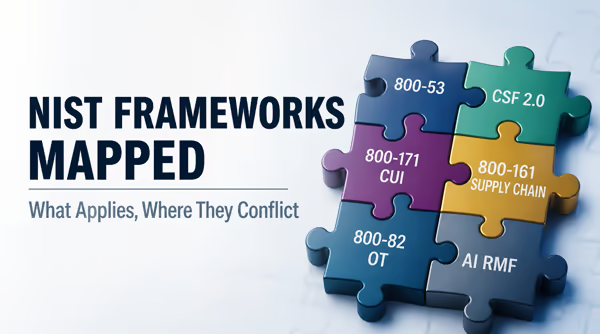
NIST framework group: the complete guide to 800-53, CSF 2.0, 800-171, OT overlays, supply chain, AI, and identity
Vulnox assessments show that 71% of organizations subject to multiple NIST frameworks are satisfying the wrong one first. This guide maps all 34 NIST frameworks -- from 800-53 baselines to the AI RMF and OT overlays -- showing where they overlap, where they conflict, and which controls buy you the most coverage across the group.
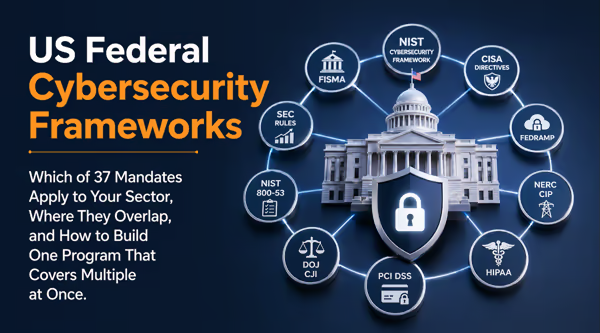
US federal cybersecurity frameworks: the complete guide to all 37 mandates
The US federal compliance landscape spans 37 active frameworks — from CJIS and NERC CIP to the SEC Cybersecurity Rule and GLBA Safeguards Rule. In our assessments, most organizations are unknowingly subject to 4 or more simultaneously. This guide maps every framework, who it applies to, where they conflict, and the fastest path to multi-framework coverage.
PCI DSS SAQ types explained: which one applies to your organization
Most merchants filing under SAQ A or SAQ B have never verified they actually qualify. In our assessments, SAQ misclassification is the single most common PCI DSS error we find — and it voids the compliance claim entirely.
Ready to Secure Your Digital Assets?
Get a comprehensive vulnerability assessment for your website today.