Automated compliance audit software: a post-mortem on building it ourselves first

TL;DR
Automated compliance audit software is not a compliance program. It is an evidence review and gap identification engine. The difference matters because organizations that treat it as a program skip the governance work that no software can do for you.
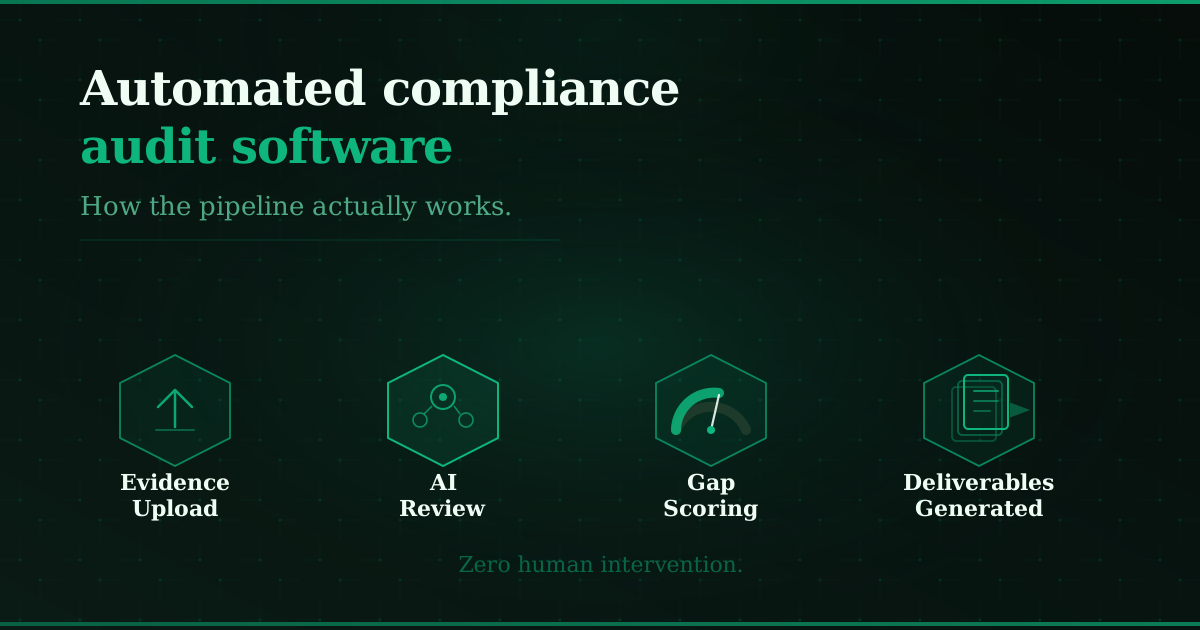
The technical pipeline behind good automated compliance audit software — questionnaire mapping to SCF controls, AI evidence review per control, scoring against must-have and should-have criteria, deliverable generation — takes roughly 60 interconnected workflows to run reliably end-to-end with no human intervention.
The blind spot every vendor underplays: automation catches missing documentation and weak evidence. It cannot catch documentation that looks complete but describes a process nobody actually follows. That gap between documented and operational is where most real audit failures live.
We found that organizations with 100% questionnaire completion rates and zero evidence uploads for an entire control category are more common than you would expect. The software flags it. Nobody fixes it until a deadline forces them.
A structurally inevitable compliance failure is coming for a specific archetype of company — the 30-person SaaS firm that automated its way to ISO 27001 certification using AI-generated policies — and the certification bodies are not yet equipped to catch it.
We tried to build this ourselves. Here is what broke.
Before we built Vulnox into what it is now, we ran compliance assessments the way most boutique security firms do: spreadsheets, email threads, shared folders, and a consultant on video calls walking clients through control requirements one by one. For a single ISO 27001 engagement, the evidence collection phase alone took three to four weeks. Clients would upload a document to Google Drive, we would review it, write findings in a Word document, email it back, get a revised document, repeat. The same control — say, risk management documentation — might go through four review cycles before it was defensible. We knew this was inefficient. What we did not fully appreciate until we tried to automate it was how many implicit judgment calls were embedded in that manual process. When a consultant reviews a risk register and decides it is 'partially compliant,' they are simultaneously checking currency, organizational specificity, executive authorization, methodology completeness, and whether the format matches what an ISO auditor would expect to see. None of those checks were written down anywhere. They lived in the consultant's head. The first version of our automation scored everything too generously because we had not encoded the judgment — we had only encoded the checklist.
The breakthrough was not better AI. It was better criteria. Once we mapped every control requirement to explicit must-have and should-have criteria derived from the Secure Controls Framework, the AI had something real to evaluate against. Before that, it was pattern-matching against document structure. After that, it was evaluating content against defined standards. The scores dropped across the board. Clients were unhappy at first. Then they went through certification audits and the findings matched what we had flagged, not what the previous tool had cleared.
How the technical pipeline actually works
The full automation pipeline for a Vulnox gap analysis runs across roughly 60 n8n workflows connected to Supabase as the data layer, with edge functions triggering workflow execution based on database events. Here is the actual sequence. A client selects a framework — ISO 27001, GDPR, HIPAA, PCI DSS, or any of the 258 frameworks in scope. They pay via Stripe. The payment webhook fires a Supabase edge function that creates the assessment record and sends the questionnaire. The questionnaire is mapped to SCF (Secure Controls Framework) control numbers. Every answer — yes, no, partial — gets stored against the specific SCF number it maps to. Once the questionnaire is complete, the system generates an Evidence Request List (ERL): the specific documents needed per control, derived from the SCF mapping. The client uploads evidence files to their assessment. Each upload triggers an edge function that queues the file for AI review. The AI agent evaluates each document against the must-have and should-have requirements for its assigned control — checking for executive approval presence, document currency, organizational specificity, completeness of procedural detail, and resource allocation documentation. Scores are written back to the database per control. Once all evidence for a framework request has been reviewed, a second n8n workflow chain fires to generate deliverables: the Gap Analysis Report, One-Pager, Control Maturity Chart, Evidence Checklist, Industry Benchmark, Remediation Roadmap, Executive Summary, and Risk Register. No human reviews any of this. The client gets a complete deliverable package.
Example
In practice, the AI evidence review step is where most of the complexity lives. A single control like E-GOV-04 (governance and oversight) might have three separate documents uploaded against it — a privacy steering committee charter, a committee meeting photo, and a revised charter. The AI has to evaluate all three together, determine whether they collectively satisfy the must-have requirements, identify what is missing, score the control, and write a finding that is specific enough to be actionable. For E-GOV-04 in a recent assessment, the three documents collectively addressed 4 of 6 must-have requirements. The gaps: no executive approval signature on any document, and incomplete incident response and management review process documentation. Score: 50%. That finding went directly into the remediation roadmap with the specific gap, the affected systems, and an estimated remediation timeline.
The SCF-to-ERL mapping is what makes framework-agnostic evidence review possible. Rather than building a separate review model for every framework, the SCF acts as a universal control taxonomy. ISO 27001 controls, GDPR articles, HIPAA safeguards, and NIST 800-53 controls all map to SCF numbers. The evidence review logic operates at the SCF level. This means a document reviewed for an ISO 27001 assessment can be re-evaluated for a GDPR assessment without re-uploading, because the SCF mapping handles the translation between frameworks.
What the client actually goes through
- Step 1
Framework selection and payment
Output:Assessment record created in Supabase. Questionnaire link sent automatically.
Purpose:Client selects the target framework from 258 options and pays via Stripe. The framework choice determines which SCF controls are in scope and what questionnaire is generated.
- Step 2
Questionnaire completion
Output:Completed questionnaire stored per SCF number. High-severity flags identified automatically — questions answered 'no' that map to critical controls are surfaced immediately as gap indicators.
Purpose:Client answers yes/no/partial for each control question. Questions are written at a level that someone without a compliance background can answer accurately. Answers map to specific SCF control numbers, not just framework categories.
- Step 3
Evidence Request List review
Output:Prioritized evidence upload queue. Controls with the lowest questionnaire scores get flagged as high-priority evidence requests.
Purpose:System generates the specific documents needed per control based on SCF mapping. Client sees exactly what to upload and why — not a generic document checklist but a control-specific request tied to their questionnaire answers.
- Step 4
Evidence upload and AI review
Output:Per-control compliance score, finding description, gap identification, and quality assessment (currency, specificity, completeness, professionalism) stored for each reviewed document.
Purpose:Each document upload triggers immediate AI evaluation against the must-have and should-have criteria for its assigned control. The client does not wait for a batch review — findings begin accumulating as documents arrive.
- Step 5
Deliverable generation
Output:Complete deliverable package available for download. Full assessment cycle from payment to deliverables requires no human intervention at any step.
Purpose:Once all evidence for the framework request has been reviewed, the deliverable generation workflow fires. This produces all eight deliverable documents: Gap Analysis Report, One-Pager, Control Maturity Chart, Evidence Checklist, Industry Benchmark, Remediation Roadmap, Executive Summary, Risk Register.
Three things the build taught us that we did not expect
Assessment base: Vulnox gap analysis assessments, 2025, across ISO 27001 v2022, GDPR, HIPAA, and PCI DSS frameworks
The evidence-to-score compression problem
When we moved from manual scoring to automated AI scoring, we expected scores to be roughly consistent with what consultants had been producing. They were not. Automated scores ran 12-18 percentage points lower on average across the same evidence sets. We initially assumed the AI was being too harsh. After reviewing 40 scored controls manually against the AI output, we found the opposite: the AI was correctly identifying gaps that human reviewers had been glossing over — specifically, missing executive approval signatures and vague resource allocation language. Human reviewers had been mentally compensating for weak documentation by giving benefit of the doubt. The AI did not. The automated scores were more accurate. The manual scores had been inflated by reviewer generosity. Vulnox assessment data, 2025.
If you previously used a consultant for gap analysis and are now evaluating automated compliance audit software, expect your scores to drop. That is not the software being broken. It is the software being more honest than the consultant was.
The 100% questionnaire / zero evidence anomaly
In roughly one in five Vulnox assessments, at least one entire control category shows 100% questionnaire completion with zero evidence uploads. The category most commonly affected is Governance. Clients answer all governance questions affirmatively — yes, we have a risk committee, yes, we have a steering committee charter, yes, we conduct management reviews — and then upload nothing. When we follow up, the most common explanation is not that the documents do not exist. It is that the documents are 'not ready yet' or 'need to be updated before sharing.' This means the control is operational in concept but the documentation is not defensible. The software correctly scores this as a gap. The client is often surprised because they genuinely believe the governance structure exists. The gap is not the governance structure. It is the paper trail that makes it auditable. Vulnox assessment data, 2025.
Automated compliance software surfaces this gap immediately and unambiguously. Manual consultants often let it slide with a note to 'follow up on documentation' that never gets resolved before the assessment closes. The automation is less polite about the gap and more useful because of it.
The multi-framework evidence reuse rate
Organizations running assessments across multiple frameworks simultaneously — for example, ISO 27001 and GDPR, or HIPAA and PCI DSS — reuse between 40% and 65% of their evidence documents across frameworks, based on Vulnox assessment data from 2025. This is higher than most clients expect when they are budgeting for multi-framework compliance. A data classification policy reviewed for ISO 27001 is also relevant evidence for GDPR Article 30 compliance. A risk register reviewed for HIPAA maps to ISO 27001 risk management controls. The SCF-to-framework mapping makes this reuse explicit rather than requiring the client to figure out which documents overlap. The practical implication for cost is significant: the second and third framework assessments are meaningfully cheaper in client effort than the first, because a large portion of the evidence already exists and has already been reviewed.
If a vendor is quoting you per-framework pricing with no acknowledgment of evidence reuse, they either do not have a unified evidence model or they are not passing the efficiency through to you. Ask specifically how evidence uploaded for one framework is handled when you add a second framework assessment.
What automation cannot catch and we will not pretend otherwise
Documented-but-not-operational controls
Automated evidence review evaluates documentation. It cannot evaluate whether the documented process is actually followed. A change management policy that describes a formal approval workflow scores well if the document is complete, signed, and current. Whether the three developers on your team actually submit change requests through ServiceNow before deploying to production is something the document cannot prove and the software cannot verify. This is the largest category of gap that automated compliance audit software structurally cannot close. The only ways to close it are technical controls that enforce the process (so non-compliance is impossible, not just documented as prohibited) or manual testing by a human reviewer who interviews staff and reviews system logs. Gap analysis flags the documentation quality. Operational compliance verification is a different engagement.
Cross-control root cause synthesis
As we described in the tool comparison article, automated scoring produces per-control findings. It does not automatically surface the pattern when 14 controls share one upstream root cause. Our remediation roadmap groups findings by priority and affected system, which helps. But the synthesis step — 'all of these gaps trace back to the absence of a governance sign-off workflow' — currently requires a human to recognize the pattern across the roadmap. We are working on this. It is not solved yet and we will not claim it is.
Evidence quality in non-English environments
Our AI review model was trained primarily on English-language compliance documentation. We assess clients whose documentation is in Arabic, Dutch, French, and German. For non-English evidence, the model evaluates structural and formatting signals more heavily than content signals, because content parsing is less reliable. This means a well-structured but thin Arabic-language policy may score higher than its content warrants, and a content-rich but informally formatted Arabic-language procedure may score lower than it deserves. We flag this limitation explicitly in assessment reports for non-English evidence submissions. It is a known gap in current capability.
Intent and organizational context
A document describing a data privacy steering committee means something different in a 12-person startup where the 'committee' is one founder and a part-time consultant than it does in a 500-person organization with a dedicated privacy team. Both organizations can submit the same document template with the same structural completeness and receive the same score. The software does not know the organizational context behind the document. A human reviewer with industry experience would weight these differently. We try to compensate through the Company Context section of the assessment, which captures employee count, industry, and infrastructure profile, and which is fed into the AI review model. It helps. It does not fully solve the problem.
More automation in the pipeline does not mean better coverage
Common belief
The assumption most CTOs bring to evaluating automated compliance audit software is that a more automated pipeline — one that pulls evidence directly from your AWS config, GitHub, Okta, JumpCloud, and ticketing system — is more thorough than one that requires manual document uploads.
What we found
In Vulnox assessments, technical control categories — Change Management, Cloud Security, Access Management — consistently score 20-40 percentage points higher than governance control categories — Governance, Compliance documentation, Risk Management formalization. The gap is not because organizations are bad at governance. It is because technical controls are enforced by systems and governance controls are enforced by culture and process. Systems leave evidence automatically. Culture does not. Vulnox assessment data, 2025.
The controls that fail in real ISO 27001 audits are almost never the technical controls. MFA status, access logs, change records, vulnerability scan results — these are verifiable, improvable, and in most cases already partially implemented. They are also the controls that integration-heavy platforms surface most prominently because the data is available. The controls that actually block certification are governance controls: executive approval on policies, formalized review cadences, documented resource allocation, complete incident response procedures with named owners. None of these come from an API. They come from your governance process, and whether or not that process exists and is documented is something only a document review can determine. A platform that pulls your JumpCloud MFA status and your GitHub commit history and calls it a gap analysis has given you a technical posture report. That is useful. It is not a gap analysis.
Two things coming that automated compliance software is not ready for
Certification bodies will begin requiring evidence provenance metadata — proof that a document was created and approved before the assessment date, not generated in response to it — and this will break the business model of platforms that offer AI-generated policy templates as gap remediation.
The current audit model trusts submitted document dates. A policy dated six months ago that was actually written last Tuesday in response to a gap finding is indistinguishable from a policy that has genuinely been in operation for six months — unless the auditor checks document metadata, version history, or asks to see the approval workflow log. Most do not. When the first high-profile certification fraud case involves AI-generated policies submitted as operational documentation, certification bodies will respond with metadata requirements. Platforms whose value proposition is 'we generate the missing policies for you' will need to either prove operational history or stop offering the service. This is not a hypothetical risk. It is a structural inevitability given current incentives.
Confidence: highPublication of updated ISO 27001 certification body guidance requiring document provenance evidence — version history, approval timestamps, or workflow audit logs — as part of Stage 1 audit submissions. Watch for guidance updates from UKAS, DAkkS, or ANAB within 18-24 months.A specific archetype of company will experience a public compliance failure that forces the industry to define what 'automated compliance' actually certifies. The archetype: a 25-35 person B2B SaaS company, post-Series A, that achieved ISO 27001 certification using automated tooling and AI-generated policies, passes its initial Stage 2 audit, and then fails its surveillance audit 12 months later because none of the documented processes were operationally embedded.
ISO 27001 surveillance audits check whether the ISMS is being actively maintained — management reviews are happening, internal audits are being conducted, non-conformities are being tracked and resolved. A company that automated its way to certification without building the operational habits behind the documentation will have clean policies and no evidence of operational follow-through. The surveillance audit finds nothing was actually running. The certification gets suspended. This has not happened publicly yet at scale, but the conditions for it are present in the current market. The certification bodies are not yet treating automated-platform certifications differently from consultant-led ones.
Confidence: mediumA publicly reported ISO 27001 certification suspension for a company that used an automated compliance platform, where the stated reason involves lack of operational implementation rather than documentation gaps. Industry press coverage or certification body appeals decisions would confirm this.
The one thing to verify before you trust any automated compliance platform
Ask the platform to show you a completed assessment for a company that failed — a real client who went through the process and came out with a score below 60%, or who had a critical gap in a control category they thought was covered. If the platform cannot show you a failure case, one of two things is true: either they have never had a client with serious gaps (implausible) or their scoring model is calibrated to produce reassuring results rather than accurate ones. Every automated compliance audit platform should be able to show you what an honest bad result looks like. If they only show you dashboards with green progress bars, you already know what the software is optimizing for.
Further Reading
compliance framework automation
How We Mapped 258 Compliance Frameworks to a Single Automated Audit Systemcompliance gap analysis tool comparison
Compliance gap analysis tool comparison: what the demos don't show youhow much does a compliance gap analysis cost
How much does a compliance gap analysis cost in 2026Vulnox Service
digital footprint analysisNIST CSRC
NIST security control assessment proceduresISACA
ISACA continuous compliance monitoringISO 27001
ISO 27001 information security management
Frequently Asked Questions
How does automated compliance audit software actually review evidence documents?
The better platforms map uploaded documents against must-have and should-have criteria derived from a control taxonomy like the Secure Controls Framework. For each document, the AI checks for executive approval presence, document currency, organizational specificity, completeness of procedural detail, and resource allocation documentation. Each criterion is scored independently, producing a per-control compliance percentage. Platforms that only check for document existence or keyword presence produce scores that do not reflect audit defensibility. Vulnox assessment data, 2025.
What is the difference between automated compliance audit software and a GRC platform?
Automated compliance audit software identifies gaps — it tells you what is missing and how far you are from a defensible control implementation. GRC platforms manage ongoing compliance after controls are implemented — evidence collection, control testing, audit trail management. The sequencing matters: gap analysis first, then GRC platform if continuous monitoring is needed. Buying a GRC platform before understanding your gaps means monitoring controls that are not properly defined.
Can automated compliance software handle multiple frameworks at once?
Yes, if it uses a unified control taxonomy like the SCF (Secure Controls Framework) as the underlying model. The SCF maps ISO 27001, GDPR, HIPAA, PCI DSS, and 250+ other frameworks to a common control numbering system. Evidence uploaded for one framework can be evaluated against another without re-uploading. In Vulnox assessments, organizations running two frameworks simultaneously reuse 40-65% of their evidence, meaningfully reducing the effort for the second assessment. Vulnox assessment data, 2025.
What does automated compliance audit software miss that manual consultants catch?
Two things primarily. First, cross-control root cause synthesis: a consultant looking at 14 gaps will often identify they share one upstream cause. Automated tools report 14 separate findings. Second, documented-but-not-operational controls: software reviews documents, not practices. A complete, signed change management policy scores well even if developers never actually follow the change approval process. Manual testing through staff interviews and system log review is the only way to verify operational compliance.
How long does a full automated compliance audit take from payment to deliverables?
In the Vulnox pipeline, the questionnaire, evidence upload, and AI review phases are client-paced — the automation is waiting on document submissions, not the reverse. Once all evidence for a framework is uploaded and reviewed, deliverable generation is automated and requires no human intervention. The bottleneck is almost always client-side evidence gathering, not the platform. Organizations with well-organized documentation complete assessments in days. Organizations gathering documentation for the first time take weeks.
Will automated compliance audit scores be lower than what a consultant previously gave us?
Almost certainly yes, and that is expected. In Vulnox assessments, automated scores ran 12-18 percentage points lower on average than equivalent manual consultant assessments of the same evidence. Human reviewers extend benefit of the doubt — they compensate mentally for missing approval signatures or vague resource allocation language. Automated scoring does not. The automated scores are more accurate. The consultant scores were inflated by reviewer generosity. Vulnox assessment data, 2025.
Is automated compliance audit software accepted as evidence by ISO 27001 certification bodies?
The audit software output is preparation for certification, not a substitute for it. The certification body assesses your evidence and controls directly. What matters is whether the automated platform accurately identified your weakest evidence so you could fix it before the certification audit. A platform that cleared controls with weak documentation gave you false confidence. A platform that flagged them accurately let you remediate before the certification body found them.
Related Articles
Compliance gap analysis tool comparison: what the demos don't show you
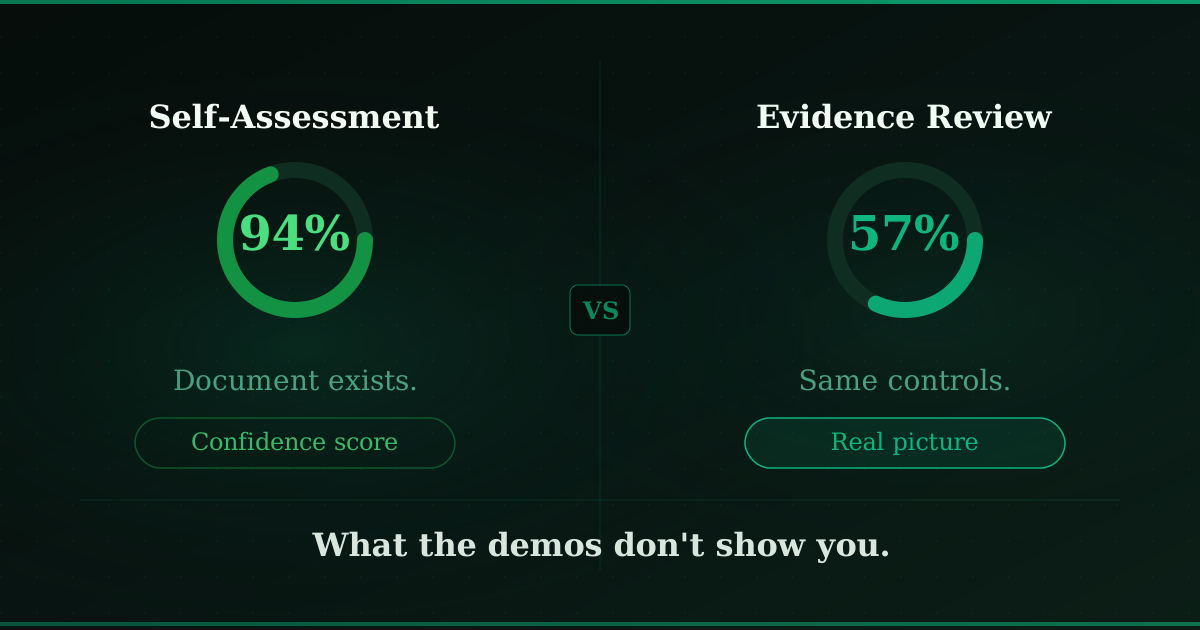
Most compliance gap analysis tools measure whether documentation exists, not whether it is defensible. Based on real assessment data, here is what the dashboards do not show you — and the one question that separates useful tools from expensive false confidence.
Ready to Secure Your Digital Assets?
Get a comprehensive vulnerability assessment for your website today.