Compliance gap analysis tool comparison: what the demos don't show you
 Julian ThorneApril 22, 2026
TL;DR
Most compliance gap analysis tools score you against a framework but cannot tell you why your evidence is weak — they flag absence, not quality. That is a different problem.
We found that 14 of 17 controls assessed in a recent ISO 27001 engagement had the same root cause: missing executive approval signatures. The tool flagged 14 gaps. A human reviewer would have flagged one governance failure.
Automated platforms are meaningfully faster and cheaper for initial assessments and repeatable re-assessments. Where they lose is in cross-control pattern recognition — something consultants do implicitly but rarely document.
The counterintuitive finding: companies that scored highest on self-assessment questionnaires had the worst evidence quality. High questionnaire scores correlate with documentation confidence, not documentation completeness.
The industry has not agreed on what 'passing' a gap analysis actually means in terms of audit defensibility. That open question is worth asking your vendor before you buy anything.
The demo looked great. The actual assessment did not.
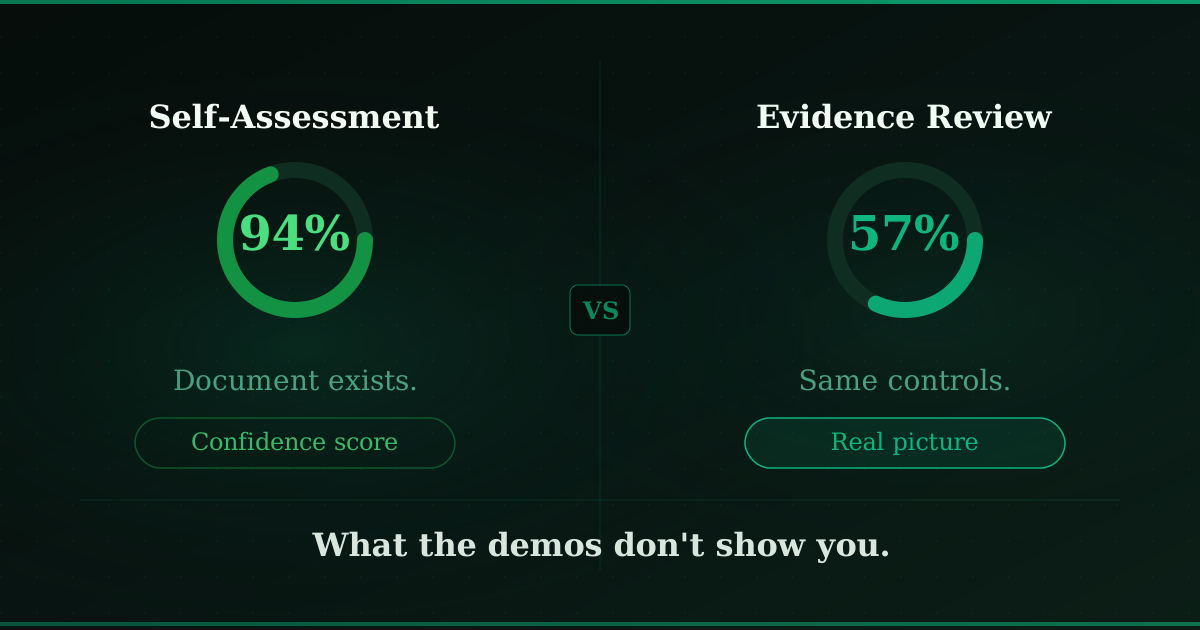
A healthcare company with 40 employees had already sat through three vendor demos before talking to us. All three platforms showed clean dashboards, green progress bars, and a framework coverage percentage that climbed reassuringly as you uploaded documents. One vendor demo-ed a 94% compliance score achieved in under two hours using their pre-loaded template library. The compliance officer was impressed. She asked us whether Vulnox could match that speed. We told her we probably could not — and that the 94% number was not measuring what she thought it was measuring. It was measuring whether a document existed for each control category. It was not measuring whether the document was signed, current, specific to her environment, or defensible under audit. When we ran our own assessment against the same 17 controls she had already 'passed' in the other platform, 16 came back as partial compliance. The highest-scoring category, Change Management, came back at 57% — despite her self-assessment questionnaire showing 100% on every Change Management question.
That gap between questionnaire score and evidence quality is the central problem with most compliance gap analysis tools on the market. They are measuring the wrong thing, and they are doing it very efficiently.
What the tools actually differ on
Questionnaire-only platforms
These tools map your yes/no/partial answers to framework controls and produce a score. Speed is their real product — you can get a number in under a day. The problem is that questionnaire responses are self-reported. We see this consistently: organizations answer 'yes' to 'do you have an incident response process?' because they have a document with that title. Whether that document has executive approval, defined resource allocation, or tested procedures is a different question that the platform never asks. Questionnaire-only tools produce a confidence score, not a compliance score. Those are not the same thing.
Useful for a quick internal benchmarking exercise or board reporting where you need a number. Not useful for ISO 27001 certification prep, regulatory audit readiness, or any situation where an external party will review your evidence.
Evidence review platforms with AI scoring
These tools accept document uploads and run automated review against control requirements. Quality varies significantly based on what the AI is actually evaluating. The better platforms assess document currency, specificity to the organization's environment, completeness of must-have versus should-have requirements, and whether formal approvals are present. The weaker ones check for keyword presence — if your incident response policy contains the word 'containment,' it scores points. We have seen documents written in Arabic score identically to the same document translated into English, because the platform was checking structure, not content. That matters if your organization operates in a non-English environment.
This is where Vulnox sits. Our AI agent reviews uploaded evidence against the Secure Controls Framework (SCF) control requirements, maps findings to specific must-have and should-have criteria, and produces per-control compliance scores with explicit gap descriptions. The output is the Gap Analysis Report, Control Maturity Chart, Evidence Checklist, Industry Benchmark, and Remediation Roadmap. The score reflects evidence quality, not self-reported confidence.
Manual consultant-led assessments
A good consultant does something no current tool does well: cross-control pattern recognition. In the healthcare company example above, a seasoned ISO 27001 consultant would have looked at 14 controls with the same gap and immediately written one finding — 'governance approval process is absent across the entire ISMS' — rather than 14 separate remediation tickets. That synthesis is genuinely valuable. It is also expensive, slow, and inconsistent across consultants. We have reviewed consultant reports where the same control was scored differently in two assessments of the same client six months apart because a different analyst ran the second one. Repeatability is not a strength of the manual model.
For a first-ever certification assessment where you need narrative context, consultant pattern recognition is worth paying for. For annual re-assessments, recurring framework additions, or organizations managing multiple frameworks simultaneously, the economics do not hold. A $15,000 consultant engagement to re-assess 40 controls you assessed last year is hard to justify when the gaps are 80% the same.
GRC platforms (ServiceNow GRC, OneTrust, Drata, Vanta)
These are continuous compliance monitoring platforms, not gap analysis tools — though they are frequently compared. GRC platforms work well once your controls are implemented and you need ongoing evidence collection, control testing, and audit trail management. They are the wrong starting point if you do not know what your gaps are yet. We see organizations buy Drata or Vanta before completing a gap analysis, then discover mid-implementation that their foundational governance documentation is so weak that the continuous monitoring signals are meaningless. You cannot monitor a control you have not properly defined. The gap analysis should precede the GRC platform purchase, not follow it.
If you are pre-certification and do not yet have a documented ISMS, buy a gap analysis first. If you are post-certification and need ongoing evidence management, a GRC platform makes sense. These are sequential investments, not competing ones.
What we actually see in client environments
Assessment base: Vulnox gap analysis assessments, 2025-2026, across ISO 27001 v2022, GDPR, and HIPAA frameworks
The single-root-cause gap cluster
In a January 2026 ISO 27001 assessment of a 40-employee healthcare organization using JumpCloud, self-hosted Git, and ServiceNow, 14 of 17 assessed controls came back with the same critical gap: missing executive approval signatures on governance documentation. Every tool submission category — Asset Management, Change Management, Compliance, Data Classification, Governance, Risk Management — had this gap. The client had assumed this was 14 separate problems. It was one process failure: nobody had ever established a document sign-off workflow. The remediation was a single governance step, not 14 separate workstreams.
Most compliance gap analysis tools report gaps at the control level. They cannot tell you that 14 control-level gaps share a single upstream cause. This is the pattern recognition problem. When you are evaluating tools, ask how they surface cross-control correlations. If the answer is 'they appear in separate remediation tickets,' that tool is going to generate a remediation roadmap that looks more complicated than the actual problem.
The questionnaire-evidence inversion
Across multiple Vulnox gap analysis assessments in 2025, we found a consistent pattern: organizations that scored 90%+ on self-assessment questionnaires had evidence that scored 15-25 percentage points lower on average when documents were actually reviewed. The inverse was also true — organizations that hedged on questionnaire answers (answering 'partially' rather than 'yes') tended to submit stronger evidence because they understood the nuance of their own controls. The organizations most confident in their answers were the ones most likely to have documentation that was generic, unsigned, or copied from a template without customization.
If a compliance gap analysis tool is primarily questionnaire-driven, high scores should make you more skeptical, not more confident. The questionnaire measures how certain your team is about their controls. It does not measure whether that certainty is warranted.
The should-have compliance floor
In every Vulnox assessment conducted against ISO 27001 v2022, should-have requirements (as distinct from must-have requirements) showed a consistent 50% compliance rate regardless of the organization's overall score. A company at 75% overall compliance and a company at 57% overall compliance had almost identical should-have scores. Must-have compliance drove all the differentiation. This surprised us. We expected should-have compliance to track with overall maturity. It does not. Should-have items appear to be systematically deprioritized across the board — not because organizations are unaware of them, but because they are not blocking certification and are therefore perpetually deferred.
If you are evaluating a compliance tool and they show you a score that includes should-have requirements in the overall percentage, ask them to break it out. Should-have items inflating an overall score can make a 57% organization look like a 65% organization. That matters when you are trying to understand true certification readiness.
More features does not mean better compliance outcomes
Common belief
The assumption most buyers bring into a compliance gap analysis tool evaluation is that the platform with the most framework coverage, the most integrations, and the most detailed reporting is the one that will produce the most accurate picture of their compliance posture.
What we found
In Vulnox assessments, technical controls (access management, change management, cloud security) consistently score 20-35 percentage points higher than governance controls (executive approvals, policy formalization, review cadence documentation). Platforms with deep technical integrations surface the high-scoring controls prominently. The governance gaps — the ones that actually block certification — end up buried in a list of medium-priority remediation items. Vulnox assessment data, 2025.
It does not work that way in practice. More frameworks means the platform had to build a generic evidence review model that works across 258 different control sets. Generic models make conservative scoring decisions — they cannot evaluate context. An evidence document that is highly specific to a healthcare organization running on-premise infrastructure with Arabic-language documentation is going to score worse on a generic platform than a boilerplate English-language template, because the generic model is pattern-matching against expected document structures rather than evaluating actual control coverage. We also found that platforms with extensive integration libraries (connecting to your AWS, Okta, GitHub, etc.) produce a false sense of completeness. Automated evidence collection from integrations pulls telemetry — logs, configuration states, access records. It does not pull governance documentation, policy approvals, or procedural evidence. The controls that keep failing in real audits are governance controls, not technical controls. JumpCloud can prove you have MFA enabled. It cannot prove your risk committee charter has been approved by the CISO.
What clients say before they see the evidence review
'We already did a gap analysis last year with [consultant firm]. We know our gaps. We just need something cheaper to track remediation progress.'
Root cause:When we look at the prior assessment, it is almost always a questionnaire-based scoring exercise dressed up with a consultant narrative. The evidence was rarely reviewed in detail. Remediation progress tracking against questionnaire answers does not tell you whether the underlying control has actually improved — it tells you whether someone updated their answer from 'no' to 'partially'. Three of the last five clients who came to us with this framing discovered during our evidence review that their prior 'remediation' had addressed the symptom (updating a document) without addressing the cause (getting it approved, tested, and embedded in operations).
'The other platform showed us 78% compliant. You're showing us 60%. One of you is wrong.'
Root cause:Both scores can be technically correct and measuring genuinely different things. The 78% platform scored presence and structure — did a policy document exist for this control category, did it contain the required sections, was it dated within 12 months. The 60% score reflects evidence quality against must-have and should-have requirements — is the document signed, is the resource allocation quantified, are the procedures specific to this organization's environment and systems. A document can exist, be structured correctly, and still be worthless in an audit because it was never approved by anyone with authority. The 78% tool does not know that. It saw a document.
'We have Change Management at 100% on our self-assessment. Why is your report showing 57%?'
Root cause:This is the questionnaire-evidence inversion in practice. The self-assessment questions for Change Management ask about process: do you have a defined change control process, are changes documented, are they reviewed before implementation. The answers were yes, yes, yes. The evidence submitted was a Change Control Board charter — one document. That document had no executive approval signature, no resource allocation details, and no training documentation. The questionnaire measured whether the process existed in concept. The evidence review measured whether the process was implemented, authorized, and auditable. These are different questions.
Where this market is heading
Compliance tools will begin producing AI-generated evidence documents to fill gaps, and this will create a new category of audit failure that does not yet have a name.
The logical next step for any compliance platform trying to improve customer scores is to offer AI-generated policy templates, procedure documents, and governance charters that automatically fill evidence gaps. Several platforms already do this. The problem is that AI-generated documents are structurally indistinguishable from real organizational documents unless an auditor goes looking for operational specificity — references to actual systems, real personnel names, dated approval signatures from identifiable individuals. Most auditors do not look that hard during initial reviews. They will eventually. When an ISO 27001 certification body starts systematically failing organizations whose evidence was AI-generated because it contains no operationally specific detail — no mention of the actual systems in scope, no named individuals, no traceable approval history — this will be treated as a fraudulent audit submission in some jurisdictions. The category does not have a name yet. I would call it evidence fabrication by omission. It is not lying about your controls. It is submitting documentation that implies implementation without evidence of it.
Confidence: highFirst instance of a certification body publicly rejecting an ISO 27001 submission on the grounds that evidence documentation was AI-generated and lacked operational specificity. This will appear in ISO certification body guidance documents or appeals decisions within 24 months.The regulatory trend toward continuous compliance monitoring will make point-in-time gap analysis tools obsolete for larger organizations, but will increase demand for them among smaller organizations entering regulated markets for the first time.
EU regulations including NIS2, DORA, and the evolving AI Act enforcement mechanisms are pushing toward continuous demonstrable compliance rather than annual certification. For organizations above ~200 employees with dedicated compliance staff, point-in-time gap analysis will become a baseline input into a continuous monitoring program rather than the end state. For organizations under 50 employees entering a regulated market for the first time — a healthcare startup preparing for HIPAA, a SaaS company landing its first EU enterprise customer and needing GDPR evidence — the gap analysis remains the correct starting point. The market will bifurcate. Enterprise compliance spend moves toward GRC platforms with continuous monitoring. SMB compliance spend stays with affordable, fast, point-in-time assessments that tell you what to fix before you go anywhere near a certification body.
Confidence: mediumIf the percentage of ISO 27001 first-time certifications from organizations under 100 employees grows year-over-year through 2027 while large enterprise adoption of point-in-time tools declines, the bifurcation is occurring. Certification body statistics from UKAS or equivalent bodies would confirm this.
My honest take on where automated tools win and where they do not
I think the compliance tool market has a presentation problem more than a capability problem. The platforms that do evidence review well are genuinely useful — they catch gaps that self-assessment questionnaires miss, they produce structured findings that map to remediation priorities, and they do it at a price point that makes annual re-assessment economically rational. What they cannot do is replace the judgment call that comes from having seen fifty organizations in the same industry fail on the same three controls for the same structural reason. That cross-client pattern recognition is a human skill, and the tools that claim otherwise are overselling. Where I think automated platforms unambiguously win: repeatability. Running the same assessment against the same framework twice a year, with consistent scoring criteria, across multiple frameworks simultaneously, is something no consultant team can do economically. The consistency is the value. The same control scored by the same criteria in January and July tells you whether you actually improved or just updated your documentation. A different consultant team in July tells you something different about their scoring interpretation. For organizations managing ISO 27001, GDPR, and HIPAA simultaneously — which is a realistic profile for any healthcare-adjacent SaaS company — the economics of automated gap analysis are not close. That said, I would not use an automated tool as the sole basis for a first-time certification submission without having a human review the cross-control patterns first. The tools are good at finding gaps. They are less good at telling you which gaps share an upstream cause.
Counterargument
The strongest argument against this position is that the human judgment I am describing — cross-control pattern recognition — is itself inconsistent and therefore not as valuable as I am suggesting. Two experienced ISO 27001 consultants reviewing the same evidence set will identify different root causes and prioritize different remediation paths. The consistency argument cuts both ways. If human reviewers are not consistent either, then the tool's consistency may actually be the more defensible basis for audit preparation, even if it misses synthesis. That is a reasonable position and I do not have strong data to refute it.
What to actually do before you buy a tool
Before you sign up for any compliance gap analysis platform, ask them one specific question: show me an example output for a control that has evidence uploaded but the evidence is weak — unsigned, generic, or missing resource allocation details. If the platform shows that control as passing because a document exists, you are looking at a questionnaire-dressed-as-evidence-review tool. If it shows a partial compliance score with specific findings about what the document is missing and why, you are looking at a tool that will tell you something useful. That one question will tell you more than any demo dashboard or framework coverage comparison chart. Run the question on every platform you are evaluating. The answer will be different.
Further Reading
how much does a compliance gap analysis cost
How much does a compliance gap analysis cost in 2026automated compliance audit software
Automated compliance audit software: a post-mortem on building it ourselves firstcompliance framework automation
How We Mapped 258 Compliance Frameworks to a Single Automated Audit SystemVulnox Service
digital footprint analysisISACA
ISACA risk management frameworksNIST Risk Management Framework
NIST Risk Management FrameworkENISA
ENISA cybersecurity risk management
Frequently Asked Questions
What is the difference between a questionnaire-based compliance tool and an evidence review platform?
Questionnaire-based tools score your self-reported answers against framework controls and produce a confidence score. Evidence review platforms evaluate the actual documents you upload against must-have and should-have criteria — checking for executive approval, document currency, operational specificity, and completeness. In Vulnox assessments, organizations scoring 90%+ on questionnaires regularly score 15-25 percentage points lower when their actual documents are reviewed. Vulnox assessment data, 2025.
Can I use a GRC platform like Drata or Vanta instead of a gap analysis tool?
GRC platforms are continuous compliance monitoring tools designed for organizations that have already implemented their controls and need ongoing evidence collection. A gap analysis tells you what is missing before you build. Buying a GRC platform before completing a gap analysis is a common sequencing mistake — you end up monitoring controls that are not properly defined. The gap analysis should come first, then the GRC platform if ongoing monitoring is needed.
How many controls does a typical ISO 27001 gap analysis cover?
ISO 27001 v2022 has 93 controls across 4 themes and 11 clauses. A scoped assessment may not cover all 93 — it depends on what systems and processes are in scope. In a recent Vulnox assessment of a 40-employee healthcare organization, 17 controls were assessed within the defined scope covering on-premise infrastructure, JumpCloud identity management, self-hosted Git, and ServiceNow. Vulnox assessment data, January 2026.
What is the most common gap that automated compliance tools miss?
Executive approval signatures on governance documentation. In a recent Vulnox ISO 27001 assessment, 14 of 17 controls had the same critical gap: no formal executive sign-off on any policy or procedure document. Most compliance tools flag this as 14 separate gaps. The root cause is a single missing governance process. Cross-control pattern recognition — identifying that 14 gaps share one upstream cause — is something most automated tools do not surface. Vulnox assessment data, 2026.
How much does a compliance gap analysis cost compared to a consultant?
A manual consultant-led ISO 27001 gap analysis typically runs $8,000-$20,000 depending on scope and firm. Automated platforms range from $299 (Vulnox, single framework assessment with full deliverables) to several thousand dollars annually for GRC platforms that include gap analysis as one feature. The economic case for automated platforms is strongest for re-assessments and organizations managing multiple frameworks simultaneously, where consultant costs scale linearly and automated costs do not.
Will an automated gap analysis be accepted by an ISO 27001 certification body?
The gap analysis itself is internal preparation — certification bodies assess your evidence and controls directly, not the gap analysis report. What matters to the certification body is the quality of your evidence: are your documents signed, specific to your environment, current, and complete. An automated gap analysis that accurately identifies weak evidence will help you fix the right things before a certification audit. One that scores based on document existence rather than quality gives you false confidence about where you actually stand.
What should I ask a compliance tool vendor before buying?
Ask them to show you an output for a control where evidence was uploaded but is weak — unsigned, generic, or missing resource allocation. If the control shows as passing because a document exists, the tool is measuring presence, not quality. If it shows partial compliance with specific findings about what the document is missing, the tool will tell you something actionable. That single question is more diagnostic than any demo dashboard.
Related Articles
Automated compliance audit software: a post-mortem on building it ourselves first
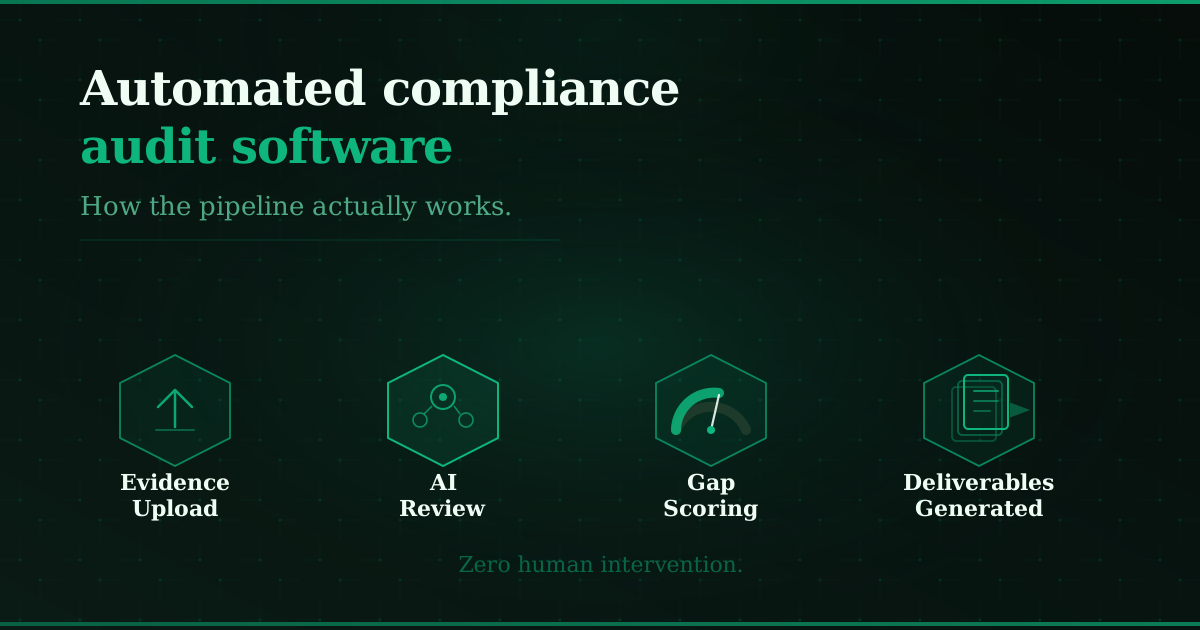
A CTO post-mortem on building compliance automation before buying it. How the technical pipeline actually works, where AI evidence review fails honestly, and what no vendor demo will show you.
Ready to Secure Your Digital Assets?
Get a comprehensive vulnerability assessment for your website today.