How much does a compliance gap analysis cost in 2026
 Leo HallowayApril 22, 2026
TL;DR
A manual consultant-led compliance gap analysis for ISO 27001 costs between $8,000 and $25,000 depending on scope, firm size, and geography. Automated platforms run $299 to $2,500 per framework assessment. The outputs are not equivalent — what you are paying for is different in each model.
The number that surprises most buyers: re-assessment. A $15,000 consultant engagement to re-assess the same 40 controls twelve months later is a hard budget conversation when 70-80% of the gaps are structurally identical to last year. Automated re-assessment at a fraction of the cost changes the economics of annual compliance maintenance.
The counterintuitive cost driver is not the assessment itself — it is the remediation coordination overhead that follows. Organizations that receive a 200-line gap report with no prioritization spend more in internal staff time triaging findings than they paid for the assessment.
Across Vulnox assessments in 2025, organizations managing two frameworks simultaneously reused 40-65% of their evidence, meaning the second framework assessment costs meaningfully less in client effort than the first — a cost structure most vendors do not make transparent.
The hidden cost that nobody prices into a compliance budget: failed certification. A Big Four firm charges $15,000 for a gap analysis and then another $20,000+ for the remediation advisory when certification fails. An accurate upfront assessment that flags every weak control before the certification audit is worth more than its sticker price.
The number that changes the budget conversation
$8,000 to $25,000
Typical price range for a manual consultant-led ISO 27001 gap analysis in Western Europe and North America, based on market rate data for mid-tier consulting firms in 2025. Enterprise firms and Big Four engagements run higher — $30,000 to $60,000 for large-scope assessments covering 93 controls across complex multi-site environments.
$299
Vulnox automated gap analysis per framework, including all eight deliverables: Gap Analysis Report, One-Pager, Control Maturity Chart, Evidence Checklist, Industry Benchmark, Remediation Roadmap, Executive Summary, and Risk Register. No human consultant involvement. Full automation from payment to deliverable.
3 to 6 months
Estimated remediation timeline appearing in every medium-priority gap across Vulnox ISO 27001 assessments in 2025-2026. This is the internal cost period — staff time, process redesign, document rework — that the assessment price does not include and that most buyers underestimate when budgeting.
0.3 FTE
Compliance analyst effort estimated for continuous monitoring strategy development in a recent Vulnox ISO 27001 assessment of a 40-employee healthcare organization. Plus 10 days for a monitoring tool integration specialist and 5 hours of executive leadership time. This is the hidden organizational cost behind a single medium-priority gap. Vulnox assessment data, January 2026.
The invoice that reframed the whole budget
A 35-person healthcare SaaS company received an invoice from a mid-tier consulting firm for $18,500. It covered a twelve-week ISO 27001 gap analysis engagement: kickoff workshops, control walkthroughs, evidence collection, and a final report. The compliance officer signed it off without much pushback because the board had asked for ISO 27001 certification and this was the cost of figuring out where they stood. Four months later, the remediation advisory quote came in at $22,000. The certification body's Stage 1 audit found findings that the gap analysis had not flagged with enough specificity to act on. The total spend before a single certification stamp: $40,500, not including internal staff time. When the compliance officer called us afterward, the first thing she said was not that the consultant had done a bad job. She said the report had 200 line items and she had no idea which ones were actually blocking certification and which ones were nice-to-haves. The prioritization was the missing piece.
That is the cost structure problem with most compliance gap analysis engagements, manual or automated. The assessment price is the visible number. The triage cost — the internal staff hours spent figuring out what to fix first — is invisible until you are already in it.
What actually drives the price difference
The cost of a compliance gap analysis is not primarily a function of how many controls are assessed. It is a function of how evidence is collected and evaluated, and how findings are structured for action. Manual consultant engagements charge for time. A senior ISO 27001 consultant at a mid-tier firm bills $150 to $250 per hour. A gap analysis covering 40 controls with evidence review, client interviews, and report writing takes 60 to 120 hours of billable time depending on how organized the client's documentation is. Add project management, travel if on-site, and report production, and you arrive at the $8,000 to $15,000 range for a straightforward engagement. Scope creep, multiple revision rounds, or disorganized client evidence can push that to $20,000 or beyond without a clause in the statement of work that defines scope limits. Automated platforms charge for infrastructure and AI processing, not time. The marginal cost of running an additional evidence review is near zero once the pipeline is built. That cost structure gets passed through to the buyer: a fixed price per framework assessment regardless of how many documents you upload or how many revision cycles your evidence goes through.
Example
The cost difference becomes most visible at re-assessment. A healthcare organization that paid $12,000 for its first ISO 27001 gap analysis and resolved 60% of its gaps over the following year needs to re-assess to measure progress and identify remaining gaps before its certification audit. The consultant re-engagement quote is $9,000 — discounted from the original because some scoping work is done, but still priced at hourly rates for a full evidence review cycle. The automated re-assessment is the same price as the original: $299. The controls are the same. The framework is the same. The infrastructure cost does not change because the client already went through this once.
The price-to-defensibility ratio is where automated and manual models diverge most sharply. A $12,000 consultant report that produces qualitative findings written in narrative prose is harder to use as a remediation tracking document than a structured report with per-control scores, explicit must-have and should-have gap descriptions, affected systems, and estimated effort. The Vulnox deliverable set — eight documents including the Remediation Roadmap and Risk Register — is structured for action, not for reading. That structure is what makes the cost-per-actionable-finding ratio favorable even against much cheaper manual alternatives.
Manual consultant vs automated platform vs hybrid: five dimensions
Time to first finding
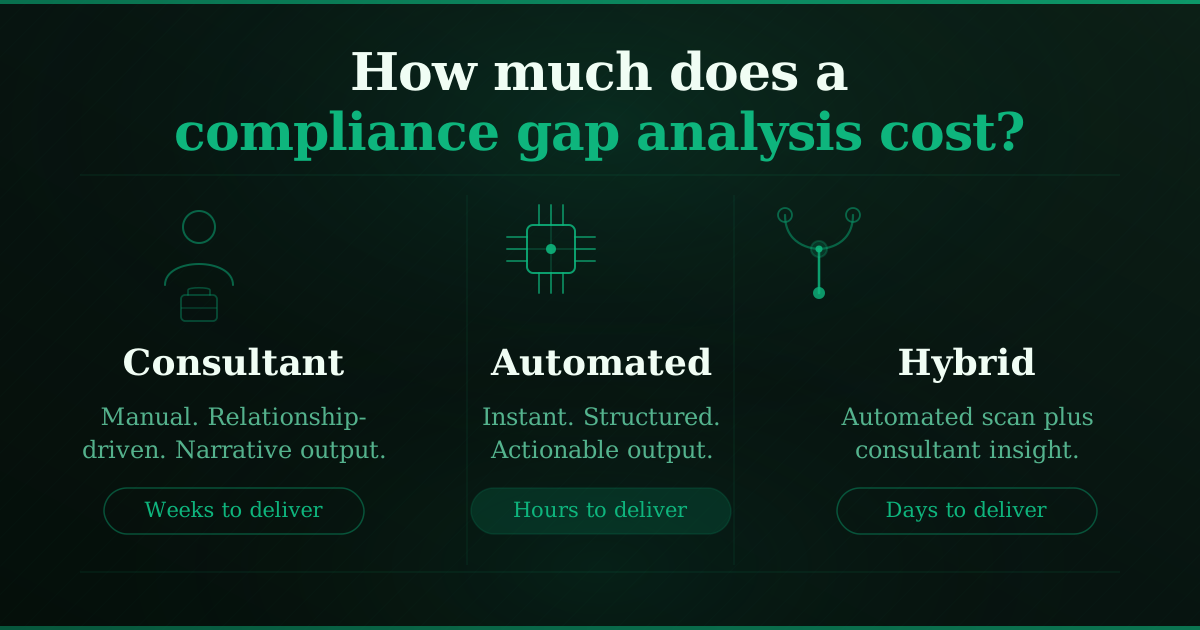
Manual consultant: 2 to 6 weeks from kickoff to initial findings, depending on evidence collection speed and consultant availability. Automated platform: findings begin accumulating per control as each document is uploaded and reviewed — first findings available within hours of starting the evidence upload phase. Hybrid (automated assessment plus consultant interpretation): automated findings in days, consultant narrative layer added in 1 to 2 weeks.
If you are working toward a certification deadline, time-to-finding matters. A 6-week wait for initial findings with 3 to 6 months of remediation needed afterward is a tight timeline for any organization that has not started gap analysis at least 9 months before their target certification date.
Cost for first assessment
Manual consultant: $8,000 to $25,000 for a scoped ISO 27001 engagement. Automated platform: $299 to $2,500 depending on platform and framework. Hybrid: $2,000 to $8,000 — automated evidence review plus a consulting layer for root cause synthesis and remediation planning.
For a first-ever gap analysis where you genuinely do not know where you stand, the consultant's contextual judgment has value that justifies some premium. For a second or third assessment of the same framework, or for adding a second framework to an existing compliance program, the economic case for manual consultants weakens significantly.
Cost for annual re-assessment
Manual consultant: $6,000 to $15,000 — discounted from the original but still hourly-rate-driven. Automated platform: same price as the original assessment. GRC platform with built-in continuous monitoring: $3,000 to $15,000 per year subscription, but this is monitoring ongoing compliance, not a point-in-time gap assessment.
This is where automated platforms win unambiguously. An organization that needs to demonstrate annual gap analysis for customer security reviews, board reporting, or certification maintenance cannot justify $10,000 per year for an engagement that is 80% identical to last year's. The math does not work at that scale.
Audit defensibility of output
Manual consultant report: narrative findings written by a named professional with verifiable credentials. Carries weight with certification bodies that recognize the consulting firm. Automated platform report: structured per-control findings with explicit scoring criteria, gap descriptions, and evidence review documentation. Less relationship-dependent, more reproducible. A certification body can follow the scoring logic. Hybrid: combines structured scoring with consultant sign-off.
For a first ISO 27001 certification submission, some certification bodies and enterprise procurement teams place weight on a consultant-signed assessment. For internal use, board reporting, or customer security questionnaire responses, automated structured output is equally defensible and often more useful because it is actionable rather than narrative.
Multi-framework coverage
Manual consultant: each additional framework is a separate engagement at near-full price. A firm quoting ISO 27001 and GDPR simultaneously might offer a 20-30% discount for overlap, but two engagements is still two sets of billable hours. Automated platform with SCF-based evidence model: evidence uploaded for one framework is re-evaluated for a second framework without re-uploading. Vulnox assessment data shows 40-65% evidence reuse across framework pairs, meaning the second framework assessment requires 35-60% of the client effort of the first.
Organizations managing multiple frameworks simultaneously — a realistic profile for any company with EU customers (GDPR), US healthcare exposure (HIPAA), and a security certification requirement (ISO 27001 or SOC 2) — should factor multi-framework efficiency into their platform evaluation. Per-framework pricing that does not acknowledge evidence reuse is leaving money on the table.
What the cost data from real assessments shows
Assessment base: Vulnox gap analysis assessments, 2025-2026, ISO 27001 v2022, GDPR, HIPAA, PCI DSS
The remediation effort is almost always underestimated by a factor of two
In a January 2026 Vulnox ISO 27001 assessment of a 40-employee healthcare organization, the Risk Prioritization Matrix identified 16 medium-priority gaps and 1 low-priority gap across 17 assessed controls. Every medium-priority gap carried a 3 to 6 month estimated remediation timeline. The most resource-intensive single gap — missing executive approval signatures across all governance documentation — required a compliance analyst at 0.3 FTE for strategy development, a monitoring tool integration specialist for 10 days, and 5 hours of executive leadership time. That is a single gap. When clients budget for remediation, they typically estimate total effort based on the number of gaps times a per-gap assumption. They do not account for the organizational coordination cost — scheduling executive time, running revision cycles on documentation, getting sign-off chains in place. The actual cost is 1.5 to 2 times what the line-item estimate suggests. Vulnox assessment data, January 2026.
When evaluating the total cost of a compliance gap analysis, the assessment price is the smallest number in the equation. Budget planning that treats assessment cost as the primary variable is looking at the wrong line item. The remediation coordination overhead is where the real spend is, and the quality of the assessment output — specifically how well it prioritizes and groups gaps — determines how efficiently that overhead gets managed.
Governance gaps are cheaper to fix than technical gaps but get deprioritized because they feel less urgent
Across Vulnox assessments in 2025, governance gaps — missing executive approvals, incomplete policy review cadences, vague resource allocation documentation — had lower estimated remediation effort than technical gaps like incomplete continuous monitoring infrastructure or missing vulnerability management processes. The governance fixes are largely administrative: schedule a review meeting, get signatures, update a document. They take 1 to 4 weeks with minimal budget. Technical gaps require tooling, integration work, and sometimes headcount. Yet in remediation roadmaps, clients consistently deprioritize governance gaps because they feel less concrete. The result: they spend money on technical remediation while the governance gaps — which are the ones actually blocking certification — stay open. Vulnox assessment data, 2025.
A cost-optimized remediation sequence starts with governance gaps. They are cheap to fix, they unblock everything else, and they are what certification bodies check first. If your gap analysis output does not distinguish between governance gaps and technical gaps in its prioritization, you are likely to spend money in the wrong order.
The second framework assessment costs 40-60% less in client time than the first
In Vulnox assessments where clients ran ISO 27001 and GDPR simultaneously, evidence reuse averaged 52% across the two framework assessments. Documents like the data classification policy, the risk register, the access control policy, and the incident response procedure were relevant evidence for controls in both frameworks. The SCF-to-framework mapping identified the overlap automatically. The client did not re-upload or re-label documents — the system re-evaluated existing evidence against the second framework's control requirements. For a 40-employee organization, this translated to roughly half the evidence collection time for the GDPR assessment compared to the ISO 27001 assessment. Vulnox assessment data, 2025.
If you are planning compliance coverage across multiple frameworks, sequence them so the framework with the broadest evidence requirements goes first. The evidence you generate for ISO 27001 covers a large proportion of what GDPR, HIPAA, and PCI DSS also require. Treating each framework as a standalone engagement with separate evidence collections is the most expensive way to build a multi-framework compliance program.
What clients say about compliance gap analysis pricing before they understand what they are buying
'We got a quote for $18,000 from a consultant and $299 from your platform. There must be something wrong with the $299 number. What are you cutting?'
Root cause:Nothing is cut. The cost structures are genuinely different. A consultant charges for the time of a credentialed human being reviewing your evidence, writing findings, and producing a narrative report. An automated platform charges for infrastructure, AI processing, and a structured deliverable pipeline. The $299 buys you eight deliverable documents with per-control scores, explicit gap descriptions, a prioritized remediation roadmap, and an industry benchmark comparison. The $18,000 buys you that plus a human relationship, a narrative layer, and the ability to call someone when you have questions about the findings. If you are buying your first-ever gap analysis and need contextual guidance on what the findings mean for your specific business, the human relationship has value. If you know what ISO 27001 controls mean and need a structured assessment to track progress, the $299 buys what you actually need.
'We already paid a consultant $14,000 last year. Why would we pay again this year? The gaps are the same.'
Root cause:This complaint contains the answer. If the gaps are the same, you spent $14,000 last year on an assessment that did not produce remediation. That is not a pricing problem — it is a prioritization problem. The assessment identified findings but the output format did not make it clear enough what to fix first, who was responsible, or what the business impact of leaving specific gaps open was. A re-assessment makes sense when you have actually remediated gaps and want to measure progress, or when you need current documentation for a customer security review or certification audit. If the gaps are genuinely unchanged, the re-assessment will confirm that quickly and at low cost. The uncomfortable version of this conversation is that $14,000 was spent generating a report that sat in a folder.
'The consultant's report had 200 findings. We have no idea where to start. We need someone to tell us what actually matters.'
Root cause:This is a deliverable quality problem, not a findings volume problem. A 200-item gap report with no prioritization structure is an evidence dump, not a remediation plan. The findings that actually matter for certification readiness are the must-have control gaps, the controls with high likelihood and high impact scores in the risk matrix, and the governance gaps that block everything else. In the Vulnox Risk Prioritization Matrix, every gap gets a risk score, a likelihood rating, an impact rating, an affected systems list, and a remediation timeline. A compliance officer looking at that output knows immediately that the 0 critical gaps and 16 medium gaps are a three-to-six-month programme, and that the single highest-risk item is executive approval signatures across governance documentation — one process fix that resolves the highest-scoring gap across 14 controls simultaneously.
Where I think the pricing conversation goes wrong
The compliance gap analysis market prices on the wrong variable. It prices on the assessment — the event — rather than on the outcome, which is certification readiness or demonstrable control improvement. A $20,000 assessment that leaves the client with a report they cannot act on is worse value than a $299 assessment that produces a prioritized roadmap with specific, fixable gaps. The sticker price comparison is a distraction. The relevant question is: after receiving this output, does your team know exactly what to fix, in what order, and what the impact of each fix is on your overall certification readiness? If yes, the assessment was priced correctly relative to its value regardless of the number. If no, you overpaid regardless of the number. I think buyers anchor on price because it is the only number they can see before the engagement starts. The output quality — prioritization structure, evidence specificity, gap actionability — is invisible until you have the report in hand. That information asymmetry is why expensive consultants with strong brands win deals that their output quality does not justify.
Counterargument
The strongest counterargument is that for organizations navigating a compliance framework for the first time, the value of a human consultant is not primarily in the report — it is in the advisory relationship during remediation. A consultant who can answer 'should this policy cover our cloud environment even though we said we are on-premise?' or 'does our Change Control Board charter need to be signed by the board itself or just the CISO?' is providing value the report cannot. That advisory continuity during the remediation phase is real and it costs money. For a genuinely first-time ISO 27001 certification with no internal compliance expertise, the consultant premium may be justified on those grounds alone. I do not have strong data on how often that advisory relationship is actually used versus how often the report sits in a folder.
How compliance gap analysis pricing will change
Within three years, compliance gap analysis will be priced as a subscription rather than a project, and the per-assessment model will survive only in the enterprise segment.
The economics of recurring compliance obligations — annual ISO 27001 surveillance, GDPR accountability documentation, HIPAA periodic risk assessments — favor subscription pricing over per-event pricing. Organizations that need to demonstrate compliance continuously to customers, regulators, and certification bodies cannot rationalize a project-cost model that resets every year. Automated platforms have the infrastructure to support subscription pricing; their marginal cost per re-assessment is near zero. The transition will happen when a large enough automated platform offers unlimited re-assessments within a framework for an annual fee and acquires enough market share to force pricing pressure on competitors. The per-assessment model will persist for large enterprises with complex multi-site scopes where project pricing reflects genuine variable cost.
Confidence: mediumIf two or more automated compliance platforms shift to subscription pricing with unlimited re-assessments within 36 months, and if per-assessment pricing platforms see measurable customer churn in the SMB segment, the transition is occurring. Watch pricing page changes at Vanta, Drata, and emerging automated assessment platforms.Compliance gap analysis costs will become a line item in enterprise procurement contracts, with buyers requiring a gap analysis completion certificate before signing software vendor agreements above a certain contract value.
Enterprise procurement teams are already asking for SOC 2 reports and ISO 27001 certificates. The next step is requiring evidence that the vendor has assessed and is actively remediating gaps — not just that they passed a point-in-time audit two years ago. When this becomes a standard procurement requirement, the demand for affordable, fast, repeatable gap analysis increases significantly for SMB software vendors who cannot justify a $15,000 annual consultant engagement but need to produce a current gap assessment to close enterprise deals. The cost of not having a current gap analysis becomes a deal-blocker, which changes the price sensitivity calculation entirely.
Confidence: mediumAppearance of 'current gap analysis report dated within 12 months' as a standard line item in enterprise security questionnaires from Fortune 500 procurement teams. Security questionnaire aggregators like OneTrust or SecurityScorecard would be the first to reflect this shift.
The actual budget question to answer before you start
Before you evaluate any compliance gap analysis option on price, answer this question internally: how many frameworks do you need to cover in the next 12 months, and how many times will you need to re-assess each one? If the answer is one framework, assessed once, for a first-time certification with no internal compliance expertise, a consultant engagement at $8,000 to $15,000 with advisory support during remediation is defensible. If the answer is two or more frameworks, or any re-assessment within 12 months, or no available budget for consultant advisory fees, the automated platform math is not close. Run those numbers before you take a single vendor meeting. The pricing conversation is much simpler once you know which question you are actually trying to answer.
Further Reading
compliance gap analysis tool comparison
Compliance gap analysis tool comparison: what the demos don't show youcompliance framework automation
How We Mapped 258 Compliance Frameworks to a Single Automated Audit Systemdo I need a compliance gap analysis
Do I need a compliance gap analysis?Vulnox Service
digital footprint analysisPCI Security Standards Council
PCI Security Standards CouncilAICPA
AICPA professional standardsISACA
ISACA audit and assurance resources
Frequently Asked Questions
How much does an ISO 27001 gap analysis cost from a consultant?
A manual consultant-led ISO 27001 gap analysis runs $8,000 to $25,000 for mid-tier firms in Western Europe and North America, based on 2025 market rates. Large-scope engagements with Big Four or enterprise firms run $30,000 to $60,000. Price is primarily driven by billable hours — a senior ISO 27001 consultant at $150 to $250 per hour, covering 60 to 120 hours for a scoped engagement. Disorganized client documentation or scope creep pushes the final invoice higher without a firm scope cap in the statement of work.
What does an automated compliance gap analysis cost?
Automated platforms range from $299 to $2,500 per framework assessment depending on the platform and scope. The Vulnox gap analysis is $299 per framework and includes eight deliverables: Gap Analysis Report, One-Pager, Control Maturity Chart, Evidence Checklist, Industry Benchmark, Remediation Roadmap, Executive Summary, and Risk Register. The price does not change based on how many documents you upload or how many controls are in scope for your environment.
Is a cheap compliance gap analysis worth anything?
It depends entirely on what the output measures. A cheap platform that scores based on questionnaire answers or document existence will produce an inflated score that does not reflect audit defensibility. A cheap platform that runs AI evidence review against explicit must-have and should-have control criteria will produce findings as actionable as a $15,000 consultant report — sometimes more actionable because the output is structured for remediation rather than written as narrative prose. The price tells you nothing about accuracy. Ask to see a real output with weak evidence scored partially, not just a clean demo.
What is the total cost of ISO 27001 compliance including the gap analysis?
The gap analysis is typically the smallest cost in the total compliance program. For a 40-employee organization, a realistic budget breakdown: gap analysis $299 to $15,000 depending on approach; remediation effort 0.3 FTE compliance analyst for 3 to 6 months plus specialist time for specific technical gaps; certification body Stage 1 and Stage 2 audit $5,000 to $15,000; annual surveillance audit $3,000 to $8,000. Internal staff coordination time — scheduling executive approvals, running document revision cycles — is the line item most organizations forget to budget and consistently underestimate by a factor of two. Vulnox assessment data, 2026.
How much does it cost to run gap analysis across multiple frameworks?
With a consultant, each additional framework is a near-full-price separate engagement with a possible 20-30% overlap discount. With an automated platform using a unified evidence model like SCF, the second framework reuses 40-65% of evidence already submitted for the first framework, meaning the client effort — and in some pricing models, the cost — is significantly lower. For organizations covering ISO 27001, GDPR, and HIPAA simultaneously, sequencing ISO 27001 first maximizes evidence reuse for the other two. Vulnox assessment data, 2025.
How often should a compliance gap analysis be redone?
ISO 27001 requires continuous improvement and periodic reassessment — most organizations re-assess annually ahead of their surveillance audit. GDPR and HIPAA have similar ongoing assessment obligations. The re-assessment frequency question is really a cost question: at $15,000 per consultant engagement, annual re-assessment is hard to justify for an SMB. At $299 per automated assessment, it is a quarterly conversation. The organizations that maintain the strongest compliance posture are the ones that can afford to re-assess frequently, which means the assessment cost model directly affects how well organizations maintain compliance over time.
What hidden costs should I budget for after a compliance gap analysis?
Three categories most organizations underestimate. First, executive time: governance gaps — the most common finding in Vulnox assessments — require executive approval signatures, committee reviews, and sign-off cycles. A single gap requiring 5 hours of leadership time times 14 similar gaps is 70 hours of executive scheduling. Second, document revision cycles: getting policies from draft to signed and approved takes more rounds than expected. Third, specialist time for technical gaps: continuous monitoring infrastructure, vulnerability management tooling, and access review processes often require contractor or specialist effort. Budget 1.5 to 2 times your line-item remediation estimate to account for coordination overhead. Vulnox assessment data, 2026.
Ready to Secure Your Digital Assets?
Get a comprehensive vulnerability assessment for your website today.