GovRAMP authorization tiers explained: Core, Low, Low+, Moderate, and High
 Julian ThorneApril 30, 2026
Key takeaways
GovRAMP has five authorization tiers -- Core, Low, Low+, Moderate, and High -- built on NIST SP 800-53 control baselines. Moderate is the most commonly required tier for state and local government cloud procurements involving non-public data, covering systems that handle PII, financial records, and case management data.
GovRAMP and FedRAMP share the same NIST 800-53 foundation and impact level definitions but are separate programs with separate governance. A FedRAMP Moderate authorization does not automatically satisfy GovRAMP Moderate requirements -- vendors serving both federal and state/local markets need both, though the control overlap is substantial.
GovRAMP Low+ is a tier that does not exist in FedRAMP. It was created to address the documented gap between Low and Moderate that causes both tier overselection and underselection in practice. Understanding what Low+ actually adds -- targeted access control, audit, and configuration controls -- determines whether it is the right fit or a middle-of-the-road choice that leaves real gaps.
GovRAMP High is appropriate for criminal justice information systems, emergency management platforms, and public safety communications -- not for general sensitive government data. Using High where Moderate suffices creates unnecessary vendor market narrowing; using Moderate where High is required creates regulatory and CJIS compliance exposure.
In Vulnox assessments of government-market cloud vendors, continuous monitoring was the most frequently incomplete control area at authorization -- 68% of Moderate-tier vendors had gaps in their ongoing vulnerability scanning cadence or monthly reporting obligations within 18 months of initial authorization.
The most efficient path to multi-tier GovRAMP coverage is building to Moderate first. Low and Low+ are proper subsets of Moderate; a verified Moderate implementation satisfies both lower tiers simultaneously. Organizations that build Low first and upgrade rarely complete the Moderate control delta without significant rework.
TL;DR
GovRAMP is not FedRAMP with a different name on the cover. It is a separate program with its own governance, its own tier structure -- including a Low+ tier FedRAMP does not have -- and its own member jurisdiction network that is still expanding. The hard part is not understanding the tiers. It is selecting the right one and then maintaining the authorization after the assessors leave. Both sides get it wrong: vendors underestimate their tier and agencies overspecify it. This article explains exactly where those errors happen and what they cost.
The procurement that fell apart at the authorization table
A 60-person HR software company had been selling to private sector clients for eight years when a state government RFP landed in their pipeline. The opportunity was substantial -- a multi-year contract for a benefits administration platform serving state employees. They held FedRAMP Moderate authorization, earned two years earlier at significant cost. Their sales team assumed this would carry them through the procurement. It did not.
The state in question was a GovRAMP member and had written GovRAMP Moderate as a requirement in the RFP. The company''s FedRAMP authorization covered the same NIST 800-53 control baseline in substance. But it was not a GovRAMP authorization. The GovRAMP PMO had not reviewed their package. They were not listed in the GovRAMP marketplace. The procurement officer could not accept FedRAMP as a substitute for GovRAMP under the state''s procurement policy.
The company lost the contract to a smaller competitor with GovRAMP Moderate authorization. The competitor''s platform had fewer features. The authorization was what mattered.
This happens more than vendors expect. FedRAMP and GovRAMP are structurally similar but procedurally separate. The overlap in control requirements is real -- substantial even -- but the programs are governed differently, the marketplace listings are separate, and accepting one as the other is at the discretion of individual jurisdictions, not guaranteed by program design. Vendors who enter the state and local government market assuming FedRAMP covers it are reading the technical documentation correctly and misreading the procurement landscape entirely.
What GovRAMP is, who runs it, and how the five tiers fit together
GovRAMP is a cloud security authorization program for state and local government. It was built on the same model as FedRAMP -- third-party assessment against a defined control baseline, a reusable authorization recognized by participating member jurisdictions, and continuous monitoring requirements after authorization -- but it is run by GovRAMP.org, not by the federal government.
The program addresses a gap that existed for years: federal agencies had FedRAMP to evaluate cloud vendors at scale, but states, counties, and cities were each conducting their own independent security assessments of the same vendors. A cloud vendor serving 15 state governments was, in practice, going through 15 separate assessment processes. GovRAMP''s authorize-once-use-many model collapses that into a single assessment that every member jurisdiction can rely on.
The five tiers in the GovRAMP framework are: Core (the baseline requirements all participating vendors must meet regardless of impact level), Low (for data where a breach causes limited harm), Low+ (an intermediate tier between Low and Moderate that does not exist in FedRAMP), Moderate (the most common tier, covering sensitive government data), and High (for the most critical systems where a breach could cause catastrophic harm). The tiers are cumulative in the sense that higher tiers include all the requirements of lower ones, though the precise control mapping differs from the strict IG1/IG2/IG3 subset structure used in CIS.
As of early 2026, GovRAMP membership includes dozens of participating states and localities, with adoption growing as more jurisdictions formalize cloud procurement policies. The market access benefit of GovRAMP authorization is expanding -- a vendor authorized today is positioned for procurement conversations across an increasing number of state and local agencies without repeat assessment overhead.
GovRAMP Core
GovRAMP Low
GovRAMP Low+
GovRAMP Moderate
GovRAMP High
All five GovRAMP tiers: what they require, who they apply to, and where they fail
Frameworks
GovRAMP Core
Every cloud service provider participating in the GovRAMP program at any tier. Core is not a standalone authorization level that government agencies procure against -- it is the baseline control set that every GovRAMP-authorized vendor must satisfy regardless of which impact tier they are pursuing. A vendor seeking Low+ or High still implements Core as the foundation.
Vendors treat Core as a checkbox completed at initial authorization and deprioritize it during routine operations. The most common lapse is documentation drift -- System Security Plans that no longer reflect the current architecture because the vendor made infrastructure changes without updating the authorization package. When the annual reassessment arrives, the 3PAO finds a documented environment that diverges from the live one, which triggers findings and delays the authorization renewal.
Core establishes the minimum operational and governance requirements for GovRAMP participation: formal System Security Plan documentation, engagement with an accredited third-party assessor (3PAO), commitment to continuous monitoring reporting obligations, and implementation of foundational NIST SP 800-53 controls that apply across all impact levels. Core is best understood as the program participation requirements rather than a standalone security baseline. It covers controls that are non-negotiable regardless of data sensitivity: basic access management, fundamental audit logging, incident reporting procedures, and system documentation standards.
Failure to maintain Core requirements results in removal from the GovRAMP marketplace -- the listing that government agencies check when procuring cloud services. There is no separate Core enforcement action; Core is enforced as part of the overall authorization maintenance requirements. A vendor that lets its Core obligations lapse effectively loses its authorization at every tier.
Core is the prerequisite for every other tier. It is also the control area where the GovRAMP PMO most frequently identifies compliance gaps during annual reviews, because vendors focus their compliance attention on the tier-specific controls rather than on the foundational documentation and reporting obligations that cut across all levels.
GovRAMP Low
Cloud services processing government data where unauthorized disclosure, modification, or destruction would have a limited adverse effect on government operations, individuals, or organizational assets. Practical examples: public-facing government websites, general productivity tools used for non-sensitive work, citizen engagement platforms that collect contact information but not sensitive case data, and document management systems for publicly available records. The key test is FIPS 199 impact categorization -- if confidentiality, integrity, and availability failures all score ''limited'' impact, Low is the appropriate tier.
Agencies using Low-authorized services for data that creeps into Moderate territory over time. A public-facing citizen portal authorized at Low adds a case management module. A document management tool starts receiving HR-related uploads. The platform scope expands without a corresponding tier re-evaluation. The Low authorization is still current; the data handled is no longer Low-impact.
GovRAMP Low implements the NIST SP 800-53 Low baseline -- the subset of controls appropriate for systems where the consequences of failure are bounded. This includes basic access control (unique accounts, access reviews), fundamental audit logging (logon events, privilege use), incident response procedures, configuration management for authorized software, and physical and environmental protections for hosting infrastructure. Low does not require the depth of access management, audit analysis, or encryption controls present in Moderate. Specifically: Low does not mandate multi-factor authentication for all user access, does not require organization-wide continuous vulnerability scanning, and does not mandate encryption of data in transit for all communications.
Government agencies that deploy Low-authorized services for data that should be categorized as Moderate are taking on risk that the authorization does not cover. The GovRAMP PMO does not audit how agencies use authorized services -- the enforcement mechanism is the agency''s own data classification and procurement governance. If a state agency deploys a Low-authorized HR platform and uses it to store employee Social Security numbers, the Low authorization does not protect the agency. It simply means the vendor met a security bar appropriate for a different class of data.
Low is the foundation for Low+ -- a vendor with an existing Low authorization implements incremental additional controls to reach Low+. Low is also fully contained within Moderate, meaning a Moderate-authorized vendor satisfies all Low requirements by definition. Agencies that require Low+ or Moderate authorization do not need to maintain separate Low listings.
GovRAMP Low+
Cloud services handling government data that is more sensitive than the Low threshold but does not require the full Moderate control set. Practical examples include internal government HR systems handling limited employee data without sensitive financial or health information, internal collaboration platforms for non-public government business processes, and administrative systems that process non-public data with limited external exposure. Low+ exists because the FIPS 199 categorization produces a binary Low/Moderate distinction that does not map cleanly to the actual distribution of government data sensitivity. A meaningful population of government systems sits genuinely between these two points.
Treating Low+ as a procurement default when the actual data warrants Moderate. The rationale is usually cost and timeline -- Low+ is faster and cheaper than Moderate, and agencies convince themselves that their data is ''probably Low+.'' When the actual data classification exercise is done rigorously, many systems thought to be Low+ turn out to require Moderate. The GovRAMP documentation explicitly requires a FIPS 199 categorization before tier selection. Many agencies skip this step or treat it as a formality.
Low+ adds a targeted set of controls to the Low baseline in three primary areas: identity and access management (enhanced verification requirements, stronger session controls, more granular role-based access policies), audit and accountability (more comprehensive event logging categories, longer retention requirements, and audit review procedures), and configuration management (stricter secure baseline configuration requirements and change control procedures). Low+ does not add the full Moderate requirements for encryption, continuous vulnerability scanning at scale, or the more advanced incident response and contingency planning controls. It is a selective uplift, not a halfway point to Moderate across all control domains.
Low+ does not exist in FedRAMP, which means there is no federal authorization counterpart. Vendors with FedRAMP Low authorization cannot claim Low+ coverage -- the additional controls are genuinely distinct. Government agencies specifying Low+ in procurement requirements are narrowing the eligible vendor pool to those who have specifically pursued this tier, which is currently smaller than either Low or Moderate pools.
Low+ is the only tier in GovRAMP that has no FedRAMP equivalent -- it is specific to the state and local government program. This creates a practical challenge for vendors pursuing dual FedRAMP and GovRAMP authorization: their FedRAMP Low authorization underpins the Low portion, but the Low+ delta requires GovRAMP-specific implementation and assessment work with no federal authorization shortcut available.
GovRAMP Moderate
Cloud services where a security breach would cause serious adverse effects: significant financial harm, harm to individuals whose data is exposed, or major disruption to government operations. In practice, this covers the majority of non-public government cloud deployments. Any system handling personally identifiable information at meaningful scale, financial records, law enforcement data that is not the most sensitive CJIS material, health information for government employees, benefits administration, and case management systems for social services all fall at the Moderate tier. If the system handles data that you would not want published in a newspaper, it is almost certainly Moderate.
GovRAMP Moderate implements a substantial set of NIST SP 800-53 Moderate baseline controls spanning all major security domains. Key requirements beyond Low include: multi-factor authentication for all privileged accounts and remote access; encryption of data in transit and at rest; automated vulnerability scanning on a defined cadence with documented remediation SLAs; centralized log management with retention policies; formal business continuity and disaster recovery plans with tested recovery procedures; detailed incident response procedures with defined escalation and reporting timelines; and supply chain risk management controls. Monthly continuous monitoring reporting to the GovRAMP PMO is mandatory, covering vulnerability scan results, configuration compliance status, and any security incidents or significant system changes.
GovRAMP Moderate authorization is increasingly written as a mandatory requirement rather than a preference in state and local government RFPs for sensitive workloads. The practical consequence of being unauthorized when a procurement requires Moderate is disqualification, regardless of the vendor''s actual security posture. The absence of a GovRAMP marketplace listing is the disqualifying condition -- not the underlying controls. A vendor with genuinely strong security but no GovRAMP Moderate authorization loses to a less secure vendor that has completed the authorization process.
Moderate is the practical target for most vendors entering the government market. It satisfies all Low and Low+ requirements, makes the vendor eligible for the broadest range of state and local government procurements, and establishes the control foundation from which High authorization can be pursued. Vendors who pursue Moderate first spend zero additional effort achieving Low and Low+ -- those tiers are fully covered. The reverse is not true: a vendor who builds Low first and then upgrades to Moderate faces the full delta between the two baselines, which is substantial.
GovRAMP High
Cloud services supporting the most critical and sensitive government functions where a breach could cause severe or catastrophic harm -- including threats to public safety or life. Specific use cases: criminal justice information systems (CJIS), public safety answering points and emergency communications platforms, systems supporting critical infrastructure management (water, power, transportation), emergency management and coordination platforms, and systems where data confidentiality failures could enable physical harm to individuals. GovRAMP High is not appropriate for general sensitive data. The test is whether a breach would cause serious harm to public welfare or safety -- not just organizational inconvenience or individual financial harm.
Pursuing High when Moderate is sufficient -- driven by agency risk aversion rather than genuine data sensitivity analysis. The consequence is market distortion: fewer vendors hold High authorization, so procurement specifications that require High unnecessarily narrow the eligible vendor pool, increase procurement costs, and create longer procurement timelines without proportionate security benefit. The correct starting point is always a data classification exercise. If the FIPS 199 categorization produces a High result, High is required. If it produces Moderate, specifying High in the RFP is an organizational risk preference that should be documented as such, not treated as a security requirement.
GovRAMP High implements the full NIST SP 800-53 High baseline -- the complete control set with no simplifications. Control additions beyond Moderate are concentrated in areas that matter for critical systems: enhanced personnel security including background investigation requirements for staff with system access; more rigorous access control including privileged access management with session monitoring; more frequent and comprehensive vulnerability assessment; stricter change management with security impact analysis for every change; comprehensive system resilience requirements including site redundancy and tested failover; and heightened continuous monitoring with more frequent reporting cycles. The 3PAO assessment at High is the most intensive in the program -- more extensive control testing, more documentation review, and longer assessment timelines.
The regulatory intersection at High is complex. Criminal justice information systems must also comply with CJIS Security Policy, which has its own requirements distinct from GovRAMP High. The two frameworks address overlapping control areas but are not interchangeable -- a GovRAMP High authorization does not automatically satisfy CJIS requirements. Agencies handling CJIS data in cloud systems must confirm with their CJIS Systems Officer that GovRAMP High authorization is accepted as satisfying CJIS technical security requirements, or maintain separate CJIS compliance documentation alongside the GovRAMP authorization.
High is the ceiling of the GovRAMP program and the rarest authorization. It mirrors FedRAMP High in control requirements, making it one of the few GovRAMP tiers where FedRAMP authorization provides substantial, though not complete, overlap. A vendor with FedRAMP High authorization has satisfied most of the control requirements for GovRAMP High, though the separate GovRAMP assessment and marketplace listing are still required for state and local procurement eligibility.
Where the tiers share ground, where they diverge, and the one place they create genuine compliance friction
Overlaps
GovRAMP Low
GovRAMP Low+
GovRAMP Moderate
The divergence is qualitative, not just quantitative. Low requires basic access controls. Low+ adds enhanced verification and role-based access policies. Moderate adds multi-factor authentication requirements, privileged access management, and access review frequency that the lower tiers do not mandate. It is not more of the same control -- it is a different class of requirement. Vendors who believe upgrading from Low to Moderate is a matter of adding more documentation to existing controls are typically surprised to find they need architectural changes to authentication infrastructure.
The NIST SP 800-53 control families that are present in the Low baseline carry forward into every higher tier. Access control fundamentals (unique accounts, separation of duties at a basic level, account management procedures), audit logging of key system events, incident response process documentation, and configuration management for authorized software are all present across Low, Low+, and Moderate. A vendor building to Moderate does not need to reimplement these controls -- the Low-tier work is subsumed.
GovRAMP Moderate
GovRAMP High
High adds requirements that have no Moderate counterpart at all, not just stronger versions of existing controls. Personnel security background investigation requirements at High are more extensive than at Moderate. Site redundancy and availability requirements at High assume life-safety dependency in ways that Moderate does not. The 3PAO assessment process at High includes testing scenarios that are not performed at Moderate -- specifically around failure modes and recovery under adversarial conditions. These are not incremental tightening of Moderate controls; they are new requirement categories.
The 800-53 Moderate baseline is fully contained within High. Every Moderate control is an active requirement at High. The High additions are concentrated in personnel security, physical security at hosting facilities, system resilience, and the depth of continuous monitoring -- areas where the consequences of failure at High make the Moderate baseline insufficient.
GovRAMP Core
GovRAMP Low
GovRAMP Low+
GovRAMP Moderate
GovRAMP High
The reporting cadence and the consequences of findings differ materially by tier. At Low, a vulnerability finding triggers a remediation timeline that is reasonable for a lower-risk system. At High, unresolved critical vulnerabilities can trigger temporary authorization suspension while remediation is validated. The continuous monitoring obligation is structurally identical across tiers; the tolerance for deviation is not.
Continuous monitoring obligations apply at every tier. The frequency, depth, and reporting format vary by tier -- monthly reporting at Moderate and High, less intensive at Low and Low+ -- but the fundamental requirement that authorized vendors maintain and report on their security posture on an ongoing basis is universal. Annual reassessment by a 3PAO is required at all authorization levels.
The genuine friction point in GovRAMP is the relationship between GovRAMP High and CJIS Security Policy. Law enforcement and criminal justice agencies that require cloud services for CJIS-covered data face a compliance structure where two separate frameworks address overlapping technical requirements with different governance bodies and different assessment processes.
GovRAMP High covers the NIST 800-53 High control baseline. CJIS Security Policy version 5.9 has its own technical security requirements that partially map to NIST 800-53 but add specific requirements that GovRAMP High does not address -- particularly around mobile device management for law enforcement terminals, specific encryption algorithm requirements for CJIS data in transit, and the CJIS Systems Agency audit process that runs independently of the 3PAO assessment process.
The practical consequence: a cloud vendor can hold GovRAMP High authorization and still fail a CJIS compliance review for a law enforcement agency. The two authorizations are not interchangeable. Agencies that specify GovRAMP High in procurement requirements for CJIS-covered systems and assume this covers their CJIS obligations are exposed to a compliance gap that neither framework document explicitly warns about. The FBI CJIS Division''s guidance on cloud services and the GovRAMP documentation both address their own requirements -- neither tells you what the other requires.
What Vulnox assessments found in government-market cloud vendors
Assessment base: Vulnox gap assessment and procurement support data, 2024-2025, across government-market cloud vendors and state government IT procurement engagements. Vendor size range: 15 to 400 employees. Government client jurisdictions: 8 US states, 3 counties.
Continuous monitoring was incomplete or degraded in 68% of Moderate-tier vendors assessed within 18 months of initial authorization
In Vulnox gap assessments of cloud vendors holding or pursuing GovRAMP Moderate authorization, continuous monitoring obligations were the most frequently incomplete control area -- not the initial control implementation, but the ongoing maintenance after authorization was granted. The specific failures: vulnerability scanning cadence had slipped from the required frequency in 31 of 47 assessed vendors; monthly reporting packages to the GovRAMP PMO were missing one or more required data elements in 29 vendors; and significant system changes had been made without the corresponding Plan of Action and Milestones (POA&M) updates in 22 vendors. The initial authorization passed. The operational discipline required to maintain it did not hold.
GovRAMP authorization is a point-in-time event with ongoing obligations attached. Vendors who staff up for the assessment and then revert to normal operations find the authorization degrading within 12 to 18 months. Government agencies relying on the GovRAMP marketplace listing as current evidence of security posture are getting a status indicator that lags the vendor''s actual security operations by months. The authorization is accurate on the day it was granted and increasingly approximate after that.
Data classification exercises were completed at Low tier but not refreshed when platform scope expanded
In 14 of 19 assessments of vendors authorized at Low or Low+, the initial FIPS 199 system categorization was performed at platform launch and had not been revisited since. In 9 of those 14 cases, the platform had added features, integrations, or government agency use cases that processed data at a higher sensitivity level than the original categorization assumed. A citizen portal authorized at Low had added a case management feature used by social services agencies for benefit eligibility determination -- data that clearly meets the Moderate impact threshold. The Low authorization remained current. The data scope had changed.
GovRAMP tier authorization is not self-adjusting. A platform that grows into higher-sensitivity use cases does not automatically trigger a re-authorization requirement -- that requires the vendor to self-identify the scope change and initiate the upgrade process. The agencies using the expanded platform believed they were operating under a valid authorization for their use case. They were using a platform whose authorization was calibrated for a different, less sensitive version of the product.
FedRAMP authorization was cited as equivalent to GovRAMP in 11 of 23 vendor RFP responses reviewed for government procurement support engagements
In procurement support work conducted by Vulnox for state government IT offices, 11 of 23 vendor RFP responses for cloud procurements that specified GovRAMP Moderate submitted FedRAMP Moderate authorization as an equivalent or comparable credential. Seven of those 11 vendors had no GovRAMP authorization at all. The remaining four had GovRAMP Low, not Moderate. The procurement specifications were explicit: GovRAMP Moderate authorization required. The vendor submissions conflated the two programs'' technical similarity with program equivalence.
Government procurement teams reviewing these submissions need to understand the structural distinction to evaluate them correctly. Technical staff who know the NIST 800-53 baseline is shared between FedRAMP and GovRAMP may be tempted to accept FedRAMP as equivalent. Procurement policy in GovRAMP member jurisdictions does not allow this substitution unless the jurisdiction has explicitly adopted a FedRAMP reciprocity policy -- which some have and many have not. The consequence of accepting a non-equivalent authorization is a procurement that lacks the standardized assurance the program was designed to provide.
Supply chain risk management controls were the weakest control family in Moderate assessments, with material gaps in 71% of assessed vendors
Across 34 vendors assessed at or pursuing GovRAMP Moderate, supply chain risk management (SCRM) controls -- NIST SP 800-53 SA-12 family and related controls -- were the control area with the highest rate of material findings. Specific gaps: 24 vendors had no formal process for assessing the security posture of critical subservice providers (hosting, DNS, CDN, authentication); 19 had no contractual security requirements flowing down to subservice providers; and 11 had not identified which subservice providers were critical to the platform''s security function. The vendors knew who their cloud providers were. They had not assessed whether those providers'' security practices were consistent with GovRAMP Moderate requirements.
GovRAMP Moderate authorization assures the security of the authorized vendor''s own system. It does not automatically assure the security of the subservice providers on which that system depends. A government agency whose citizen data flows through a GovRAMP Moderate-authorized platform that in turn uses a non-GovRAMP-authorized data analytics subprocessor has a chain-of-custody gap that the Moderate authorization does not close. Supply chain risk management findings at GovRAMP Moderate are not just compliance gaps -- they are the specific attack paths that supply chain compromises exploit.
The mistakes that show up across both vendor and agency sides
Mistakes
Vendors assuming FedRAMP authorization satisfies GovRAMP requirements
The technical overlap is real and substantial. FedRAMP and GovRAMP share the NIST SP 800-53 foundation, use the same impact level definitions, and employ similar 3PAO assessment processes. Vendors who spent 12 months and significant resources earning FedRAMP Moderate naturally read GovRAMP as a lightweight derivative. The documentation reinforces this -- GovRAMP explicitly models itself on FedRAMP and acknowledges the overlap. What the documentation does not emphasize clearly enough is that the programs are governed by separate bodies, use separate marketplace listings, and require separate assessments. A FedRAMP Moderate authorization is evidence of strong security posture; it is not a GovRAMP Moderate authorization.
Vendors miss procurement opportunities in states that have formalized GovRAMP as a requirement. The window matters: procurement cycles in state government are typically 12 to 24 months from RFP to contract award. A vendor that discovers the FedRAMP/GovRAMP distinction after an RFP is published has no time to close the gap before bid submission. The GovRAMP authorization process itself takes 6 to 12 months at Moderate. The consequence is not just one lost contract -- it is systematic exclusion from a market segment while the authorization process runs.
Agencies specifying Moderate when Low+ is the technically correct tier
Risk aversion expressed through tier specification is common in government procurement. Program managers who are unfamiliar with the FIPS 199 categorization process default to the next tier up as a hedge. Legal and compliance teams, aware that a data breach would be damaging, push for the highest defensible standard. The result is procurement specifications that require Moderate authorization for systems that, when a proper data classification is done, would legitimately categorize as Low+. No one is explicitly told they are overspecifying; they are told the higher tier provides more assurance, which is technically true even when disproportionate.
Overspecification narrows the eligible vendor pool without a corresponding security benefit. If the data genuinely categorizes as Low+ and the agency requires Moderate, smaller vendors with Low+ authorization are excluded from consideration. The agency may end up with a larger, more expensive vendor when a lower-cost option would have provided equivalent protection for the actual data. More practically: agencies that routinely overspecify tiers contribute to a procurement environment where Low+ authorization is undersupported by vendor investment, because the market signal says Moderate is what government buyers require.
Treating initial authorization as the endpoint rather than the starting line
The authorization process is long, expensive, and intensive. Vendors who have completed it experience a natural decompression -- the audit passed, the marketplace listing is live, the sales team can reference the authorization. The continuous monitoring obligations feel like maintenance rather than mission-critical operations. Security staff who were fully engaged during the assessment phase shift attention to product development and customer delivery. The monthly reporting requirements continue, but they are handled as paperwork rather than as genuine security oversight. The compliance machinery keeps running; the security intent behind it gradually fades.
Authorization degradation is not instantaneous -- it accumulates. At month 12 post-authorization, the gaps are manageable. At month 18, the annual reassessment is approaching and the vendor is scrambling to close findings that accumulated while attention was elsewhere. In the worst case, the reassessment produces enough significant findings that the authorization is suspended while remediation is completed -- a fact that becomes visible in the GovRAMP marketplace and triggers questions from every government customer currently using the platform. The authorization that was earned as a sales credential becomes a sales liability.
The insight that only appears when you look at all five tiers together
GovRAMP''s Low+ tier is not just a convenience tier added between Low and Moderate. It is an admission that the FedRAMP impact level model -- binary Low/Moderate -- does not accurately represent the distribution of government data sensitivity in state and local contexts. This matters for how you read the entire program.
FedRAMP was designed for federal agencies whose data sensitivity tends to cluster at Moderate and High -- federal systems handling citizen data, national security-adjacent systems, and mission-critical operational platforms. The Low tier in FedRAMP is rarely used; the vast majority of federal cloud procurements are at Moderate or High. FedRAMP Low exists as a category but is not the operational center of the program.
State and local government data sensitivity is distributed differently. Local government agencies run public websites (genuinely Low), internal administrative systems (the Low/Moderate grey zone that Low+ was designed for), HR and benefits systems (Moderate), and public safety systems (High). The distribution is flatter. The Low/Moderate grey zone is heavily populated in a way it is not at the federal level.
The cross-framework insight: when you look at the full five-tier structure together, GovRAMP is not FedRAMP extended to state and local government. It is a distinct risk calibration for a distinct data environment. The Low+ tier is the most visible evidence of this -- it exists because the federal model''s binary categorization produces systematic misfits when applied to the state and local context. Vendors and agencies that treat GovRAMP as ''FedRAMP for states'' will systematically misapply it, either overengineering controls for genuinely Low+ systems or underprotecting them by leaving them at Low.
Every government agency and every vendor approaching GovRAMP should treat the data classification exercise as the genuine starting point, not a formality. The tier that is correct for your system is determined by your data, not by what seems administratively manageable or what your peer agencies have done. If the classification exercise produces Low+, Low+ is correct -- and Low+ is a real tier with real controls, not a participation trophy between Low and Moderate.
Reading any single GovRAMP tier document, the Low+ tier looks like a pragmatic addition to reduce upgrade friction. It is only when you read all five tiers together and compare the GovRAMP structure to FedRAMP that the deeper reason becomes visible: the programs are calibrated for fundamentally different data environments, and Low+ is where that calibration diverges most clearly from the federal model.
The most efficient path through the GovRAMP tier structure
For cloud vendors entering the state and local government market, the sequencing question is whether to build to their actual target tier from the start or to stage through lower tiers. The answer depends on one factor: what tier does the data you intend to process require?
If the answer is Moderate -- which it is for most vendors with a genuine government-market product -- build to Moderate first. Do not pass through Low and Low+ on the way. The Moderate control implementation subsumes both lower tiers completely. A vendor with verified GovRAMP Moderate authorization can truthfully claim Low and Low+ coverage at the same time, because the Moderate baseline includes all the controls from both lower tiers. The reverse is not true. A vendor who builds to Low first and then upgrades to Moderate will discover that the delta between Low and Moderate is not incremental polish -- it is architectural changes to authentication infrastructure, centralized log management implementation, and supply chain risk management processes that require vendor relationship changes. Starting at Moderate eliminates the rework.
For agencies, the sequencing question is different: it is about the data classification exercise before the RFP is written. Every procurement that specifies a GovRAMP tier without a documented FIPS 199 categorization is guessing, not deciding. The classification exercise is not technically complex -- it is a structured risk assessment against defined impact criteria. Most agencies can complete it in-house with standard risk management tools. It takes days, not weeks. Skipping it and defaulting to Moderate because ''our data is sensitive'' produces the overspecification failure pattern described above.
Vendors: Step 1 -- determine your genuine target tier based on the most sensitive data your platform processes. Step 2 -- if the target is Moderate, build directly to Moderate. Do not pursue Low as a stepping stone. Step 3 -- implement in control dependency order: Core documentation and SSP first, then access management controls (the foundation for everything else), then audit and monitoring infrastructure, then incident response procedures, then supply chain risk management. SCRM is where most vendors start late and scramble at assessment. Begin vendor assessment conversations before implementation is complete, not after. Step 4 -- budget for continuous monitoring operations, not just the assessment. The authorization process is a one-time cost. The ongoing operations are a recurring one, and they are what determines whether the authorization maintains its value.
The shortcut that consistently fails: vendors who complete the initial 3PAO assessment and then reduce security staffing or attention because the authorization is ''done.'' GovRAMP Moderate requires monthly reporting, regular vulnerability scanning, prompt POA&M updates for new findings, and annual reassessment. The security function that earned the authorization needs to be the same function that maintains it. Vendors who treat the authorization as a sales milestone rather than an operational standard see the gap between their marketplace listing and their actual security posture widen every month. The annual reassessment makes this visible at the worst possible time -- when the vendor is in active procurement conversations and an assessor produces a finding report.
Where GovRAMP is heading
By 2028, more than 35 US states will have formal procurement policies that reference GovRAMP authorization for cloud services handling PII, with Moderate required as a minimum for most sensitive workloads. Self-attestation against NIST 800-53 will no longer be accepted as an alternative in those jurisdictions for Moderate-equivalent data.
The program had approximately a dozen participating states in its early years. Membership has been expanding as state CISOs observe the procurement efficiency gains from the authorize-once model and as high-profile state government data breaches create political pressure for more rigorous cloud vendor vetting. The trajectory is consistent with how FedRAMP expanded -- slow initial adoption, then rapid acceleration once a critical mass of early adopters demonstrated the procurement model worked. The falsifiable signal is whether NASCIO -- the National Association of State Chief Information Officers -- formally endorses GovRAMP as the recommended cloud authorization standard in their annual guidance. If that happens before 2027, the 35-state prediction is likely conservative.
Confidence: highIf GovRAMP membership growth stalls below 25 states by 2027, or if a competing state-level cloud authorization framework emerges with greater adoption, the prediction is wrong. Alternatively, if the federal government absorbs state and local cloud authorization into FedRAMP through a formal reciprocity agreement, the GovRAMP program itself could consolidate rather than expand.Within three years, a significant state government data breach will be publicly traced to a subservice provider of a GovRAMP Moderate-authorized cloud vendor -- specifically a data analytics or AI processing subprocessor that was not included in the vendor''s GovRAMP authorization scope. This will trigger a formal change to GovRAMP requirements for subservice provider assessment at Moderate.
The supply chain control gap documented in Vulnox assessments -- 71% of Moderate-assessed vendors with material SCRM findings -- is a structural vulnerability, not a random deviation. The vendor holds the authorization. The subservice provider holds the data. GovRAMP Moderate authorization assures the authorized platform, not the full data processing chain. AI and analytics subprocessors are the newest addition to this risk surface: cloud vendors are increasingly routing government data through AI processing layers for features like natural language search and predictive analytics. These subprocessors often have no government cloud authorization and no formal contractual security requirements from the primary vendor. The ingredient for this breach is present. The observable signal that the prediction is arriving: CISA or GovRAMP PMO publishing specific guidance on AI subprocessor risk management before the breach occurs would indicate the risk is being recognized proactively.
Confidence: mediumIf GovRAMP updates SCRM requirements at Moderate to explicitly cover AI and analytics subprocessors before a public breach occurs, the structural vulnerability would be addressed and the prediction partially falsified. If no such breach is publicly attributed to this specific mechanism by 2028, the prediction is wrong on timing even if the structural risk remains.
A position worth stating directly
GovRAMP is solving the right problem with a model that works, but the program''s biggest risk is the gap between authorization count and authorization quality. The authorize-once model only delivers on its promise if the authorizations in the marketplace reflect the vendors'' current security posture, not just their posture on the day the 3PAO submitted its report. The continuous monitoring requirements exist precisely to address this -- but the enforcement mechanism for continuous monitoring gaps is less visible and less immediate than the initial authorization process.
The program needs a publicly accessible indicator of continuous monitoring compliance status, not just authorization status. Government agencies checking the GovRAMP marketplace today see whether a vendor is authorized. They do not see whether the vendor has submitted its last three monthly reports on time, whether there are open critical findings, or whether the annual reassessment is overdue. That information asymmetry means the marketplace listing is doing more assurance work than it can actually support.
I recognize this creates a vendor relations problem -- public disclosure of ongoing findings would complicate the commercial relationships that make vendor participation valuable. But the alternative is a program whose reliability decays over time as authorization counts increase and monitoring oversight does not scale proportionally.
Counterargument
The strongest counterargument is that public disclosure of continuous monitoring findings would discourage vendors from participating in the program at all. If holding a GovRAMP authorization means having your security gaps publicly visible, many vendors would choose to operate outside the program rather than accept that exposure. A smaller authorized vendor pool helps no one. The counterargument is reasonable but incomplete: the current model already creates the problem of authorizations that overstate current posture, and the consequence is that government agencies extend trust that is not fully warranted. At some point, one high-profile breach traced to a GovRAMP-authorized vendor with degraded continuous monitoring will do more damage to the program''s credibility than graduated transparency would have.
One action for this week
If your organization is a cloud vendor with any state or local government customers, or any intention of entering that market, do one thing this week: check the GovRAMP marketplace to see whether you have an active authorization listing, and if you do, verify that your most recent monthly continuous monitoring report was submitted on time and complete.
If you do not have a GovRAMP authorization and your product handles data that state or local government agencies would categorize as Moderate, the procurement conversations happening right now in your target states are writing RFPs that may require it. Authorization takes 6 to 12 months at Moderate. The state procurement cycles that will publish in the next 18 months are being scoped today.
For government agencies: before the next cloud procurement RFP is finalized, run the FIPS 199 categorization for the system being procured. The 15 minutes spent confirming the correct tier before the RFP is published saves months of procurement complications after vendor responses come in with the wrong authorization level. The tier is not a preference -- it is a determination.
Further Reading
Deep dive into GovRAMP Core requirements and the 60-control PMO review process
GovRAMP Core requirements and the 60-control PMO reviewWhy data classification errors cause GovRAMP Low authorization submissions to fail
GovRAMP Low authorization and how data classification errors sink submissionsHow CUI boundary mistakes derail GovRAMP Low+ authorization
GovRAMP Low+ authorization and the CUI boundary mistakes that cost providersWhy the Significant Change Request process catches GovRAMP Moderate authorization providers off guard
GovRAMP Moderate authorization and the Significant Change Request processWhy FIPS-validated crypto and personnel security controls trip up GovRAMP High authorization providers
GovRAMP High authorization requirements around FIPS-validated crypto and personnel security
Frequently Asked Questions
What is the difference between GovRAMP and FedRAMP?
GovRAMP is for state and local government; FedRAMP is for US federal agencies. Both use NIST SP 800-53 controls and similar 3PAO assessment processes, but they are separate programs with separate governance and separate marketplace listings. A FedRAMP Moderate authorization does not automatically satisfy GovRAMP Moderate requirements. Vendors serving both markets typically pursue both authorizations, though the substantial control overlap reduces the incremental effort for the second authorization.
What are the five GovRAMP authorization tiers?
GovRAMP has five tiers: Core (baseline program requirements all authorized vendors must meet), Low (for data where a breach has limited impact), Low+ (an intermediate tier between Low and Moderate with no FedRAMP equivalent), Moderate (the most common tier for sensitive government data including PII, financial records, and case management), and High (for critical systems where a breach could cause severe harm including public safety systems and criminal justice information).
Does GovRAMP Low+ exist in FedRAMP?
No. GovRAMP Low+ is unique to the GovRAMP program and has no FedRAMP equivalent. It was created to address the gap between Low and Moderate that is more pronounced in state and local government than at the federal level. Vendors with FedRAMP Low authorization cannot claim GovRAMP Low+ coverage -- the additional controls in Low+ require separate GovRAMP-specific implementation and assessment.
What does GovRAMP Moderate require?
GovRAMP Moderate implements the NIST SP 800-53 Moderate baseline and requires: multi-factor authentication for privileged accounts and remote access, data encryption in transit and at rest, automated vulnerability scanning with documented remediation SLAs, centralized log management, tested business continuity and disaster recovery plans, formal incident response procedures, supply chain risk management controls, and monthly continuous monitoring reporting to the GovRAMP PMO.
How long does GovRAMP Moderate authorization take?
GovRAMP Moderate authorization typically takes 6 to 12 months from preparation through authorization, depending on the vendor''s starting security posture and the complexity of their system. Vendors already aligned with NIST 800-53 Moderate or holding FedRAMP Moderate authorization move faster. The assessment process involves a 3PAO reviewing the System Security Plan, testing controls, and producing an assessment report that the GovRAMP PMO reviews before granting authorization.
Is GovRAMP High the same as CJIS compliance?
No. GovRAMP High and CJIS Security Policy are separate frameworks that address overlapping control areas but are not interchangeable. GovRAMP High implements the full NIST 800-53 High baseline. CJIS Security Policy has additional requirements specific to criminal justice information, including particular encryption standards and the CJIS Systems Agency audit process. Agencies handling CJIS data must confirm with their CJIS Systems Officer whether GovRAMP High authorization satisfies their specific CJIS obligations.
Should a vendor pursue Low then upgrade to Moderate, or go directly to Moderate?
Go directly to Moderate if that is your genuine target tier. GovRAMP Moderate control implementation fully subsumes Low and Low+ -- a verified Moderate authorization covers all three lower tiers simultaneously. Vendors who build Low first and upgrade to Moderate face significant rework, particularly in authentication infrastructure, centralized logging, and supply chain risk management. The staged approach takes longer and costs more than building to Moderate from the start.
What is the most common reason GovRAMP authorizations degrade after initial approval?
Continuous monitoring obligations are the most frequently incomplete control area after initial authorization. In Vulnox assessments of GovRAMP Moderate vendors, 68% had gaps in their ongoing vulnerability scanning cadence, monthly reporting completeness, or POA&M maintenance within 18 months of authorization. Vendors staff up for the assessment process and then reduce security operations attention afterward, allowing the authorization to drift from their actual security posture.
Related Articles
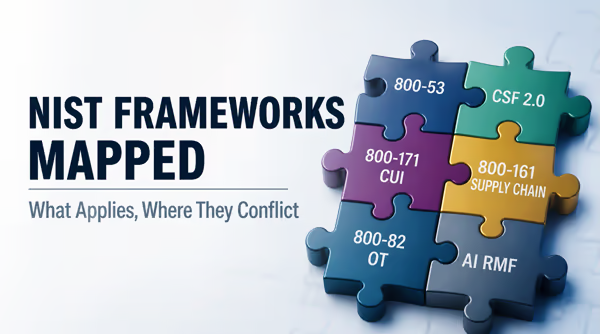
NIST framework group: the complete guide to 800-53, CSF 2.0, 800-171, OT overlays, supply chain, AI, and identity
Vulnox assessments show that 71% of organizations subject to multiple NIST frameworks are satisfying the wrong one first. This guide maps all 34 NIST frameworks -- from 800-53 baselines to the AI RMF and OT overlays -- showing where they overlap, where they conflict, and which controls buy you the most coverage across the group.
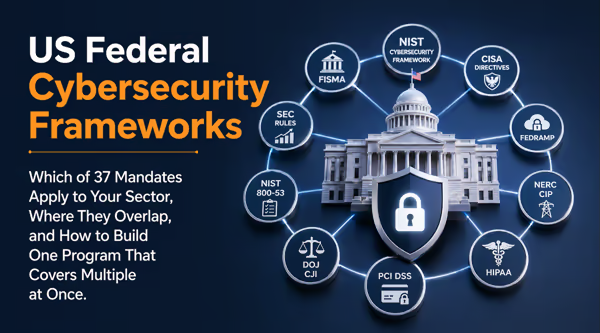
US federal cybersecurity frameworks: the complete guide to all 37 mandates
The US federal compliance landscape spans 37 active frameworks — from CJIS and NERC CIP to the SEC Cybersecurity Rule and GLBA Safeguards Rule. In our assessments, most organizations are unknowingly subject to 4 or more simultaneously. This guide maps every framework, who it applies to, where they conflict, and the fastest path to multi-framework coverage.
PCI DSS SAQ types explained: which one applies to your organization
Most merchants filing under SAQ A or SAQ B have never verified they actually qualify. In our assessments, SAQ misclassification is the single most common PCI DSS error we find — and it voids the compliance claim entirely.
Ready to Secure Your Digital Assets?
Get a comprehensive vulnerability assessment for your website today.