GovRAMP Core requirements: what the 60-control PMO review actually demands
 Julian ThorneMay 5, 2026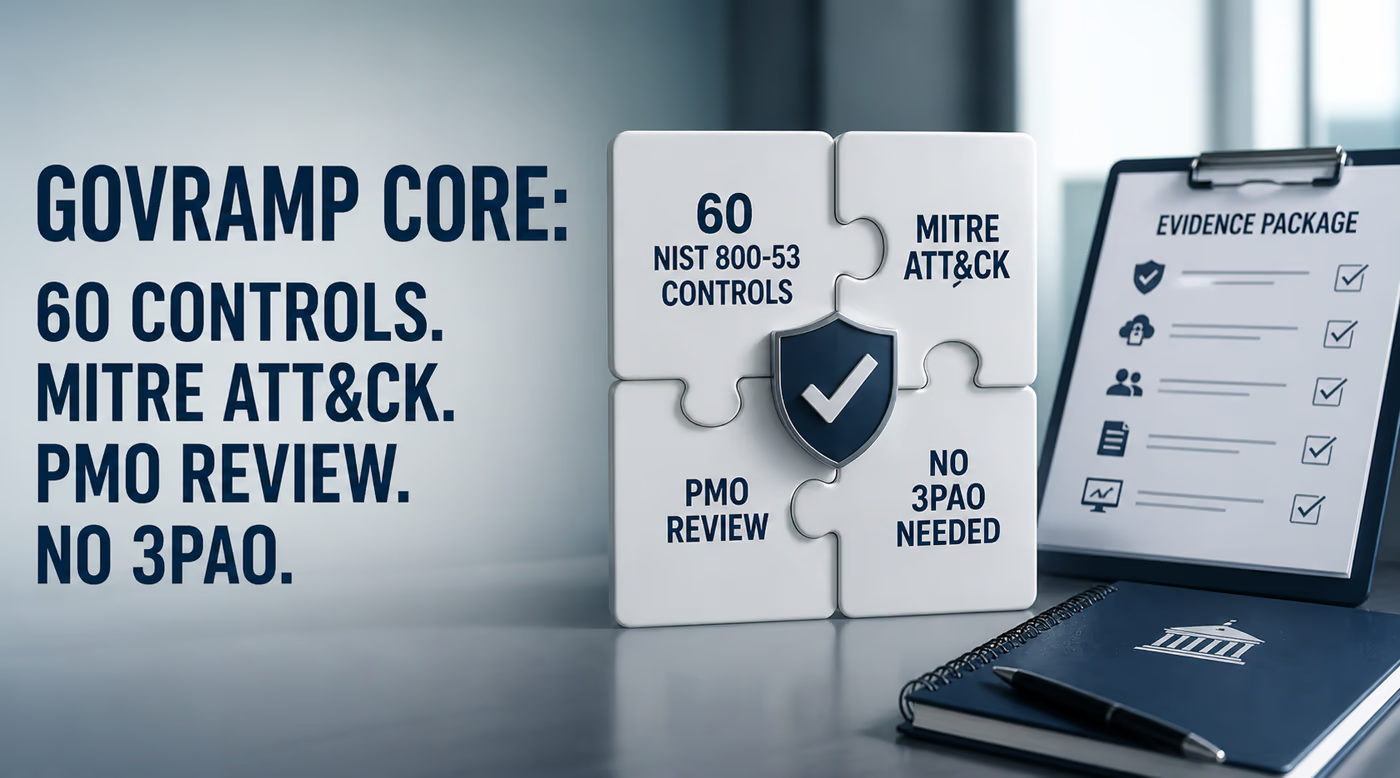
Key takeaways
GovRAMP Core, launched May 2025, requires validation of 60 NIST 800-53 Rev. 5 controls selected against the MITRE ATT&CK framework — not a self-attestation, but a PMO-reviewed submission with no 3PAO audit required.
Core status does not require a government sponsor, making it the only verified GovRAMP designation accessible to providers without an existing agency relationship.
Annual PMO assessment fees range from $9,000 (under $1M revenue) to $17,000 (over $5M revenue), plus quarterly continuous monitoring fees of $250 to $1,000 — substantially lower than the full 3PAO audit path.
Core sits on the GovRAMP Authorized Product List (APL), giving procurement officials a searchable signal that a provider has cleared a verified — not just self-reported — security baseline.
The 60 controls span 11 NIST 800-53 control families. Providers who fail Core typically do so not on technical controls but on documentation gaps in access control, audit logging, and configuration management evidence.
GovRAMP Core was built to address the dead zone between the Security Snapshot (self-progress tracking) and the full Ready/Authorized path — a gap where many smaller SaaS vendors stalled for years without formal recognition.
TL;DR
GovRAMP Core is the first genuinely new entry point GovRAMP has created since the program launched. Sixty controls, PMO-reviewed, no 3PAO, no sponsor required. It solves a real problem: smaller cloud providers selling to SLED agencies were stuck in compliance limbo because full authorization was too expensive and the Security Snapshot carried no procurement weight. Core changes that equation — but only if vendors treat it as real preparation, not a documentation sprint.
The vendor stuck at the starting line
A 22-person SaaS company has been selling a case management platform to county agencies for three years. Their state client asks them to get GovRAMP verified. They look at the full authorization pathway — 12 to 18 months, a 3PAO audit, a government sponsor they do not yet have, and costs that dwarf their current compliance budget. They look at the Security Snapshot and realize it produces a score, not a designation. They end up doing nothing formal and the deal stalls. This is not an unusual story. It played out dozens of times between 2021 and 2024, when the gap between ''progressing toward'' and ''verified'' had no formal middle ground.
GovRAMP Core, introduced in May 2025, is the program''s answer to that dead zone. It does not replace the full authorization path. It creates a verified landing point before the path gets expensive — 60 controls, PMO-assessed, APL-listed, and quarterly monitored. For providers who could not previously show procurement officials anything formal, that is a meaningful change.
What the 60 controls actually cover and why the selection matters
The 60 controls required for GovRAMP Core are drawn from the NIST 800-53 Rev. 5 Moderate baseline and span 11 control families: Access Control (AC), Audit and Accountability (AU), Awareness and Training (AT), Configuration Management (CM), Contingency Planning (CP), Identification and Authentication (IA), Incident Response (IR), Risk Assessment (RA), System and Communications Protection (SC), System and Information Integrity (SI), and Supply Chain Risk Management (SR). What distinguishes this subset from an arbitrary trimmed-down checklist is the selection methodology. GovRAMP cross-referenced these controls against MITRE ATT&CK tactics — specifically initial access, credential access, persistence, and lateral movement — to prioritize controls that disrupt the most common attack chains against SLED environments rather than just covering administrative compliance surface area.
That framing matters for how you build your evidence package. A control that exists in the NIST catalog because regulators wanted completeness and a control that exists in GovRAMP Core because it maps to credential-stuffing attacks against publicly exposed login endpoints are not the same thing to assess or document. The latter requires demonstrated technical implementation. Saying you have a policy is insufficient. The PMO will ask for logs, configuration exports, and testing evidence on the controls with the highest ATT&CK relevance.
Example
Identification and Authentication controls (IA family) are where most first-time submissions run into trouble. The obvious implementation — enabling MFA on your admin console — is necessary but not what the PMO is checking against. They are looking for IA controls applied across the full authorization boundary: federated identity flows, service-to-service authentication, API key lifecycle management, and machine identity. A SaaS provider that has MFA on their AWS root account but runs inter-service calls with long-lived static credentials will pass a checkbox review and fail a PMO documentation review.
GovRAMP publishes a Core control spreadsheet through the PMO that maps each control to expected evidence types. Vendors should pull that spreadsheet before building their evidence package, not after. The gap between what you think constitutes evidence and what the PMO expects is where timelines expand from weeks to months.
What assessment data shows about where providers actually fail Core readiness
Assessment base: Vulnox assessment data, 2024-2025, drawn from pre-authorization gap analysis engagements with cloud providers pursuing GovRAMP Core and Ready status across SaaS, IaaS, and PaaS categories.
Configuration management documentation is the most common gap in pre-Core assessments
In Vulnox assessment work with cloud providers preparing for GovRAMP Core submissions, the Configuration Management (CM) family generates more remediation action items than any other control family. The specific failure is not that providers lack change management processes — most have something. The failure is that the process is undocumented at the level the PMO requires: asset inventories that are current, baseline configurations for each system component, and a documented deviation approval process. Providers typically have the practice in someone''s head or in a runbook that hasn''t been updated since initial deployment.
The client assumption going in is almost always ''we manage our infrastructure well, this will be straightforward.'' The reality is that operational discipline and documented compliance evidence are different things. A team that deploys infrastructure-as-code has version-controlled configurations but may have no formal baseline approval process or deviation log. Those are distinct evidence requirements and neither automatically satisfies the other.
Audit and Accountability controls create scope problems vendors do not anticipate
The AU control family requires that audit logs cover all components within the authorization boundary. Providers frequently define their boundary around their application layer and forget about the supporting infrastructure: database query logs, cloud provider audit trails (AWS CloudTrail, Azure Monitor, GCP Cloud Audit Logs), and third-party SaaS tools that touch data within scope. When we map the actual authorization boundary against what is being logged, there is typically a 20 to 40 percent gap in coverage — components generating events that are not captured in the centralized audit system.
This matters beyond Core compliance. An attacker who compromises a boundary-adjacent component — a CI/CD pipeline, a deployment tool, an internal integration with database access — operates in audit-log blind spots that survive the PMO review because the provider never mapped those components as in-scope. The compliance gap and the detection gap are the same gap.
Supply Chain Risk Management controls catch vendors off guard because they are newer in the baseline
SR controls entered the NIST 800-53 Rev. 5 framework as a formal family and many providers have not yet built processes around them. GovRAMP Core includes SR controls, which require providers to document their critical suppliers, assess their security postures, and have a process for managing supply chain risk. For a 25-person SaaS company running on AWS with a dozen third-party integrations, this translates to a vendor security review program that most do not have formalized. They know their dependencies exist. They have not assessed them.
SLED agencies are increasingly concerned about supply chain attacks after high-profile incidents involving government software suppliers. GovRAMP Core''s inclusion of SR controls is a direct response to that concern. Providers who dismiss it as paperwork are misreading why it is there.
The PMO review is not easier than a 3PAO audit — it is different
Common belief
Most providers assume that because GovRAMP Core does not require a third-party assessment organization, it is a lighter review. The logic goes: no external auditor means a lower bar, faster turnaround, and less scrutiny on evidence quality.
What we found
In Vulnox pre-Core gap assessments, providers who conducted a structured control-by-control evidence review before submission had an average of 2 PMO clarification rounds. Providers who assembled existing documentation without a structured gap analysis averaged 5 to 7 clarification rounds, extending timelines by 8 to 12 weeks. The preparation investment recouped itself in process time every time.
That assumption is wrong in a specific way. A 3PAO audit involves an independent assessor who has incentives to find and document findings — their credibility depends on thoroughness. The GovRAMP PMO review for Core status involves staff who are also responsible for the program''s integrity. They are not going to approve a submission with thin evidence because it is convenient. The difference is that a 3PAO will guide you through the process and flag gaps before the formal submission. The PMO reviews what you send. If the evidence package is incomplete, you get a rejection and a remediation period, not a collaborative gap-filling session.
Providers who treat Core as a documentation sprint — assembling existing artifacts without purpose-built evidence — spend more time in remediation cycles than they would have spent doing the preparation correctly. The shorter path on paper becomes longer in practice when the submission does not pass initial review.
What GovRAMP Core does not cover — and why that matters for procurement decisions
External attack surface is outside the Core scope
GovRAMP Core validates controls within the defined authorization boundary. It does not assess what the provider''s external footprint looks like to an attacker. Exposed subdomains, publicly accessible administrative interfaces, unpatched internet-facing services, and credential leaks in public repositories are not part of the 60-control review. A provider can achieve Core status with a perfectly documented internal control set and a meaningfully exploitable external attack surface. Government procurement officials who rely solely on APL listing for vendor security decisions are missing the half of the picture that attackers see first.
Continuous monitoring scope is narrow at the Core tier
Quarterly continuous monitoring for Core status covers vulnerability scan results, POA&M updates, and asset inventory maintenance. It does not include the monthly deliverables required at Ready or Authorized status, and it does not involve a 3PAO reviewing the monitoring outputs. This means that between quarterly submissions, a provider could introduce significant configuration drift, new components, or third-party integrations that change their security posture materially — and the monitoring cadence would not surface it until the next quarter.
Core status is not portable to FedRAMP
Some providers pursue GovRAMP Core with a mental model of building toward FedRAMP. Core does not accelerate a FedRAMP path the way that GovRAMP Ready or Authorized status can. Providers with existing FedRAMP authorization can fast-track into GovRAMP — but the reverse is not equally true. Core is a SLED-market credential. If the long-term goal is federal contracts, Core is not the right investment on its own.
No government sponsor means no state-specific acceptance guarantee
Core status gets a provider listed on the APL. It does not guarantee that a specific state agency will accept Core as sufficient for their procurement requirements. Some states mandate Ready or Authorized status for contracts above certain data sensitivity thresholds. A provider who achieves Core expecting it to unlock all SLED contracts will find that some doors require a higher tier. The sales conversation still requires understanding the specific agency''s requirements, not just APL listing.
Where GovRAMP Core goes from here
At least three states will formally mandate GovRAMP Core as a minimum procurement threshold for lower-sensitivity cloud contracts by end of 2026, creating a procurement floor that currently does not exist.
The APL listing creates procurement infrastructure. States that want to push vendors toward verified security status without requiring full authorization now have a tier that is accessible enough to be realistic as a mandate. Arizona''s rapid adoption of GovRAMP after transitioning from AZ-RAMP is one early signal. As the APL population at Core status grows, state procurement offices will have enough verified vendors to make Core a viable baseline requirement rather than an aspirational one.
Confidence: mediumBy December 2026: check whether three or more state procurement guidelines have been updated to reference GovRAMP Core as a minimum for specific contract categories. If no state has codified Core as a requirement, the prediction is wrong.GovRAMP will expand the Core control set from 60 to between 75 and 85 controls within 24 months, driven by AI-specific security requirements from the AI Security Task Force launched in April 2025.
The AI Security Task Force is the first formal mechanism GovRAMP has built to address AI-enabled cloud products. As that task force produces guidance, some of those controls will enter the baseline — and Core, as the entry-level verified tier, is the most logical insertion point for controls that address AI-specific threats like model tampering, training data exfiltration, and inference endpoint abuse. The 60-control set was defined before AI guidance existed. It will not stay at 60.
Confidence: highBy May 2027: if GovRAMP Core still requires exactly 60 controls with no AI-specific additions, the prediction is wrong. Any published update to the Core control baseline above 60 confirms the direction.
GovRAMP Core is well-designed for the wrong reason
GovRAMP Core is a good idea because it creates a verified milestone that procurement officials can actually use. The APL listing, the PMO review, the quarterly monitoring cadence — those are real signals, not marketing claims. The program needed this tier and the 60-control design against MITRE ATT&CK is more thoughtful than most compliance bodies would have produced.
But the reason the program introduced Core is also slightly uncomfortable: they needed to retain vendors who were abandoning the pathway because full authorization was economically inaccessible. That is a market sustainability problem dressed up as a security solution. The 60 controls are justified on threat-relevance grounds. The tier exists because the full path was hemorrhaging participants.
That is fine, actually. A compliance program that loses participants is not achieving its public security mission. Core gets more providers into the ecosystem, into quarterly monitoring, and onto a path with formal incentives to continue. That beats the alternative — a program with high standards and low participation. The strongest counterargument is that Core creates a ''compliance destination'' risk: providers who achieve Core and stop there, treating it as their security program rather than a stepping stone. That risk is real. Some percentage of Core providers will not progress further. The program should be tracking progression rates and publishing them. If the data shows Core is a stopping point for most providers rather than a waypoint, the incentive structure needs adjustment.
Counterargument
The strongest counterargument against Core is that it risks becoming a ceiling rather than a floor for many providers — particularly smaller SaaS vendors who achieve the designation and market it aggressively to SLED prospects, creating a misleading impression of full authorization equivalence. GovRAMP should publish clear, public-facing language distinguishing Core from Ready and Authorized status in procurement contexts, with explicit guidance to state procurement officials on what each tier does and does not cover.
One thing to do before your next SLED sales conversation
Before your next pitch to a county, district, or state agency, pull the GovRAMP APL and check what status your competitors hold. If they are Authorized and you are unverified, you are not competing on security — you are hoping the buyer does not ask. If they are also unverified, GovRAMP Core is the fastest path to a differentiated procurement position without a 12-month authorization cycle. The PMO Core control spreadsheet is publicly available. Download it, run it against your current control implementation, and assess your actual gap to submission-ready. That exercise takes a day and produces a real answer. If the gap is smaller than you assumed, the path to APL listing is shorter than you think. If the gap is larger, you need to know that before you commit to a government contract that requires verified status.
Further Reading
Qatar Personal Data Privacy Law compliance
Qatar Personal Data Privacy Law: Complete PDPPL Compliance GuideCIS CSC v8.1 IG3 requirements
CIS CSC v8.1 IG3 requirements: the external attack surface your program still ignoresSB1386 compliance assessment
CA SB1386 Breach Notification Compliance GuideGovRAMP authorization tiers explained: Core, Low, Low+, Moderate, and High
GovRAMP Core requirements and the 60-control PMO review
Frequently Asked Questions
What is GovRAMP Core status and how does it differ from full GovRAMP authorization?
GovRAMP Core, launched May 2025, is a verified security designation requiring 60 NIST 800-53 Rev. 5 controls reviewed by the GovRAMP PMO. Unlike full Authorized status, it does not require a third-party assessment organization (3PAO), a government sponsor, or the full NIST 800-53 control set (which covers hundreds of controls at the Moderate baseline). Core is listed on the Authorized Product List (APL) but represents a formal intermediate milestone, not full authorization.
How much does GovRAMP Core cost?
GovRAMP Core has a one-time annual PMO assessment fee of $9,000 for providers with under $1M in revenue, $11,000 for providers with $1M to $5M in revenue, and $17,000 for providers over $5M in revenue. After achieving Core status, quarterly continuous monitoring fees apply: $250/quarter (under $1M revenue), $500/quarter ($1M to $5M), and $1,000/quarter (over $5M).
Which NIST 800-53 control families are included in GovRAMP Core?
GovRAMP Core covers 60 controls across 11 NIST 800-53 Rev. 5 control families: Access Control (AC), Audit and Accountability (AU), Awareness and Training (AT), Configuration Management (CM), Contingency Planning (CP), Identification and Authentication (IA), Incident Response (IR), Risk Assessment (RA), System and Communications Protection (SC), System and Information Integrity (SI), and Supply Chain Risk Management (SR). Controls were selected based on their alignment with the MITRE ATT&CK framework.
Does GovRAMP Core require a government sponsor?
No. GovRAMP Core does not require a government sponsor, making it the only verified GovRAMP designation accessible to cloud providers who have not yet established an agency relationship. This is a key differentiator from Provisionally Authorized and Authorized status, both of which require a government sponsor or GovRAMP Approvals Committee sponsorship.
What evidence do I need to submit for GovRAMP Core?
GovRAMP Core requires documented evidence for all 60 controls before submission. The GovRAMP PMO provides a Core control spreadsheet and pre-organized evidence folder structure. Common evidence types include asset inventories, baseline configuration records, audit log outputs, access control policy documentation, MFA implementation evidence, incident response plan documentation, and supply chain vendor assessment records. The PMO reviews submitted documentation directly — there is no 3PAO to guide you through gaps before submission.
Will GovRAMP Core status satisfy all SLED procurement requirements?
Not necessarily. GovRAMP Core gets a provider listed on the Authorized Product List (APL) with a Core designation, which many agencies will recognize. However, some states and agencies require Ready or Authorized status for contracts above specific data sensitivity thresholds. Providers should verify the specific procurement requirements of their target agency before treating Core status as sufficient for all SLED contracts.
How does GovRAMP Core relate to MITRE ATT&CK?
The 60 controls in GovRAMP Core were selected by cross-referencing the NIST 800-53 Rev. 5 Moderate baseline against MITRE ATT&CK tactics — specifically initial access, credential access, persistence, and lateral movement. This means the controls are prioritized based on their effectiveness against real-world attack techniques documented in ATT&CK, not simply for regulatory coverage completeness. GovRAMP''s Security Snapshot scoring also incorporates ATT&CK control protection values.
Related Articles
GovRAMP Moderate authorization: why the Significant Change Request process catches providers off guard
GovRAMP Moderate is the first tier where you need a government sponsor, annual 3PAO reassessment, and a Significant Change Request process that can pause normal product releases for months. Most providers who stall post-authorization were not prepared for what maintaining Moderate status actually costs operationally.

GovRAMP Low+ authorization: the impact level that punishes providers who get the CUI boundary wrong
GovRAMP Low+ is where providers handling limited Controlled Unclassified Information land — or discover they should not be there. The defining failure is not a missing control. It is a CUI boundary that was drawn before anyone asked what data the government actually sends through the system.

GovRAMP High authorization: why FIPS-validated crypto and personnel security controls catch providers off guard
GovRAMP High is where cloud providers discover that having strong encryption is not the same as having FIPS 140-2 validated encryption — and that distinction alone has derailed authorizations from vendors who passed every other control family. The architectural constraints at High are qualitatively different from every lower tier.
Ready to Secure Your Digital Assets?
Get a comprehensive vulnerability assessment for your website today.