NIST framework group: the complete guide to 800-53, CSF 2.0, 800-171, OT overlays, supply chain, AI, and identity
 Julian ThorneMay 5, 2026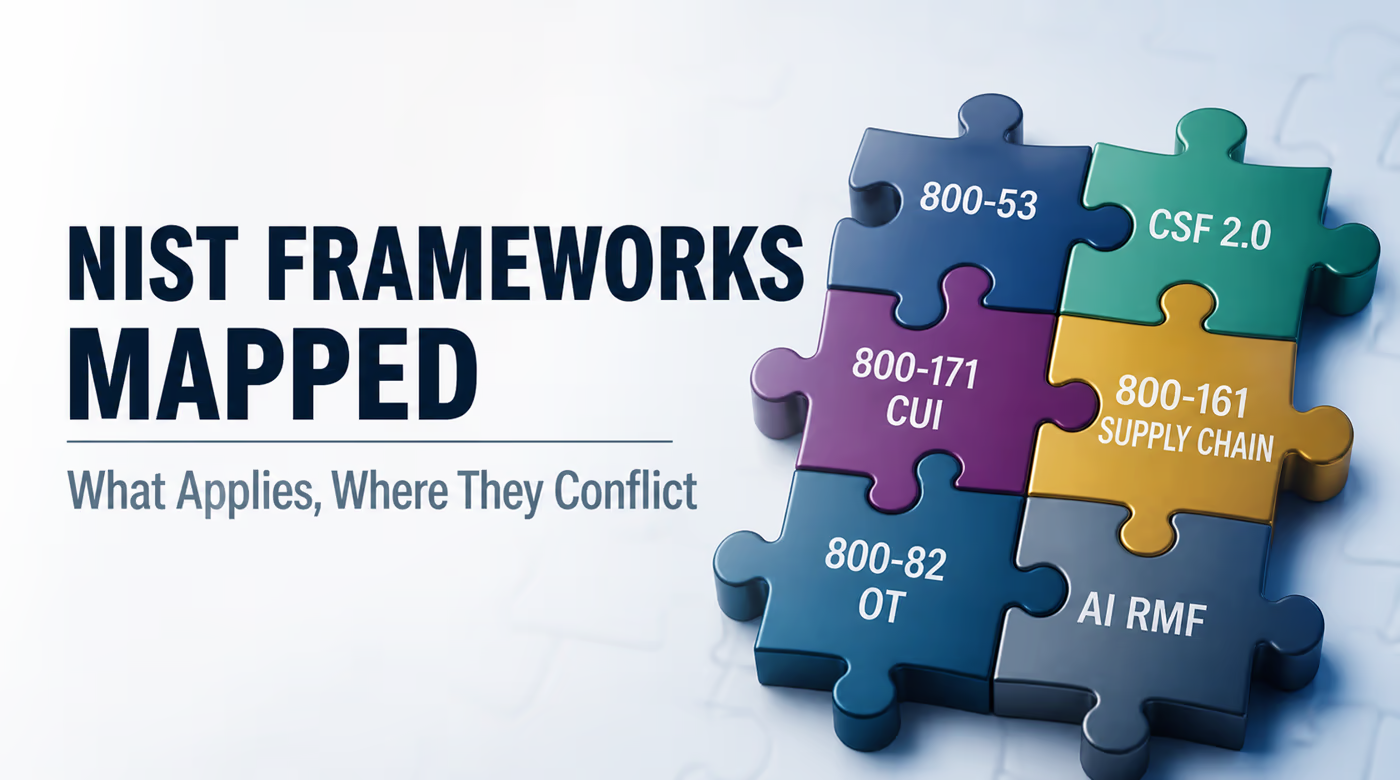
Key takeaways
NIST 800-53 Rev 5 is the master control catalog for the entire group -- 34 frameworks in this group derive their control language from it, but only 6 of those 34 are mandatory for any single organization. Knowing which 6 apply to you before spending budget is the only sensible starting point.
NIST 800-171 R3 added 17 new requirements over R2, including organization-defined parameters (ODPs) that CMMC 2.0 Level 2 assessors will verify against -- contractors still running R2 self-assessments are not prepared for third-party assessment under the current rule.
The 800-161 supply chain framework runs across 5 tiers (C-SCRM Baseline, Flow Down, Level 1, Level 2, Level 3) that are not sequential maturity levels -- they are simultaneous obligations mapped to your position in the federal acquisition chain, and most contractors are applying only one when all five apply.
NIST 800-82 R3 OT overlays (Low, Moderate, High) diverge from the 800-53B baselines in 23 control areas where availability outranks confidentiality -- applying standard IT security controls to OT without the overlay produces a system that is technically compliant and operationally dangerous.
The NIST AI RMF (AI 100-1) and its Generative AI Profile (AI 600-1) have no enforcement mechanism as of 2025, but the EU AI Act and emerging US federal procurement rules are referencing both as the baseline for AI system audits -- early voluntary adoption creates a defensible paper trail that organizations without it will not be able to reconstruct retroactively.
NIST CSF 2.0 added a sixth function -- Govern -- that did not exist in v1.1, and this function has direct mapping to 800-53 PM (Program Management) controls that most organizations have left unimplemented because they were never part of a low or moderate baseline.
Covering 800-53 R5 moderate baseline satisfies approximately 78% of 800-171 R3 requirements by control count, but the 22% gap includes the highest-weighted CMMC practices -- organizations that assume moderate baseline coverage means 800-171 coverage will fail a DIBCAC assessment on exactly those gaps.
TL;DR
The NIST framework group is not one framework with versions. It is 34 separate documents covering federal controls, CUI protection, OT security, supply chain risk, digital identity, secure development, zero trust, AI risk, and privacy -- each with its own scope, enforcement mechanism, and failure modes. The hard part is not understanding any single document. The hard part is knowing which ones apply simultaneously to your organization and where following one creates a gap in another.
When the wrong framework passes the audit
A defense subcontractor handling engineering drawings for a federal prime had completed an 800-171 R2 self-assessment in early 2024. Scored 98 out of 110. Clean documentation. The ISSO was proud of it. Six months later, a DIBCAC assessment found 14 findings, 4 of them high severity. The disconnect: the self-assessment had been conducted against R2, CMMC 2.0 Level 2 had updated its practice mapping to align with R3, and the contractor had never re-mapped. They had also applied the wrong 800-161 tier -- they were treating themselves as a Level 1 organization when their contract vehicle placed them in a Level 2 flow-down obligation. Two clean audit reports. Two frameworks applied incorrectly. The environment had not changed.
The problem was not technical. The controls were mostly there. The problem was that nobody had looked at the 34 frameworks in this group as a connected system. They had picked the two that sounded relevant and assumed the rest did not apply. That assumption is the single most predictable failure mode across every NIST-adjacent engagement I have worked.
What the NIST framework group actually covers
NIST publishes security and risk management guidance across five distinct problem domains, all of which end up inside this framework group. The first domain is the federal control catalog -- 800-53 in its R4 and R5 variants, plus the 800-53B baselines that segment those controls into Low, Moderate, High, and Privacy impact levels. The second domain is CUI protection for nonfederal systems -- 800-171 in R2 and R3, plus the companion assessment methodology publications 800-171A and 800-171A R3. The third domain is operational technology -- 800-82 R3 with its Low, Moderate, and High OT overlays that modify standard 800-53 controls for industrial control systems where a patch reboot can take a production line offline for 72 hours. The fourth domain is supply chain risk management -- 800-161 R1 with its five implementation tiers representing different positions in the federal acquisition hierarchy. The fifth domain is specialized guidance covering risk management processes (800-39), the Risk Management Framework workflow (800-37 R2), systems security engineering (800-160), digital identity (800-63B), zero trust architecture (800-207), and secure software development (800-218 SSDF). Sitting above all of these is the Cybersecurity Framework (CSF 2.0), which functions as a communication and governance layer rather than a control catalog. And cutting across the whole group are three frameworks that did not exist five years ago: the AI RMF (AI 100-1), the Generative AI Profile (AI 600-1), and the Privacy Framework 1.0. The group is not a ladder. It is a matrix. Most organizations need to be operating in at least three of these five domains simultaneously and are not.
NIST SP 800-53 R4
NIST SP 800-53 R4 (low)
NIST SP 800-53 R4 (moderate)
NIST SP 800-53 R4 (high)
NIST SP 800-53 R5
NIST SP 800-53B R5 (low)
NIST SP 800-53B R5 (moderate)
NIST SP 800-53B R5 (high)
NIST SP 800-53B R5 (privacy)
NIST SP 800-53 R5 (NOC)
NIST CSF 2.0
NIST AI 100-1 (AI RMF 1.0)
NIST AI 600-1
NIST Privacy Framework 1.0
NIST SP 800-37 R2
NIST SP 800-39
NIST SP 800-63B
NIST SP 800-82 R3 LOW OT Overlay
NIST SP 800-82 R3 MODERATE OT Overlay
NIST SP 800-82 R3 HIGH OT Overlay
NIST SP 800-160
NIST SP 800-161 R1 C-SCRM Baseline
NIST SP 800-161 R1 Flow Down
NIST SP 800-161 R1 Level 1
NIST SP 800-161 R1 Level 2
NIST SP 800-161 R1 Level 3
NIST SP 800-171 R2
NIST SP 800-171 R3
NIST SP 800-171A
NIST SP 800-171A R3
NIST SP 800-172
NIST SP 800-207
NIST SP 800-218 (SSDF)
NIST SP 800-160
Framework by framework: what each one actually requires
Frameworks
NIST SP 800-53 R4 and R4 baselines (Low, Moderate, High)
Federal agencies and their contractors operating information systems prior to the R5 transition. Many legacy FedRAMP authorizations still reference R4 control families. Organizations maintaining older ATOs that have not been reauthorized under R5.
Organizations treating R4 as still current when their agency or cloud environment has transitioned to R5. The control numbering is largely consistent but the enhancements and ODPs changed materially. R4 audit logs passed on a metric that R5 now requires a specific format for.
R4 contains 18 control families and approximately 900 controls and enhancements across Low, Moderate, and High impact baselines. The High baseline added significant controls around audit, incident response, and personnel security that the Moderate baseline did not require. R4 was the first version to formally integrate privacy controls into the catalog, though they remained an appendix rather than a full family.
FISMA compliance for federal agencies. FedRAMP authorization for cloud service providers. Failure to maintain an ATO under an applicable baseline results in the system being considered unauthorized, which triggers reporting obligations under FISMA and can result in system shutdown orders from the authorizing official.
R4 is the predecessor to R5. Many 800-171 R2 requirements were derived from a subset of R4 Moderate controls. Organizations migrating from R4 to R5 will find that R5 added a Privacy control family (PT) and reorganized several Supply Chain controls (SR) that did not exist as a family in R4.
NIST SP 800-53 R5 and R5 baselines (Low, Moderate, High, Privacy, NOC)
All federal agencies operating non-national-security information systems, FedRAMP cloud service providers, and any organization seeking to align with the current federal security standard. The NOC (Not Otherwise Categorized) variant covers controls that do not fit neatly into Low, Moderate, or High impact categorizations.
Selecting only one of Low, Moderate, High, or Privacy when multiple apply. A system categorized as Moderate that processes PII needs the Moderate baseline plus the Privacy overlay. Many organizations pick Moderate and stop. The Privacy overlay adds 30+ controls that are invisible inside a pure Moderate selection.
R5 reorganized R4 into 20 control families, added the Supply Chain Risk Management (SR) family, elevated privacy controls from an appendix to a full integrated family (PT), and introduced organization-defined parameters more explicitly throughout. The Privacy baseline is a separate overlay -- it applies to systems that process PII regardless of their Low, Moderate, or High categorization, meaning a Low-impact system processing PII carries both the Low baseline and the Privacy baseline simultaneously.
FISMA, FedRAMP, and by reference through CMMC 2.0 and many sector-specific frameworks. OMB Memorandum M-21-31 tied logging requirements directly to R5 control enhancements. An agency that has not transitioned from R4 to R5 is technically operating against a superseded standard, which creates audit findings in annual FISMA reporting.
800-53 R5 is the source catalog from which 800-171 R3, the 800-82 OT overlays, and the 800-161 supply chain tiers all derive their control language. Understanding R5 deeply makes every other framework in this group faster to map.
NIST CSF 2.0
Any organization globally that wants a risk-based cybersecurity management structure. CSF 2.0 is sector-agnostic and organization-size-agnostic. It is voluntary for private sector organizations and referenced but not mandated by most US federal requirements, though CISA uses it heavily in its guidance to critical infrastructure sectors.
Using CSF 2.0 as the compliance artifact rather than the management layer. Organizations submit a CSF profile to regulators as evidence of compliance. CSF profiles describe intent and current state -- they are not evidence of control implementation. An auditor who asks for CSF profiles and gets them without underlying control evidence has learned nothing about actual security posture.
CSF 2.0 organizes security activities across six Functions: Govern, Identify, Protect, Detect, Respond, Recover. The new Govern function added in v2.0 covers organizational context, risk management strategy, roles and responsibilities, policy, oversight, and supply chain risk management. Each function contains Categories and Subcategories that map to specific 800-53 R5 controls. CSF 2.0 is not a control catalog -- it is a management framework. It tells you what questions to answer, not specifically how to answer them.
Voluntary. However, CISA''s Cross-Sector Cybersecurity Performance Goals (CPGs) align to CSF functions, and sector regulators in financial services, healthcare, and energy are increasingly referencing CSF maturity in examination criteria. Not formally audited, but increasingly expected.
CSF 2.0 maps explicitly to 800-53 R5, 800-171 R2, and COBIT. The Govern function maps most directly to 800-53 PM (Program Management) controls. Organizations that implement the Govern function properly are simultaneously satisfying 800-53 PM controls that most low-baseline implementations miss entirely.
NIST AI 100-1 (AI RMF 1.0)
Organizations designing, developing, deploying, or using AI systems. This includes federal agencies under Executive Order 14110 and any private sector organization that wants a structured approach to AI risk. Healthcare organizations using clinical decision support AI, financial institutions using algorithmic underwriting, and any SaaS company embedding AI features into products that federal customers will use.
Treating AI RMF as a documentation exercise. Organizations produce GOVERN policies and MAP inventories without connecting them to operational decisions about model deployment, data governance, or incident response. The framework has no value if the MAP function does not produce a real inventory of AI systems in production.
The AI RMF is organized around four core functions: GOVERN, MAP, MEASURE, MANAGE. GOVERN establishes organizational AI risk culture and accountability. MAP contextualizes AI risk to specific use cases. MEASURE defines metrics and evaluation methods. MANAGE implements responses to identified risk. The framework does not specify controls -- it specifies activities and outcomes. Organizations must build their own control implementations against these outcomes.
Currently voluntary. However, the EU AI Act references AI RMF-compatible practices for high-risk AI systems. Federal agencies under EO 14110 are required to conduct AI risk assessments that are substantially aligned with AI RMF. The absence of documented AI risk management is increasingly a finding in federal procurement reviews.
AI RMF GOVERN function aligns to CSF 2.0 GOVERN and 800-53 PM controls. AI RMF MEASURE function maps to 800-53 RA (Risk Assessment) and CA (Assessment, Authorization, and Monitoring) families. An organization with a mature 800-53 R5 implementation has approximately 60% of the structural scaffolding needed for AI RMF -- the gaps are AI-specific measurement and bias evaluation.
NIST AI 600-1 (Generative AI Profile)
Organizations specifically using or deploying generative AI systems -- large language models, image generation, code generation, multimodal systems. This is a profile layered on top of AI RMF 1.0, not a standalone framework. It applies wherever AI RMF applies but the AI system in scope produces synthetic content.
Ignoring AI 600-1 entirely because AI RMF feels sufficient. The confabulation risk and information integrity attack categories in AI 600-1 have no equivalent in AI RMF 1.0 and no coverage in 800-53 R5. Organizations deploying LLMs without addressing these specific risks have a documented gap that is going to appear in vendor assessments within two years.
AI 600-1 identifies 12 unique risks specific to generative AI that AI RMF 1.0 does not fully address: confabulation, data privacy violations, homogenization, human-AI configuration failures, information integrity attacks, information security risks, intellectual property issues, obscured provenance, value chain complexity, data bias, and harmful content generation. For each risk, it specifies suggested actions mapped back to AI RMF subcategories.
Voluntary. The same procurement trajectory as AI RMF applies -- early adoption creates documentation that will matter when federal agencies start requiring AI risk attestations from vendors.
AI 600-1 is a profile of AI RMF. It does not stand alone. An organization cannot implement AI 600-1 without first having AI RMF governance in place.
NIST Privacy Framework 1.0
Any organization processing personal data that wants a structured risk management approach to privacy. Particularly useful for organizations that need to align privacy operations with 800-53 R5 privacy controls or with external privacy regulations without a direct US federal mandate.
Treating Privacy Framework as separate from the security program. Privacy and security teams in the same organization often implement Privacy Framework and 800-53 independently, producing duplicate documentation, conflicting data inventories, and privacy impact assessments that do not reference the security controls protecting the same data.
Privacy Framework organizes activities across five Functions: Identify-P, Govern-P, Control-P, Communicate-P, Protect-P. Each function has Categories and Subcategories. The framework is explicitly designed to complement CSF, with parallel structure and cross-references. It does not replace GDPR, CCPA, or other statutory requirements -- it provides a management layer for operationalizing those requirements.
Voluntary. No direct enforcement. However, the 800-53 R5 Privacy baseline maps almost entirely to Privacy Framework subcategories, so organizations using Privacy Framework as their governance layer and 800-53 R5 Privacy baseline as their control implementation have a defensible position in regulatory inquiries.
Privacy Framework maps directly to CSF 2.0 and 800-53 R5 Privacy baseline. The Protect-P function is essentially the Privacy baseline controls expressed as outcomes rather than implementation specifications.
NIST SP 800-37 R2 (Risk Management Framework)
Federal agencies and their contractors operating information systems subject to FISMA. The RMF is the authorization process -- it defines how an organization selects controls, implements them, assesses them, and obtains authorization to operate (ATO). It is not optional for covered federal systems.
Treating 800-37 as a documentation checklist rather than a risk decision process. The Authorize step produces a formal risk acceptance by a named individual. When that individual has not actually reviewed the residual risk, the authorization is a signature on a document, not a risk decision. This is predictable and universal.
800-37 R2 defines a seven-step process: Prepare, Categorize, Select, Implement, Assess, Authorize, Monitor. The Prepare step was added in R2 and is consistently underimplemented -- it requires establishing organizational risk management roles, identifying common controls, and building the risk management strategy before any system-level work begins. Skipping Prepare means every downstream step is built on an undocumented foundation.
FISMA compliance. An ATO obtained through a flawed RMF process is not invalidated retroactively, but a subsequent assessment or audit will find the gaps and the ATO can be suspended or revoked. Authorizing officials who sign ATOs without adequate Prepare-step documentation carry personal accountability under FISMA.
800-37 R2 is the procedural framework for implementing 800-53 controls. You cannot have a proper ATO without 800-37. The two are inseparable for federal systems. 800-39 provides the organizational risk management context within which 800-37 operates.
NIST SP 800-39 (Managing Information Security Risk)
Federal agencies and organizations that want a structured three-tier risk management architecture: organization level, mission/business process level, and information system level. Primarily referenced in federal contexts but applicable to any organization building a risk management hierarchy.
Building system security plans (SSPs) without Tier 1 risk framing. The SSP inherits assumptions about acceptable risk from the organization level. Without those assumptions documented, every SSP is written against an undefined risk appetite.
800-39 defines risk framing, risk assessment, risk response, and risk monitoring across three organizational tiers. The critical insight is that risk at the information system level (Tier 3) cannot be properly managed without risk framing decisions made at the organization level (Tier 1) and mission process level (Tier 2). Most organizations only operate at Tier 3.
No direct enforcement outside FISMA context. Referenced by 800-37 R2 as foundational to the Prepare step. Organizations that have not implemented Tier 1 and Tier 2 risk management are essentially making ad hoc risk decisions at the system level without organizational context.
800-39 is the conceptual foundation for 800-37. The three-tier model in 800-39 maps directly to the organizational roles established in the 800-37 Prepare step. CSF 2.0 Govern function addresses similar organizational-level risk governance.
NIST SP 800-63B (Digital Identity Guidelines)
Federal agencies and their service providers implementing digital authentication. The partial mapping in the framework group reflects that 800-63B covers authentication assurance levels (AAL1, AAL2, AAL3) and is specifically referenced by many federal systems for login and access management. Commercial organizations adopt it as the standard for strong authentication implementation.
Implementing MFA without verifying the AAL level matches the system''s risk categorization. An organization that deploys SMS OTP for a Moderate-impact system and calls it AAL2-compliant has misread the guidance. 800-63B is explicit that out-of-band authentication via public switched telephone network is restricted and carries specific conditions that most implementations do not meet.
800-63B specifies authentication assurance levels: AAL1 requires single-factor authentication with approved cryptography; AAL2 requires multi-factor with an approved combination; AAL3 requires hardware-based cryptographic authenticator with verifier impersonation resistance. It explicitly prohibits SMS OTP at AAL2+ for high-risk applications and mandates checking passwords against known breached credential lists.
Required for federal digital services under OMB M-19-17. FedRAMP High systems require AAL3 for privileged access. Non-compliance creates identity risk findings in security assessments. The prohibition on SMS OTP is frequently ignored in practice and consistently appears as a finding.
800-63B maps to 800-53 R5 IA (Identification and Authentication) family. IA-2 and IA-5 controls reference AAL levels directly. Organizations implementing 800-53 IA controls without reference to 800-63B AAL definitions are implementing to an undefined standard.
NIST SP 800-82 R3 OT Overlays (Low, Moderate, High)
Organizations operating industrial control systems (ICS), supervisory control and data acquisition (SCADA) systems, distributed control systems (DCS), programmable logic controllers (PLCs), or any operational technology environment where physical processes are computer-controlled. Federal facilities, utilities, manufacturing, water treatment, oil and gas, transportation.
Applying the wrong impact level for the OT environment. A water treatment SCADA system controlling chlorination is a High-impact system for availability and safety -- applying the Low OT overlay because the data classification is low produces a configuration that fails to protect the physical process.
800-82 R3 provides three OT overlays that modify the 800-53B baselines for operational technology environments. The overlays specify which controls apply, which are not applicable, and which require OT-specific tailoring. In OT environments, availability is the primary security property -- not confidentiality. This inverts the standard IT priority. The High OT overlay adds specific requirements for safety system separation, engineering workstation controls, and supply chain integrity for ICS components that have no equivalent in standard IT baselines.
Referenced by TSA cybersecurity directives for pipeline and rail operators, NERC CIP for bulk electric systems, and CISA advisories. Not universally mandated but increasingly required by sector regulators. An OT environment assessed against 800-53 Moderate without the OT overlay will show compliant on controls that are actively harmful to apply in an ICS context.
800-82 R3 overlays are applied on top of 800-53B baselines. They do not replace 800-53 -- they modify it. Organizations running converged IT/OT environments need both 800-53 and 800-82 overlays simultaneously. The supply chain controls in 800-82 High overlay reference 800-161 C-SCRM practices for ICS component procurement.
NIST SP 800-160 (Systems Security Engineering)
Systems engineers, architects, and acquisition officials building or procuring federal information systems. 800-160 is specifically for organizations that design systems from scratch or conduct major system upgrades, embedding security as an engineering discipline rather than a post-deployment overlay.
Treating 800-160 as relevant only to new system development. Organizations with legacy systems in modernization programs often skip the 800-160 framework because the system already exists. Partial modernization without security engineering review produces a hybrid architecture where new components have strong controls and legacy components have none.
800-160 provides a systems security engineering framework integrating security into the full system development lifecycle using ISO/IEC/IEEE 15288 as the base systems engineering process. It defines trustworthiness as the composite of security, safety, reliability, resilience, and privacy. It requires security be addressed at requirements, architecture, design, implementation, integration, verification, validation, transition, operation, maintenance, and disposal phases.
Referenced in DoD acquisition policy. Increasingly required for high-value asset (HVA) system development. No standalone enforcement outside acquisition context, but systems that skip security engineering and add controls post-deployment consistently produce the gaps that 800-171 and CMMC assessments find.
800-160 informs how 800-53 controls get implemented at the design level rather than bolted on after deployment. Supply chain security requirements in 800-160 feed directly into 800-161 C-SCRM practices. 800-160 and 800-218 (SSDF) share significant overlap for software-heavy systems.
NIST SP 800-161 R1 and its tiers (C-SCRM Baseline, Flow Down, Level 1, Level 2, Level 3)
Any organization in the federal acquisition ecosystem -- prime contractors, subcontractors, and sub-tier suppliers handling federal contracts where cybersecurity supply chain risk is relevant. The five tiers represent different roles in the acquisition hierarchy, not sequential maturity stages. A company can simultaneously be a Level 2 organization to its prime and a Level 3 organization to its own sub-tier suppliers.
Applying only one tier. The most common pattern in our assessments is a prime contractor that has implemented Level 1 (enterprise governance) but has no Flow Down mechanism -- their subcontractors are operating with zero contractual security requirements. The flow down tier is the most consistently missing piece, and it is the tier that creates the actual supply chain breach path.
The C-SCRM Baseline defines minimum practices all organizations should implement regardless of their position in the supply chain: supplier identification, risk assessment processes, and contractual security requirements. Flow Down specifies which security requirements must be contractually passed to sub-tier suppliers. Level 1 covers enterprise-level C-SCRM governance. Level 2 covers mission/business process-level practices. Level 3 covers information system-level controls. Each level builds on the previous but all five apply to most federal prime contractors and their significant subcontractors.
Executive Order 14028 on Improving the Nation''s Cybersecurity directly references supply chain security practices consistent with 800-161. Federal contracts increasingly include clauses requiring 800-161 alignment. CMMC 2.0 Level 2 and Level 3 practices incorporate several 800-161 controls. Non-compliance creates contract performance risk and can trigger termination for cause clauses in some acquisition vehicles.
800-161 control language derives from 800-53 R5 SA (System and Services Acquisition) and SR (Supply Chain Risk Management) families. The SR family was added to 800-53 R5 specifically to align with 800-161 practices. Organizations implementing 800-53 R5 Moderate and above are partially implementing 800-161 whether they know it or not -- the question is whether they have the governance layer (Level 1) to make it intentional.
NIST SP 800-171 R2 and R3 (CUI Protection)
Nonfederal organizations that process, store, or transmit Controlled Unclassified Information (CUI) under federal contracts or agreements. This includes defense contractors, research universities with federal grants, healthcare organizations with government research contracts, and any company in the DoD supply chain with access to technical drawings, specifications, or other CUI categories.
Scoring the self-assessment against the wrong version. We assessed a defense electronics manufacturer in early 2024 whose SPRS score of 94 was calculated against R2 using an assessment methodology that predated the DoD''s scoring methodology update from November 2020. Their actual score under the current methodology was 61. The 33-point gap was entirely a measurement artifact -- the controls were the same, the scoring rules were different.
800-171 R2 contains 110 requirements across 14 families derived from a subset of 800-53 R4 Moderate controls. 800-171 R3 restructured the requirements into 17 families, added organization-defined parameters (ODPs) that must be documented and implemented, and added 17 new requirements that did not exist in R2. R3 also explicitly aligns to 800-53 R5 rather than R4, which means the control mapping shifted and organizations that built their SSP against R4-mapped R2 requirements need to remap to R5. CMMC 2.0 Level 2 is currently aligned to R2, with a pending transition to R3 that the DoD has signaled will happen but has not formally dated.
DFARS clause 252.204-7012 requires covered defense contractors to implement 800-171 and report any cyber incidents. Starting with CMMC 2.0 full implementation, Level 2 contractors will require third-party assessment (C3PAO) rather than self-assessment. False claims in self-assessments submitted to the DoD Supplier Performance Risk System (SPRS) carry False Claims Act liability -- the DoJ has already prosecuted cases.
800-171 R3 is a subset of 800-53 R5. Every 800-171 R3 requirement maps back to one or more 800-53 R5 controls. Organizations that implement 800-53 R5 Moderate will satisfy most of 800-171 R3, but the gaps are in areas 800-53 Moderate does not require -- specifically several configuration management and incident response requirements that 800-171 mandates even at its base level.
NIST SP 800-171A and 800-171A R3 (CUI Assessment Methodology)
Third-party assessors conducting CMMC assessments, organizations conducting self-assessments, and government assessment teams evaluating nonfederal systems for CUI protection adequacy. 800-171A provides the assessment procedures; 800-171 provides the requirements. You cannot correctly assess against 800-171 without the companion 800-171A methodology.
Conducting gap assessments using only the examine method. Organizations review their SSP documentation against 800-171 requirements and mark them satisfied. 800-171A requires that many requirements also be tested -- verifying that the documented control actually functions. A policy that says MFA is required is evidence of the examine objective. Verifying that MFA actually challenges users at login is the test objective. Both must be met.
800-171A defines assessment objectives and methods for each 800-171 requirement. Each assessment objective specifies what to examine (documentation, mechanisms, activities), who to interview, and what to test. R3 aligned the assessment objectives to 800-171 R3''s restructured requirements and added specificity to assessment procedures that R2-era 800-171A left vague. The distinction between ''examine,'' ''interview,'' and ''test'' methods matters -- a requirement satisfied only by documentation review but not by testing is partially assessed.
C3PAOs conducting CMMC Level 2 assessments are required to use 800-171A R3 procedures. Self-assessments that do not follow 800-171A methodology are not considered credible evidence by DCSA. An SPRS score derived without 800-171A methodology cannot be defended under False Claims Act scrutiny.
800-171A is inseparable from 800-171. It is the assessment companion. 800-171A R3 aligns to 800-171 R3 as 800-171A aligns to 800-171 R2. CMMC assessment procedures are built on 800-171A methodology.
NIST SP 800-172 (Enhanced CUI Requirements for Critical Programs and HVAs)
Organizations handling CUI associated with critical programs or high-value assets -- specifically where the consequence of compromise is catastrophic rather than merely serious. This includes programs involving advanced weapons systems, intelligence activities, or other designations where standard 800-171 protection is deemed insufficient.
Organizations confusing 800-172 with 800-171 R3. The enhanced requirements in 800-172 are not simply harder versions of 800-171 controls. Penetration-resistant architecture requires capabilities like moving target defense and cyber deception that have no analog in standard enterprise security programs. Organizations that read 800-172 and map it to their existing control framework are categorically misunderstanding what Level 3 requires.
800-172 adds 35 enhanced requirements on top of the full 800-171 baseline. These requirements are organized into three categories: penetration-resistant architecture (requiring capabilities like deception technologies, adversarial testing, and redundant independent authentication), damage-limiting operations (requiring system partitioning, information fragmentation, and operational security measures), and designing for cyber resiliency and survivability (requiring the system to maintain mission capability under active attack). These are not incremental hardening steps -- they represent a qualitatively different security posture.
CMMC 2.0 Level 3 is built on 800-172. Only organizations on specific contracts involving critical programs will be required to achieve Level 3. The number of contracts requiring Level 3 is smaller than Level 2 but the consequences of non-compliance are proportionally higher -- these are the contracts where a security failure means a weapons system compromise.
800-172 requires full 800-171 compliance as a prerequisite -- it adds to the base, it does not replace it. Several 800-172 enhanced requirements map to 800-53 R5 High baseline controls, particularly in the SA, SC, and SI families.
NIST SP 800-207 (Zero Trust Architecture)
Organizations implementing or planning zero trust network architectures. Mandatory reference for federal agencies under CISA Zero Trust Maturity Model and OMB M-22-09. Widely adopted by commercial organizations moving away from perimeter-based security models.
Declaring zero trust based on product acquisition. An organization that deploys a ZTNA product without implementing the identity governance and device health validation tenets has acquired zero-trust-branded technology operating in a non-zero-trust architecture. The product vendors are not going to tell them this.
800-207 defines zero trust as a security model based on the principle that no implicit trust is granted based on network location. It specifies seven tenets: verify all resources, grant least privilege, inspect all traffic, authenticate and authorize all connections, collect and analyze all available data, apply dynamic policy based on observed behavior, and maintain awareness of current state of assets. It then defines three ZTA deployment models -- enhanced identity governance, micro-segmentation, and network infrastructure/software-defined perimeter -- and describes how 800-53 controls support each model.
Federal agencies are required to meet CISA Zero Trust Maturity Model targets under OMB M-22-09 by specific fiscal year deadlines. Agencies that have not completed identity pillar maturity are behind on these deadlines. Commercial organizations face no direct mandate but many regulated sectors are incorporating zero trust requirements into examination criteria.
800-207 maps to 800-53 R5 AC, IA, SC, SI, and CA families. The identity tenet of ZTA depends directly on 800-63B AAL implementations. Organizations implementing 800-207 without 800-63B AAL2/3 for privileged access have a foundational gap in their ZTA.
NIST SP 800-218 (SSDF v1.1)
Software producers selling to or used by federal agencies, following the requirements of OMB M-22-18 which requires federal agencies to obtain software attestations aligned with SSDF. Any organization that develops software used in federal information systems.
Self-attesting without evidence. The attestation form asks producers to confirm SSDF alignment. Many organizations sign the form based on a general belief that they do secure development without mapping their practices to specific SSDF tasks. When agencies request supporting artifacts, the documentation does not exist.
SSDF v1.1 organizes secure development practices across four groups: Prepare the Organization (PO), Protect the Software (PS), Produce Well-Secured Software (PW), and Respond to Vulnerabilities (RV). Each group contains practices, tasks, and example implementations. PO requires establishing security requirements and toolchains. PS requires protecting code, dependencies, and build environments. PW requires threat modeling, code review, and security testing. RV requires vulnerability disclosure processes and patch deployment tracking.
OMB M-22-18 and M-23-16 require federal agencies to collect software attestation forms (on the standard self-attestation form) from software producers. Producers that cannot attest to SSDF alignment lose federal sales channels. False attestations carry potential liability. CISA is developing criteria for third-party validation of attestations.
SSDF PW practices map to 800-53 R5 SA (System and Services Acquisition) and SI (System and Information Integrity) families. SSDF RV maps to 800-53 IR family. Organizations with mature 800-53 R5 implementations have partial SSDF coverage but the build environment protection (PS group) and software composition analysis requirements are frequently absent from standard 800-53 implementations.
Where these frameworks share ground and where they pull in opposite directions
Overlaps
NIST SP 800-53 R5 Moderate
NIST SP 800-171 R3
800-171 R3 requires specific configuration management practices for CUI systems that the 800-53 Moderate baseline does not mandate at that specificity. 800-171 R3 also requires a system security plan format and content that differs from the 800-53/800-37 SSP structure -- organizations often maintain two separate SSPs, one for FISMA and one for CMMC, which create maintenance burden and drift.
Access control, identification and authentication, configuration management, incident response, and media protection -- these families appear in both with substantial content overlap. Implementing 800-53 R5 Moderate satisfies approximately 78% of 800-171 R3 requirements by control count (Vulnox gap analysis data, 2024).
NIST CSF 2.0 Govern function
NIST SP 800-53 R5 PM family
800-53 PM controls are specific and testable -- PM-1 requires a documented information security program plan with specific content. CSF 2.0 Govern subcategories are outcome-oriented -- GV.PO-01 requires that organizational cybersecurity policy is established. The outcome is the same but the evidence standard is different. An auditor checking 800-53 PM-1 compliance needs to see the documented plan. A CSF profile reviewer needs to see that the organization has a policy -- which could be a one-page document. This gap means CSF-aligned organizations often cannot satisfy 800-53 PM requirements with their existing documentation.
Organizational cybersecurity policy, roles and responsibilities, risk management strategy, supply chain risk oversight, and performance measurement. CSF 2.0 Govern subcategories map almost one-to-one with 800-53 R5 PM controls.
NIST SP 800-161 R1 C-SCRM Baseline
NIST SP 800-53 R5 SR family
800-161 specifies organizational and process requirements that span all five tiers simultaneously. 800-53 SR controls are applied at the information system level. An organization implementing 800-53 SR controls system by system without the Level 1 enterprise governance required by 800-161 has controls without governance -- each system has supply chain requirements but nobody is aggregating supplier risk across the enterprise.
Supplier identification, supplier risk assessment, contractual security requirements, and supply chain incident response. The 800-53 R5 SR family was specifically created to provide control-level specificity for the practices 800-161 describes at a process level.
NIST SP 800-82 R3 OT Overlays
NIST SP 800-53 R5 Moderate Baseline
800-82 R3 modifies availability and patching requirements in ways that directly conflict with 800-53 Moderate implementations. 800-53 Moderate CM-3 requires change control with rollback capability and timely patching. In OT environments, 800-82 R3 tailors this to accommodate patch schedules aligned with plant maintenance windows that may be 12-18 months apart. An ICS environment assessed against unmodified 800-53 Moderate will show findings on patching that are actually appropriate mitigations in the OT context.
Access control, audit and accountability, configuration management, contingency planning, and system and communications protection -- all present in both standard IT baseline and OT overlay.
NIST AI RMF 100-1
NIST SP 800-53 R5 RA and SA families
800-53 RA and SA controls are designed for deterministic systems where behavior is predictable from inputs. AI systems are non-deterministic -- the same input can produce different outputs, outputs can change as models are updated, and risk profiles shift as training data and deployment contexts change. The static risk assessment model in 800-53 does not accommodate the continuous re-evaluation that AI RMF MEASURE requires.
Risk assessment, software/system acquisition, and monitoring. AI RMF MAP and MEASURE functions share substantial ground with 800-53 RA-3 (Risk Assessment), SA-11 (Developer Testing and Evaluation), and CA-7 (Continuous Monitoring).
The sharpest conflict in this group is between 800-82 R3 availability-first OT security and 800-53 R5 confidentiality-default IT security when applied to converged IT/OT environments. An organization running a converged network where IT and OT share infrastructure must apply both frameworks simultaneously, and the control implementations will point in different directions on patching cadence, network segmentation architecture, remote access controls, and incident response procedures. The 800-82 tailoring guidance is the resolution mechanism, but it requires deliberate OT-specific scoping decisions that most IT security teams are not equipped to make without OT engineering input. A second significant conflict exists between 800-171 R3 and 800-53 R5 on system security plan format and content requirements. CMMC assessors use a different SSP template than the standard FISMA SSP, and the two documents do not map cleanly. Organizations maintaining systems that are simultaneously subject to FISMA ATO requirements and CMMC assessments end up maintaining parallel documentation artifacts that drift apart over time.
What the data from assessments actually showed
Assessment base: Vulnox assessment data, 2023-2024, covering gap assessments, OT security assessments, supply chain security component assessments, and SSP readiness reviews across defense, manufacturing, and research sector clients.
71% of organizations in multi-framework NIST environments were satisfying the wrong framework first
Across 47 gap assessments conducted by Vulnox in 2023-2024 where clients were subject to two or more NIST frameworks simultaneously, 33 of them had invested the majority of their compliance effort in the framework with the lowest enforcement risk rather than the framework with the highest operational exposure. The most common pattern: a defense contractor with both CMMC Level 2 obligations (800-171) and an internal IT governance program (CSF) had built an extensive CSF profile and done minimal 800-171 implementation work. Their CSF profile looked excellent. Their SPRS score was 41.
Framework selection is a resource allocation decision, not an academic exercise. Organizations that prioritize based on perceived difficulty or internal visibility rather than enforcement consequence end up well-documented on frameworks nobody is checking and non-compliant on the ones carrying False Claims Act exposure.
The 800-161 Flow Down tier was absent in 94% of supply chain assessments
Vulnox conducted supply chain security component assessments for 18 organizations in 2024 that self-identified as 800-161 compliant. 17 of those 18 had implemented Level 1 enterprise governance -- they had C-SCRM policies, supplier lists, and risk assessment procedures. 1 of the 18 had a functional Flow Down mechanism that contractually required security practices from sub-tier suppliers. The other 17 had supply chain security programs that stopped at their own front door.
The entire point of 800-161 is that your security posture is only as strong as your weakest supplier. A Level 1 governance program without Flow Down is a risk register that documents the risk without mitigating it. The actual attack surface -- the sub-tier suppliers with no contractual security requirements -- remains completely unaddressed.
OT environments assessed against unmodified 800-53 baselines showed a 23-control miscategorization rate
In 6 OT security assessments conducted in 2023, Vulnox found an average of 23 controls per environment where the finding status was incorrect because the assessor had not applied the 800-82 R3 overlay. The most common pattern: patch management controls marked as deficiencies because the ICS environment had not patched in 14 months, when the 800-82 tailoring for that control specifically accommodates extended patch windows for OT systems where live patching is infeasible. These were not security failures. They were assessment methodology failures producing incorrect risk scores.
An OT environment with a clean 800-53 Moderate assessment has not necessarily been assessed at all -- it may have been assessed against the wrong standard. The inverse is also true: a non-compliant OT finding against 800-53 that actually reflects appropriate OT-tailored controls will produce remediation effort directed at controls that should not be implemented as written in OT contexts.
800-171 R3 ODP documentation was missing in 100% of R2-era SSPs reviewed post-R3 publication
Following the June 2023 publication of 800-171 R3, Vulnox reviewed 11 existing SSPs for defense contractor clients to assess R3 readiness. All 11 had been prepared against R2. None contained organization-defined parameter (ODP) documentation, which R3 introduced as a required element for 17 requirements. The clients believed their SSPs were current. They were not. The R3 ODP requirements are not cosmetic additions -- they require the organization to define specific parameter values (e.g., the frequency of security awareness training, the specific types of privileged accounts subject to review) and document them in the SSP.
An SSP that does not document ODPs for R3 requirements cannot be used as the basis for a CMMC Level 2 assessment after the R3 transition. Organizations that have not reviewed their SSPs against R3 since its publication have a compliance gap they are likely unaware of.
The mistakes that show up across every NIST engagement
Mistakes
Treating 800-53 baselines as fixed rather than as starting points for tailoring
The baseline selection process in 800-37 R2 produces a named output -- Low, Moderate, or High -- and that named output gets treated as the final control set. The tailoring step that follows baseline selection is documented in 800-53 R5 but consistently skipped because it requires judgment calls that organizations are not comfortable documenting. Tailoring means adding controls the baseline does not require, removing controls that do not apply to the system, and compensating for controls that cannot be implemented as written. Skipping tailoring means implementing controls that are irrelevant to the system and missing controls the system actually needs.
A cloud-native system operating entirely on FedRAMP-authorized infrastructure that implements every 800-53 Moderate control as written ends up documenting physical access controls for data centers it does not own and lacks the cloud-specific controls (for example, the FedRAMP-required controls in the SC and CA families related to shared responsibility) that its actual risk profile demands. The SSP is technically complete and operationally wrong.
Running 800-171 self-assessments without the 800-171A assessment procedures
800-171A is a companion document that organizations discover after they have already built their assessment methodology. By the time they find it, their internal assessment process is established, their SPRS score is submitted, and changing the methodology feels like admitting the previous score was wrong. Which it probably was. The structural reason is that 800-171 is the visible requirement -- it is what the DFARS clause cites -- and 800-171A is the procedural companion that receives much less attention in the contracting and compliance community.
Self-assessment scores that cannot withstand third-party scrutiny. The DoJ has made clear that SPRS scores constitute representations to the federal government. A score derived without 800-171A methodology -- specifically one that does not include the test and interview methods for requirements where 800-171A mandates them -- is a score that an attorney will characterize as not having been properly determined. The False Claims Act exposure is real and the DoJ has already demonstrated willingness to pursue it.
Implementing CSF 2.0 as a compliance destination rather than a governance layer
CSF 2.0 produces visible, communicable outputs -- Current Profiles, Target Profiles, Implementation Tiers -- that satisfy executive reporting requirements and look like compliance evidence. They are not. They are management communication tools. The confusion happens because CSF profiles are requested by regulators and auditors who are using them as a proxy indicator of security maturity, and organizations optimize for producing the proxy rather than building the underlying security program the proxy is supposed to represent.
Organizations with polished CSF 2.0 profiles and underdeveloped control implementations. In our assessments, a high CSF Implementation Tier self-rating has essentially zero correlation with actual 800-53 control coverage. A Tier 4 (Adaptive) organization in CSF terms can have a 800-53 Moderate coverage rate below 50% if their security governance is sophisticated but their technical controls are not. The profile describes ambition, not state.
Conflating 800-161 maturity levels with sequential implementation stages
The Level 1, Level 2, Level 3 nomenclature in 800-161 reads like a maturity model where you complete Level 1 before starting Level 2. It is not. The levels map to organizational tiers -- enterprise, mission/business process, and information system -- that must be addressed simultaneously. The misreading is natural and the 800-161 document does not do a particularly good job of clarifying it. Organizations that read it as sequential spend 12 months on Level 1 enterprise governance and then discover that their Level 2 and Level 3 obligations have been unaddressed throughout.
Supply chain governance programs that are architecturally incomplete. Level 1 without Level 3 means enterprise policy exists but the system-level controls that enforce it do not. Level 3 without Level 1 means system-level controls exist without the organizational authority and resource allocation to sustain them. The 800-161 architecture requires all three levels to be functional -- at whatever maturity -- simultaneously.
Scoping AI RMF adoption as an IT project rather than an organizational risk governance decision
When organizations decide to adopt AI RMF, the task typically lands with the IT security team or the data science team. Both groups approach it as a technical framework implementation. AI RMF GOVERN function requires executive-level accountability for AI risk decisions, documented organizational values that inform AI system design, and supply chain risk management for AI components -- none of which IT or data science teams can deliver unilaterally. The governance function requires authority that does not sit in technical teams.
AI inventories without governance and governance policies without inventories. The technical team builds the MAP function output (AI system inventory) without the GOVERN function context (organizational risk tolerance, values, accountability). The legal or compliance team writes AI governance policies without the MAP function input (they do not know what AI systems exist). Neither output is useful alone and the two teams rarely synchronize.
The accountability gap that only appears when you look at all 34 frameworks together
Every framework in the NIST group requires some form of named accountability -- an authorizing official (800-37), a risk executive function (800-39), a C-SCRM Lead (800-161), an AI Risk Officer (AI RMF), an SSDF owner (800-218). When you look at any single framework, the named role requirement looks like a governance formality. When you look at all 34 frameworks simultaneously, a structural problem emerges: the accountability roles required across the frameworks are almost never the same person, they are rarely in formal communication with each other, and none of the frameworks specify what happens when their respective accountable role makes a decision that conflicts with another framework's accountable role. The 800-37 authorizing official can accept residual risk on a system. The 800-161 C-SCRM Lead can identify a supplier in that system's stack as high-risk. Neither framework specifies a resolution mechanism when the ATO accepts risk that the C-SCRM program has flagged as unacceptable. In practice, the ATO wins because it is the documented federal authorization. The supply chain risk stays on a register nobody checks.
Organizations operating across multiple NIST frameworks need a single enterprise risk council or equivalent governance body with authority over all the named framework roles simultaneously. Without it, framework-specific decisions made in isolation will produce an environment where the FISMA ATO, the CMMC assessment, the supply chain risk register, the AI risk inventory, and the zero trust architecture program are all producing separate risk pictures that nobody is integrating. The combined risk picture is never assembled. A significant finding in any one of those programs is visible only to the team running that program.
Reading 800-37 alone, the authorizing official accountability structure looks complete. Reading 800-161 alone, the C-SCRM governance structure looks complete. Reading AI RMF alone, the GOVERN function looks complete. No single document acknowledges the others' governance structures or defines how conflicts between them are resolved. The integration gap only becomes visible when you map all the required accountable roles simultaneously and ask who arbitrates between them.
The most efficient sequence for covering multiple frameworks in this group
For organizations that must cover multiple NIST frameworks simultaneously, the sequencing logic starts with 800-53 R5 at the appropriate baseline. This is not because 800-53 is the most important framework -- it is because 800-53 R5 is the source catalog from which nearly every other framework in the group derives its control language. Time spent implementing 800-53 R5 Moderate is directly reusable against 800-171 R3, 800-161 supply chain controls, SSDF practices, and CSF 2.0 Categories. It is the highest-leverage starting point in the group. The second priority is scoping: before implementing a single control, map which additional frameworks apply to your organization. A defense contractor with CUI, a SCADA environment, and software development in the same organization needs 800-53 R5, 800-171 R3, 800-82 R3 OT overlays, 800-161 supply chain tiers, and 800-218 SSDF simultaneously. The scope mapping takes two to four weeks and saves twelve months of rework. Third priority is the governance layer: implement 800-37 R2 Prepare step and 800-39 Tier 1 and Tier 2 risk framing before building system-level SSPs. Organizations that skip organizational risk framing produce SSPs that cannot be authorized because the authorizing official has no organizational risk context to make the authorization decision against.
Start with 800-53 R5 Moderate as the core control set. Add the Privacy overlay if the system processes PII. Add 800-82 R3 OT overlay at the appropriate impact level if OT is in scope. Add 800-171 R3 requirements gap analysis -- the delta between 800-53 R5 Moderate and 800-171 R3 is approximately 22% of 800-171 requirements by count but those requirements are disproportionately weighted in CMMC scoring. Add 800-161 supply chain tiers based on your position in the acquisition hierarchy -- do not skip Flow Down. Add 800-207 zero trust architecture mapping to existing AC, IA, SC controls. Add 800-218 SSDF if software development is in scope. Add AI RMF and AI 600-1 if AI systems are in scope. CSF 2.0 can be implemented as the communication and governance layer on top of all of the above without requiring separate control implementation -- it is a lens on what you have already built.
Implementing CSF 2.0 first and mapping backward to 800-53. This is the most frequently attempted shortcut and it fails for a specific structural reason: CSF 2.0 subcategories are outcome statements, not control specifications. When organizations build their security programs from CSF outcomes backward to 800-53 controls, they consistently undershoot on control specificity in the IA and CM families. CSF GV.AT-02 says that personnel are provided with awareness training -- satisfying this subcategory with a once-annual general security awareness course will fail 800-53 AT-2 and 800-171 R3 requirement 3.2.1, both of which require role-based training with specific content for privileged users. The CSF outcome was met. The underlying control requirements were not. Every compliance project that starts with CSF and maps backward ends up revisiting the same control families multiple times.
Where this framework group is heading in the next three years
By end of 2026, at least one False Claims Act prosecution will result in a judgment specifically tied to a SPRS score calculated against 800-171 R2 after the CMMC 2.0 transition to 800-171 R3 has been formally dated, on the grounds that the contractor knew the version transition was pending and submitted a score they knew would not hold under the updated requirement.
The DoJ Civil Division Cyber Fraud Initiative has already demonstrated the enforcement theory and willingness to pursue FCA cases based on cybersecurity misrepresentations. The version transition from R2 to R3 creates a specific window where contractors can plausibly claim they did not know their score was non-current -- but that window closes the moment DoD formally dates the R3 transition. Contractors who submit R2-based scores after that date have a documented knowledge problem. The observable signal that this prediction is arriving: increased DoJ Civil Division inquiries to C3PAOs about the version basis of assessments they have conducted.
Confidence: mediumNo FCA prosecution related to version-basis SPRS misrepresentation by December 2026, or a formal DoD policy statement that R2 scores remain acceptable for a defined period post-R3 transition dating.Within 24 months, a mid-size federal contractor will experience a supply chain compromise traceable to a sub-tier supplier that was not covered by any Flow Down requirement, and the resulting DCSA investigation will produce the first formal agency finding specifically citing 800-161 Flow Down non-implementation as a contributing cause.
The structural conditions for this prediction are already fully in place. Vulnox data shows 94% of 800-161-aligned organizations have no functional Flow Down mechanism. The federal defense supply chain includes hundreds of small manufacturers and software shops with no contractual security requirements. Nation-state adversaries targeting the defense industrial base have demonstrated both the capability and the intent to use supply chain access as an initial vector. The only variable is timing. The observable signal that this prediction is arriving: DCSA issuing updated guidance specifically requiring C3PAOs to assess Flow Down implementation as a condition of CMMC Level 2 assessment completion.
Confidence: highA formal DCSA finding report that identifies a supply chain compromise without citing Flow Down non-compliance, suggesting the investigation framework does not yet recognize 800-161 Flow Down as an accountability standard.NIST AI 600-1 confabulation risk controls will become a contractual requirement in federal AI procurement within 18 months, initially through agency-specific acquisition clauses before any formal FAR update, creating a patchwork of inconsistent AI attestation requirements that mirrors the early CMMC rollout pattern.
Federal agencies are deploying generative AI tools at a rate that has outpaced governance frameworks. When the first significant federal AI incident involving confabulated output in a decision-support context occurs -- and this is a question of when, not if -- the procurement response will be immediate and agency-specific rather than coordinated. Agencies will reach for the nearest available framework, which is AI 600-1. The CMMC parallel is structural: before the FAR rule was finalized, individual agencies were inserting CMMC-like clauses into contracts through DFARS, creating exactly the patchwork compliance problem the unified rule was meant to solve. The observable signal: two or more agencies issuing separate AI attestation clauses with different AI 600-1 mapping requirements within a 12-month period.
Confidence: mediumA coordinated OMB or OFPP memorandum establishing a unified AI attestation standard before any agency issues an independent clause, preventing the patchwork from forming.
On whether NIST''s voluntary frameworks are actually voluntary
The framing of CSF 2.0, the Privacy Framework, the AI RMF, and 800-218 SSDF as voluntary is technically accurate and practically misleading. These frameworks are voluntary in the same way that wearing a seatbelt was voluntary in 1965 -- correct as a legal statement, irrelevant as a risk assessment. Federal procurement is the mechanism. When OMB requires agencies to collect SSDF attestations from software vendors, the vendor''s choice to ignore 800-218 is the choice to exit the federal market. When CISA builds its Zero Trust Maturity Model on 800-207, the agency''s choice to ignore it is the choice to accept a FISMA finding. The frameworks marketed as voluntary are the ones that have not yet completed the procurement-rule-to-regulatory-requirement pipeline. That pipeline has a predictable structure and a roughly 24-to-36-month cycle time from voluntary publication to procurement-enforced adoption. Organizations that wait for the enforcement signal before implementing are systematically 24 to 36 months behind. The cost of being behind is not a fine -- it is the cost of emergency remediation under contract pressure, which is three to five times the cost of planned implementation.
Counterargument
The counterargument is that the pipeline is not as predictable as I am suggesting -- some frameworks stay voluntary indefinitely, and organizations that implement them in anticipation of enforcement that never comes have spent real resources on compliance work that generated no return. The CIS Controls have been influential for years without ever becoming a procurement requirement. This is a real argument. My position holds anyway because the selection criterion is not which frameworks will become mandatory -- it is which frameworks are already being used by assessors, regulators, and buyers as proxy indicators of security maturity. A customer who asks for your CSF profile is not enforcing a mandate. They are making a procurement decision. The voluntary framework is already creating commercial consequence.
The starting point that actually matters
The 34 frameworks in the NIST group are not 34 separate compliance programs. They are one interconnected architecture designed to protect federal systems, CUI, OT environments, supply chains, software, identity, AI, and privacy through a common control language that traces back to 800-53 R5. The organizations that handle this architecture well are the ones that mapped which frameworks apply to them before building anything. The ones that handle it poorly are the ones that picked the two frameworks with the most familiar names, implemented them, and assumed the rest did not apply. The single most useful action you can take this week is to pull your active federal contracts, identify every DFARs clause and agency-specific requirement, and map each one to the NIST framework it references. Most organizations have never done this systematically. The ones that have it done are the ones that did not get surprised by a DIBCAC assessment.
Further Reading
GovRAMP authorization tiers cloud security state local government
GovRAMP authorization tiers explained: Core, Low, Low+, Moderate, and HighUS federal cybersecurity frameworks
US federal cybersecurity frameworks: the complete guide to all 37 mandatesPCI DSS SAQ types
PCI DSS SAQ types explained: which one applies to your organization
Frequently Asked Questions
Which NIST frameworks apply to a defense contractor handling CUI?
At minimum: NIST SP 800-171 R3 (CUI protection requirements), 800-171A R3 (the assessment methodology used in CMMC evaluations), and 800-161 R1 supply chain tiers based on your position in the acquisition hierarchy. If your contract involves critical programs, 800-172 enhanced requirements apply. If you develop software used in federal systems, 800-218 SSDF attestation is required under OMB M-22-18. If you operate OT or ICS environments, 800-82 R3 OT overlays apply at the appropriate impact level. The 800-53 R5 Moderate baseline is the underlying control catalog from which most of these requirements derive.
What is the difference between NIST 800-171 R2 and R3, and does it affect my CMMC assessment?
800-171 R3 added 17 new requirements over R2, introduced organization-defined parameters (ODPs) that must be documented in your SSP, restructured requirements into 17 families (up from 14), and realigned to 800-53 R5 rather than R4. CMMC 2.0 Level 2 is currently mapped to R2. The DoD has signaled a transition to R3 alignment but has not formally dated it as of mid-2025. Organizations preparing for third-party CMMC assessment should document their SSP against R3 now -- the ODP documentation in particular is a gap in every R2-era SSP we have reviewed, and it will be assessed once the transition is formally dated.
Does implementing NIST CSF 2.0 satisfy NIST 800-53 requirements?
No. CSF 2.0 is a management and communication framework. Its subcategories describe outcomes; 800-53 controls specify implementations. A CSF Current Profile documents your organization''s current security state at an outcome level -- it is not evidence of control implementation. Regulators and auditors who accept CSF profiles as compliance evidence are accepting a proxy that tells them little about actual control coverage. Organizations subject to FISMA, FedRAMP, or CMMC need 800-53 control implementation evidence, not CSF profiles. CSF is useful as the governance layer on top of a 800-53 implementation, not as a substitute for one.
What is the 800-161 Flow Down requirement and why does it matter?
NIST 800-161 R1 Flow Down is the tier of the supply chain risk management framework that requires organizations to contractually pass security requirements down to sub-tier suppliers. It is the most consistently missing element in supply chain security programs. An organization with Level 1 enterprise governance but no Flow Down mechanism has supply chain risk documentation without supply chain risk mitigation -- their sub-tier suppliers have no contractual security obligations. Vulnox assessment data shows 94% of self-identified 800-161-compliant organizations have no functional Flow Down mechanism. The actual attack surface in most supply chains lives at the sub-tier level.
How do NIST 800-82 OT overlays differ from standard 800-53 baselines?
800-82 R3 provides Low, Moderate, and High overlays that modify 800-53B baselines for operational technology environments where availability outranks confidentiality. The overlays adjust 23 control areas, most significantly patching cadence (accommodating 12-18 month plant maintenance windows), remote access architecture (restricting interactive remote access to OT components), and incident response procedures (prioritizing process continuity over evidence preservation). Applying unmodified 800-53 Moderate to an ICS environment produces compliance findings on patching that represent appropriate OT mitigations, and missing findings on OT-specific controls that the standard baseline does not include.
Is NIST CSF 2.0 mandatory for federal agencies?
Not directly, but practically close. CSF 2.0 is voluntary by statute. However, CISA''s Cross-Sector Cybersecurity Performance Goals align to CSF functions, OMB guidance references CSF in risk management expectations for agencies, and CISA''s Zero Trust Maturity Model maps to CSF. Federal agencies that do not align to CSF 2.0 face increasing friction in FISMA reporting and cross-agency security programs. For private sector organizations, CSF is referenced in examination criteria by financial regulators and sector agencies. The voluntary label is accurate; the practical consequence of non-alignment is growing.
What controls does NIST 800-53 R5 Moderate satisfy in 800-171 R3?
Approximately 78% of 800-171 R3 requirements by control count, based on Vulnox gap analysis data from 2024. The 22% gap includes several configuration management requirements specific to CUI system boundary definition, incident handling and reporting requirements that 800-171 mandates at a specificity the Moderate baseline does not reach, and media sanitization requirements for CUI media that differ from standard federal media handling. Critically, the gap requirements include some of the highest-weighted practices in CMMC scoring -- organizations that assume Moderate baseline coverage equals 800-171 R3 coverage will fail a DIBCAC assessment on the delta.
How does NIST AI RMF relate to 800-53 R5 for organizations already implementing the security controls?
Organizations with mature 800-53 R5 implementations have approximately 60% of the structural scaffolding needed for AI RMF, based on control mapping analysis. The AI RMF GOVERN function maps to 800-53 PM and SA families. The MEASURE function maps to RA and CA families. The gaps are AI-specific: bias evaluation and fairness measurement (no 800-53 equivalent), model provenance and documentation (partial coverage in SA-11), confabulation risk controls (no 800-53 equivalent), and continuous re-evaluation as models update (800-53 CA-7 continuous monitoring does not accommodate non-deterministic system behavior). These gaps cannot be closed by extending 800-53 implementations -- they require AI-specific governance and measurement practices.
Related Articles
US federal cybersecurity frameworks: the complete guide to all 37 mandates
The US federal compliance landscape spans 37 active frameworks — from CJIS and NERC CIP to the SEC Cybersecurity Rule and GLBA Safeguards Rule. In our assessments, most organizations are unknowingly subject to 4 or more simultaneously. This guide maps every framework, who it applies to, where they conflict, and the fastest path to multi-framework coverage.
PCI DSS SAQ types explained: which one applies to your organization
Most merchants filing under SAQ A or SAQ B have never verified they actually qualify. In our assessments, SAQ misclassification is the single most common PCI DSS error we find — and it voids the compliance claim entirely.
NIST security and privacy framework group: all 34 publications mapped
Organizations subject to NIST requirements routinely implement the wrong framework or miss entire publications that apply to them. This maps all 34 NIST frameworks, their relationships, and the gaps that only appear when you read them together.
Ready to Secure Your Digital Assets?
Get a comprehensive vulnerability assessment for your website today.